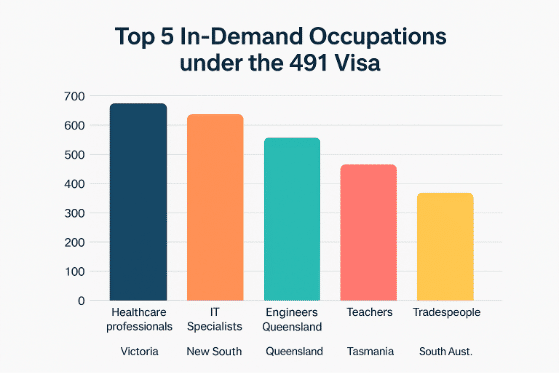
The Skilled Work Regional (Provisional) visa, or subclass 491, is a 5-year points-tested visa that lets skilled workers live and work in designated regional areas of Australia, with a pathway to permanent residency after 3 years. It requires either state/territory nomination or sponsorship by an eligible family member, and the base application fee currently starts from AUD 6,140 (₹4.21L).
The Australian Visa Subclass 491 is still one of the more realistic PR routes for skilled Indian professionals, especially if you're not landing an invite for the 189 or 190. It's a genuine pathway, not a consolation prize, plenty of applicants use the regional route deliberately for the better nomination odds and the clear runway to permanent residency once the 3 years are done.
This guide walks you through:
The updated 2026 fees, since government charges jumped sharply from 1 July.
The 65-point eligibility calculator and what actually earns you points.
The full application process, from EOI to visa grant.
How the 491 converts into permanent residency through the Subclass 191.
What Is the Australian Visa Subclass 491?
Officially called the Skilled Work Regional (Provisional) visa, the 491 is built for skilled professionals willing to base themselves in a regional part of Australia rather than a major metro. It's temporary, valid for 5 years, and exists specifically to plug skill shortages outside cities like Sydney, Melbourne, and Brisbane.
You don't get handed this visa on request. Either a state or territory nominates you, or an eligible relative already living in a regional area sponsors your application. Once granted, you're allowed to work full-time or part-time in your nominated region, study anywhere in Australia while living there, and bring eligible family members along with you.
Worth being upfront about this one. The 491 usually makes sense if:
You want to live somewhere like Adelaide, Hobart, or Newcastle rather than a capital city, and you're fine with that for a few years.
You weren't selected in a metro-focused draw for the 189 or 190 and want another shot at PR.
Your occupation shows stronger demand on regional lists than on the general skilled list.
All three main skilled pathways, 491, 190, and 189, need the same 65-point minimum, so points alone won't tell you which one to pick. Nomination availability and where you're actually willing to live usually decide it.
Australian Visa 491 Requirements
There's a base layer of eligibility everyone needs to clear before points or nomination even come into play.
You need to be under 45 years old at the time you're invited to apply.
Your nominated occupation has to sit on the Skilled Occupation List relevant to regional areas.
You need a positive skills assessment from the recognized assessing authority for that occupation.
Competent English is required, generally proven throughIELTS,PTE, orTOEFL.
Beyond that baseline, a few more conditions decide whether your application actually goes through.
Requirement
Details
Points Test
Minimum 65 points
Sponsorship/Nomination
State or territory nomination, or sponsorship by an eligible relative
Health Requirements
Medical exam for the applicant and all dependents
Character Requirements
Police clearance certificates for the applicant and all dependents
Australian Visa 491 Points Calculator
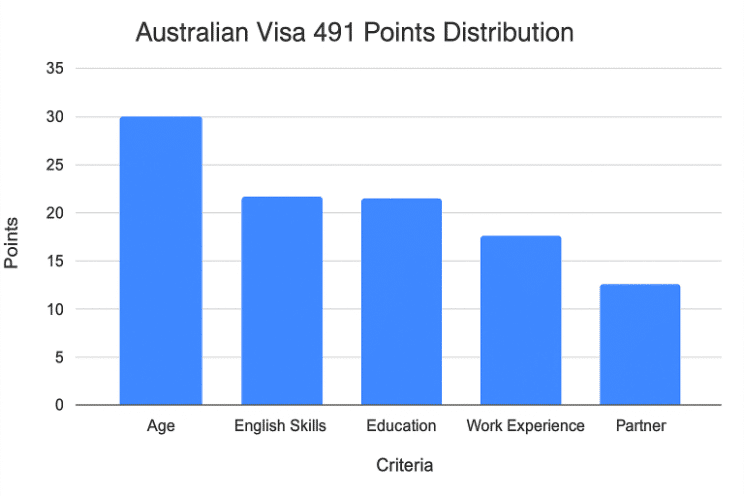
Points aren't just a formality here, they're the gate. You need at least 65 to even be considered for state nomination or family sponsorship, and they're calculated across five broad categories.
Criteria
Max Points
Example
Age
30
25–32 years
English Skills
20
IELTS 8+
Work Experience
15
8+ years in nominated occupation
Education
20
Master's or PhD
Partner Skills
10
Partner meets skill requirements
Work experience specifically breaks down by years in the role. Roughly 3–4 years earns 5 points, 5–7 years earns 10, and 8 or more years gets you the full 15. It's worth documenting this carefully, since underclaiming or overclaiming experience is one of the more common reasons applications get flagged.
How to Apply for the Australian Visa 491
The process runs in a fairly fixed order, and skipping ahead usually just costs you time later.
Step 1: Check your eligibility and occupation list Confirm your occupation actually sits on the regional Skilled Occupation List, and that you clear the basic age, skills, and English requirements before doing anything else.
Step 2: Complete a skills assessment Get a positive assessment from the relevant authority for your occupation. This is what confirms your qualifications and experience are genuinely equivalent to what's expected.
Step 3: Submit an Expression of Interest (EOI) Lodge your EOI through SkillSelect, listing your points, skills, and experience. Only applicants with a competitive score actually get considered for nomination.
Step 4: Secure nomination or sponsorship A state or territory nominates you, or an eligible relative sponsors you. Without this step, you can't move forward with the visa application at all.
Step 5: Apply through the Department of Home Affairs portal Submit your full application online, attach every supporting document, and pay the application charge.
Step 6: Complete health and character checks You and all dependents included in the application need medical exams and police clearance certificates.
Step 7: Wait for the decision Processing generally takes 7 to 12 months. You'll get notified through your ImmiAccount once a decision is made.
A quick note on documents you'll need across these steps: passport and ID for identity verification, your skills assessment result, English test scores, work and education certificates, and your nomination or sponsorship confirmation. Missing or inconsistent documentation is genuinely one of the biggest reasons applications stall.
Australian Visa 491 Cost in 2026
This is the section that's changed the most. Government fees for the 491 rose sharply from 1 July 2026, so if you've seen older figures quoting around AUD 4,640, that's now out of date.
Applicant Type
Fee (AUD)
Fee (INR)
Main Applicant
6,140
₹4.21L
Additional Applicant (18 and over)
3,070
₹2.10L
Dependent Child (under 18)
1,535
₹1.05L
Notes: These are non-refundable government charges alone, they don't include your skills assessment (typically AUD 500–2,000, ₹34,260–₹1.37L depending on the authority), English test fees, medical exams, or police clearance costs. Budget separately for those, and factor incost of living in Australia once you're actually settling into your nominated region.
Benefits of the Australian Visa 491
Beyond just the PR pathway, there's a fair bit this visa actually gets you day to day.
You get to live and work in a regional area with genuinely high demand for your skills, often with less competition than a major city job market.
Your spouse and children can be included in the application, and dependents get full work and study rights, not restricted ones.
You and your family get access to Australia's healthcare system and local schools while the visa is active.
You build genuine Australian work experience, which counts for a lot when you're eventually applying for the 191 or looking at long-term career options.
491 Visa to PR Pathway (Subclass 191)
The whole point of the 491 for most applicants is what it leads to. The Subclass 191 converts your provisional regional visa into permanent residency, once you've genuinely put in the regional time.
To qualify, you need to:
Have held a Subclass 491 (or 494) visa and lived, worked, and studied only in your designated regional area for at least 3 years.
Meet the minimum taxable income requirement during that period, more on this below since the exact figure is genuinely unclear right now.
Clear health and character requirements again, including fresh police checks if your earlier ones have expired.
Have complied with every condition tied to your original nomination or sponsorship.
The 191 application fee itself is far lower than the 491, sitting around AUD 630 (₹43,168) for most applicants coming through the standard regional provisional stream.
Australian States Offering 491 Visa Nomination
Nomination availability varies quite a bit by state, and this is often the actual bottleneck, not your points score.
State/Territory
Nomination Details
New South Wales (NSW)
Nominations for high-demand regional occupations
Victoria (VIC)
Regional nomination available through SkillSelect
Queensland (QLD)
Supports 491 visa for regional skilled occupations
South Australia (SA)
Nomination for eligible occupations in regional areas
Western Australia (WA)
Nomination for certain regional occupations
Tasmania (TAS)
Regional nomination for skilled applicants
Northern Territory (NT)
Nomination for regional skilled occupations
Australian Capital Territory (ACT)
Limited regional nomination options
Should You Go for the 491 Visa in 2026?
Here's the gist of where things actually stand, plus a few honest thoughts before you commit to this route:
The pathway itself is still solid. Regional Australia genuinely needs skilled workers, and the points system, while competitive, is transparent enough that you can plan around it if your profile is strong.
Budget for the real 2026 cost, not the old numbers. Government fees jumped from around AUD 4,640 to AUD 6,140 this year, so factor that in early rather than getting caught off guard mid-process.
Nomination is usually the actual bottleneck, not your points score. Even a strong 65+ profile can stall if your occupation isn't in demand for the specific state you're targeting, so research state-by-state occupation lists before committing to one.
The 191 income threshold question is genuinely unresolved across sources right now. Don't assume either AUD 53,900 or "no threshold at all" without checking directly with Home Affairs or a registered migration agent closer to your 191 application, this isn't something worth guessing on given how much it affects your 3-year plan.
If you're not committed to regional living for at least 3 years, this isn't the visa to force. The 8579 condition is actively enforced, and non-compliance can jeopardize your PR pathway entirely.
If regional Australia genuinely fits your life plans and your occupation shows demand there, the 491 remains a sensible, well-documented route to PR. Just go in with the current fees and a realistic read on nomination competition, not a two-year-old blog post.
The Australian Visa 491 is valid for five years. Holders must live and work primarily in a designated regional area during this period, which is also what builds eligibility toward the Subclass 191 permanent residency pathway.
What is the current cost of the 491 visa in 2026?
As of 1 July 2026, the main applicant fee is AUD 6,140 (₹4.21L), up from the earlier AUD 4,640. Additional applicants 18 and over pay AUD 3,070 (₹2.10L), and dependent children under 18 pay AUD 1,535 (₹1.05L).
Can previous 489 Visa holders apply for the 491 Visa?
Yes. Applicants who previously held a 489 Skilled Regional Visa can apply, provided they meet current points requirements and can show compliance with their earlier visa conditions.
Are there English proficiency exemptions for the 491 Visa?
Exemptions may apply for citizens of countries like the UK, USA, Canada, or New Zealand, or those who completed a tertiary qualification taught in English. Otherwise, results from IELTS, PTE, or another approved test are mandatory.
Does state nomination guarantee 491 Visa approval?
No. Nomination is a mandatory step, but it doesn't guarantee approval on its own. You still need to clear the points threshold, health and character checks, and full documentation review.
What is the minimum income requirement to move from 491 to 191?
This is genuinely disputed across current sources. Some cite AUD 53,900 (₹3.69L) annually as the threshold, while others state no legislated minimum currently exists, only a requirement to show three years of ATO tax filings. Verify directly with Home Affairs or a migration agent before relying on either figure.
Can I change my nominated occupation after submitting an EOI?
Yes, but you'll need to submit a fresh Expression of Interest for the new occupation, and it must be on the relevant Skilled Occupation List for your target state or territory.
How do partner skills affect my 491 points score?
If your partner has a positive skills assessment and competent English, you can claim up to 10 additional points, which can meaningfully improve your chances of nomination.
Can I apply for the 491 visa without a relative sponsor?
Yes, relative sponsorship is entirely optional. Most applicants qualify through state or territory nomination alone.
What is the processing time for the Australian Visa 491?
Most applications are processed within 7 to 12 months from submission, though this can vary depending on your occupation, state, and how complete your documentation is.
Can adult children be included in a 491 visa application?
Yes, if they're under 23 and financially dependent, or have a disability that prevents self-support. You'll need to provide clear evidence of dependency to include them.
With over 12 years of experience in the education sector, Harjeet specializes in study abroad counseling and visa management. She has a proven ability to guide students through university applications...
Refer Your Friend & Earn upto ₹15000
Help your friend upgrade to a Global Career and earn rewards together.