The GRE syllabus covers three main areas: Verbal Reasoning, Quantitative Reasoning and Analytical Writing, with the current GRE General Test taking approximately 1 hour and 58 minutes to complete.
The test checks a mix of language skills, quantitative reasoning and analytical writing abilities. The Verbal section focuses on understanding and analysing written material, Quantitative Reasoning covers basic mathematical concepts and problem-solving, while Analytical Writing assesses how clearly you can develop and support an argument.
GRE Verbal Reasoning Syllabus
The Verbal Reasoning section tests how well you can understand written material, draw conclusions, identify an author's assumptions or perspective, and understand relationships between words and concepts. It includes Reading Comprehension, Text Completion and Sentence Equivalence.
It's less about memorising words blindly. The section also checks how well you use context and logic when working through a passage or sentence.
Reading Comprehension
Reading Comprehension questions assess your ability to understand and analyse passages, which can cover subjects such as the humanities, social sciences and natural sciences.
Important skills include:
Identifying main ideas
Finding supporting points
Understanding an author's assumptions and perspective
Making inferences
Recognising logical relationships
Understanding meaning and purpose
Following text structure
Distinguishing major points from minor or irrelevant information
You aren't expected to have specialist knowledge of every passage topic. What matters is how accurately you can understand and reason from the information provided.
Text Completion
Text Completion questions give you a short passage with one or more missing words, and you have to use the information around each blank to complete the passage logically.
The focus is on:
Understanding the overall meaning
Using context clues
Recognising relationships between ideas
Choosing words that make the passage coherent
Some questions contain more than one blank, and each blank has its own answer choices.
Sentence Equivalence
Sentence Equivalence questions contain one blank, and you need to select two answers that complete the sentence while producing sentences with the same meaning.
That means simply finding two synonyms isn't enough. Both choices must fit the sentence logically, grammatically and in terms of meaning.
The GRE Quantitative Reasoning syllabus measures basic mathematical skills, understanding of elementary concepts and your ability to use quantitative methods to solve problems. ETS groups the content into four areas: Arithmetic, Algebra, Geometry and Data Analysis.
The maths isn't at an advanced university level. ETS says the content is generally no higher than a second course in algebra and doesn't include trigonometry or calculus.
Arithmetic
Arithmetic topics include:
Properties and types of integers
Divisibility and factorisation
Prime numbers
Remainders
Odd and even integers
Arithmetic operations
Exponents and roots
Estimation
Percentages
Ratios
Rates
Absolute value
Number lines
Decimals
Sequences of numbers
Many Quantitative Reasoning questions are presented as word problems, so you'll need to translate information given in words into mathematical relationships.
Algebra
The Algebra section covers:
Algebraic expressions
Exponents
Factoring and simplifying expressions
Relations and functions
Equations and inequalities
Linear equations
Quadratic equations
Simultaneous equations and inequalities
Word problems
Coordinate geometry
Graphs, slopes and intercepts
You may come across algebra questions in real-life settings as well as purely mathematical ones, so applying the concept matters just as much as knowing it.
Geometry
Geometry topics include:
Parallel and perpendicular lines
Circles
Triangles
Quadrilaterals
Other polygons
Congruent and similar figures
Three-dimensional figures
Area
Perimeter
Volume
The Pythagorean theorem
Angle measurement
Coordinate geometry
The GRE doesn't test your ability to construct geometric proofs. Also, figures aren't necessarily drawn to scale, so answers should be based on mathematical reasoning rather than visual estimation.
Data Analysis
Data Analysis covers topics such as:
Mean, median and mode
Range
Standard deviation
Interquartile range
Quartiles and percentiles
Tables and graphs
Probability
Conditional probability
Probability distributions
Normal distributions
Counting methods
Combinations and permutations
Venn diagrams
Questions can use tables, graphs, charts and other data displays, and some may appear as part of Data Interpretation sets.
Analytical Writing measures your ability to articulate and support ideas, construct arguments and maintain a focused and coherent discussion. It doesn't require you to demonstrate specialist knowledge of a particular subject.
The current GRE includes one Analytical Writing task, which is always the first section of the test and has a 30-minute time limit.
Analyze an Issue
The task asks you to take a position on an issue and support your response with reasons and examples.
You should be able to:
Present a clear position
Consider different aspects of the issue
Develop your reasoning
Support ideas with relevant examples
Maintain a focused and coherent response
ETS states that the current GRE contains one “Analyze an Issue” task.
The GRE uses different question formats across its three measures, so understanding them before you start practising can save some confusion.
Section
Major Question Types
Verbal Reasoning
Reading Comprehension, Text Completion, Sentence Equivalence
Quantitative Reasoning
Quantitative Comparison, Multiple Choice, Numeric Entry, Data Interpretation
Analytical Writing
Analyze an Issue
For Quantitative Reasoning, ETS specifies four main formats: Quantitative Comparison, Multiple Choice - Select One Answer Choice, Multiple Choice - Select One or More Answer Choices, and Numeric Entry. Data Interpretation sets can also contain multiple-choice or numeric-entry questions.
Verbal Reasoning, meanwhile, includes Reading Comprehension, Text Completion and Sentence Equivalence, with Reading Comprehension questions appearing in sets and the other two formats generally appearing as independent questions.
How to Prepare for the GRE Syllabus
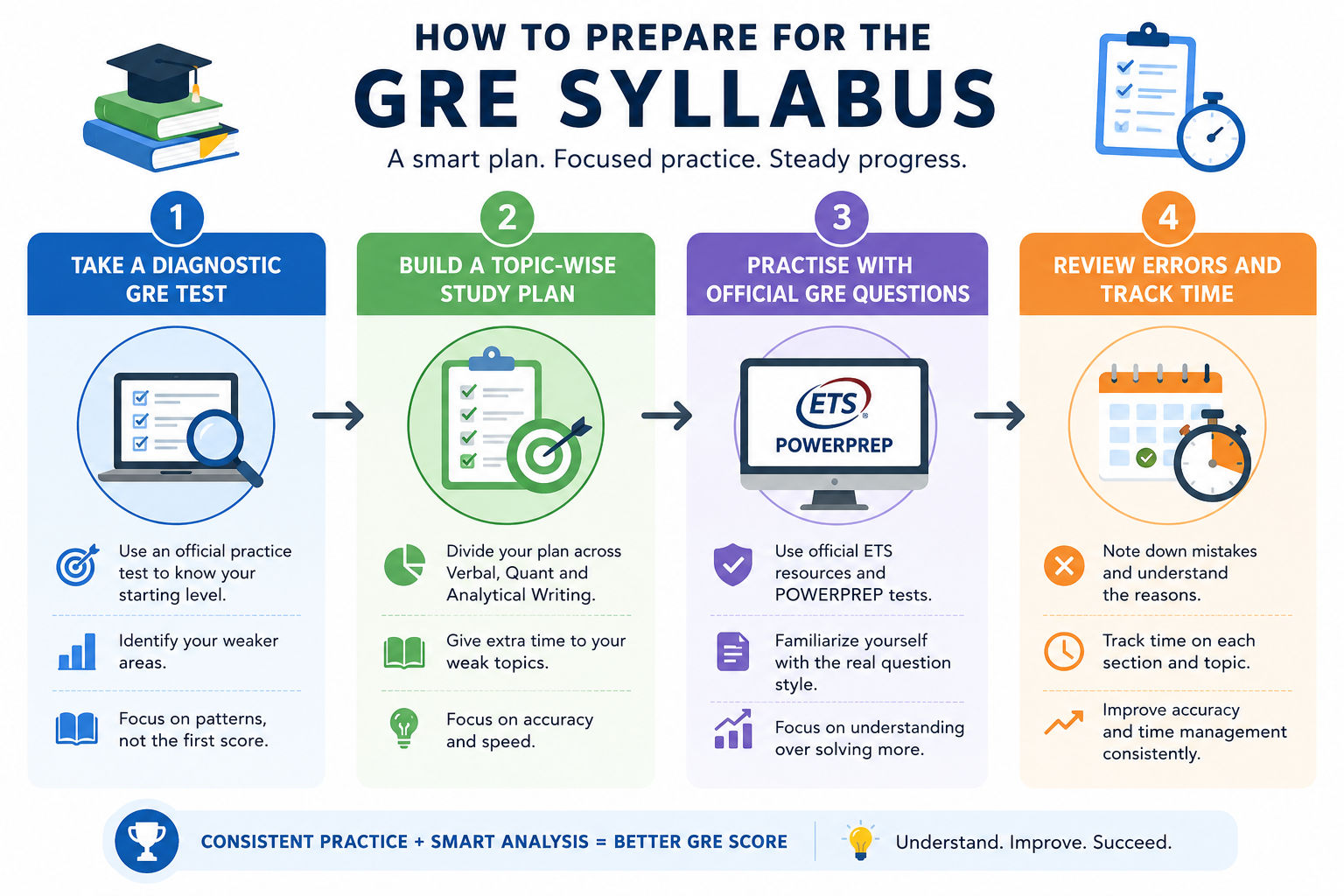
A good GRE study plan should start with your current level rather than an arbitrary number of study hours. First find the gaps, then build the plan around them.
Consistency matters. Keep reviewing your mistakes, track your timing, and adjust your study plan as you improve. This can help you prepare more confidently for the GRE.
The current GRE syllabus covers Verbal Reasoning, Quantitative Reasoning and Analytical Writing, with the shorter test format taking around 1 hour and 58 minutes. The exam includes one Analyze an Issue task, two Verbal Reasoning sections and two Quantitative Reasoning sections.
The GRE exam syllabus isn't tied to one particular academic field. Its Quantitative Reasoning section covers arithmetic, algebra, geometry and data analysis, while Verbal Reasoning focuses on reading and language-based reasoning. So, preparation should be based on the current official content rather than an old topic list.
If you want to know more about the GRE or need help planning your preparation, you can book a free 1:1 session with upGrad experts and get guidance based on your target score and study plans.
Study Abroad Preparation Course
What does the Course include:
12 Weeks of Dedicated Coaching to Build a robust profile for Top 1% Universities
SOP & Personal Statements For Academic Writing
25 hours of live online classes with mock tests for IELTS
Visa, University Application & Submission
Country-specific Support with Education loan Guidance
International Faculty Masterclass
FAQs
1. Is GRE difficult to pass?
The GRE doesn't have a fixed pass or fail mark. Your result is reported as section scores, and the score you need depends on the university and programme you're applying to. A strong preparation plan should therefore focus on your target score rather than simply passing the test.
2. Is GRE harder than JEE?
The GRE and JEE test very different skills. JEE places much greater emphasis on advanced mathematics, physics and chemistry, while the GRE focuses on verbal reasoning, basic quantitative concepts and analytical writing. For students with a strong JEE background, GRE Quant may feel more manageable.
3. Is GRE easier than IELTS?
It's difficult to compare them directly because the two exams measure different abilities. IELTS focuses on English proficiency, while the GRE tests verbal reasoning, quantitative reasoning and analytical writing. Students comfortable with mathematics and analytical questions may find parts of the GRE easier than IELTS.
4. Is GRE easy for Indian students?
The answer depends on your academic background and English skills. Students with strong reading, vocabulary and basic mathematics may find the GRE manageable, but the verbal section can require substantial preparation, particularly for students who aren't used to reasoning through English-language passages.
5. Does the GRE have negative marking?
The GRE doesn't use traditional negative marking for incorrect answers. However, leaving questions unanswered can affect your performance, so it's generally better to make a reasoned attempt when you're unsure rather than skip a question without considering the available choices.
6. How important is vocabulary for the GRE?
Vocabulary is useful for the Verbal Reasoning section, particularly when solving Text Completion and Sentence Equivalence questions. However, memorising word lists alone isn't enough. You also need to understand context, relationships between ideas and how words function within a sentence.
7. Can I prepare for the GRE while studying or working?
Yes, many students prepare alongside college or full-time work. A realistic schedule usually works better than long study sessions once in a while. Setting weekly targets for practice, revision and mock tests can help you maintain steady progress without disrupting your regular commitments.
8. Is the GRE required for every master's programme?
No. GRE requirements are decided by individual universities and programmes, and some may make the test optional or not require it at all. Before registering, check the latest admission requirements of each university on your shortlist.
9. Is there a separate GRE CS syllabus for Computer Science applicants?
There isn't a separate official GRE exam syllabus for students applying to Computer Science programmes. GRE applicants take the same General Test, covering Verbal Reasoning, Quantitative Reasoning and Analytical Writing, regardless of their intended graduate field.
10. How is the GRE syllabus for Quant section different from the maths syllabus taught in school?
The GRE Quant syllabus focuses on arithmetic, algebra, geometry and data analysis rather than advanced mathematics. The GRE maths syllabus generally doesn't require calculus or trigonometry, but students still need strong problem-solving and quantitative reasoning skills.
11. Where can I find the latest GRE syllabus?
The safest source for the latest GRE exam syllabus is the official ETS website, because test content and preparation guidance can change. Students should also avoid using very old preparation books without checking whether their question formats and test structure match the current GRE.
Sr. Content Writer & Study Abroad Expert |109 articles published
Kanika has 5+ years of experience as a writer and content developer. She has written for a wide range of industry verticals, including hospitality, restaurants, non-profits, finance, IT, HR, technolog...
Download Free GRE Syllabus PDF to Read
Refer Your Friend & Earn upto ₹15000
Help your friend upgrade to a Global Career and earn rewards together.