STEM courses in USA cover Science, Technology, Engineering, and Mathematics, featuring top fields like Computer Science, Mechanical Engineering, and Data Science. Graduating from a certified STEM program allows international students to apply for a 24-month OPT (Optional Practical Training) extension, taking total post-study work authorisation up to 36 months.
USA remains the biggest hub for these programs globally, with Computer Science, Data Science, and Mechanical Engineering continuing to be the most sought-after picks among Indian students.
STEM occupations in USA are projected to grow 8.1% between 2024 and 2034, well ahead of the 2.7% growth expected for non-STEM roles, according to the latest US Bureau of Labor Statistics projections. Computer and mathematical occupations alone are growing at 10.1%, more than three times the pace of the overall economy.
STEM Courses in USA
USA universities offer over 300 STEM programs, spanning everything from data analytics to architectural technology. Whether you're eyeing a bachelor's or amaster's in USA, here's a field-wise breakdown of the most popular picks.
Science: MS in Physics, MS in Chemistry, MS in Environmental Science, BSc in Physics, BSc in Chemistry, BSc in Biology
Engineering: MS in Mechanical Engineering, MS in Civil Engineering, MS in Electrical Engineering, B.Eng in Mechanical Engineering, B.Eng in Civil Engineering, B.Eng in Computer Engineering
Mathematics: MS in Applied Mathematics, MS in Statistics, MS in Actuarial Science, BSc in Mathematics, BSc in Statistics, BSc in Data Science
Architecture: MArch, MS in Urban Planning, MS in Landscape Architecture, BArch, BSc in Architectural Technology, BSc in Building Sciences
Management: MS in Engineering Management, MS in Business Analytics,MS in Data Analytics, BSc in Business Analytics, BSc in Information Systems Management
STEM Courses in USA: QS World University Rankings 2027
The QS World University Rankings 2027, released in June 2026, threw up a few surprises this year, including Stanford tying for second place globally. Here's how the top US STEM schools stack up.
University
QS World Rank 2027
Annual Tuition Fee (approx)
Massachusetts Institute of Technology
1
USD 69K (₹65.21L)
Stanford University
=2
USD 65K (₹61.43L)
Harvard University
5
USD 63K (₹59.54L)
California Institute of Technology
7
USD 66K (₹62.37L)
University of Pennsylvania
=16
USD 68K (₹64.26L)
Cornell University
=16
USD 70K (₹66.15L)
Yale University
=20
USD 68K (₹64.26L)
University of California, Berkeley
=20
USD 52K (₹49.14L)
University of Chicago
27
USD 70K (₹66.15L)
Princeton University
=43
USD 63K (₹59.54L)
How to Select the Best STEM University in USA?
Rankings only tell you part of the story, and going purely by QS position can lead you to skip a school that's actually a stronger fit for your specific field. A university that's ranked lower overall might still have a standout engineering department, better funding for your area of research, or stronger placement ties with the companies you actually want to work for. Here's what actually matters once you start shortlisting.
Look at subject-specific rankings, not just the overall score
Program rankings matter more than a university's overall QS position for STEM fields.
MIT,Stanford, and Caltech consistently top engineering, AI, and computer science subject tables. MIT alone holds the #1 spot in QS subject rankings for Engineering & Technology, Computer Science, and Physics & Astronomy, a good example of howMIT's subject-wise rankings tell a sharper story than its overall QS position alone
Check subject-specific rankings directly instead of going by the headline QS number alone, since a school's overall rank can hide real strength (or weakness) in your specific field
Compare tuition against real cost of living
Sticker price alone can be misleading once you factor in where you'll actually be living.
Private universities like Cornell and Chicago now charge around USD 70K (₹66.15L) a year in tuition
Public universities like UC Berkeley cost less on paper at around USD 52K (₹49.14L), but localcost of living can offset that saving, especially in cities like San Francisco or Boston
Check the curriculum structure
The right fit depends on how you learn best.
Hands-on learners can look at universities like Northeastern, which run co-op programs with paid industry work terms built into the degree
Research-focused students should look at Caltech or Princeton, which give undergraduates early lab access and funded research slots
Evaluate internship and industry access
Location and industry ties matter more than most applicants realise.
Stanford and Berkeley sit right next to Silicon Valley, which shows up directly in placement numbers
Look for STEM-specific job fairs and check whether the university has direct hiring tie-ups with companies like Google, IBM, or Tesla
Check scholarships and financial aid early
Aid policies at the top schools have shifted significantly in the last year, and it's worth knowing this before you rule a school out on cost alone.
At MIT, 88% of the latest class graduated debt-free, and families earning under USD 200K (₹1.89CR) now attend tuition-free under MIT's latest aid policy
Harvard similarly waives tuition, housing, and fees for families earning under USD 85K (₹80.33L)
These numbers move often, so always confirm on the university's financial aid page before you apply
Understand OPT and work visa policy
Your post-study work options depend entirely on your program's designation.
Make sure your program is on the DHS STEM-designated degree list
This is what qualifies you for the 24-monthOPT extension, taking your total post-study work window to 36 months
Tuition is only one part of your annual budget, and it's easy to underestimate the rest until you're actually there. Housing, food, transport, and supplies add up fast, and together they often push your real annual spend well past what the tuition figure alone suggests. Here's a realistic breakdown of what to budget for.
Cost
Annual Expense (USD)
Annual Expense (INR)
Tuition Fees
USD 60K to 70K
₹56.7L to ₹66.15L
Housing
USD 14K
₹13.23L
Food
USD 9K
₹8.51L
Personal Expense
USD 9K
₹8.51L
Books and Supplies
USD 2K
₹1.89L
For a full monthly breakdown by city, check the detailedcost of living in USA guide.
STEM Courses in USA: Scholarships
A number of top schools now offer generous need-based aid that can bring your actual cost down significantly.
Harvard College Financial Aid (Need-based, Undergraduate) Eligibility: demonstrated financial need, all admitted students including international. Coverage: families earning under USD 85K (₹80.33L) typically pay nothing toward tuition, fees, housing, or travel.
MIT Scholarship (Need-based, Undergraduate) Eligibility: financial need. Coverage: families earning under USD 200K attend tuition-free; median scholarship covers a large share of the total cost.
Knight-Hennessy Scholars (Merit-based, Graduate) Eligibility: admission to any graduate programme at Stanford. Coverage: tuition, living stipend, and one annual travel allowance for up to three years.
Yale Scholarship (Need-based, Undergraduate) Eligibility: demonstrated financial need, regardless of citizenship. Coverage: 100% of demonstrated need met; average award over USD 50K (₹47.25L).
Here's how the process typically unfolds, step by step.
Shortlist your programs: Match your academic interests and career goals against specific STEM programs. Use QS subject rankings and university websites rather than relying on overall rankings alone.
Check admission requirements: Look at prerequisite coursework, minimum GPA, and standardised test cutoffs for each program you're targeting.
Prepare your documents: Gather transcripts, LORs, an SOP, and an updated resume well ahead of deadlines.
Submit your applications: Fill out each university's application form carefully and keep track of individual deadlines.
Apply for financial aid: Scholarship and assistantship deadlines often fall earlier than admission deadlines, so don't wait for an offer letter before you start.
Prepare for interviews, if required: Some programs, especially at the graduate level, include an interview as part of admissions.
Track your application status: Check portals regularly and respond quickly to any requests for extra documents.
Handle post-admission steps: Once you have offers in hand, compare aid packages, confirm your seat, and start on your visa application and housing search.
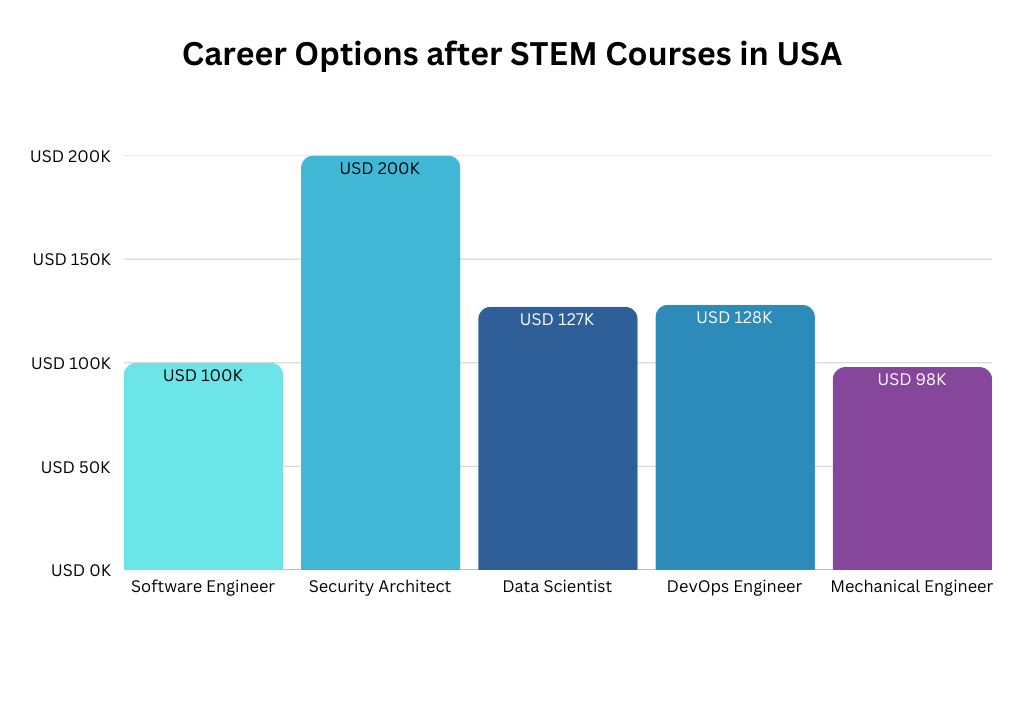
Career Options after STEM Courses in USA
STEM degrees open up some of the highest-paying entry points in US job market, and the gap versus non-STEM roles is wide right from the first job. A STEM background also gives you flexibility to move across industries later, since skills in data, engineering, and analytics translate well beyond a single sector. Here's a look at where the money actually is right after graduation.
Job
Average Annual Salary (USD)
Average Annual Salary (INR)
Security Architect
USD 200K
₹1.89CR
DevOps Engineer
USD 128K
₹1.21CR
Data Scientist
USD 127K
₹1.20CR
Software Engineer
USD 100K
₹94.5L
Mechanical Engineer
USD 98K
₹92.61L
Top Recruiters of STEM Graduates in USA
Big tech and engineering names dominate STEM hiring in US, and most of them recruit directly from campus, so your university's placement pipeline matters as much as the brand name on your degree.
Google, Microsoft, Amazon, Apple, Meta: Technology, E-commerce, and Cloud
Tesla: Automotive and Energy
IBM: IT Services and AI
Boeing: Aerospace Engineering
Why Study STEM Courses in USA?
A few numbers make the case better than any pitch could, and taken together they explain why STEM continues to pull in the largest share of Indian students headed abroad.
STEM occupations are projected to grow 8.1% between 2024 and 2034, nearly three times faster than non-STEM roles
Computer and mathematical occupations specifically are growing at 10.1%, the second-fastest of any occupational group in the economy
Data scientist roles remain one of the fastest-growing jobs in the country, driven largely by AI and data-analysis demand
A STEM-designated degree gets you a 24-month OPT extension, giving you up to 36 months of work authorisation after graduation
Degrees from top US STEM schools carry global recognition, so your options aren't limited to US job market alone
Put together, these numbers point to a fairly clear conclusion: STEM in US isn't just a popular choice, it's one backed by real, measurable demand on the hiring side.
How Can upGrad Help You Study in USA?
Picking the right university, meeting eligibility requirements, and staying on top of visa timelines gets a lot easier with the right support system.
University shortlisting based on your academic profile and career goals
Guidance on GPA requirements, transcripts, LORs, and test prep
Help deciding betweenIELTS,TOEFL, or Duolingo, andGRE or GMAT as needed
Scholarship and financial aid search support
F-1 visa application support, including Form I-20 and interview prep
STEM in USA still holds up as one of the strongest bets for Indian students, purely on the numbers. Faster job growth than almost any other field, a 36-month work window after graduation, and salaries that comfortably beat the national average.
That said, it's not a one-size-fits-all decision. Here's a quick gut check before you commit:
If you're aiming for research-heavy fields like AI, robotics, or core engineering, the reputation and lab access at schools like MIT, Caltech, or Stanford genuinely make a difference to your career trajectory. Go for it.
If budget is a real constraint, don't rule out public universities like UC Berkeley just because they don't sit at the very top of the rankings. The STEM-designated OPT extension and recruiter access matter more than the last few QS ranks.
If you're unsure about committing to a full two-year master's, look closely at co-op-style programs like Northeastern's, which let you earn and build experience while you study.
If your profile is still a work in progress, spend more time on GRE prep and your SOP than on chasing a slightly higher-ranked school. Admissions committees weigh the full application, not just test scores.
Rest of it, honestly, comes down to fit. The rankings, fees, and scholarships all point in useful directions, but the right STEM programme is the one that matches your specific goals and budget.
A STEM course covers Science, Technology, Engineering, or Mathematics, spanning fields like computer science, mechanical engineering, physics, and data analytics. In US, these programs are known for strong research funding, industry ties, and eligibility for extended post-study work authorisation.
What is the best course in STEM?
There's no single "best" course, it depends on your interests and career goals. Computer Science and Data Science currently see the strongest hiring demand and salaries, while core engineering fields like mechanical and civil engineering offer steady, long-term career paths.
Who is eligible for STEM?
Eligibility depends on your degree level. Undergraduate applicants need a strong high school record in math and science, while graduate applicants typically need a relevant bachelor's degree with a GPA of 3.0 or higher, along with English proficiency and standardised test scores where required.
How many years is the STEM course?
Bachelor's degrees usually take 3 to 4 years, while master's degrees take 1 to 2 years. Some universities offer accelerated or part-time formats that can shorten or extend this depending on your study plan.
How much does it cost to study STEM courses in USA?
Tuition alone runs around USD 60K to 70K (₹56.7L to ₹66.15L) a year at most top schools. Add housing, food, and personal expenses, and total annual costs can cross USD 90K (₹85.05L), though scholarships and need-based aid can bring this down significantly.
What tests do I need for STEM admission in USA?
Most universities ask for IELTS (6.5 to 7.5) or TOEFL (80 to 100) for English proficiency. Graduate programs often require a GRE score above 150, while undergraduate applicants may need SAT scores above 1500. Always confirm the exact cutoff with your target university.
Can international students work while studying STEM courses?
Yes. F-1 visa holders can work up to 20 hours a week on campus during semesters. After graduation, Optional Practical Training allows 12 months of work, with an additional 24-month extension specifically for STEM degree holders, taking the total to 36 months.
Is GRE mandatory for all STEM programs in USA?
No. Several graduate schools have waived the GRE requirement for certain disciplines, and undergraduate programs typically don't require it at all. Always check the specific admissions policy for your target program, since this varies widely by university.
Are there STEM courses that don't need IELTS in USA?
Some universities accept the Duolingo English Test as an alternative, and a few waive English proficiency tests entirely if you've studied in English previously. That said, most universities still expect IELTS or TOEFL scores from international applicants.
What is the acceptance rate at top STEM universities in USA?
Highly ranked schools like MIT and Harvard have acceptance rates in the low single digits. Public universities such as UC Berkeley admit a somewhat larger share of applicants, but competition for STEM seats specifically remains intense across the board.
Can STEM graduates apply for permanent residency in USA?
Yes, though not directly through the degree itself. STEM graduates typically move from OPT to an H-1B work visa through employer sponsorship, and from there can pursue a green card. The extra time from the STEM OPT extension often helps strengthen this path.
Anupriya Mukherjee is a passion-driven professional working as a Content Marketer and earlier worked as a Digital Marketeer. With around 6 years of work experience, she has experience creating high-qu...
Refer Your Friend & Earn upto ₹15000
Help your friend upgrade to a Global Career and earn rewards together.