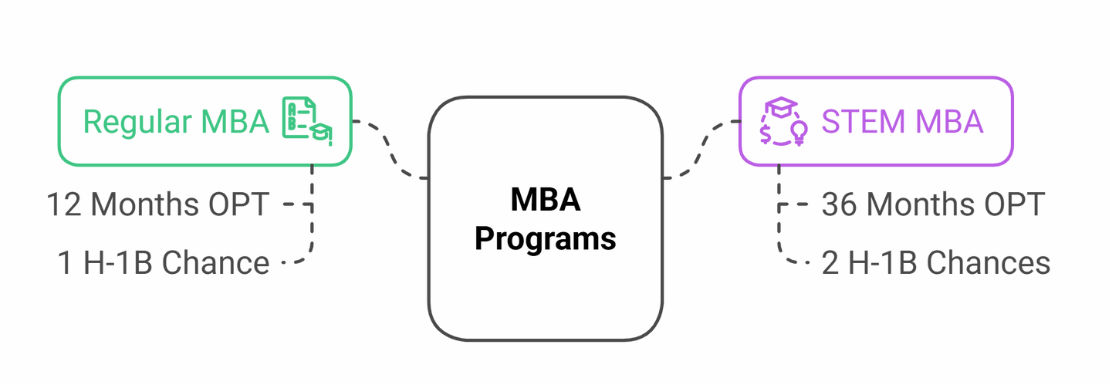
A STEM MBA in USA is basically a regular MBA with one extra tag attached, a STEM designation that ties it to science, technology, engineering, and math. That single tag matters a lot more than it sounds, because it's what unlocks 36 months of OPT for international students after graduation instead of just 12. Schools like Harvard Business School, the Wharton School, and Stanford Graduate School of Business are usually the first names that come up when people talk about top programs here.
Rankings shifted; there's a new $100,000 (₹94.5L) H-1B fee in the mix now, and the H-1B lottery itself doesn't work the way it used to, it's wage-weighted instead of a flat random draw. All three of these actually change how you should be picking a program right now, and honestly, most guides floating around online still haven't caught up with any of it.
So here's what we're covering. The shortlist of universities with their fees, eligibility criteria, the whole application and visa process, what things actually cost and where scholarship money is hiding, and a straight answer on what these new H-1B rules mean for someone in your position.
What Is a STEM MBA?
Let's start with the basics before we get into rankings and fees. A STEM MBA is still a regular MBA at its core, but it carries an additional STEM designation under US Department of Homeland Security's CIP code list. That one label changes your entire post-study timeline in a big way, so it's worth understanding properly before you shortlist anything.
Here's what that designation actually buys you:
Non-STEM MBA grads get 12 months of OPT (Optional Practical Training) to work in US after graduating
STEM-designated MBA grads get those same 12 months, plus a 24-month STEM OPT extension on top, so 36 months total
That's three extra years to build US work experience and try your luck at the H-1B lottery, instead of just one shot at it
Why a STEM MBA Still Makes Sense in 2026
Here's the honest picture, not the sales pitch. A lot has moved this year, and some of it actually works in your favor if you know how to read it.
The Rankings Just Shifted, and It Matters
For six years straight, Stanford GSB held the #1 spot in the QS Global MBA Rankings without much competition. That streak just ended. Here's how the current QS Global MBA Rankings 2026 order actually looks:
Wharton (University of Pennsylvania)
Harvard Business School
MIT Sloan
Stanford GSB
HEC Paris
If you've read anywhere that Stanford, Wharton, and Harvard "share the top spots" for 2025, that's outdated information doing the rounds. Wharton is now the clear #1, and Stanford actually dropped to fourth after weaker scores on employability and value for money.
Salaries Are Genuinely Strong, but Verify Per School
Money talk matters here, so let's be straight about it. Graduates from top US STEM MBA programs report starting salaries well into six figures, with the highest earners at schools like Stanford and Harvard going even higher. That said, exact numbers move every single year and vary hugely by school, specialization, and even the hiring cycle you graduate into, so always check the specific program's latest employment report rather than relying on a blanket figure floating around online.
The Bigger Reason to Care Right Now: H-1B Just Got Harder
This is the part most guides still haven't caught up on, and it's honestly the most important update in this entire article. A few things changed on the H-1B front recently, and here's what you actually need to know:
In last September, a new $100,000 fee got attached to new H-1B petitions. Here's the part people panic over unnecessarily though: this fee applies mainly to petitions filed for candidates who are outside US at the time of filing. If you're already in US on OPT and your employer files for a change of status from F-1 to H-1B, this fee generally doesn't apply to you.
On top of that, the H-1B lottery itself changed shape entirely. It's no longer a flat random draw where everyone has equal odds. It's now wage-weighted, meaning higher-salary registrations get noticeably better odds of getting picked.
Put those two changes together and the STEM MBA's 36-month runway becomes more valuable, not less. You get three separate lottery attempts instead of one, and a STEM MBA typically puts you in a higher salary band from day one, which now directly improves your odds in that weighted draw.
That's the real 2026 argument for choosing a STEM MBA, and it's not one you'll find spelled out clearly in most existing guides yet.
Top STEM MBA Universities in USA
Fees and rankings shift constantly in this space, so treat the table below as a starting shortlist rather than gospel. Always confirm live deadlines on the university's own admissions page before you apply anywhere.
Nothing dramatic has changed on the eligibility front, so this part holds up well year to year. Here's what most schools are actually looking for on your application:
Academic background: A bachelor's degree from an accredited university, GPA of 3.0 or higher on a 4.0 scale. A STEM undergrad isn't mandatory at all, but be ready to show you can handle quant-heavy coursework once you're in.
Test scores: GMAT or GRE, usually. Waivers exist for exceptional academic or professional profiles, but don't count on getting one, treat the test as mandatory in your planning.
Work experience: 2 to 5 years is the sweet spot most schools look for, ideally with some analytical or leadership weight to your role, not just tenure.
English proficiency: TOEFL 90 to 100, or IELTS 6.5 to 7.0. Some schools also accept PTE or Duolingo, so check the specific program's list before booking a test.
Applying isn't as complicated as it feels once you break it into stages. Here's the order that actually works, split into the two phases most applicants get stuck on.
Shortlisting and Testing
This is the groundwork phase, and rushing it usually backfires later.
1. Shortlist and check requirements: Look at each school's STEM CIP code, GMAT or GRE expectations, and work-ex norms before you commit real time to an application.
2. Book your tests early: GMAT or GRE first, then your English test. Give yourself enough room to retake either one if your first score doesn't land where you want it.
Documents and Submission
Once your scores are in, this is where the actual application comes together.
3. Get your documents together: Transcripts, resume, SOP, and 2 to 3 solid recommendation letters. Quality over quantity here, every single time.
4. Submit before the early rounds: Round 1 or Round 2 applications generally have better odds and more scholarship money on the table than later rounds do.
5. Prep for interviews: Some schools interview by invitation only. Know your story cold, especially why STEM, why this school, and why now.
6. Wait for your decision: Usually a few weeks to a couple of months after you apply, depending on the school and round.
Visa and Pre-Departure
Once you've got your offer in hand, the paperwork side of things kicks off properly. Here's how that plays out in two stages.
Getting Your F-1 Visa Sorted
This is the part that trips up a lot of first-time applicants, so plan for it early rather than at the last minute.
Your school issues Form I-20 once you formally accept your offer
Fill out the DS-160 form and book your visa interview slot early, slots fill up fast in peak intake months
Carry proof of funds, a valid passport, and your admission documents to the interview without fail
Once your visa comes through, there's still a checklist worth running through before departure day.
Sort your accommodation, some schools have grad housing, others leave you to find your own
Book flights with enough buffer to land before orientation begins
Attend any pre-arrival sessions your school offers, they're genuinely useful for settling in faster
What a STEM MBA Actually Covers
Course structure hasn't shifted much over the years, and honestly, that's a good thing, it's built to stay relevant rather than chase trends. Here's a breakdown of what you'll actually be studying:
Electives: machine learning, big data for business, fintech, cybersecurity, cloud systems for enterprise
Tools you'll actually use hands-on: Python, R, SQL, Tableau, Excel
Most programs also include a capstone project and some form of internship or co-op built into the curriculum
Cost of Studying: What to Actually Budget
Tuition is the headline number everyone quotes, but it's far from the whole bill. Here's a realistic annual breakdown for a top-tier program, so you're not caught off guard later.
Expense
Annual Estimate (USD)
Annual Estimate (INR)
Tuition
$91,172
₹86.2L
Mandatory fees
$6,473
₹6.1L
Health insurance
$5,367
₹5.1L
Books and supplies
$1,250
₹1.2L
Food and housing
$28,476
₹26.9L
Personal expenses
$3,510
₹3.3L
Transportation
$1,323
₹1.3L
Scholarships Worth Applying For
Funding a STEM MBA feels intimidating at first glance given the fee tables above, but it's genuinely doable if you apply early and cast a wide net across both school-specific and external options.
School-Specific Scholarships
Most of this money is already sitting inside the admissions process, you just need to know it's there.
Many top schools automatically consider admitted students for merit scholarships, no separate application needed on your end
Harvard Business School reports around half its MBA students receive some form of scholarship support during the program
Programs like WashU Olin's McDonnell International Scholars Academy offer full tuition plus a living stipend for exceptional international applicants
External Scholarships to Check Out
Beyond the university itself, a handful of external scholarships are worth applying to well before your admission decision even comes in.
Fulbright-Nehru Master's Fellowships, for Indian citizens headed to a US master's program including STEM MBAs, covers tuition, living costs, and airfare
Consortium for Graduate Study in Management Fellowship, covers full tuition plus fees for eligible applicants
MPOWER Global Citizen Scholarship, up to $8,000 (₹7.6L) toward tuition or expenses at partner schools
This is where the STEM tag really earns its keep, and it's worth understanding both the roles and the pay bands before you pick a specialization.
Common roles: Product Manager, Data Analytics Manager, Technology Consultant, Operations Manager, IT Project Manager
Recruiters actively hiring STEM MBA grads span tech, consulting, and finance, think Microsoft, Amazon, Deloitte, Accenture
Salary bands vary a lot by role and city, always check a source like Glassdoor or a school's own employment report rather than a single aggregated number floating around
With the new wage-weighted H-1B lottery, landing a higher-paying offer isn't just about the paycheck anymore, it directly improves your visa odds too, so specialization choice matters more than it used to
Picking the right STEM MBA program isn't just about rankings, it's about matching your GMAT score, budget, and career goals to the right school and the right application round. Here's where upGrad's mentors actually plug into that process:
Help you shortlist programs based on your GMAT or GRE score, work experience, and target specialization
Guide you through STEM OPT and H-1B strategy, so you're planning your visa runway before you even land in US
Support you through scholarships, exam prep, SOPs, and every last document, so nothing slips through the cracks near a deadline
Conclusion
Here's the quick gist before you decide anything, plus where I'd land if I were weighing this myself.
Rankings shifted this year, Wharton is #1 now, not Stanford, so don't apply purely off old lists you find online
The 36-month OPT window is still the single biggest reason a STEM MBA beats a regular one for international students, that hasn't changed
The new H-1B fee mostly hits candidates applying from outside US, not students already on OPT, so don't let headlines scare you off unnecessarily
The wage-weighted lottery actually favors STEM MBA grads, since you're more likely to land a higher-paying offer that scores better in the draw
If you've got a decent GMAT score, 2 to 5 years of work experience, and a genuine interest in a tech-adjacent business role, this is still one of the strongest study-abroad bets going into 2026. If you're on the fence purely because of visa headlines, it's worth talking to someone who's actually tracking these policy changes closely rather than deciding off a scary news headline alone.
It depends on your goals, but if you want more time to work in US after graduation, yes. A STEM MBA gets you 36 months of OPT versus 12 months for a non-STEM MBA, which means more chances at the H-1B lottery and more runway to find the right job.
Can I convert a non-STEM MBA to a STEM designation after enrolling?
Some schools allow this if you meet extra academic requirements, usually by adding quantitative courses like data analytics or machine learning in your first year. It's not universal though, so check with your specific school's academic office before assuming it's possible.
Do I need a technical undergraduate degree to apply for a STEM MBA?
No, most programs accept students from any academic background. What matters more is your comfort with quantitative coursework and how you present that in your application, not your undergrad major.
Is GMAT compulsory for a STEM MBA in USA?
Not always. Several schools offer GMAT waivers for candidates with strong academic records or significant work experience, and some accept GRE instead. Always check the specific program's current policy since this varies a lot school to school.
How long does it take to get an admission decision after applying?
Usually a few weeks to a couple of months, depending on the round you apply in and the school's own timeline. Early rounds tend to move faster and also come with better scholarship availability.
Can I work part-time while pursuing a STEM MBA in USA?
Yes, F-1 students can generally work up to 20 hours a week on campus during the academic term, and full-time during official breaks. Off-campus work options like CPT are more limited and need approval from your school's international office.
What happens if I don't find a job during my initial OPT period?
You're allowed a limited number of unemployment days during OPT before it affects your status, so it's worth tracking this closely with your school's DSO. A STEM designation gives you a longer overall window, but the unemployment cap still applies throughout.
Are online or part-time STEM MBA programs available in USA?
A few schools offer part-time formats, but most STEM MBAs are structured as full-time programs because of how technical the coursework is. If a part-time or online path matters to you, narrow your shortlist early since options are limited.
Do STEM MBA graduates need a job offer before applying for OPT?
No, you can apply for post-completion OPT without a confirmed job offer, but you do need to find employment within the allowed unemployment window once your OPT starts. Employment isn't a prerequisite for approval, just for staying compliant afterward.
Can I switch employers while on STEM OPT?
Yes, but your new employer has to meet the same STEM OPT requirements, including E-Verify enrollment, and you'll need an updated Form I-983 filed within the required timeframe. Any gap between jobs also counts against your unemployment limit.
Is a STEM MBA worth it if I eventually want to return to India?
It can be, since the analytical and tech-business skill set translates well to roles in India's growing tech and consulting sectors too. US work experience during OPT is often seen as a strong differentiator on Indian job applications as well.
upGrad Abroad Editorial Team |5005 articles published
We are a dedicated team of study-abroad experts, ensuring intensive research and comprehensive information in each of our blogs. With every piece written, we aim at simplifying the overseas education ...
Refer Your Friend & Earn upto ₹15000
Help your friend upgrade to a Global Career and earn rewards together.