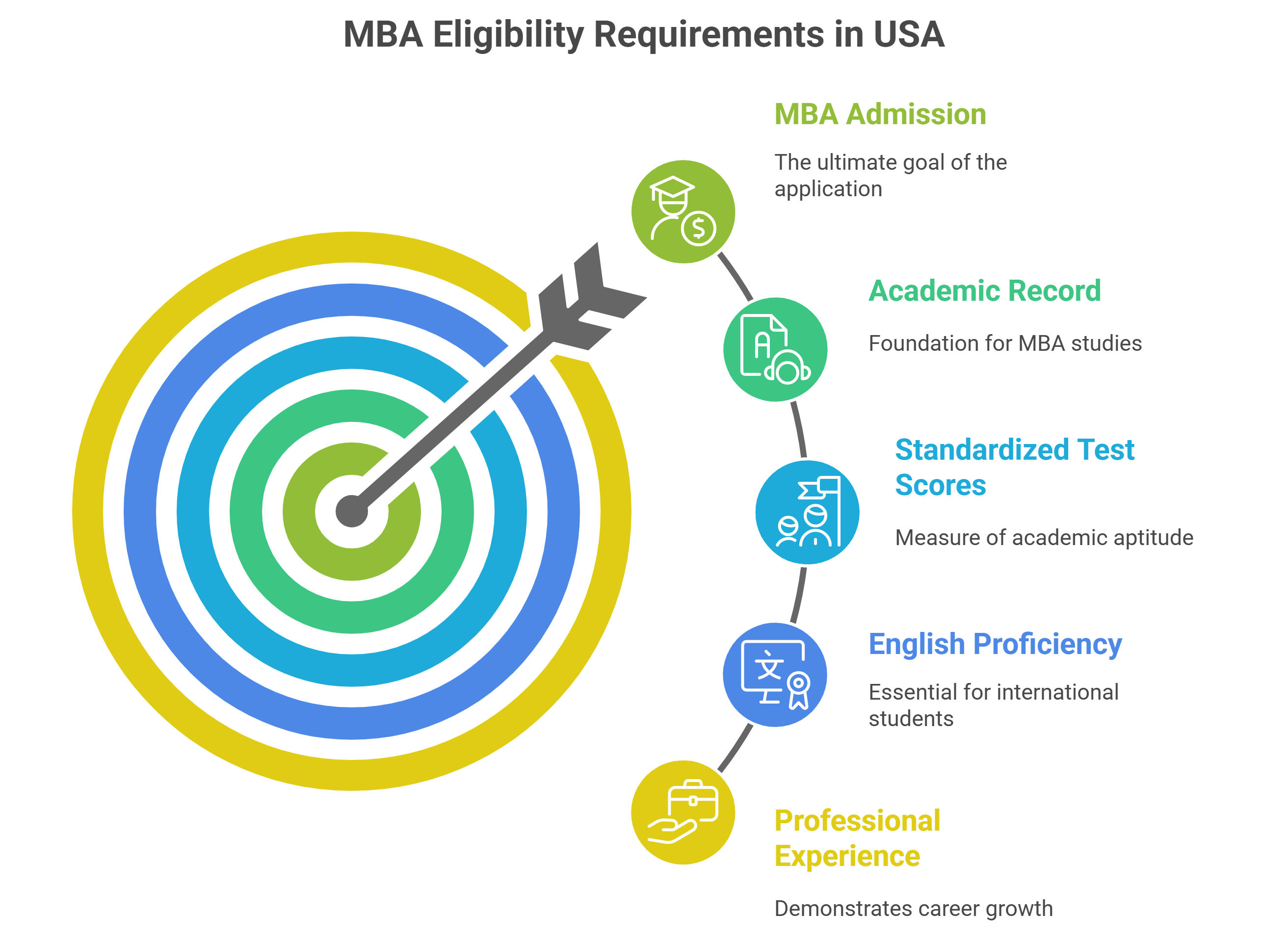
To pursue an MBA in USA, you will usually need a bachelor’s degree, a GMAT or GRE score (if required), and proof of English proficiency. Some universities also expect work experience, especially for full-time MBA programs.
Here are the key highlights to help you understand the eligibility requirements:
Requirement
What most business schools expect
Bachelor’s degree
Any stream. A 3-year degree is accepted by many schools, while top schools prefer 4 years
GPA
Around 3.0 on a 4.0 scale, and 3.5+ at top schools
Work experience
2 to 5 years for a full-time MBA
GMAT / GRE
700 to 740+ (GMAT) or 320 to 330+ (GRE) at top schools. Many schools offer waivers
English test
IELTS, TOEFL or Duolingo, with scores depending on the school
Documents
SOP, 2 to 3 LORs, resume, transcripts, and passport
Proof of funds
Approx. USD 70,000 to 145,000 (INR 67L to 139L) for the first year, depending on the school
Interview
Video or live, at some schools
Now, let’s understand each point in detail. We will go through the academic, work experience, test score, English language, document, financial, and interview requirements one by one, so you know what to prepare and what to expect at each stage.
Academic Qualifications for MBA in USA Eligibility
Your degree is the first thing a US business school looks at. The MBA in USA eligibility rules start with your bachelor’s degree and your grades, and only then move on to work experience and test scores.
Here is how the eligibility criteria for MBA in USA usually work on the academic side:
Bachelor’s Degree
You need a recognised bachelor’s degree from a university your target school accepts.
Here are some points to keep in mind:
Any stream works; engineering, commerce, arts, science or law graduates can all apply, so you don’t need a business degree.
Many US schools accept a 3-year degree, but a lot of the top ones prefer a 4-year degree.
The same goes for specialised programs. For example, eligibility for MBA in healthcare management in USA doesn’t require a medical or healthcare degree. Some schools just like to see a bit of related work or interest.
GPA
Most MBA schools in USA ask for around 3.0 on a 4.0 scale.
What counts as a good GPAdepends on the type of school, for example:
School type
GPA usually expected
Top universities
3.5 and above
Mid-tier universities
3.2 to 3.5
Affordable universities
2.7 and above
Note: A lower GPA doesn’t automatically rule you out. A strong work record or a good GMAT score can help balance it.
Marks and Grading System: You don’t have to convert your marks yourself. Percentages, CGPA, divisions and ECTS credits are all accepted. The university converts them to its own scale when it reviews your file.
Transcript evaluation
Some schools ask international applicants for a WES (World Education Services) evaluation. WES checks your transcripts and converts them into US system, so the admissions team can compare you fairly with other applicants.
Not every school needs it, so look at the application checklist for each one.
Work experience is where US MBA programs differ the most. Most full-time programs want 2 to 5 years, because they like classes full of people who have already managed projects, worked in teams and have some idea of where they want to go.
One thing to note here is that MBA schools care less about how many years you have worked and more about what you did in those years. Two years with real responsibility and a clear career path will often beat five years of doing the same task.
Here is how much experience each type of school expects:
School type
Experience usually expected
Top MBA schools
4 to 6 years
Mid-tier schools
3 to 5 years
Affordable schools
1 to 3 years
These are only estimated years, not the cutoffs.
What if you are a fresher?
You can still apply. Some universities run early-career MBA tracks, and others accept students with no full-time job. In that case, they will look hard at your internships, leadership roles and grades, so those need to be strong.
Accelerated or 1-year programs are also worth a look, since many of them care more about your academics than your years of work.
What if you are applying for an Executive MBA?
Executive MBA in USA eligibility is a different story. These programs are built for senior people, so they usually ask for 8 to 12 years or more of experience, often with some team management.
What admissions teams look for
Whatever your number of years, try to show these in your application:
Growth, such as promotions or bigger roles over time
Results you can measure, like revenue, costs saved or people managed
Leadership, which doesn’t need a title. Leading a project or training a new joiner counts too
A clear reason for why an MBA is the next step for you
Most US business schools ask for a GMAT or GRE score. It gives them one common number to compare applicants from very different colleges, countries and grading systems. The MBA requirements in USA around tests also vary a lot by school, and for programs like finance, expect the quant section to be looked at more closely.
Almost every school accepts both the GMAT Focus Edition and the GRE, so you can pick whichever suits you better. If you are stronger at maths and data questions, theGMAT often feels more natural. If you are better at vocabulary and reading, the GRE may be easier.
Score ranges by school type
School type
Expected GMAT Score Range
Expected GRE Score Range
Top schools
700 to 740+
320 to 330+
Mid-tier schools
650 to 690
305 to 320
Affordable schools
580 to 640
295 to 310
These are typical ranges, not cut-offs. The number that matters most is the average score of the school’s last admitted class. If your score is near or above it, you are in a good position.
Applying without a GMAT or GRE
If you don’t want to write the test, you still have options:
Waiver programs, where the school looks at your grades, work quality, and achievements instead.
Accelerated or 1-year MBAs, which often put academics ahead of test scores.
Professional credentials like CFA or CPA, which show you can handle serious quantitative work.
Check each school’s waiver rules early, because they differ and some need you to apply for the waiver separately.
If your earlier education wasn’t in English, US business schools will want proof that you can follow lectures, join class discussions, and write assignments without struggling.
Some schools waive the test if your bachelor’s degree was taught fully in English. This is not automatic, though, so check the policy on each school’s international admissions page. It’s worth doing early if you studied in India.
Accepted tests
Almost every school takes IELTS and TOEFL iBT. Most also accept DET, though a few top schools still prefer the other two. If you are comparing options, look at which test the school lists first on its page.
Here are the approximate minimum score ranges by MBA school type in USA:
School type
IELTS
TOEFL iBT
DET
Top universities
7.0 to 7.5
100 to 110+
125 to 140+
Mid-tier universities
6.5 to 7.0
80 to 100
105 to 120
Other emerging universities
6.0 to 6.5
70 to 80
90 to 105
Higher-ranked schools expect stronger scores, so aim a little above the minimum if you can.
A few practical points
If your score is below the minimum, most schools won’t move your application forward.
Some schools let you retake the test within the same admission cycle, so you don’t always have to wait for the next intake.
Some schools accept DET as an alternative if you missed the IELTS or TOEFL cutoff.
Book your test early. Scores usually take a few days to a couple of weeks to reach the school, and you don’t want that delay to hold up your application.
A few things make this easier: Write a fresh SOP for each school instead of reusing one, and pick recommenders who have seen your work up close, then share your resume and goals with them so their letters have real detail. Ask your university for transcripts early, since they can take weeks to arrive.
Applying from India? Look at the WES line before the others. The eligibility for MBA in USA for Indian students usually comes down to how your degree and grades read in US terms, and since only some schools ask for a WES report, check each school’s list before you pay for one.
Financial Requirements for MBA in USA: Proof of Funds & Budget
Financial proof is a key part of your application, because universities and visa authorities need to know you can cover your tuition and living expenses when you study in USA. Most schools ask for proof of funds for at least one year, which you can show through bank balances, an education loan or sponsor support.
Here is what tuition costs per year:
School type
Approx. Annual Tuition Fees (USD/INR)
Top schools
USD 85,000 to 91,000 (INR 81L to 87L)
Mid-tier schools
USD 60,000 to 75,000 (INR 57L to 72L)
Affordable schools
USD 35,000 to 56,000 (INR 33L to 54L)
Living expenses come on top of tuition, and rent is extra. The estimated monthly costs for a family of four are USD 4,280.8 (INR 4.1L), excluding rent. For a single person, they are around USD 1,231 (INR 1.2L) a month, excluding rent.
If your education is funded by family or a sponsor, universities usually ask for bank statements, an affidavit, and a financial support letter.
Most schools ask for these after they issue an admission, since they are needed for the I-20, but some programs may ask for basic financial details while you apply.
MBA Interview Requirements for Top US Universities
Not every applicant gets an interview. At most top schools it comes after your written application is read, and an invite is a good sign but not an offer.
It lets the admissions team see what essays can’t: how you speak, how clearly you explain your goals and how you would come across to classmates.
You will usually meet one of these formats:
Video interview. You record answers to timed questions, with nobody on the other side. Practise out loud with a timer, because the countdown catches most people off guard.
Live interview. A conversation, online or in person, with an admissions officer or an alumnus. Alumni interviews tend to feel like a chat, while admissions officer interviews are usually tighter.
Behavioural or situational round. You are asked how you handled teamwork, a disagreement or a hard decision. Keep two or three real work stories ready that show leadership.
Questions to prepare for, since they repeat across schools:
Walk me through your resume
Why an MBA, and why now
Why this school
What do you want to do after graduating
Reread your own essays and resume before the day, because interviewers often pick up on what you wrote. Formats differ by school, so check each school’s admissions page.
How to Improve Your Profile for MBA in USA Admission?
Meeting the eligibility criteria for MBA in USA only gets your application read. It doesn’t get you admitted. Every school has hundreds of applicants with similar degrees, scores, and years of experience, so the ones who stand out are usually the ones who can show impact, not just list qualifications.
The good news is that most of this can be improved in a few months, and you don’t need to fix everything at once.
Here are the four areas worth your time:
Area
What to do
Example
GMAT / GRE
Find where you lose marks, usually quant, and fix that first
Mock at 640, target school averages 700: spend a month on quant, one official mock a week
Certification
Take one that matches your post-MBA goal
Financial modelling for finance, data analytics for consulting or tech
Leadership
Pick moments where things changed because of you
Trained new joiners, revived a college club, led a volunteering drive
Resume
Swap duties for numbers, show promotions clearly
“Managed 12 client accounts, grew renewals by 18%”
If you’re short on time, start with your test score. It is the quickest to improve, and you can retake it if the first attempt falls short.
Conclusion
MBA in USA eligibility is not decided by one number. A school looks at your degree and grades, the work you have done, how well you speak and write, and how clear you are about why you want an MBA. If one area is weaker, another can make up for it. A modest GMAT score can be balanced by strong work results, and a short work history by good internships and leadership.
What to do next:
Check the GPA, test, and experience ranges for the schools on your shortlist
Decide early whether you will take the GMAT/GRE or apply to waiver-friendly programs
Book your English test and start collecting documents, since recommendation letters and transcripts take the longest
Work out your budget for one full year, including tuition and living costs
1. What is the eligibility for MBA in healthcare management in USA?
You don’t need a medical degree. Most schools accept any bachelor’s degree, and your GMAT/GRE and English scores are looked at as usual. Some schools prefer a little work or volunteering in healthcare, so check each program’s page.
2. Can I apply for an executive MBA in USA with 5 years of experience?
Usually not. Executive MBA in USA eligibility is built around senior roles, and most programs want 8 or more years with some team management. With 5 years, a part-time or full-time MBA is the better fit.
3. What is the eligibility for MBA in USA for Indian students with a BTech degree?
A BTech is accepted, since schools don’t ask for a business background. Top schools prefer a 4-year degree, which BTech is. Add a decent GPA, a GMAT or GRE score and 2 to 3 years of work experience to compete well.
4. Is there an age limit for MBA eligibility in USA?
No, schools don’t set a strict age limit. Most applicants are between 24 and 32, mainly because that is when people have the right work experience. Older applicants with strong careers get admitted too, so don’t worry.
5. Do gap years or backlogs affect the MBA requirements in USA?
Yes, in most cases. Explain the gap honestly, whether it was for work, study, family or health. Backlogs are fine if you cleared them and your later grades improved. Schools care more about your overall record than one bad year.
6. How long is a GMAT or GRE score valid for MBA applications?
Both scores are valid for five years from the test date. If you wrote the test a few years ago, it still works, as long as it won’t expire before you submit. Check the date on your score report
7. Can I work part-time during an MBA in USA on an F-1 visa?
Yes, but only on campus, and usually up to 20 hours a week while classes run. Off-campus work needs special permission, such as a paid internship linked to your course. Check with your school’s international office before taking any job.
8. What is a STEM MBA and who can apply for it?
A STEM-designated MBA has enough technical coursework, like analytics, to count as a STEM degree. Anyone who meets the usual requirements can apply. International students can then work in the US for up to three years after graduating.
9. Can international students get scholarships for an MBA in USA?
Yes. Many schools offer merit-based scholarships to international students, and some, like Harvard Business School, also give need-based aid. Applying in the early rounds helps, since funds are limited. Check each school’s financial aid page for deadlines.
10. How many MBA schools should I apply to in USA?
Most applicants apply to four to six schools. Pick a mix: one or two reach schools, two or three where you match the usual profile, and one safer option. Each application needs its own essays.
11. Are the eligibility criteria for an online MBA in USA easier?
Often yes. Many online MBAs ask for less work experience and waive the GMAT or GRE. But check that the school is accredited, and note that a fully online course usually doesn’t qualify you for an F-1 student visa.
upGrad Abroad Editorial Team |5034 articles published
We are a dedicated team of study-abroad experts, ensuring intensive research and comprehensive information in each of our blogs. With every piece written, we aim at simplifying the overseas education ...
Refer Your Friend & Earn upto ₹15000
Help your friend upgrade to a Global Career and earn rewards together.