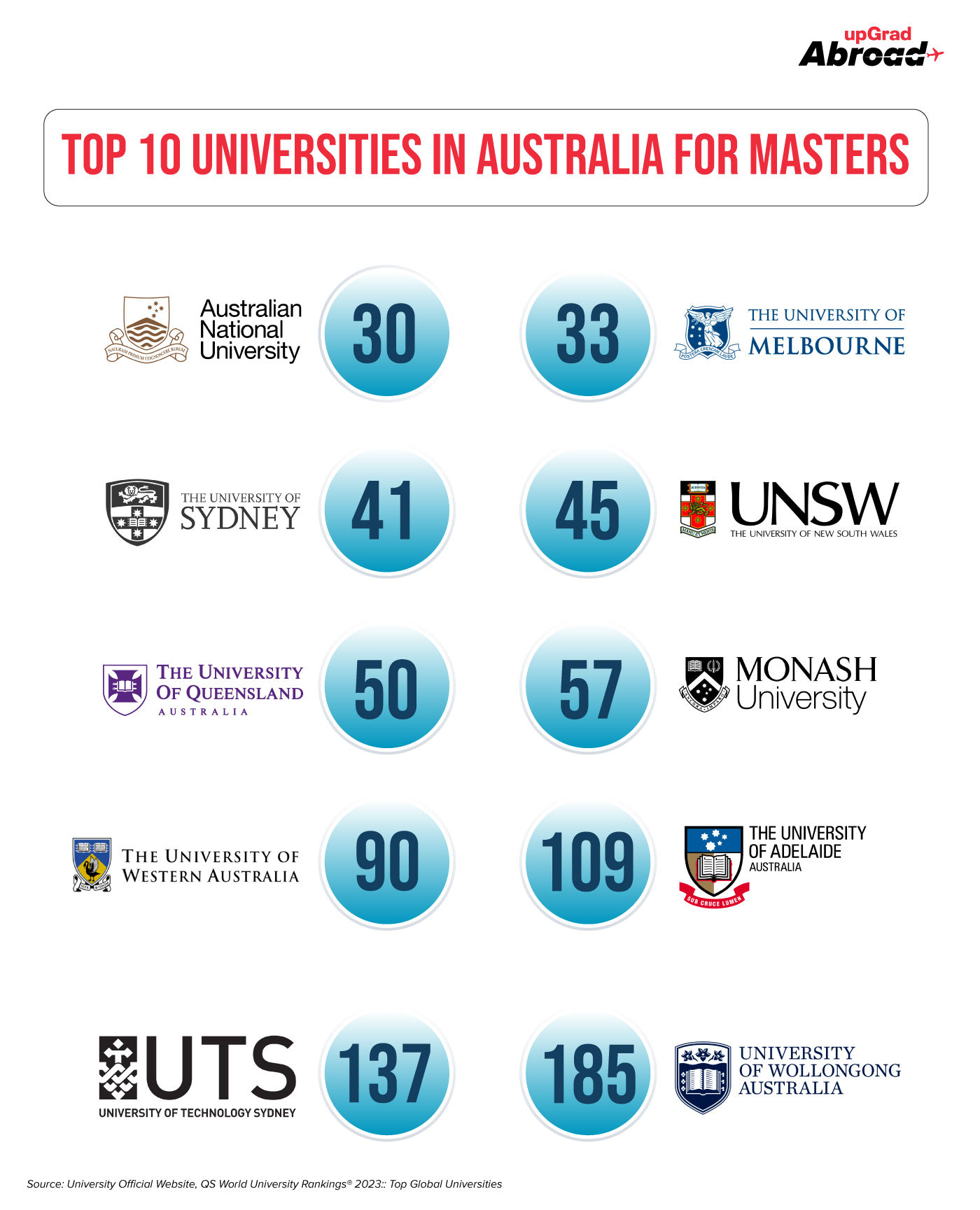
Australia is home to some of the best universities in the world for a masters degree, and the top picks include University of Melbourne, Australian National University, University of Sydney, UNSW Sydney and Monash University. These schools are known for strong programs in tech, business and science, and most of them rank inside the global top 50 too.
If you're looking at the top universities in Australia for masters, here's a quick fact to know first: UNSW Sydney has actually overtaken Melbourne this year, becoming the country's number one ranked university for the first time ever. On top of that, Australia offers over 22,000 course options across 40 plus universities, so there's genuinely something here for almost every field of study.
In this article, we'll walk you through the best universities in Australia for masters, how they compare by subject, what the fees and living costs look like, admission requirements, the application process, scholarships you can apply for, and what your career options look like once you're done. Everything you need to make this decision, in one place.
List of Best Universities in Australia for Masters
Let's start with the obvious question first. Which are the top universities in Australia for masters right now? According to the QS World University Rankings 2027, released in June 2026, UNSW Sydney has actually knocked University of Melbourne off the top spot in Australia for the first time ever. Big shift. Here's how the top ten stack up globally.
Now let's look at each one a bit closer, so you know what makes them different from each other.
UNSW Sydney
UNSW is Australia's number one ranked university now, and it got there mostly on strong employment outcomes and sustainability scores. Here's what stands out about it:
Best known for engineering, tech and business programs
Strong industry partnerships that help with job placements
Ranked first in Australia for employment outcomes
If you care about where your degree gets you a job fastest, UNSW deserves a serious look among the top universities in Australia for masters.
University of Melbourne
Melbourne has been Australia's academic heavyweight for years and it's still one of the best universities in Australia for masters, even after slipping to number two locally this year. A few things worth knowing:
Known for business, law and data science courses
Strong global research output and reputation
Campus life in Melbourne city is genuinely hard to beat
If research output and global name value matter to you, this one's worth shortlisting.
University of Sydney
Sydney was Australia's first university, founded way back in 1850, and it still holds serious weight today. Quick look at its strengths:
Strong in computer science, medicine, engineering and arts
Wide internship and networking options thanks to the city itself
Member of the Group of Eight, Australia's most research-intensive universities
A lot of students pick Sydney simply because the city offers so much beyond the classroom.
Australian National University
ANU sits in Canberra and it's the go-to name for research, public policy and natural sciences. Here's why it stands out:
Highest share of Nobel Prize winning faculty in the country
Strong focus on government-funded research centers
Great pick if you're leaning toward research-based masters programs
Monash University
Monash runs multiple campuses across Victoria and even has campuses in Malaysia and South Africa. What makes it worth considering:
Strong in IT, data science, health and business
Genuinely huge international student community
Well rounded option among the top universities in Australia for masters
University of Queensland
UQ is based in Brisbane and has built a solid reputation over the years. Its main strengths are:
Strong focus on environmental and life sciences
Known for winning more national teaching awards than most Australian universities
Good option if fieldwork and research based learning appeal to you
University of Western Australia
UWA is based in Perth and tends to fly a little under the radar compared to the Go8 names. Worth knowing:
Known for engineering and resources related courses
Smaller class sizes compared to the bigger cities
A good pick if you want strong academics without the Sydney or Melbourne price tag
Adelaide University
Adelaide University works well for students looking at slightly different specialisations. Here's what it offers:
Good for tech, wine science and health related courses
Comparatively lower cost of living than Sydney or Melbourne
Popular among students looking for cheap universities in Australia for masters
University of Technology Sydney
UTS has built its name around being practical and industry focused. A few highlights:
Focused on design, tech and business courses
Strong links with industry for placements and projects
One of the more affordable options among universities in Australia for masters
RMIT University
RMIT rounds out the top ten and is known for a very hands-on approach to learning. What it's known for:
Practical, industry-linked programs in design and IT
Strong reputation for creative and technical courses
Based in Melbourne, so you still get access to the city's opportunities
Other Top Universities for Masters
Beyond the top universities, there are a few more names worth knowing about. Here they are:
University of Queensland: strong in environmental and life sciences
University of Western Australia: known for engineering and resources, based in Perth
Adelaide University: good for tech, wine science and health related courses
University of Technology Sydney: focused on design, tech and business
RMIT University: known for practical, industry-linked programs in design and IT
Best Universities in Australia for Masters by Subject
Rankings are one thing, but honestly, picking your university in Australia for masters really comes down to what you actually want to study. Some universities are simply stronger in certain fields than others, and that matters more than the overall rank number. Here's a quick breakdown by subject so you can match your interest to the right campus.
Engineering and Technology
If engineering's your thing, a couple of names come up again and again among students. Here's where to look:
UNSW and Monash: strong industry tie-ups and well equipped lab facilities
University of Western Australia: solid choice if you're leaning toward resources or mining engineering
All three offer good placement support through industry partnerships
Computer Science and Data Science
For universities in Australia for masters in computer science, a few campuses dominate most student shortlists. Here's what stands out:
Melbourne, Sydney and Monash: top picks, covering AI, machine learning and software engineering
UNSW: excellent specifically for cyber security
Most programs here come with strong placement support and industry projects
Business and Management
Business is one of the most popular fields among international students, and Australia has plenty of strong options here. Worth knowing:
Melbourne, UNSW and Monash: well recognised programs covering finance to project management
ANU: better suited if public administration or policy work interests you over corporate roles
Sydney: leans heavily into commercial law and HR specialisations
Other Popular Courses
A few other fields worth knowing about, in case your interest lies elsewhere:
Health sciences and public health: Melbourne, UNSW and Monash
Environmental management: UNSW and University of Queensland
Architecture and urban planning: UTS and UNSW
Media and communication: Melbourne and Sydney
Cost of Studying Masters in Australia
This is probably the part you actually clicked in for. Masters tuition in Australia generally sits between AUD 22,000 to AUD 90,000 a year (roughly INR 12.3 lakhs to INR 50.4 lakhs), depending on the university and course you pick.
Tuition Fees for International Students
Fees vary quite a bit across universities, so it helps to think of them in three simple buckets. Here's how they break down.
Affordable Universities (AUD 22,000 – 35,000 a year)
University of Technology Sydney
University of Wollongong
Adelaide University
These are solid picks if you're specifically looking at cheap universities in Australia for masters without compromising too much on quality.
Mid-Range Universities (AUD 35,000 – 50,000 a year)
Monash University
Australian National University
University of Queensland
A good middle ground if you want strong rankings without the top-tier price tag.
Premium Universities (AUD 50,000 – 90,000 a year)
University of Melbourne
UNSW Sydney
University of Sydney
These sit among the best universities in Australia for masters, but the fees reflect that reputation.
University Name
Approximate Annual Masters Fee (AUD/INR)
University of Melbourne
45,000 – 60,000 (25.2 – 33.6 lakhs)
UNSW Sydney
40,000 – 56,000 (22.4 – 31.4 lakhs)
University of Sydney
40,000 – 54,000 (22.4 – 30.2 lakhs)
Monash University
35,000 – 45,000 (19.6 – 25.2 lakhs)
ANU
30,000 – 45,000 (16.8 – 25.2 lakhs)
University of Technology Sydney
22,000 – 35,000 (12.3 – 19.6 lakhs)
Additional Study and Living Costs
Tuition is only part of the picture. Rent, food, transport and daily expenses add up too, and this is where a lot of students underestimate their budget. Here's a standard monthly living cost breakdown to give you a clearer picture.
Expense
Approximate Monthly Cost (AUD/INR)
Rent (shared accommodation)
700 – 1,000 (39,200 – 56,000)
Groceries and food
300 – 450 (16,800 – 25,200)
Public transport
100 – 150 (5,600 – 8,400)
Utilities (electricity, internet)
150 – 200 (8,400 – 11,200)
Entertainment and miscellaneous
150 – 250 (8,400 – 14,000)
Total
1,400 – 2,050 (78,400 – 1,14,800)
Source: Numbeo
Admission Requirements for Masters in Australia
Getting into a good university in Australia for masters isn't as complicated as it sounds, once you know what's actually expected of you. Most universities check three things mainly, your academics, your English score, and your documents. Some courses ask for a bit more, but this covers the basics for almost every masters program out there.
Academic and English Language Requirements
Every university has its own cutoffs, but the general pattern stays pretty similar across the board. Here's what most of them look for:
A bachelor's degree from a recognised university, in a related field
Minimum GPA of around 4.0 to 5.0 out of 7.0, which works out to roughly 60 to 65 percent
IELTS score of 6.0 overall, with no individual band below 5.5
GRE or GMAT score, needed mostly for MBA or research-heavy programs
Some of the top universities in Australia for masters, like Melbourne or UNSW, may ask for slightly higher scores depending on how competitive the course is. So it's always worth checking the exact cutoff on the course page itself.
Documents Required for Admission
Once your scores are sorted, the next step is getting your paperwork together. Here's what you'll typically need on hand before you apply:
Keep scanned copies of everything ready in one folder. It saves a lot of last-minute scrambling when deadlines are close.
How to Apply for a Masters in Australia?
Once you've shortlisted your courses, applying isn't nearly as overwhelming as people make it sound. It usually comes down to three simple stages, and most universities follow this same basic pattern. Here's how it works, step by step.
Shortlist Universities and Courses
Start by comparing courses across the best universities in Australia for masters based on a few key things:
Your budget and course fees
Subject interest and specialisation options
Where you eventually want your career to go
Eligibility criteria and application deadlines, since these vary a lot even between two courses at the same university
Don't just chase rankings here. A lower ranked course that fits your goals better is often the smarter pick.
Check Eligibility and Submit Applications
Once your final list is ready, go through everything one more time before hitting submit. Here's what your application usually needs:
Completed application form
All required documents, transcripts, SOP, LORs and English scores
Application fee payment
Confirmation that you meet every eligibility requirement listed
Missing even one document can delay your application by weeks, so double check before you submit.
Receive Admission and Prepare for Study
If your application gets accepted, here's what happens next:
You'll receive an offer letter from the university
Accept the offer and pay the initial deposit
The university issues your Confirmation of Enrolment, or CoE
Use this CoE to apply for your student visa
This CoE is the one document you absolutely need before moving to the visa stage, so don't lose track of it.
Scholarships for Masters in Australia
Studying at the top universities in Australia for masters doesn't always mean paying full price. There's a decent range of scholarships out there, and some of them cover your entire tuition. Let's look at where to find them.
Scholarships for International Students
A lot of students assume scholarships get sorted automatically along with the course application, but that's not how it works. Here's what you actually need to keep in mind:
AUD 15,000 (around INR 8.4 lakhs), for regional study
Griffith Remarkable Scholarship
University specific
Up to 50 percent tuition waiver
International Excellence Scholarship (Newcastle)
University specific
Up to AUD 60,000 total, AUD 15,000 per year
Executive Dean's Master of Engineering Scholarship (Edith Cowan)
University specific
20 percent reduction in tuition fees
A quick look at what makes each one worth considering:
Australia Awards Scholarships: Fully government funded and covers pretty much everything, tuition, travel and a living allowance. Highly competitive, so apply early.
Destination Australia Awards: A good option if you're open to studying at a regional campus instead of a big city.
Griffith Remarkable Scholarship: Based purely on your academic performance in your previous degree.
University specific scholarships: Most Go8 universities run their own merit based awards directly, so it's worth checking each university's scholarship page separately.
How to Apply for Scholarships
Applying for a scholarship isn't automatic, so keep these points in mind:
Most scholarships need a separate application from your course application
Check each scholarship's deadline early, since many close months before the intake starts
Keep your SOP and academic records ready in advance, as scholarships usually ask for these too
Some scholarships require a personal statement specifically about financial need or leadership experience, so read the criteria carefully before applying
Career Opportunities After Masters in Australia
Once you're done with your degree, Australia gives you a decent runway to work and gain experience through the Temporary Graduate visa, subclass 485. Here's how the duration breaks down:
Coursework masters graduates: 2 years
Masters by research graduates: 3 years
Indian students: an extra year on top of this, under the AI-ECTA agreement
Do keep in mind the visa rules have gotten a bit stricter lately. Here's what's changed recently:
Application fee has gone up to AUD 5,750 (around INR 3.2 lakhs)
Age limit for applying has dropped from 50 to 35 years for most streams
Genuine Graduate requirement now applies, so you'll need to show your study was genuine and career focused
Job wise, here's what graduates typically earn across a few common roles.
Job Role
Approx. Annual Salary (AUD/INR)
Engineering Manager
1,70,000 (95.2 lakhs)
Data Scientist
1,13,500 (63.6 lakhs)
Architect
90,000 (50.4 lakhs)
Electrical Engineer
88,000 (49.3 lakhs)
Chief Financial Officer
85,000 (47.6 lakhs)
Source: Glassdoor
How to Choose the Right University for Masters in Australia?
With so many universities in Australia for masters to pick from, narrowing it down can feel overwhelming. Here's a simple way to think about it, broken into three things that actually matter.
Course and Career Goals
Before you shortlist anything, think about where you want to end up career wise first. A few things to keep in mind:
Work backward from your career goal to the course, not the other way around
A university known for engineering might not suit you if you're aiming for a business role, even if it ranks higher overall
Check if the course offers specialisations that match your specific interest, not just the general subject area
Fees, Location and Overall Budget
Your budget plays a bigger role than most students expect, so plan this out properly. Here's what to consider:
Compare tuition fees across universities, not just the reputation
If you're looking at cheap universities in Australia for masters, cities like Adelaide, Perth or Wollongong usually work out lighter on tuition and rent
Factor in living costs too, since Sydney and Melbourne cost noticeably more than smaller cities
University Reputation and Career Outcomes
Rankings matter, but they shouldn't be the only thing you look at. Keep these points in mind:
Look beyond the overall ranking number and check graduate employment rates for your specific course
A university might rank lower overall but still have excellent outcomes in your particular field
Don't judge purely on the headline rank, dig into course-level data where possible
Conclusion
Picking the right university in Australia for masters really comes down to matching three things together, your course, your budget and your career goals. A few quick pointers to keep in mind as you make your final decision:
Shortlist based on your subject strength, not just the overall university rank
Compare fees and living costs honestly, since cheap universities in Australia for masters can offer just as much value as the bigger names
Check visa and post-study work options early, since these affect your long term plans too
Whether you're eyeing UNSW for its new top ranking, or a more affordable option like UTS or Adelaide, Australia has enough range to fit most students' needs. Take your time, compare properly, and you'll land somewhere that actually works for you.
It really depends on your interest, but business, data science, engineering and computer science are some of the most popular picks among the top universities in Australia for masters right now.
How much does masters in Australia cost?
Tuition for a masters in Australia usually falls between AUD 22,000 to AUD 60,000 a year, depending on which university and course you go for.
Do I need IELTS for masters in Australia?
Most universities in Australia for masters ask for an IELTS score of 6.0 overall, with no band below 5.5, though some accept PTE or TOEFL instead.
Can I get PR in Australia after masters?
Yes, a masters degree can lead to PR eventually, especially if you first get onto the subclass 485 work visa and gain some Australian work experience along the way.
Which are the best universities in Australia for masters?
UNSW Sydney, University of Melbourne, University of Sydney, ANU and Monash University are currently the top ranked picks among the best universities in Australia for masters.
Are there cheap universities in Australia for masters?
Yes, UTS, University of Wollongong and Adelaide University are good cheap universities in Australia for masters, offering solid programs without the premium fees of the bigger names.
Which university is best for computer science masters in Australia?
Melbourne, Sydney and Monash are strong choices if you're looking at universities in Australia for masters in computer science, and UNSW stands out specifically for cyber security.
How long does a masters degree take in Australia?
Most coursework programs at universities in Australia for masters run for 1.5 to 2 years, while research based ones can stretch up to 3 years.
Can international students work while studying in Australia?
Yes, you're allowed to work up to 48 hours every fortnight during term time, and there's no limit during scheduled breaks.
What is the work visa duration after a masters in Australia?
Coursework masters graduates get 2 years on the subclass 485 visa, research masters graduates get 3 years, and Indian nationals get an extra year on top of that.
Which intake is better for masters in Australia, February or July?
Both work well, but February tends to have more course options open and scholarship deadlines usually line up earlier for this intake.
Akansha Semwal is a content marketer at upGrad and has also worked as a social media marketer & sub-editor. Experienced in creating impressive Statement of Purpose, Essays, and LOR, she knows how to c...
Download Australia Study Guide
Refer Your Friend & Earn upto ₹15000
Help your friend upgrade to a Global Career and earn rewards together.