What Is Data Ethics and Why Does It Matter?
By Sriram
Updated on Jun 17, 2026 | 9 min read | 1.95K+ views
Share:

All courses
Certifications
More
By Sriram
Updated on Jun 17, 2026 | 9 min read | 1.95K+ views
Share:
Table of Contents
Data ethics is the set of moral principles that guides how data is collected, stored, shared, and used. It draws a line between what's technically possible and what's actually right. When a company can track your location in real time, that's a capability question. Whether it should, and under what conditions, that's a data ethics question.
This blog covers the core principles of data ethics, why big data ethics has become a genuine concern for organisations, the ethical considerations in data analysis that professionals often overlook, and what India's growing tech workforce needs to know about responsible data use.
Explore upGrad's Data Science, AI, and Machine Learning programs to develop practical skills in data analytics, artificial intelligence, machine learning, data governance, responsible AI, statistical modeling, and ethical data-driven decision-making for real-world business applications.
Popular Data Science Programs
Data ethics refers to the moral principles that guide how organizations collect, store, process, analyze, and use data.
Organizations now have access to unprecedented amounts of information about customers, employees, patients, and citizens. While this data creates opportunities for better services and smarter decisions, it also raises serious questions about privacy, fairness, transparency, and accountability.
Imagine a company using customer data to personalize recommendations. That sounds useful. But what happens if customers don't know their data is being collected? What if the recommendation system unfairly favors certain groups while excluding others?
That's where ethical decision-making becomes critical.
Organizations follow ethical data practices to:
Free Courses
Data ethics is a framework for making judgment calls when the rules don't give you a clear answer. Most frameworks share a few common principles, even if the language differs.
People should know what data you're collecting and why. Consent isn't just a tick-box on a sign-up form. It's the actual understanding a person has about how their data will be used before they agree. Vague terms like "we may share your data with partners" don't count as real consent.
Transparency goes alongside this. If a model uses someone's data to make a decision about them, whether it's a loan approval or a content recommendation, they deserve to know that.
Bias doesn't disappear simply because a decision is automated. If an algorithm is trained on historical hiring records, it can inherit and repeat the same prejudices present in past decisions. That's why fairness involves reviewing the results produced by a system, not just its inputs.
Accountability means someone is responsible when things go wrong. It's easy to blame the model. Algorithms don't decide how they're trained or where they're deployed. Those choices are made by people, which means accountability ultimately rests with the individuals and organizations behind the system.
Collect only what you need. Use it only for the stated purpose. While regulations like GDPR reinforce these principles, they also represent practical ways to manage data responsibly and avoid unnecessary risks. Holding more data than you need creates more risk without adding value.
Principle |
What It Means |
Common Violation |
| Consent | User agrees to data use | Hidden data sharing in T&Cs |
| Fairness | Decisions remain unbiased | Biased training data |
| Accountability | Clear ownership of outcomes | Blaming the algorithm |
| Data Minimisation | Collect only necessary data | Excessive data harvesting |
| Transparency | Decisions are explainable | Black-box model outputs |
Also read: Data Cleaning Techniques: 15 Simple & Effective Ways To Clean Data
Organizations are collecting more data than ever before, and customers are becoming increasingly aware of how their information is used. As AI-driven decisions influence areas like hiring, lending, healthcare, and marketing, ethical data practices have become essential for maintaining trust and reducing risk.
Several factors have pushed data ethics into the spotlight:
One mistake can damage trust quickly. Rebuilding it takes years.
Many people confuse ethics with legal compliance. Here are the main differences:
Data Compliance |
Data Ethics |
| Focuses on legal requirements | Focuses on moral responsibility |
| Follows regulations and standards | Goes beyond legal obligations |
| Avoids penalties and violations | Builds trust and fairness |
| Minimum acceptable behavior | Responsible decision-making |
An organization might legally collect customer information. However, ethical concerns arise if customers don't clearly understand how their information will be used.
Must read: Exploratory Data Analysis: Role & Techniques for Business Insights
Data Science Courses to upskill
Explore Data Science Courses for Career Progression
IIIT Bangalore
Executive Post Graduate Certificate in Data Science & AIPlacement Assistance
Ethical considerations in data analysis start before you run a single query. The choices you make about what data to use, how to clean it, and which metrics to optimise all carry ethical weight.
If your training dataset over-represents one group, your model will perform worse for everyone else. This isn't just a technical problem. It's an equity problem. A credit-scoring model built mostly on urban data will systematically disadvantage rural applicants, even if location isn't an explicit variable.
The fix isn't always more data, sometimes it's asking why certain groups are underrepresented in the first place, and whether the task you're solving is itself fair.
A dataset might not include race or gender. But postal code, name, and purchase history can all function as proxies for these attributes. Removing a sensitive variable doesn't remove discrimination if correlated variables remain in the model.
This is one of the trickiest ethical considerations in data analysis, because the discrimination isn't visible at the feature level. You have to audit the outputs, not just the inputs.
Can you explain why a model made a specific decision? If not, deploying it in a high-stakes setting is ethically questionable. Medical diagnoses, loan decisions, criminal risk scores: these all affect real lives. People deserve to understand what drove the outcome.
XAI (Explainable AI) is a growing field specifically because black-box models create accountability gaps. It's not just an academic concern anymore. Regulators are starting to require it.
Must read: The Data Analytics Lifecycle: A Complete Guide from Discovery to Decision-Making
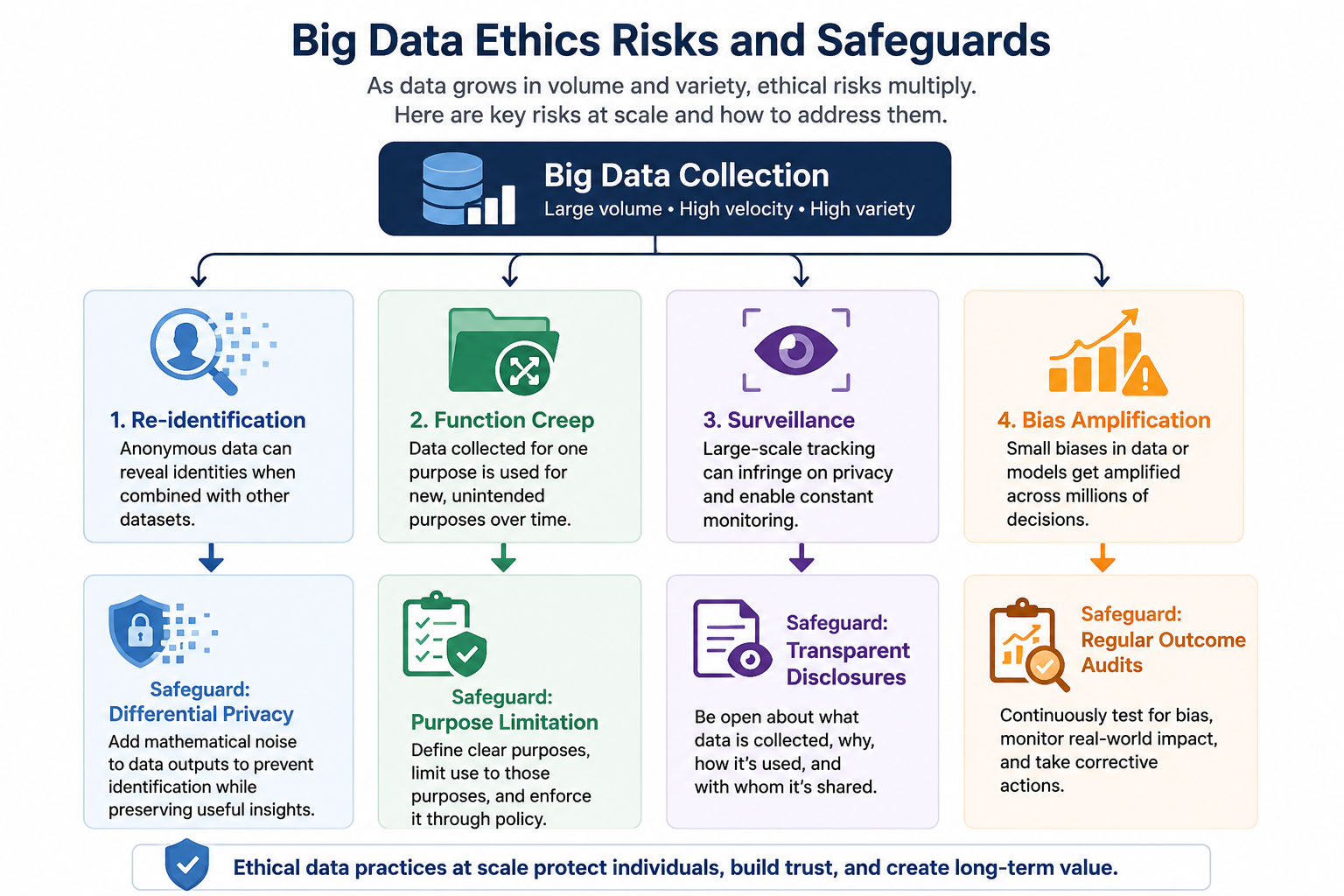
Big data ethics raises questions that don't arise at smaller scales. When you're analysing one person's health record, careful human judgment is possible. When you're processing 500 million records, the ethical risks scale with the volume and speed.
Anonymised data isn't as anonymous as it sounds. Researchers have shown that combining a few seemingly innocent data points, zip code, birth date, and gender, can re-identify a large proportion of individuals in a supposedly anonymised dataset. The more data you hold, the more re-identification becomes possible.
This is a core big data ethics concern because organisations routinely share "anonymised" data without fully understanding how vulnerable it is.
Also read: Top 20 Challenges in Data Science: A Complete 2026 Guide
Data collected for one purpose often ends up being used for another. A fitness app collects health data to track workouts. That same data becomes interesting to insurers, employers, and advertisers. This function creep is a predictable consequence of building large datasets without clear purpose limitations.
Ask yourself this: if users knew every possible use case for their data, would they still consent? That's the real test.
Big data concentrates knowledge in the hands of whoever holds it. A large platform knows more about its users' behaviour than the users know about themselves. That's an asymmetry worth thinking about carefully, especially when that knowledge is used to influence behaviour.
Do read: What are the Characteristics of Big Data: Types & 5V’s
Data science ethics is where abstract principles meet real decisions. A data scientist isn't usually the one setting company policy. But they make dozens of choices every week that carry ethical consequences.
When a data scientist builds a model to optimise for clicks, they're not responsible for the recommendation system it powers. Or are they? Data science ethics asks practitioners to think downstream. If you can foresee a harmful use, you have some responsibility to flag it, even if you didn't design the product.
This isn't comfortable. Raising ethical concerns in a commercial setting can feel like slowing things down. But the cost of getting it wrong, regulatory, reputational, human, is usually much higher than the cost of pausing.
Must read: Data Visualisation: The What, The Why, and The How!
This is rarely discussed anywhere. Can a data scientist decline to build something they think is harmful? Legally, that depends on employment terms. Ethically, the answer is clearly yes. Professionally, it's complicated.
The Centre for Data Ethics and Innovation in the UK has published frameworks to help organisations think through these decisions at the team and leadership level. But individual practitioners often face these calls alone, in sprint planning, not in a committee room.
Model outputs come with confidence intervals and error rates. But those numbers often don't make it into the executive summary. A model that's "85% accurate" sounds impressive until you realise it's wrong 15% of the time in a system making thousands of decisions a day.
Data science ethics includes the obligation to communicate what a model can't do, not just what it can. That's a skill, and one that isn't taught often enough.
Also read: Top 10 Challenges of Big Data & Simple Solutions To Solve Them
The Centre for Data Ethics and Innovation (CDEI) is a UK government body set up to investigate and advise on how data-driven technologies should be governed. It doesn't just publish guidelines. It conducts research, runs pilot programmes, and works with regulators to shape policy.
Why does this matter for a data professional in India? Because global standards tend to converge. GDPR shaped India's own Digital Personal Data Protection Act. The CDEI's work on algorithmic transparency influences how product teams at multinational companies build their internal review processes.
Framework / Body |
Country/Region |
Key Focus |
| GDPR | European Union | Data privacy and consent |
| DPDP Act 2023 | India | Personal data protection |
| Centre for Data Ethics and Innovation | United Kingdom | Algorithmic accountability |
| NIST AI Risk Management Framework | United States | AI risk management |
| UNESCO AI Ethics Recommendation | Global | Ethical and inclusive AI |
India's DPDP Act is still being operationalised, but it introduces meaningful obligations around consent, purpose limitation, and data principal rights. Any data professional working with Indian user data needs to understand it, not just as a compliance matter, but as a signal of where ethical expectations are heading.
Do read: They Say Data is the New Oil – Is it Really True?
Five years ago, data ethics was a niche academic topic. Now it's showing up in job descriptions, product reviews, and regulatory filings. Organisations that ignore it don't just face fines. They face user attrition, regulatory scrutiny, and the kind of press coverage that doesn't go away.
For anyone building a career in data science, machine learning, or product management, understanding data ethics isn't optional anymore. It's part of the job. The ethical judgment is what makes you someone the organisation actually trusts with real decisions. The field is evolving fast.
Frameworks considered rigorous three years ago are already being challenged by practitioners who've seen how they play out in production. That means the discipline is maturing.
If you're serious about working with data responsibly, start with the principles, understand the regulations relevant to your context, and build the habit of asking "what could go wrong here" before asking "how do we build this faster."
Data volumes continue to expand. Artificial intelligence continues to influence more decisions. Consumer awareness continues to rise. These trends aren't slowing down.
Organizations that treat ethics as a checkbox exercise often struggle to maintain trust when problems emerge. Those that embed ethical thinking into everyday operations are better positioned to build long-term credibility.
Data ethics isn't only a technical issue. It's a business issue, a social issue, and increasingly a leadership issue. As organizations collect more information and deploy more advanced analytics, responsible data practices will become a defining factor in how customers, employees, and regulators evaluate them.
Ready to start your journey? Book a free consultation with upGrad today to find the best path for your career.
The 5 C's of data ethics are commonly described as Consent, Clarity, Consistency, Control, and Consequences. Together, these principles encourage organizations to collect and use data responsibly while respecting user rights. They also help businesses build trust by making data practices more transparent and accountable.
Ethics refers to the moral principles that guide decisions about what is right and wrong. In a data context, ethics helps organizations determine how information should be collected, analyzed, shared, and used without causing harm to individuals, groups, or society.
The seven widely recognized ethical principles include autonomy, beneficence, non-maleficence, justice, accountability, integrity, and transparency. While different frameworks may vary slightly, these principles are often used to evaluate decisions involving technology, artificial intelligence, healthcare, and data governance.
Many organizations follow seven core data principles including consent, transparency, fairness, accountability, privacy, accuracy, and security. These principles help guide responsible data management and support ethical decision-making throughout the data lifecycle, from collection to analysis and storage.
The four fundamental concepts of ethics are autonomy, beneficence, non-maleficence, and justice. These concepts are frequently used in healthcare, technology, and research. They provide a framework for evaluating whether decisions respect individual rights and promote fair outcomes.
Artificial intelligence systems learn from historical data and can influence decisions at scale. Data ethics helps organizations identify bias, improve transparency, and maintain accountability. Without ethical oversight, AI systems can unintentionally reinforce discrimination or make decisions that negatively affect individuals.
Data ethics focuses on moral responsibility and fair decision-making, while data governance focuses on policies, processes, and controls used to manage data. Governance establishes operational rules, whereas ethics helps organizations determine whether those rules align with broader societal expectations.
Data science ethics influences how datasets are collected, cleaned, analyzed, and used to train models. Ethical practices help teams identify bias, evaluate fairness, and communicate limitations clearly. This improves trust in machine learning systems and reduces the likelihood of harmful outcomes.
Some of the most important ethical considerations in data analysis include informed consent, privacy protection, data quality, fairness, transparency, and accountability. Analysts must also consider whether their findings could unintentionally disadvantage specific groups or lead to discriminatory outcomes.
Big data ethics helps businesses manage risks associated with large-scale data collection and analysis. Issues such as surveillance, re-identification, bias amplification, and function creep become more significant as datasets grow. Ethical practices help organizations maintain customer trust while reducing reputational and regulatory risks.
The Centre for Data Ethics and Innovation (CDEI) is a UK-based organization that studies the impact of data-driven technologies on society. It provides research, guidance, and policy recommendations related to responsible AI, algorithmic accountability, transparency, and ethical technology governance.
725 articles published
Sriram K is a Senior SEO Executive with a B.Tech in Information Technology from Dr. M.G.R. Educational and Research Institute, Chennai. With over a decade of experience in digital marketing, he specia...
Speak with Data Science Expert
By submitting, I accept the T&C and
Privacy Policy
Start Your Career in Data Science Today
Top Resources
Executive Diploma
12 Months
Master's Degree
18 Months
Bootcamp
6 Months