Data Science Personal Statement Sample
Updated on Jun 25, 2026 | 15 min read | 27.15K+ views
Share:

All courses
Certifications
More
Updated on Jun 25, 2026 | 15 min read | 27.15K+ views
Share:
Table of Contents
A data science personal statement is more than a summary of your qualifications. It should explain what sparked your interest in data science, how your academic background, projects, internships, or work experience prepared you for the field, and why you are a strong fit for a specific university or program. Using measurable achievements and real examples makes your application more convincing.
This blog explains how to write a strong data science personal statement, avoid common mistakes, customize it for different universities, and review a sample that can help you create your own original statement.
Transform your career with upGrad’s Data Science Course. Learn from industry experts, work on hands-on projects, and gain the skills top employer’s demand.
Popular Data Science Programs
Before you start writing, understand the basic requirements of a strong data science personal statement. The table below highlights the ideal length, structure, purpose, and key elements that admission committees expect.
| Aspect | Details |
|---|---|
| Purpose | Showcase your motivation, skills, and career goals |
| Ideal Length | 500–1,000 words (or as specified by the university) |
| Best For | Master's applications, scholarships, and university admissions |
| Main Sections | Introduction, academic background, projects, skills, career goals, conclusion |
| Key Skills to Mention | Python, SQL, Machine Learning, Statistics, Data Visualization |
| Supporting Evidence | Projects, internships, research, certifications, achievements |
| Writing Time | 3–5 hours for drafting and editing |
| Common Mistakes | Generic content, copying samples, weak examples, grammar errors |
| Best Practice | Customize every personal statement for the university you are applying to |
Free Courses
When applying for a Master’s in Data Science, crafting a thoughtful personal statement is essential. Taking the time to research the program, understand its unique focus areas, and reflect on how your background aligns with its values will help you create a statement that truly resonates with the admissions committee.
You may follow these steps when writing a data science personal statement:
Start by identifying the programs you’re interested in. Explore the course structure, duration, and admission criteria. This helps you understand what each university values and how to align your statement with their expectations.
Example: "After researching the University of XYZ’s Data Science program, I was drawn to its emphasis on AI and machine learning. The inclusion of advanced courses like Deep Learning and Natural Language Processing aligns perfectly with my career aspirations to specialize in AI-driven analytics."
Consider how much time you can dedicate to the program and your personal goals. This reflection will help you frame your statement with honesty, showing that you're prepared, motivated, and aware of the demands of a data science master’s program.
Example: "While I am excited to pursue this Master’s program, I recognize the level of commitment required. Having worked full-time as a data analyst for the past two years, I’ve learned to balance professional responsibilities with my personal development, and I am prepared to dedicate significant time to my studies."
Think carefully about why you want to continue your education. Is it driven by a college experience, a turning point in your life, or a long-standing passion for data? Use personal examples to show how your interest in data science has evolved.
Example: "My interest in data science began during an internship where I worked with large datasets to predict customer behavior. This hands-on experience sparked a deep curiosity about data-driven decision-making, motivating me to pursue further education in this field."
Whether it's an academic challenge, a research project, or a personal event, explain how these moments shaped your goals. Universities want to understand not just what you've done but why it matters to you now.
Example: "During my final year project on predictive modeling, I faced several technical challenges. However, overcoming these obstacles not only sharpened my problem-solving skills but also solidified my desire to pursue a career in data science, where I can continue tackling complex, real-world problems."
Lastly, make sure everything ties back to the program you're applying to. What makes you a strong candidate for this specific course? How does it help you grow and how will you contribute in return?
Example: "The hands-on approach in your program, particularly the opportunity to work on industry projects, aligns with my desire to apply theory to practice. With my background in data analysis and passion for continuous learning, I am eager to contribute to class discussions and collaborative research projects."
Also Read: How to Become a Data Scientist - Answer in 9 Easy Steps
To help you get started, here's a Data Science Personal Statement Example that demonstrates how to effectively highlight your skills and aspirations.
Data Science Courses to upskill
Explore Data Science Courses for Career Progression
IIIT Bangalore
Executive Post Graduate Certificate in Data Science & AIPlacement Assistance
A compelling personal statement links your academic achievements, professional experiences, and future aspirations while aligning them with the values and goals of the program you're applying to.
Following is a data science personal statement sample:
I am writing to express my earnest desire to pursue the Master’s in Data Science program at Indian Institute of Technology (IIT) Madras. As a student of Computer Science at University of Delhi, my academic and professional journey has been shaped by a relentless curiosity to understand the power of data and its transformative potential. My decision to dive deep into the world of data science was not an arbitrary one, but rather the culmination of my experiences with large datasets and the analytical tools that revealed how data can influence decisions across industries. It was during my third year that I realized the enormous potential of data science when I worked on a data-driven project aimed at predicting traffic congestion in Delhi using machine learning algorithms. By employing models such as linear regression and support vector machines, I was able to forecast congestion patterns based on historical data. This project sparked a deeper interest in data science, especially how data can be utilized to solve real-world problems, something I hope to explore further at the graduate level. My academic foundation is supplemented by hands-on experience during my internship with Zensar Technologies, where I worked alongside the Data Science team to develop a model that predicted customer churn for a telecommunications client. Utilizing R and Python, I collaborated on data preprocessing, model training, and evaluation, ultimately delivering a predictive model that helped the client improve retention strategies by 18%. This experience not only honed my technical skills but also reinforced my belief that data science holds the key to solving many contemporary business challenges. India is witnessing a significant digital transformation, with industries across sectors looking to leverage data for informed decision-making. The rising demand for data scientists in sectors like healthcare, finance, and education aligns with my own goals. I am particularly drawn to the innovative research initiatives and cutting-edge labs at IIT Madras, known for their pioneering work in machine learning and AI-driven solutions. The curriculum’s focus on real-world applications of data science and the opportunity to collaborate with industry leaders through internships and live projects excites me greatly. Moreover, the chance to work alongside esteemed professors whose work I deeply admire, such as Professor M. S. Srinivasan, whose research in data-driven healthcare analytics aligns with my own career aspirations, is one of the primary reasons I am excited about the opportunity to study at IIT Madras. I am eager to contribute to and learn from the Data Science and AI research group, where I believe I can build upon my knowledge and explore practical applications of data science to societal problems. In the long term, I envision myself applying data science techniques in the healthcare sector to improve patient outcomes. I am particularly fascinated by the possibilities of predictive analytics to identify disease patterns early, optimize healthcare delivery, and enhance medical decision-making. By leveraging big data and machine learning algorithms, I aspire to create solutions that make healthcare more efficient and accessible to people across India. The Master’s in Data Science program at IIT Madras is the perfect platform to sharpen my skills and achieve these goals. I am confident that the rigorous academic environment, along with the unique research opportunities, will equip me with the tools and knowledge to make meaningful contributions to the field of data science. I am eager to embark on this journey, confident that it will shape me into a well-rounded data scientist capable of tackling global challenges with data-driven solutions. Thank you for considering my application. I look forward to the opportunity to contribute to the academic community at IIT Madras and further my passion for data science. Sincerely, Hardik Pandey. |
Now, let’s examine an actual data science personal statement example to gain a better understanding.
To help you craft your own standout personal statement, here are some key tips followed by a sample that illustrates how to effectively structure your narrative.
Writing an effective Data Science personal statement is about telling your story. It should tell why you’re passionate about data science, how your background has prepared you, and what unique perspectives you bring to the table.
To make your personal statement stand out, focus on showcasing your problem-solving abilities, real-world experiences, and the specific motivations driving your pursuit of a data science career. Tailor your statement to the program, highlighting how your goals align with what they offer, and demonstrate your commitment to contributing to the field.
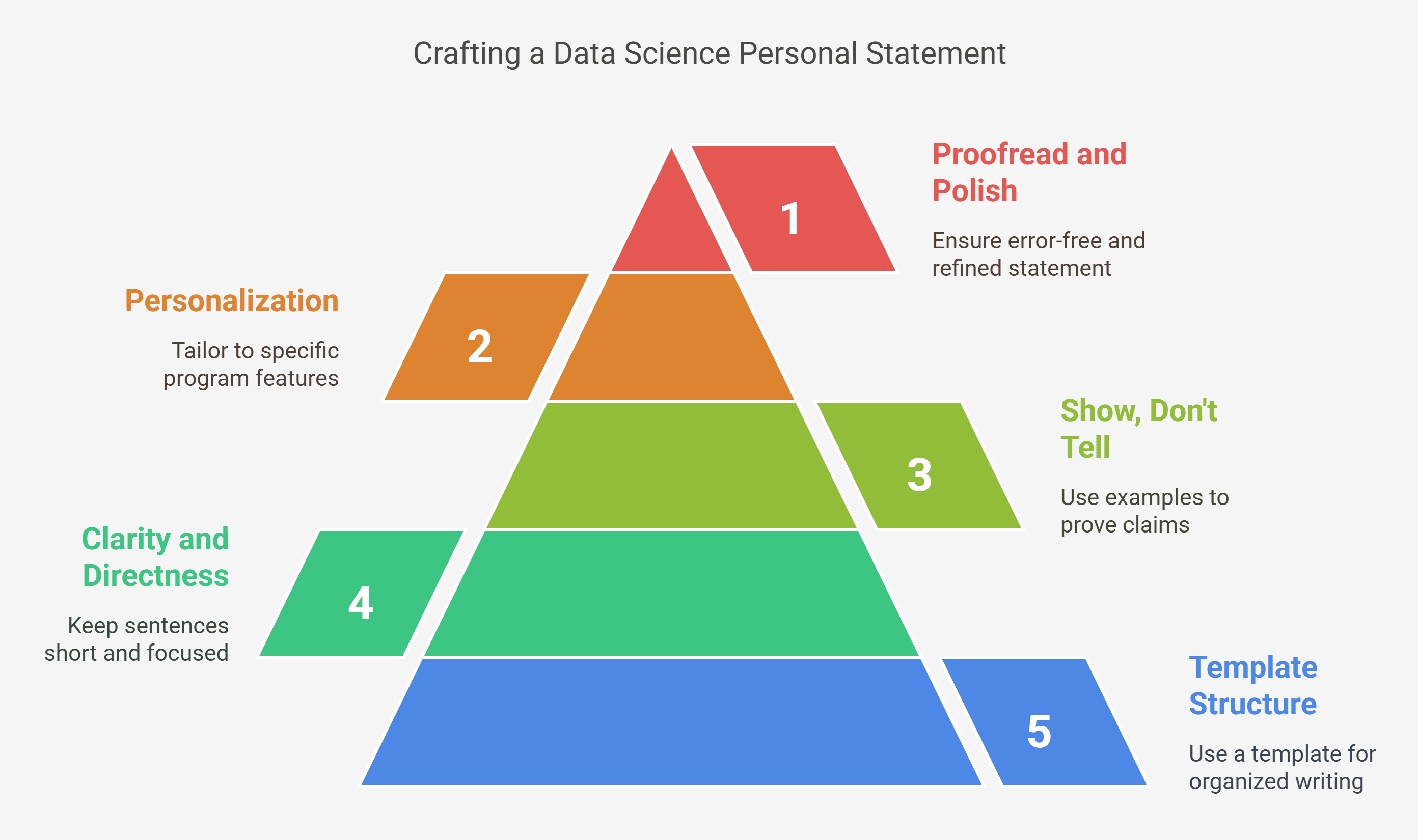
Here are some unique and often overlooked tips for writing an effective personal statement for a Master's in Data Science:
1. Highlight Your Curiosity Over Your Skills: Admissions committees want to know not just what you know, but how eager you are to learn. Instead of simply listing technical skills, share a story where your curiosity led you to explore an unfamiliar concept or technology.
For example, "I spent weeks diving into deep learning algorithms out of pure interest, experimenting with different frameworks until I achieved a model that could predict sentiment more accurately than traditional methods."
2. Show How You Handle Data-Related Failure: Data science is about experimenting and sometimes failing. Share an example of a time when a model or project didn’t go as planned, and focus on what you learned.
For instance, "When my initial model failed to predict accurately, I analyzed the data preprocessing steps, learned about feature engineering, and used this failure as a springboard to improve."
Also Read: What Is Machine Learning and Why It’s the Future of Technology
3. Demonstrate Long-Term Impact: Talk about how your data science journey isn't just for career advancement but for a larger purpose.
For example, "My interest in healthcare data stems from personal experience, watching a family member struggle with late-stage diagnosis. I aim to use predictive analytics to provide earlier interventions for chronic diseases in underserved areas."
4. Use Non-Data Examples to Show Analytical Thinking: You don’t always need data science examples to show that you can think analytically.
Whether it's solving a challenging math problem or optimizing a process in a volunteer role, demonstrating your problem-solving abilities in any context can reveal your potential as a data scientist.
5. Integrate Multidisciplinary Insights: Data science is not isolated from other fields. Show how your knowledge or experience in another area, such as economics or behavioral psychology, influences how you approach data.
For example, "My economics background has given me a solid understanding of market dynamics, which helps me design better models for predicting financial trends."
6. Reflect on Data Science's Ethical Implications: Demonstrate awareness of data science's impact on privacy, ethics, and society. Discuss how you intend to use data responsibly and thoughtfully.
For instance, "While building models to predict consumer behavior, I also think critically about the ethical implications of data collection and its potential for misuse."
Also Read: Difference Between Data Science and Digital Transformation
To ensure your personal statement makes a lasting impact, it's important to follow the right guidelines. Here are some do’s and don’t you can keep in mind while writing a data science personal statement:
A strong data science personal statement shows more than your academic achievements. It explains your motivation, highlights real projects and measurable results, and demonstrates why you are a good fit for a specific university or program. Tailoring every application instead of using a generic template can improve your chances of admission.
Take time to research each university, revise your draft carefully, and present your experiences with clarity. An original and well-structured personal statement can help you stand out in a competitive admissions process.
upGrad can help strengthen your application by adding certifications in Python, Machine Learning, and AI to your portfolio. These credentials showcase your commitment and readiness, improving your chances of standing out and securing admission to top programs.
With upGrad’s data science courses, you can master the core principles of data science, write standout personal statements, and prepare for real-world challenges.
In addition to the programs covered in the blog, here are some additional free courses to complement your portfolio:
If you're unsure where to begin or which area to focus on, upGrad’s expert career counselors can guide you based on your goals. You can also visit a nearby upGrad offline center to explore course options, get hands-on experience, and speak directly with mentors!
Similar Reads:
SOP for Indian Universities: Format, Requirements, and More
Sample SOP for Business Analytics: Format, Samples & Tips
A data science personal statement is a narrative essay that outlines your academic background, technical experiences, and career motivations. It is vital because it allows admissions committees to look beyond your grades and understand your unique passion for analytics, coding, and problem-solving within the context of their specific program.
While often used interchangeably, a personal statement typically focuses more on your personal journey, character, and motivations for choosing data science. In contrast, a Statement of Purpose is usually more formal and concentrates heavily on your academic research interests, specific technical goals, and professional roadmap.
Most universities prefer a personal statement to be between 500 and 1,000 words, which usually translates to one or two pages. However, you must strictly adhere to the specific word count provided by the university, as conciseness is a valued skill in data presentation and reporting.
A strong structure begins with an engaging hook about your interest in data, followed by your academic background and relevant projects. You should then transition into your professional experiences and future career goals, finally concluding with why that specific university is the right fit for your aspirations.
You should weave in both hard and soft skills naturally. Mention technical proficiencies like Python, SQL, or machine learning alongside critical soft skills such as analytical thinking, communication, and curiosity. This demonstrates that you have the technical aptitude and the mindset required to interpret complex data insights.
Start with a compelling anecdote or a specific problem that sparked your curiosity in the field. Avoid generic openers like "I have always loved numbers." Instead, describe a real-world moment where you realized the power of data to solve issues, creating an immediate emotional and intellectual connection.
Yes, many data science programs welcome diverse backgrounds. In your personal statement, focus on transferrable skills and any bridge courses you have taken. Explain how your unique background, whether in finance, biology, or arts, gives you a distinct perspective on analyzing data in that specific domain.
When discussing projects, focus on the "how" and "why" rather than just listing tools. Describe the problem you aimed to solve, the methodology you selected, and the actual impact of your results. This approach highlights your problem-solving process and ability to derive actionable insights from raw data.
You should include non-related work experience if you can frame it relevantly. Focus on soft skills like leadership, project management, or logical reasoning. If you used data in any capacity to make decisions in that role, highlight that specific aspect to show a practical application of an analytical mindset.
Address gaps or low grades honestly but briefly without making excuses. Focus on what you learned during that time or how you have improved since then. Pivot quickly to your recent achievements, certifications, or projects that demonstrate your current competence and dedication to the field of data science.
Maintain a professional yet enthusiastic tone throughout your writing. You want to sound confident and knowledgeable without appearing arrogant. Avoid overly complex jargon intended to impress; instead, prioritize clear and precise language that demonstrates your ability to communicate complex technical concepts simply, which is a key data science skill.
Research the university’s curriculum, specific faculty members, and unique research labs. Mention specific professors whose work aligns with your interests or particular courses that excite you. This customization proves you have done your homework and are genuinely interested in what that specific institution offers.
Yes, reviewing successful data science personal statement examples can be very helpful for understanding flow and structure. However, use them only as a reference for formatting and tone. Never copy content directly, as admissions committees value authenticity and can easily detect generic or plagiarized narratives.
An undergraduate personal statement focuses more on your potential, enthusiasm, and high school STEM foundation rather than specialized research. You should highlight your curiosity, relevant school projects, math proficiency, and any extracurricular coding activities that show an early aptitude for logical reasoning and technology.
Common mistakes include repeating your resume, using clichés, and failing to proofread for grammatical errors. Additionally, avoid being too vague about your goals or focusing too much on childhood stories. Ensure every paragraph serves a purpose in proving why you are a strong candidate for the program.
Your future goals should form a significant part of your conclusion or the latter half of the essay. Be specific about the industries or roles you want to enter, such as a machine learning engineer in healthcare. This shows the committee that you have a clear vision and direction.
Yes, mentioning specific tools like R, TensorFlow, or Tableau is beneficial, but do so in context. Instead of just listing them, describe a project where you used these tools to overcome a challenge. This provides evidence of your proficiency and shows you know how to apply technical tools practically.
It is generally safer to avoid humor, as it can be subjective and may not translate well in a formal academic context. Stick to a sincere and engaging narrative. If you want to show personality, do so through your passion for the subject matter rather than jokes.
Proofreading is absolutely critical because data science requires meticulous attention to detail. Spelling errors or awkward phrasing can suggest carelessness, which is a red flag for a field that relies on precision. Always have a peer or mentor review your essay to ensure clarity and flow.
Conclude by summarizing your main themes and reiterating your enthusiasm for the program. End with a strong, forward-looking sentence that expresses your readiness to contribute to the university community and your excitement about embarking on a career in data science. Make your final impression a lasting one.
References:
https://www.nucamp.co/blog/coding-bootcamp-full-stack-web-and-mobile-development-2025-edge-computing-in-2025-bringing-data-processing-closer-to-the-user
https://www.forbes.com/sites/bernardmarr/2024/10/30/the-10-most-powerful-data-trends-that-will-transform-business-in-2025/
https://365datascience.com/career-advice/career-guides/data-scientist-job-outlook-2025/
911 articles published
Pavan Vadapalli is the Director of Engineering , bringing over 18 years of experience in software engineering, technology leadership, and startup innovation. Holding a B.Tech and an MBA from the India...
Speak with Data Science Expert
By submitting, I accept the T&C and
Privacy Policy
Start Your Career in Data Science Today
Top Resources
Master's Degree
18 Months
Executive Diploma
12 Months
Bootcamp
6 Months