Purposive Sampling: Definition, Types, Examples, and How It Works
By upGrad
Updated on Aug 13, 2026 | 8 min read | 2.89K+ views
Share:

All courses
Certifications
More
By upGrad
Updated on Aug 13, 2026 | 8 min read | 2.89K+ views
Share:
Table of Contents
Key Highlights
Ready to bridge executive experience with doctoral research. Earn a DBA degree to unlock C-suite roles, consulting opportunities, and peak earning potential.
Purposive sampling is a non-probability sampling method in which researchers deliberately select participants because they have specific characteristics, experiences, or knowledge relevant to the research.
For example, suppose a researcher wants to understand how first-time mothers experience online parenting communities. Interviewing people at random would not be useful. The researcher may specifically recruit women who:
These participants are selected because they fit the purpose of the study.
Purposive sampling is also commonly called judgmental sampling. The researcher uses their judgment to identify participants who are most relevant to the research question.
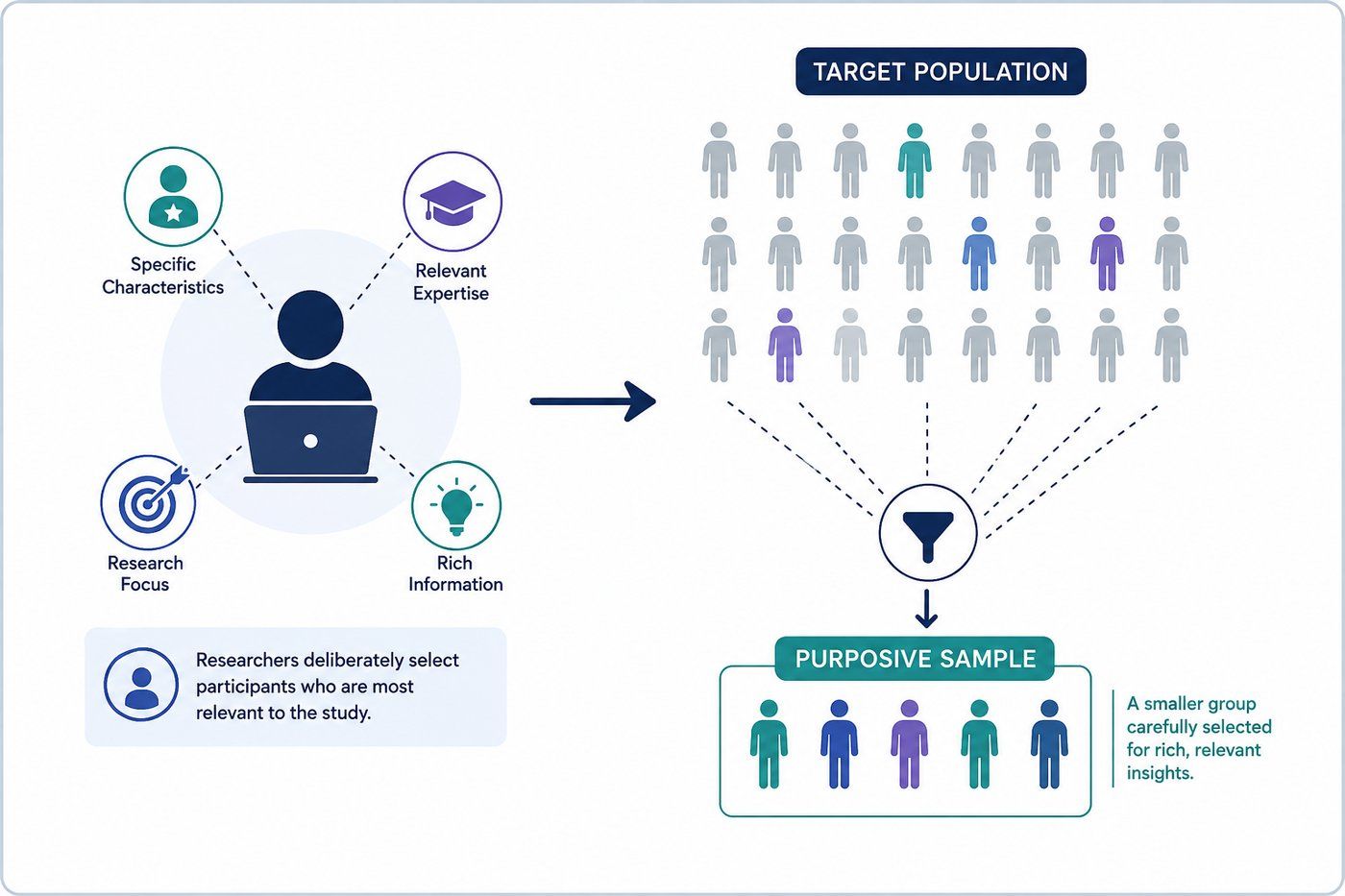
Several features distinguish this approach from probability sampling:
The main idea is not to find "average" participants. It is to find participants who can provide the type of information the study requires.
Must read: What are Sampling Techniques? Different Types and Methods
The process usually starts with research questions.
Imagine that a researcher wants to study how small businesses use social media to attract customers. The target population could be small business owners, but selecting any small business owner would be too broad.
The researcher might decide to include owners who:
The researcher can then look for people who meet these conditions.
The selection process therefore moves from the research objective to participant criteria. This is different from starting with a list of people and randomly choosing a sample.
The exact process can vary depending on the research design. A qualitative study may rely on interviews, while another study may use observations, focus groups, or document analysis.
DBA Courses to upskill
Explore DBA Courses for Career Progression
IIIT-B & IIM, Udaipur
Chief Technology Officer & AI Leadership ProgrammePurposive sampling can take different forms depending on what the researcher wants to investigate. Some approaches focus on specialised participants, while others help researchers explore common, contrasting, or unusual cases.
Expert sampling involves selecting participants with specialised knowledge, professional experience, or academic expertise related to the research topic.
For example, a study on the impact of artificial intelligence on recruitment could involve:
Their professional experience allows them to provide insights that general participants may not have.
In criterion sampling, researchers establish specific eligibility requirements before recruiting participants. Only people who meet these predefined conditions are included in the study.
For instance, a study on four-day workweeks might require participants to work full-time, have followed a four-day schedule for at least six months, and work for an organisation that officially follows the arrangement.
Homogeneous sampling focuses on participants who share similar characteristics or experiences. This allows researchers to examine a specific group in depth without introducing too many differences between participants.
A study on first-year university students, for example, might focus on full-time students in their first year at the same type of institution.
Maximum variation sampling deliberately brings together participants with different backgrounds or characteristics. The goal is to explore how experiences vary while also identifying patterns that appear across different groups.
A study on online learning might include students from different:
The purpose is to discover both common patterns and meaningful differences across participants.
Typical case sampling focuses on situations that are considered ordinary or representative of what commonly occurs in the research setting.
Imagine a researcher studying how small businesses use digital marketing. Instead of choosing the largest company or the most successful business, they might select one with characteristics that are common among similar businesses.
Sometimes, unusual cases can reveal important insights. Extreme or deviant case sampling focuses specifically on situations that stand out from the majority.
For example, a researcher studying employee retention might examine:
Looking at these extremes may help identify factors linked to unusually positive or negative outcomes.
A critical case is selected because it has particular importance to the research question.
Suppose researchers want to determine whether a new teaching approach can work in challenging classroom conditions. They might choose a school facing significant difficulties.
The case matters because findings from such an important setting could provide valuable insight into the wider research question.
Theoretical sampling is closely associated with grounded theory and differs from most other purposive approaches because participant selection can evolve during the study.
Researchers analyse early findings and use emerging concepts to decide whom to study next. For example, if workplace autonomy emerges as an important theme, they may recruit employees with different levels of autonomy to explore the concept further.
Also read: What Is Non-Probability Sampling: A Complete Guide (2026)
A good purposive sampling method starts with a clear research purpose. Researchers should be able to explain not only who they selected but also why those participants were suitable.
Start by identifying exactly what the study is trying to understand. A broad objective can make participant selection difficult. A specific objective gives the researcher a clearer basis for deciding who belongs in the sample.
For example:
Too broad:
"To understand employee experiences."
More specific:
"To understand how employees with more than two years of remote-working experience manage work-life boundaries."
The second objective gives the researcher a much clearer direction.
Next, determine the broader group that is relevant to the research.
For the remote-working study, the population might be full-time employees who work remotely.
The researcher does not necessarily need to recruit everyone in this population. The goal is to identify the people within it who can provide useful information.
The researcher should establish clear criteria for deciding who can participate.
These may include:
Clear criteria reduce ambiguity during recruitment.
The researcher then selects the most appropriate type based on the study's objective.
Participants can be recruited through professional networks, organisations, online communities, referrals, research databases, or other relevant channels.
The recruitment method should match the target population.
Accessibility alone should not become the main reason for selection. If researchers simply choose whoever is easiest to contact, the process can start to resemble convenience sampling.
The researcher should have a clear reason for deciding when recruitment can stop.
In many qualitative studies, this involves looking at data saturation, where additional data no longer produce meaningful new insights. Other researchers may consider information power, which looks at factors such as the specificity of the sample, quality of the dialogue, and relevance of the participants to the research question.
The important point is that sample adequacy should be justified rather than based on an arbitrary number.
Take your leadership to the next level with a Doctorate of Business Administration from ESGCI, Paris. Build advanced business expertise and lead with greater impact.
The best way to understand purposive sampling is to see how researchers apply it to real research questions. The selection criteria will change depending on what the study is trying to discover.
A researcher wants to understand how patients experience a new diabetes management program.
Instead of selecting patients randomly, the researcher may choose people who have participated in the program for at least six months.
Sampling approach: Criterion sampling
Why it works: These participants have direct experience with the program and can describe its benefits, challenges, and limitations.
A study examines how teachers use artificial intelligence tools to prepare classroom materials.
The researcher may select teachers who have used AI tools regularly for at least one year.
Sampling approach: Expert or criterion sampling
Why it works: The participants have practical experience with the subject being studied.
Suppose a researcher wants to understand why some startups survive beyond their first five years.
The researcher could select founders whose businesses have operated for more than five years.
The study might then include founders from different industries and company sizes.
Sampling approach: Maximum variation sampling
Why it works: The researcher can explore both common experiences and differences across successful startups.
A researcher wants to understand why consumers switch from one smartphone brand to another.
Participants could be selected specifically because they changed brands within the previous 12 months.
Sampling approach: Criterion sampling
The researcher is interested in people who have actually experienced the behaviour, rather than consumers who may only have an opinion about it.
A study investigates how employees experience remote work.
The researcher could deliberately select employees from different age groups, industries, job roles, and levels of remote-working experience.
Sampling approach: Maximum variation sampling
This can help the researcher identify patterns that appear across different groups while also finding experiences that are specific to certain participants.
A researcher studies the experiences of people who have recently migrated to a new country.
The sample could include people who moved within the past two years and have experience using local employment or public services.
The participants are selected because their experiences directly relate to the research question.
These examples show an important point: purposive sampling is not defined by a particular number of participants or a single recruitment method. It is defined by the deliberate selection of participants who fit the purpose of the study.
Also read: How To Do Market Research - [Ultimate Guide]
There is no fixed sample size for purposive sampling. The number depends on the research question, study design, participant characteristics, and depth of information required.
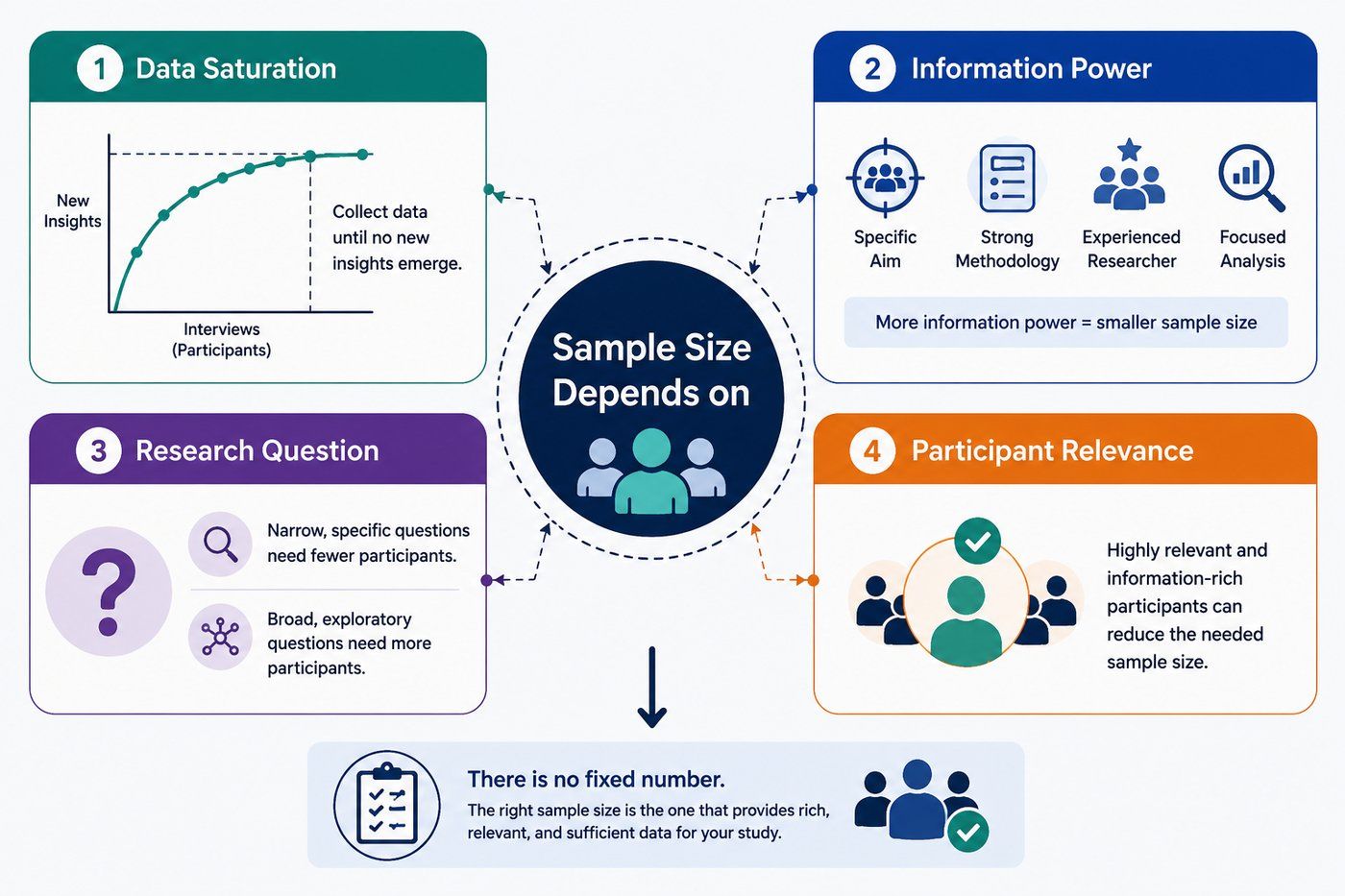
In qualitative research, researchers may use data saturation to assess whether enough participants have been included. Saturation occurs when additional data stop producing meaningful new insights.
It is not a universal participant number. A focused study may reach saturation with fewer participants, while a broader study involving diverse perspectives may require more.
Information power is another way to assess sample adequacy. A focused research question and highly relevant participants may provide enough useful information with a smaller sample.
Researchers should consider:
The final sample size should be justified in the research methodology rather than selected arbitrarily.
Also read: A Detailed Roadmap for Building Data Warehouse in 2025
Purposive sampling can be useful when researchers need participants with specific knowledge or experiences. However, it also has limitations.
Also read: Qualitative vs. Quantitative Research : Differences and Method
Different sampling methods serve different research purposes.
| Sampling method | How participants are selected | Common purpose |
| Purposive sampling | Based on relevant characteristics or research criteria | Obtain information-rich participants |
| Convenience sampling | Based on accessibility | Reach participants quickly and easily |
| Snowball sampling | Through participant referrals | Reach difficult-to-access populations |
| Quota sampling | Until predefined group quotas are filled | Include specific subgroups |
| Random sampling | Through a random selection process | Support statistical generalisation |
| Stratified sampling | Randomly selected from defined subgroups | Ensure representation across strata |
Researcher judgment is central to purposive sampling, but it can also introduce bias. Researchers can reduce this risk by making the selection process transparent.
Also read: Understanding and Conducting a Market Research like Experts
A research paper should explain who was selected, why they were selected, and how the sampling approach supported the research objective.
A basic structure can include:
For example:
"Purposive sampling was used to recruit full-time employees with at least two years of remote-working experience. Participants were selected because their direct experience was relevant to the study's objective of examining work-life boundaries in remote employment."
This makes the sampling decision clear and shows how it connects to the research question.
Also read: Data Science Research Papers: Guide to Writing & Publishing
Purposive sampling allows researchers to deliberately select participants who can provide relevant information for a specific research question.
Different approaches, such as expert, criterion, homogeneous, maximum variation, typical case, extreme case, and critical case sampling, serve different research needs.
A strong purposive sampling method requires clear selection criteria and a logical explanation of why the chosen participants are appropriate. Researchers should also consider sample adequacy and potential selection bias. When these decisions are clearly documented, purposive sampling can be an effective way to explore specific experiences, groups, and perspectives.
Your next career move starts with the right guidance. Book a consultation call with upGrad and discover the opportunities that fit your ambitions.
Judgmental sampling is another commonly used name for purposive sampling. Both terms refer to deliberately selecting participants based on their characteristics, knowledge, experiences, or relevance to the research question rather than choosing them randomly from the population.
Purposive sampling can introduce selection bias because researchers decide which participants to include. However, researchers can reduce this risk by defining selection criteria in advance, documenting recruitment decisions, considering different perspectives, and reflecting on how their own assumptions may influence participant selection.
Yes, purposive sampling can be used in quantitative research, although it is more commonly associated with qualitative studies. Its suitability depends on the research design, participant requirements, and the type of conclusions the researcher intends to draw from the collected data.
In most research contexts, purposive sampling and judgmental sampling describe the same basic approach. Both involve deliberately selecting participants because they meet specific research requirements or can provide relevant information, rather than relying on random selection from the target population.
Yes, purposive sampling can be used even when the target population is large. The overall population size is not the main deciding factor. Researchers should instead consider whether deliberately selecting participants based on specific characteristics supports the study's research objective.
A participant is suitable when they meet the predefined selection criteria and can provide information relevant to the research question. Depending on the study, this may involve specific knowledge, professional experience, behaviours, characteristics, or direct experience with the subject being investigated.
Yes, researchers can combine purposive sampling with other recruitment approaches when appropriate. For example, purposive criteria can be used to identify eligible participants, while snowball recruitment helps researchers reach additional people who meet those requirements but may be difficult to access.
Yes, purposive sampling can be used for online research when researchers need participants with specific characteristics or experiences. Participants can be recruited through online communities, professional networks, research databases, or other digital channels, provided the selection criteria remain clearly defined.
Researchers can recruit purposive samples through professional networks, organisations, online communities, research databases, referrals, or other relevant channels. The recruitment method should match the target population, while participant selection should remain based on the study's predefined requirements rather than simple accessibility.
Yes, purposive sampling does not always require a complete sampling frame. Researchers can identify suitable participants through relevant organisations, professional networks, online communities, referrals, or other recruitment channels, as long as the participants meet the study's defined selection criteria.
Researchers can expand recruitment channels, use participant referrals, or review whether the eligibility criteria are unnecessarily restrictive. However, criteria should not be changed simply to make recruitment easier. Any changes should remain consistent with the research objective and be clearly documented.
987 articles published
We are an online education platform providing industry-relevant programs for professionals, designed and delivered in collaboration with world-class faculty and businesses. Merging the latest technolo...
Speak with DBA expert
By submitting, I accept the T&C and
Privacy Policy