Non-Probability Sampling: Types, Methods, Examples, and Differences
By upGrad
Updated on Aug 13, 2026 | 7 min read | 3.48K+ views
Share:

All courses
Certifications
More
By upGrad
Updated on Aug 13, 2026 | 7 min read | 3.48K+ views
Share:
Table of Contents
Key Highlights
Take your career to the next level with a DBA degree. Build advanced business expertise, strengthen your leadership skills, and prepare to drive strategic decisions in today’s competitive business world.
Non-probability sampling selects participants without using a random process that gives every population member a known chance of selection.
People may be chosen because they are easy to reach, have certain characteristics, are referred by other participants, or are willing to take part. The choice usually depends on the research question and the people the study needs to reach.
For example, suppose a researcher wants to study how college students use educational apps. They could approach students on campus and invite them to participate. Since the students are selected based on their availability rather than randomly from the entire student population, this is an example of non-probability sampling.
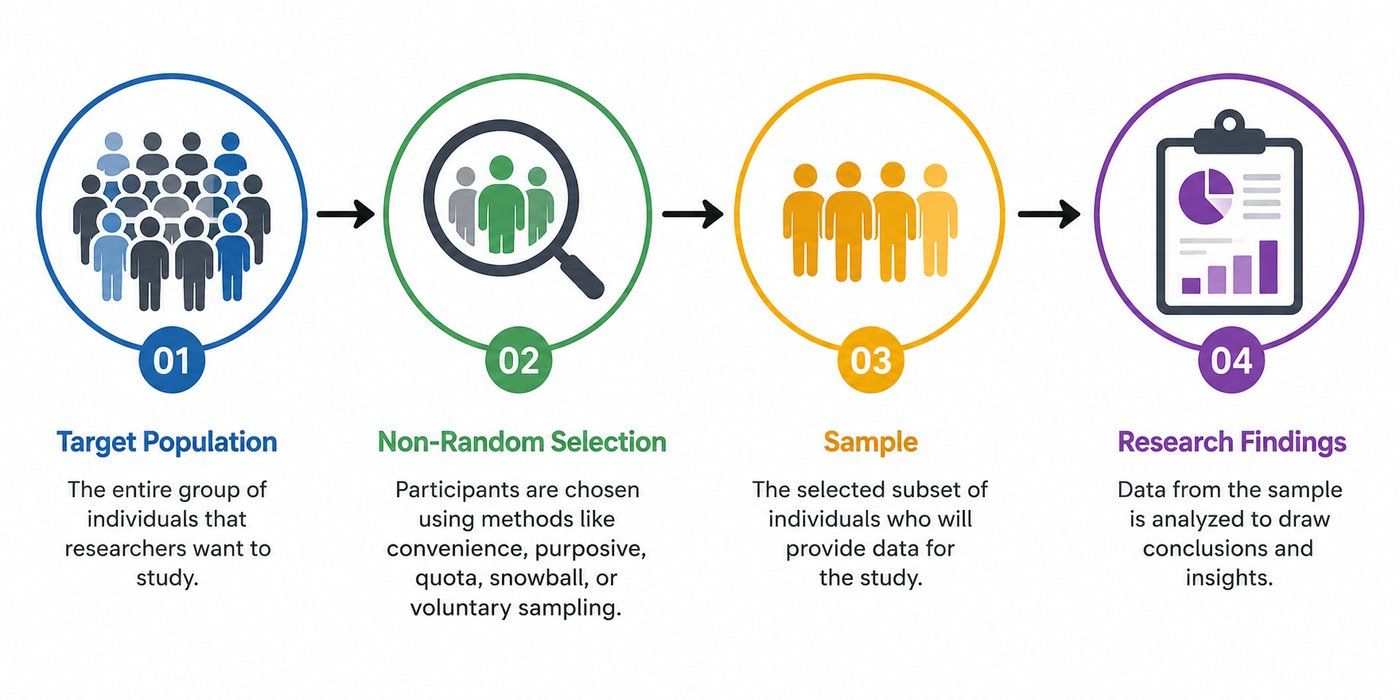
Researchers may choose non-probability sampling when random selection is difficult, costly, or not necessary for the study.
Common situations include:
Must read: What is Probability Sampling? Definition, Methods
The main non probability sampling types differ in how participants are identified and selected. The choice depends on the research objective, participant accessibility, and study design.
Convenience sampling involves selecting participants who are readily available to the researcher. It is often chosen when data needs to be collected quickly and recruitment resources are limited.
Purposive sampling involves deliberately selecting people who have a particular characteristic, skill, or experience relevant to the study. The researcher sets specific criteria before recruitment begins.
For instance, a study on leadership practices could focus on managers with several years of experience. This makes the method useful when detailed information is needed from a specific group.
Quota sampling divides participants into relevant groups and sets a target number for each group. Recruitment continues until those targets are reached.
A customer survey, for example, might require responses from different age groups. Although the quotas create a planned sample structure, participants within each group are not necessarily chosen randomly.
Snowball sampling begins with a small number of eligible participants. They then help the researcher connect with other people who meet the study requirements.
This approach can help when the target population is specialized or difficult to locate. One concern is that referrals may come from similar social or professional networks, which can limit the range of perspectives in the sample.
Voluntary sampling gives eligible people the choice to participate after receiving an invitation. It is common in online surveys, public feedback forms, and open research invitations.
The method is easy to organize and can attract many responses. However, people who feel strongly about the subject may be more motivated to take part, which can influence the results.
Also read: Data Science Case Studies That Actually Solved Problems!
DBA Courses to upskill
Explore DBA Courses for Career Progression
IIIT-B & IIM, Udaipur
Chief Technology Officer & AI Leadership ProgrammeThe non probability sampling examples can vary across research fields. The same method may be useful for one study but unsuitable for another. Researchers should therefore connect the sampling technique with the purpose of the study.
Build the expertise to lead in the AI-driven business landscape with a DBA in Emerging Technologies in Gen AI and Agentic AI from GGU.
The right sampling method depends on who you need to study and how you can reach them. Start with the research requirement, then select the method that fits the situation.
The research question should guide the decision. The easiest method to use is not always the most suitable one.
Also read: Decision Tree in AI: Working, Types and Algorithms
Probability and non-probability sampling are the two broad approaches used to select research participants. The major distinction is the process through which participants are selected.
| Factor | Probability Sampling | Non-Probability Sampling |
| Selection process | Random or probability-based | Non-random |
| Selection probability | Known or determinable | Generally unknown |
| Sampling frame | Usually required | May not be required |
| Cost and time | Often higher | Usually lower |
| Selection bias | Generally lower when properly designed | Higher risk |
| Generalizability | Stronger basis for population inference | More limited |
| Common uses | Population estimates and quantitative research | Exploratory, qualitative, pilot, and hard-to-reach research |
| Examples | Simple random, stratified, systematic, cluster | Convenience, purposive, quota, snowball, voluntary |
The main non probability sampling advantages are related to accessibility, flexibility, and cost.
Also read: Top 20 Challenges in Data Science You Must Know in 2026
Non-probability sampling can make participant recruitment easier, but researchers need to understand its limitations before choosing it. The main issue is that selection is not based on a probability mechanism, which can affect how confidently the findings can be applied beyond the sample.
Findings from a non-probability sample may not represent the entire target population. For example, surveying students from one college does not necessarily provide enough evidence to describe the views of all college students.
Some people may be more likely to enter the sample than others. A convenience sample, for instance, may overrepresent people who are easier to reach.
Researchers generally cannot determine the exact probability that each population member had of being selected. This limits some forms of statistical inference.
Methods such as purposive sampling require researchers to decide who is relevant to the study. Poorly defined criteria can lead to inconsistent participant selection.
Because the selection probabilities are not known, conventional estimates of sampling error and margin of error may not be appropriate in the same way they are for probability samples.
There is no universal sample size for non-probability research. The appropriate number depends on the study's objective, design, sampling method, and the type of information being collected.
| Research situation | Sample-size consideration |
| Qualitative interviews | Continue until sufficient depth or saturation is reached |
| Purposive sampling | Include enough relevant participants to capture important perspectives |
| Quota sampling | Set targets for the selected population groups |
| Snowball sampling | Continue recruitment until sufficient access or information is obtained |
| Quantitative survey | Consider the planned analysis, study objective, and expected variability |
A larger sample does not automatically solve the limitations of non-probability sampling. Increasing the number of participants can provide more observations, but it does not remove systematic selection differences.
Also read: Regression Vs Classification in Machine Learning: Difference Between Regression and Classification
Bias occurs when the selection or recruitment process systematically favors certain participants over others. It can affect the findings even when the data collection itself is carefully conducted.
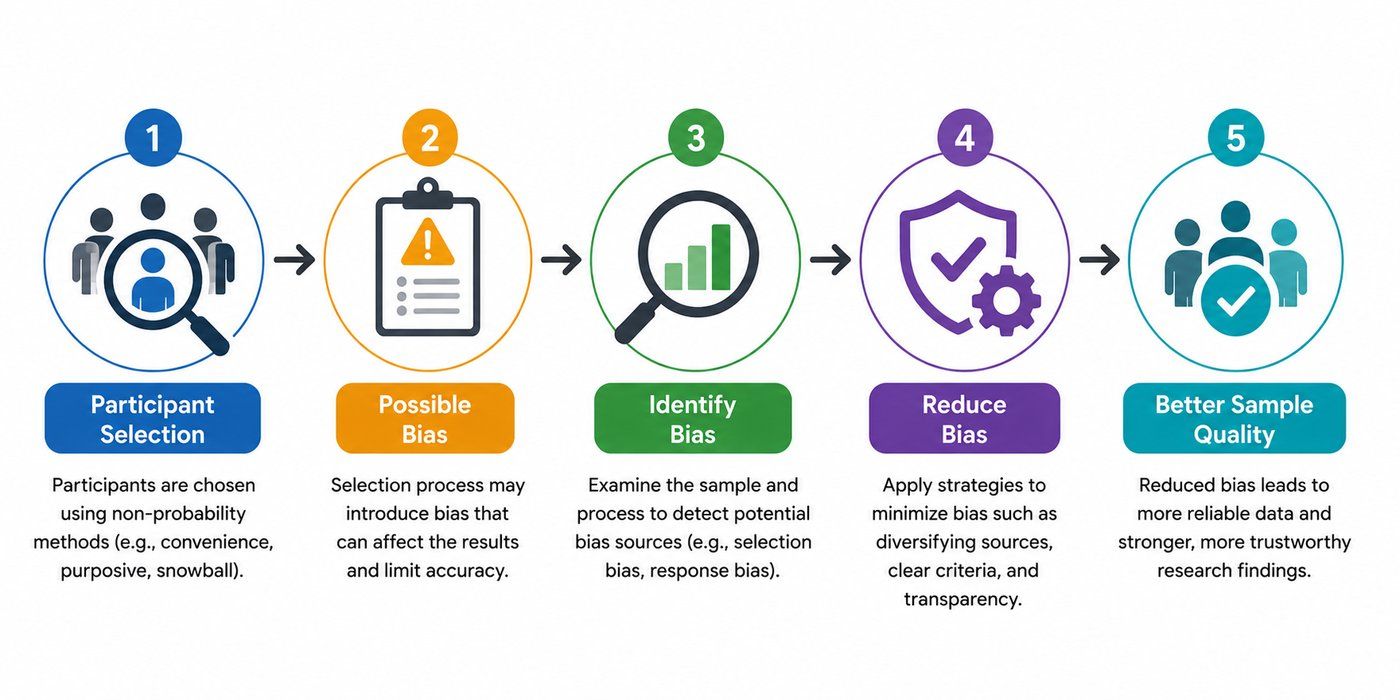
Common sources include:
Researchers can reduce these risks by using clear eligibility criteria, recruiting through multiple channels, and monitoring who is entering the sample. For quota sampling, researchers can set targets for important groups. For snowball sampling, using multiple starting participants from different networks can improve coverage.
Most importantly, researchers should acknowledge remaining sources of bias when interpreting their findings. The goal is not to claim that bias has been completely eliminated, but to show that it has been considered and managed as far as the research design allows.
Also read: Role of Big Data in Autonomous Vehicles and Future Trends
Non-probability sampling helps researchers recruit participants when random selection is difficult or does not fit the study. Methods such as convenience, purposive, quota, snowball, and voluntary sampling can serve different research needs.
The right method depends on the research question, target population, accessibility, and study design. Researchers should also consider possible bias and the limits of applying findings beyond the sample.
Ready to advance your AI leadership career? Book a consultation call with upGrad and explore the DBA in Emerging Technologies.
Sampling allows researchers to study a manageable group instead of collecting data from every member of a population. It saves time and resources while providing information that can help answer the research question.
It is often less expensive because researchers may not need a complete population list, complex random-selection procedures, or extensive recruitment infrastructure. However, the actual cost depends on the population, data collection method, and resources required to find eligible participants.
No. Convenience sampling can be reasonable when accessibility is important, particularly for exploratory work, preliminary investigations, or pilot studies. Its suitability depends on the research objective and how the resulting limitations are addressed.
Yes. Surveys can use convenience, quota, purposive, voluntary, or other non-probability approaches. The sampling method should match the population being studied and the conclusions the researcher intends to draw from the responses.
Not necessarily. Increasing the number of participants does not automatically correct systematic differences between the sample and target population. Sample quality depends on how participants were recruited as well as how many people participated.
Yes. A mixed-methods study can use different sampling strategies for its qualitative and quantitative components. For example, a researcher may recruit a broad survey group and later select participants with relevant experiences for interviews.
Data saturation refers to a point in qualitative research when collecting additional data produces little meaningful new information or themes. Researchers may use this concept when deciding whether further participant recruitment is necessary.
No. It can improve access, but its effectiveness depends on whether participants can identify and refer other eligible people. The resulting sample may also be influenced by the networks of the initial participants.
Yes. A researcher may establish quotas for particular groups and then deliberately recruit participants who meet the required characteristics within those groups. The combined approach should be clearly described in the research methodology.
No. Non-probability methods can be used in both qualitative and quantitative research. The sampling approach describes how participants are selected, while qualitative and quantitative refer to broader approaches to collecting and analyzing data.
It may be unsuitable when the primary goal is to produce population-level estimates that require a strong probability-based foundation. In such cases, a properly designed probability sampling method may provide more appropriate evidence.
987 articles published
We are an online education platform providing industry-relevant programs for professionals, designed and delivered in collaboration with world-class faculty and businesses. Merging the latest technolo...
Speak with DBA expert
By submitting, I accept the T&C and
Privacy Policy