Exploratory Research: Definition, Methods, Types, Process and Examples
By Sriram
Updated on Aug 17, 2026 | 10 min read | 4.4K+ views
Share:

All courses
Certifications
More
By Sriram
Updated on Aug 17, 2026 | 10 min read | 4.4K+ views
Share:
Table of Contents
Key Highlights
Ready to strengthen your business and leadership skills? Explore upGrad’s DBA online programs and build advanced expertise while continuing your professional journey.
Popular upGrad Programs
What is exploratory research? It’s a research approach used to investigate problems that aren’t clearly understood. Instead of testing a fixed answer, researchers explore ideas, patterns, experiences, and questions to understand what needs further study.
The simplest exploratory research meaning is learning more about an unfamiliar or poorly defined topic. For example, a company noticing declining customer engagement might use interviews, observations, and feedback to discover possible reasons before conducting a larger study.
The main purpose is to make an unclear research problem easier to understand. Researchers aren't looking for a final statistical answer at the beginning. They’re trying to discover useful information that can shape the next stage of the study.
A strong study can help researchers:
The exploratory research meaning also connects to decision-making. If researchers don't yet know which factors matter, jumping directly into a large survey can waste time and resources.
Free Courses
Exploratory research is flexible by nature. Researchers may adjust their questions, participants, or data collection approach when new information changes their understanding of the problem.
It's usually open-ended. It doesn't force participants to select from a narrow set of predetermined answers.
Key characteristics include:
The exploratory research meaning is closely tied to this flexibility because the researcher doesn't always know what the most useful finding will be before collecting data.
That's also why exploratory research shouldn't be treated as proof of a cause. A researcher might discover a strong pattern, but that pattern still needs appropriate testing before it can support a broad conclusion.
Must read: How to Become a Research Scientist
Exploratory research is useful when a problem isn’t clear yet. It helps researchers understand what’s happening before they decide what to measure or test.
It’s commonly used when:
For example, if a company sees fewer repeat purchases, sales data may show when customers leave but not why. Interviews with customers can reveal the issues behind the change.
Exploratory research works best when there’s something to discover. If the research question is already clear and the goal is to test a specific hypothesis, another approach may be more suitable.
Ready to build future-focused software skills? Explore upGrad’s Executive Post Graduate Certificate in AI-Native Software Engineering and develop practical expertise to stay ahead in AI-driven technology roles.
Recommended Courses to upskill
Explore Our Popular Courses for Career Progression
IIIT Bangalore
Executive Diploma in Machine Learning and AI360° Career Support
O.P.Jindal Global University
MBA from O.P.Jindal Global UniversityLive Case Studies and Projects
Exploratory research methods give researchers different ways to investigate an unclear problem. The right choice depends on what they need to understand, who has the relevant information, and how much existing evidence is available.
Common methods include:
Method |
What it helps explore |
Typical source |
| Literature review | Existing knowledge and gaps | Academic sources |
| Interviews | Personal experiences and motivations | Individuals |
| Focus groups | Shared and contrasting opinions | Small groups |
| Case studies | Complex situations in context | Organisations or cases |
| Observation | Actual behaviour | People or settings |
| Pilot studies | Feasibility and research procedures | Small study groups |
| Content analysis | Themes in existing material | Documents or media |
Interviews work well when personal experiences matter. Focus groups are useful when interaction between participants can reveal different opinions.
Observation is different. People don't always behave exactly as they say they do, so watching behaviour can uncover details that interviews might miss.
Also Read: Research Scientist Salary in India
Exploratory research design refers to the overall plan used to investigate an unclear problem. It needs enough direction to keep the study focused while leaving room for unexpected findings.
A good exploratory research design usually defines the research problem, questions, participants or sources, data collection methods, and approach to analysis. It can still change when early findings reveal something important.
When developing an exploratory research design, researchers should ask:
The exploratory research design should match the purpose of the study rather than follow a fixed template.
For instance, an exploratory study about workplace experiences might use interviews, while a study of shopping behaviour could combine observation with interviews.
The exploratory research design also needs ethical planning. Participants should understand what the study involves, and researchers should handle personal information responsibly.
Must read: Doctor of Business Administration Course Fees 2026: India & Global Costs, Scholarships, EMI Options
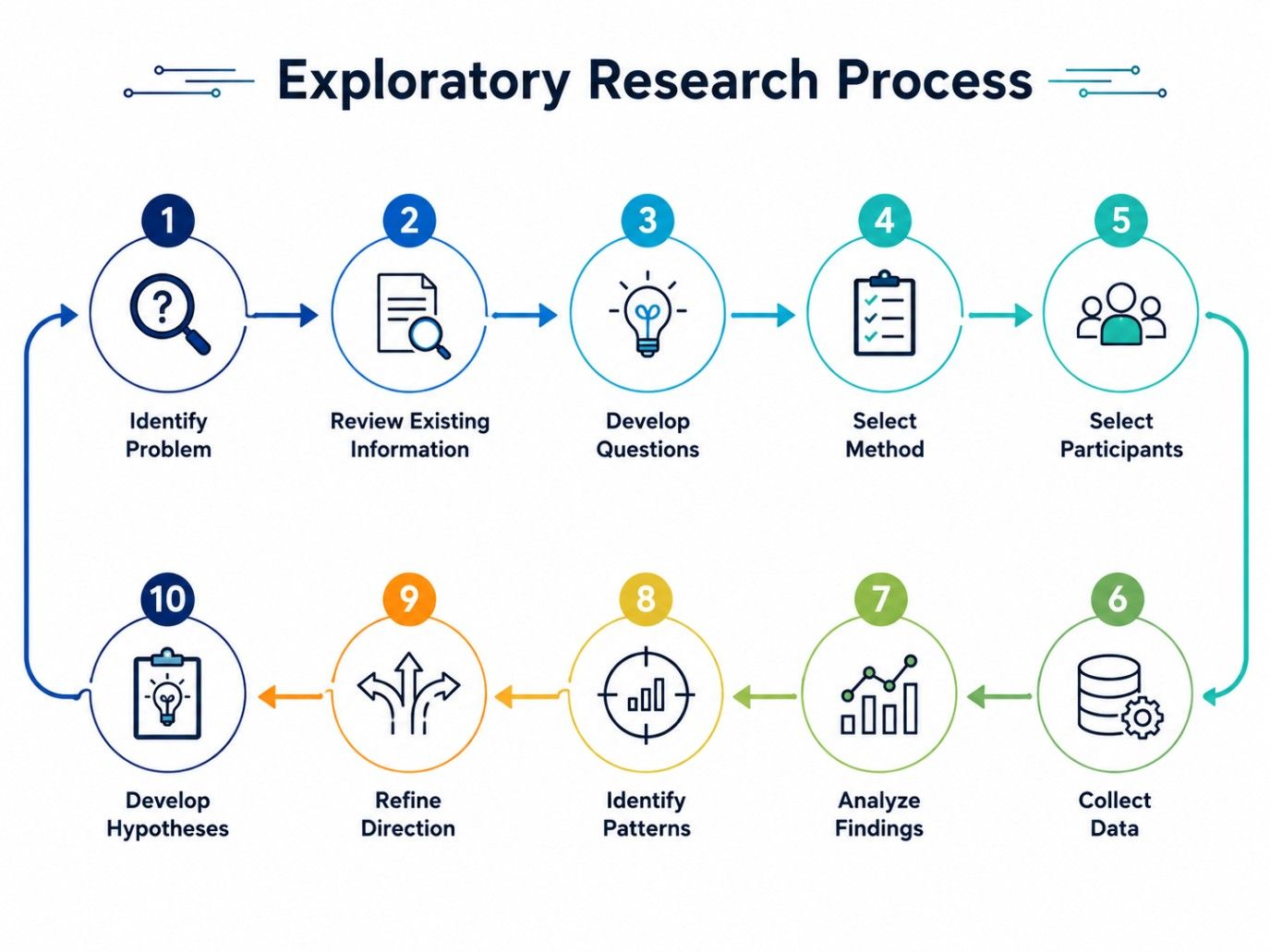
The exploratory research process usually begins with uncertainty. Researchers first identify what they don't understand and then gather information that can help clarify the problem.
A practical process looks like this:
There isn't one universal classification of exploratory research types. Different textbooks group them differently based on the method or purpose. The most useful approaches are those that help explain how researchers explore an unclear problem.
Researchers examine existing studies, reports, books, articles, and other sources to understand what is already known.
It’s often the first step because existing evidence can reveal research gaps and prevent researchers from repeating work that has already been done.
Researchers speak directly with individuals who have relevant experiences or expertise.
Open-ended questions allow participants to raise issues the researcher may not have considered.
A small group discusses a topic under the guidance of a moderator.
The interaction matters. One person's response can trigger another participant to share a different experience or opinion.
Researchers examine a specific case in depth. The case could involve an organisation, event, community, product, or situation.
This approach is useful when context matters as much as the issue itself.
Researchers observe behaviour in a natural or controlled setting.
It’s particularly useful when actual behaviour may differ from what participants report.
Also Read: What is a Doctorate Degree? Everything You Need to Know
Data collection should match the research question. There's no single method that works for every exploratory study.
Primary data can come directly from participants through interviews, focus groups, open-ended questionnaires, observations, or pilot studies. Secondary data can come from published research, reports, databases, articles, archives, and other existing sources.
The method matters.
Data source |
Useful when you want to understand |
| Interviews | Individual experiences |
| Focus groups | Group perceptions |
| Observation | Actual behaviour |
| Open-ended surveys | Views from a wider group |
| Literature | Existing knowledge |
| Case studies | Complex situations |
| Content | Themes in existing material |
A researcher might combine methods when one source isn't enough. For example, interviews could explain why customers behave a certain way, while observation could show whether that behaviour actually occurs.
Also Read: Most Asked PhD Interview Questions and Answers in India
Exploratory research examples show how researchers investigate unclear problems before conducting detailed or confirmatory studies. These examples demonstrate how interviews, observation, and focus groups can uncover useful insights and guide the next stage of research.
An online retailer notices that many customers leave before completing a purchase, but the reason isn't clear. Researchers conduct customer interviews and observe the checkout process.
They may discover issues such as unexpected delivery charges, confusing payment steps, or missing product information. These findings help the company decide what to investigate further.
A university launches a new learning platform, but student usage remains low. Researchers interview students and observe how they navigate the platform.
The research might reveal confusing menus, difficulty finding assignments, or limited awareness of key features. These insights can help the university refine the platform and develop questions for a larger study.
A company has an idea for a new product but doesn't yet know what customers actually need. Researchers conduct interviews and small focus groups with potential users.
Participants may reveal unexpected needs, frustrations, or preferences. The company can use these findings to refine the product concept before investing in development or conducting larger market research.
Also read: Types of Research Design: Key elements, Characteristics and More!
Exploratory and descriptive research answer different questions. Exploratory research investigates an unclear problem, while descriptive research focuses on describing characteristics, behaviours, or conditions that are already reasonably defined.
Factor |
Exploratory research |
Descriptive research |
| Main goal | Discover and understand | Describe |
| Problem | Often unclear | Clearly defined |
| Questions | Open-ended | Specific |
| Design | Flexible | Structured |
| Common methods | Interviews, focus groups, observation | Surveys, structured observation |
| Main output | Insights and possible hypotheses | Measured characteristics |
Must read: Best AI Tools for Research in 2026
Exploratory research is useful, but its findings shouldn't be treated as final proof. The flexible nature of the approach can produce rich insights, yet those insights may not apply to a wider population.
Common limitations include:
The biggest limitation is often overinterpretation.
A researcher might interview ten people and discover a recurring concern. That's useful evidence for further investigation, but it doesn't automatically mean the same concern affects every customer.
You’ll get more value when exploratory findings are treated as a direction for the next stage rather than as the final answer.
Also read: Qualitative vs. Quantitative Research : Differences and Methods
Start with the information you need. Don't pick a method simply because it's familiar or easy to organise.
Use interviews when individual experiences matter. Choose focus groups when interaction between participants can reveal useful differences. Consider observation when actual behaviour is more useful than reported behaviour.
Literature reviews work well when the topic already has substantial published information. Case studies suit questions where context is central, while pilot studies help researchers test whether a planned study or instrument works as expected.
Ask yourself three questions:
A good method choice keeps the research focused without limiting discovery.
Exploratory research helps researchers understand unclear or unfamiliar problems before moving to detailed studies. By using methods such as interviews, focus groups, observation, and literature reviews, researchers can uncover patterns, refine research questions, and identify possible hypotheses. Its flexible approach makes it useful when the direction of a study isn't fully clear.
A good study starts with a focused problem and suitable research methods. The findings shouldn't be treated as final proof. Instead, they should guide further research, helping researchers decide what to measure, test, or investigate next.
Ready to start your journey? Book a free consultation with upGrad today to find the best path for your career
The main goal is to understand an unclear problem and identify useful directions for further study. Researchers use it to discover patterns, perspectives, possible variables, and research questions before conducting research that requires more defined hypotheses or measurements.
Exploratory research is frequently qualitative because interviews, focus groups, observation, and open-ended responses provide detailed insights. However, researchers can also use quantitative information, particularly descriptive data, when it helps identify patterns or guide questions for later research.
There isn't one fixed sample size for every exploratory study. Researchers usually select enough participants or sources to gather meaningful perspectives and identify recurring themes, while considering the research purpose, population, method, and point at which additional data stops adding useful information.
Yes. Generating possible hypotheses is one of its important uses. Researchers can discover patterns or relationships during interviews, observations, literature reviews, or other exploratory activities and then develop hypotheses that can be examined through later research.
Yes, particularly when surveys include open-ended questions or are used to gather early information about a poorly understood issue. Surveys become more structured when the researcher already knows which variables need measurement and wants to describe or test specific relationships.
Researchers may use purposive, convenience, snowball, or other non-probability sampling approaches depending on the study. The choice depends on who can provide relevant information and what the researcher needs to discover rather than simply achieving statistical representation.
Exploratory research investigates possibilities and helps researchers understand an unclear problem. Causal research focuses on whether one factor produces a change in another. Exploratory findings can help identify relationships worth testing later, but they don't establish cause and effect by themselves.
Researchers can consider stopping when additional data produces few new insights, themes are becoming repetitive, and the research questions are clear enough to guide the next stage. The decision also depends on the study's objectives, available resources, and the complexity of the topic.
A student could investigate why classmates struggle with online learning by conducting several open-ended interviews. The student might discover issues involving distractions, unclear instructions, internet access, or course design and then use those findings to develop a more focused research question.
Yes. Companies can use it to understand customer needs before developing or testing a product. Interviews, focus groups, observation, and concept discussions can reveal unmet needs and usability concerns that might not appear in existing sales or market data.
Researchers can use the findings to refine the research problem, develop hypotheses, design a descriptive study, plan an experiment, create a survey, or conduct deeper qualitative research. The next step depends on what the exploratory findings reveal and what the original research objective requires.
730 articles published
Sriram K is a Senior SEO Executive with a B.Tech in Information Technology from Dr. M.G.R. Educational and Research Institute, Chennai. With over a decade of experience in digital marketing, he specia...
Get Free Consultation
By submitting, I accept the T&C and
Privacy Policy
Top Resources
Certification
3 Months
Certification
6 Months
O.P. Jindal Global University
Masters in International Accounting and Finance (Accredited by ACCA, UK)Master's Degree
12 Months