Mixed Methods Research: Meaning, Types & Examples
By upGrad
Updated on Sep 15, 2026 | 8 min read | 3.26K+ views
Share:

All courses
Certifications
More
By upGrad
Updated on Sep 15, 2026 | 8 min read | 3.26K+ views
Share:
Table of Contents
Key Highlights:
Ready to take your research skills to the next level? Explore upGrad's Doctorate of Business Administration programs and build the expertise to lead high-impact, real-world research.
Mixed methods research is an approach that combines both quantitative methods (numbers, statistics) and qualitative methods (experiences, observations) to answer the questions of a research study.
If you use both methods, it will fill the gap in research that will not be covered if you use only one method.
So, a researcher can do a survey of thousands of people to find a pattern (quantitative) and then interview a smaller group to understand the reasoning or experience behind that pattern (qualitative). By using both the methods will give you a full picture of the study.
When you know using one method will not be sufficient to answer your study question. Here are other several reasons to use mixed methods research:
Must read: Qualitative vs. Quantitative Research : Differences and Methods
DBA Courses to upskill
Explore DBA Courses for Career Progression
IIIT-B & IIM, Udaipur
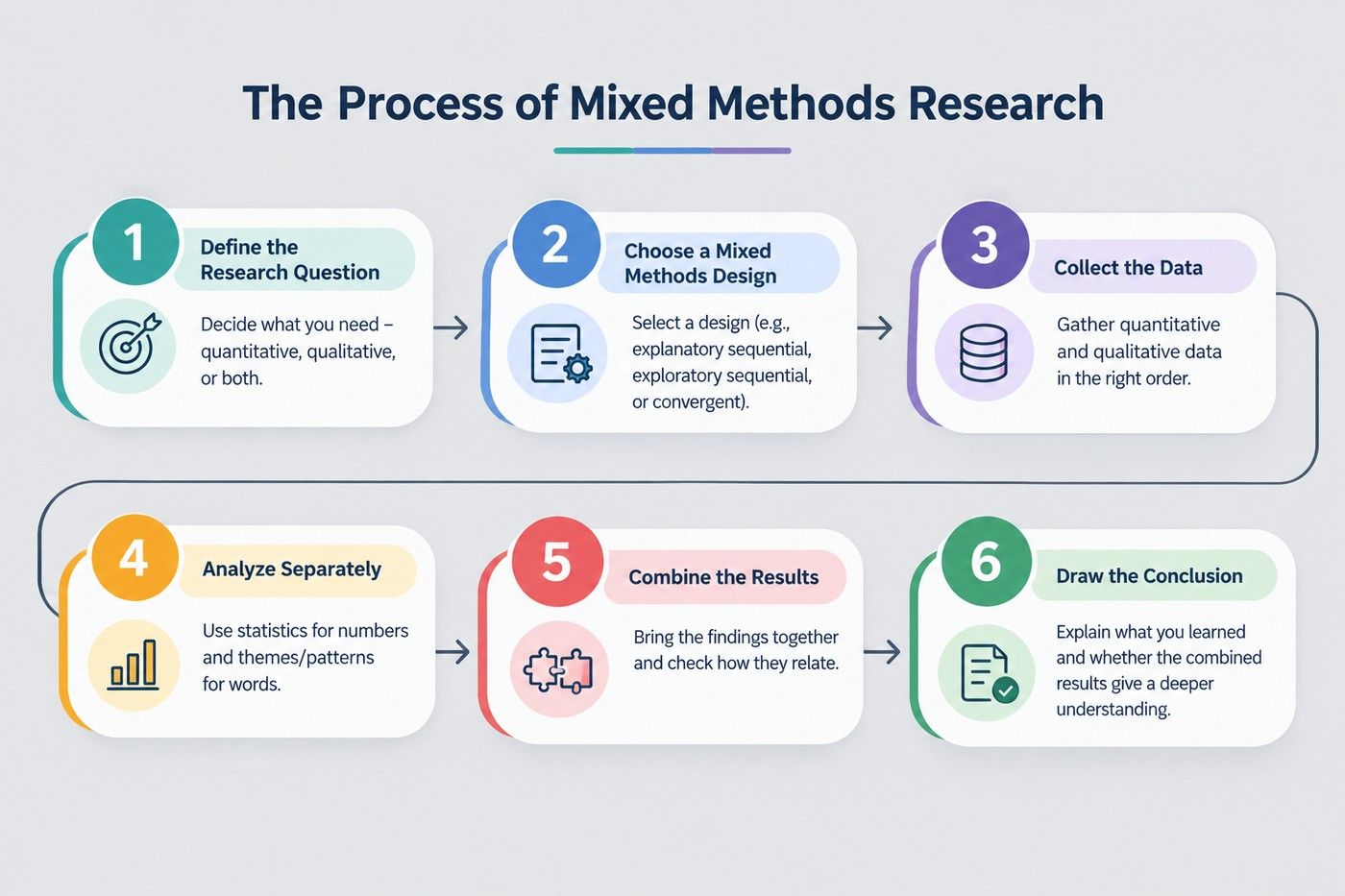
Chief Technology Officer & AI Leadership ProgrammeHere is how the researchers follow the mixed methods research, step by step:
Step 1: Decide your research question. Can it be answered in numbers or required story or both.
Step 2: Choose the mixed method design, explanatory sequential, exploratory sequential, or Convergent (parallel).
Step 3: Collect the data, quantitative and qualitative. Follow whichever order your design requires.
Step 4: Analyze each type separately. The numbers are analyzed with statistics and words are analyzed by finding themes and patterns.
Step 5: Combine the results. Bring both the findings together and check how they relate.
Step 6: Write the conclusion. Explain what you learned from combining both the methods. Did you get a fuller, richer answer than either method alone?
Also read: Understanding and Conducting a Market Research like Experts
These are the main research design qualitative quantitative and mixed methods approaches:
You first collect and analyze the quantitative data, and then use qualitative data to explain the reason behind quantitative data.
For example, it is found that 40% of the students feel anxious in maths class. But it is not clear why the students are feeling anxious. So, researchers interview a group of those students and find out the reason. Like they feel anxious because they are afraid of being called on in front of the class. With this design, now the context behind numbers is clear.
Some weaknesses of the explanatory sequential design:
The qualitative data is collected first in this design to understand the topic. Then findings are then used to build and test a quantitative tool (like a survey) on a larger group.
Like, a company wants to understand why employees are feeling burnout. But there is no survey that gives proper data to this problem in their industry. So, researchers interview 15 employees and identify common causes of burnout.
By using these themes, they build a new burnout survey and send it to all employees to check how widespread these issues are.
Some weaknesses of exploratory sequential design are:
You collect both types of data at the same time, analyze them separately, and then compare or combine the results.
For example, a hospital wants to evaluate a new patient care program. They send out a satisfaction survey (numbers) and also interview a group of patients (words) during the same month. The survey shows 85% satisfaction. After interviewing the group, the interviewers share that most of the patients like medical care but some patients get frustrated by long wait times.
Using both the methods together shows the overall positive trend and a specific issue to fix.
Weaknesses of convergent parallel design:
One method (usually quantitative) is the main focus of the study, and the other method (usually qualitative) is added in to provide extra context or insight, but isn't the main point.
Researchers are testing whether a new medication lowers blood pressure (a clinical trial, quantitative, the main focus). During the trial, the brief interviews of participants are conducted to know about their experience of taking the medication. Taking interviews is not the main reason but it decreases the compliance issues.
Weaknesses of the embedded mixed methods design:
Turn AI strategy into business impact. Explore upGrad's Chief Technology and AI Officer Program and gain the skills to lead digital transformation at scale.
The mixed methods research offers several advantages over using a single method alone:
Also read: Exploratory Research: Definition, Methods, Types, Process and Examples
Mixed methods research also comes with its own set of challenges:
Also read: How to Become a Research Scientist
The mixed methods research uses the advantages of both the methods. Measurable, generalizable power of quantitative data and the rich, detailed insight of qualitative data. Instead of choosing the benefits of one method, the researchers can use both. This helps in finding complete, more reliable answers.
There are different designs available for finding, choose the one which suits your research question and timeline better. However, the mixed methods research takes more time, resources, and skill but gives you finding that you can trust more.
Whether you work in education, healthcare, business, or public health, mixed methods research helps you understand not just what is happening, but also why it is happening. This gives you data backed and meaningful insights.
Want to strengthen your research skills further? Book a free consultation with upGrad's career counselors and explore courses that can help you master research methods, data analysis, and more.
No. Mixed methods research is most useful when combining numerical evidence with detailed perspectives can answer the research problem more effectively. If one type of data is sufficient, using a single research approach may be more appropriate.
Mixed methods research combines quantitative and qualitative approaches and integrates their findings. Multimethod research may use multiple methods within the same research tradition without necessarily combining quantitative and qualitative approaches.
Participant selection depends on the research design and purpose. Researchers may use probability sampling for quantitative data and purposive or other non-probability sampling for qualitative data, allowing each method to meet its specific needs.
Yes. Researchers can use separate participant groups for quantitative and qualitative phases when appropriate. They may also select qualitative participants from the quantitative sample, particularly when the second phase needs to explore earlier findings.
Quality is assessed by considering the rigor of both quantitative and qualitative components, as well as the quality of their integration. Researchers should ensure that each method is appropriate, well conducted, and meaningfully connected.
Triangulation involves examining a research question using multiple sources, methods, or perspectives. In mixed methods studies, comparing quantitative and qualitative evidence can help researchers identify consistent findings or understand differences between them.
There is no single sample size that applies to every mixed methods study. The quantitative sample is generally determined using statistical requirements, while the qualitative sample depends on factors such as the research purpose and information needed.
Quantitative components usually require larger sample sizes for statistical validity, while qualitative components often use smaller, purposefully selected samples for in-depth understanding.
Common tools include statistical software like SPSS or R for quantitative analysis, and qualitative analysis software like NVivo or ATLAS.ti for coding themes from interviews and text.
The researcher must carefully plan how quantitative and qualitative approaches will work together. This includes selecting suitable methods, maintaining consistency during the study, and making sure the final interpretation reflects evidence from both approaches.
It can support better decisions by providing both measurable evidence and detailed perspectives. Decision-makers can use numerical trends to understand the scale of an issue while using qualitative insights to understand the context behind those findings.
971 articles published
We are an online education platform providing industry-relevant programs for professionals, designed and delivered in collaboration with world-class faculty and businesses. Merging the latest technolo...
Speak with DBA expert
By submitting, I accept the T&C and
Privacy Policy