
All courses
Agentic AI
Agentic AI

IIIT Bangalore
Executive Programme in Generative AI for LeadersArtificial Intelligence
Degree / Exec. PG

IIIT Bangalore
Executive Diploma in Machine Learning and AI
OPJ Global University
Master’s Degree in Artificial Intelligence and Data Science
Liverpool John Moores University
Master of Science in Machine Learning & AI
Golden Gate University
DBA in Emerging Technologies with Concentration in Generative AIExecutive Certificate

IIITB & IIM, Udaipur
Chief Technology Officer & AI Leadership Programme
IIIT-B & IIM, Udaipur
Chief Data and AI Officer ProgrammeOffline Bootcamps

upGrad
Data Science and AI-MLDoctorate
For All Domains
IIITB & IIM, Udaipur
Chief Technology Officer & AI Leadership Programme
Swiss School of Business and Management
Global Doctor of Business Administration from SSBM
Edgewood University
Doctorate in Business Administration by Edgewood UniversityGolden Gate University
Doctor of Business Administration From Golden Gate University
Rushford Business School
Doctor of Business Administration from Rushford Business School, SwitzerlandGolden Gate University
Doctor of Technology in Applied & Agentic AI-d9bdeff6165f4eb1ba2adcebde78e961.svg)
University of Waterloo
Chief Technology and AI Officer ProgramLeadership / AI
Golden Gate University
DBA in Emerging Technologies with a concentration in Generative and Agentic AIMachine Learning
Machine Learning
Data Science
Degree / Exec. PG
O.P Jindal Global University
Master’s Degree in Artificial Intelligence and Data ScienceIIIT Bangalore
Executive Diploma in Data Science & AILiverpool John Moores University
Master of Science in Data ScienceExecutive Certificate

upGrad | Microsoft
Gen AI Foundations Certificate Program from MicrosoftIIIT-B & IIM, Udaipur
Chief Data and AI Officer ProgrammeupGrad | Microsoft
Gen AI Mastery Certificate for Data AnalysisupGrad | Microsoft
Gen AI Mastery Certificate for Software DevelopmentupGrad | Microsoft
Gen AI Mastery Certificate for Managerial ExcellenceupGrad | Microsoft
Gen AI Mastery Certificate for Content CreationBootcamp
Offline Bootcamps
upGrad
Data Science and AI-MLMBA
Masters

Liverpool John Moores University
Master of Business Administration from Liverpool John Moores University (LJMU) with IIM Udaipur CertificationO.P.Jindal Global University
MBA (with Career Acceleration Program by upGrad)Edgewood University
MBA from Edgewood UniversityO.P.Jindal Global University
MBA from O.P.Jindal Global UniversityExecutive Certificate
Marketing
Executive Certificate
upGrad | Microsoft
Gen AI Foundations Certificate Program from MicrosoftupGrad | Microsoft
Gen AI Mastery Certificate for Content CreationOffline Bootcamps
upGrad
Digital MarketingManagement
Degree
O.P Jindal Global University
MSc in International Accounting & Finance (ACCA integrated)
Golden Gate University
Master of Arts in Industrial-Organizational PsychologyExecutive Certificate
IIIT-B & IIM, Udaipur
Chief Technology Officer & AI Leadership ProgrammeIIIT-B & IIM, Udaipur
Chief Data and AI Officer Programme
IIM Kozhikode
Human Resource Analytics Course from IIM-KupGrad | Microsoft
Gen AI Foundations Certificate Program from MicrosoftBootcamp
HDFC Life
Insurance Fundamentals ProgramEducation
Education

Northeastern University
Master of Education (M.Ed.) from Northeastern UniversityEdgewood University
Doctor of Education (Ed.D.)Edgewood University
Master of Education (M.Ed.) from Edgewood UniversityCertifications
Project Management
Certification

Knowledgehut
Leadership And Communications In ProjectsKnowledgehut
Microsoft Project 2007/2010-ae8d039bbd2a41318308f8d26b52ac8f.svg)
Knowledgehut
Financial Management For Project ManagersKnowledgehut
Fundamentals of Earned Value Management (EVM)Knowledgehut
Fundamentals of Portfolio ManagementKnowledgehut
Fundamentals of Program Management-35c169da468a4cc481c6a8505a74826d.webp&w=128&q=75)
Knowledgehut
CAPM® CertificationsKnowledgehut
Microsoft® Project 2016Certifications & Trainings
-7f4b4f34e09d42bfa73b58f4a230cffa.webp&w=128&q=75)
Knowledgehut
PMP® CertificationKnowledgehut
PMI-RMP® CertificationKnowledgehut
PMP Renewal Learning PathKnowledgehut
Oracle Primavera P6 V18.8Knowledgehut
Microsoft® Project 2013Knowledgehut
PfMP® Certification CourseKnowledgehut
Project Planning and MonitoringPrince2 Certifications

Knowledgehut
PRINCE2® FoundationKnowledgehut
PRINCE2® PractitionerKnowledgehut
PRINCE2 Agile Foundation and PractitionerKnowledgehut
PRINCE2 Agile® Foundation CertificationKnowledgehut
PRINCE2 Agile® Practitioner CertificationManagement Certifications
Knowledgehut
Project Management Masters Certification ProgramKnowledgehut
Change ManagementKnowledgehut
Project Management TechniquesKnowledgehut
Product Management Certification ProgramKnowledgehut
Project Risk Management- Study abroad
- Offline centres
- uGSOT - B.Tech
More

%20(2)-db0b6f38da9c485faf76e366793c9b9e.webp&w=128&q=75)



BESTSELLER
IIT Delhi - Certificate Programme in Cybersecurity & AI
Master cybersecurity and AI security, together. Built for professionals securing the modern enterprise. Most programmes teach one or the other. This one teaches both cybersecurity and AI security as one discipline.
-80787fa7a92e4032b0ef39de2444ac00.webp&w=3840&q=75)
About IIT Delhi
IIT Delhi: Legacy That Nurtures Excellence
India's Premier Technical Institution
Established in 1961 by an Act of Parliament, IIT Delhi is one of India's Institutes of National Importance. For over six decades, it has shaped engineers, researchers, and leaders who drive innovation across industry, academia, and policy worldwide.
National and Global Standing
Ranked #2 in India by NIRF 2025 (Ministry of Education) and ranked #118 as per QS World Rankings 2027.
Research That Drives Real-World Impact
Known for high-impact research and strong global citation performance, IIT Delhi plays a defining role in advancing artificial intelligence, cybersecurity, computing, and emerging technologies.
Cybersecurity Foundations To AI Security Mastery, Led by IIT Delhi CEP
Certification
IIT Delhi: A Credential That Carries Weight
Recognised Academic Credential
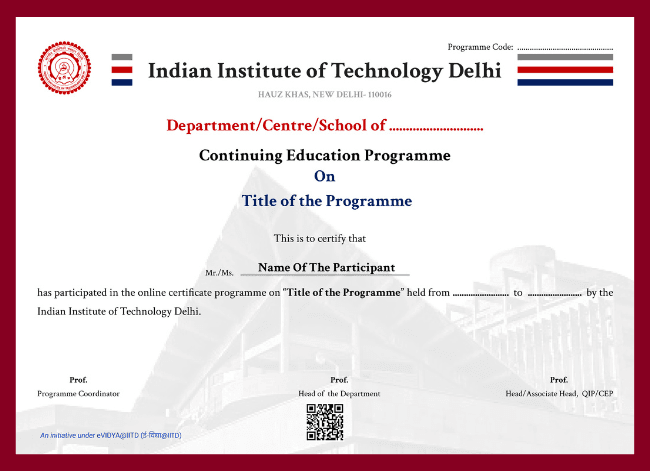
Earn an e-Certificate of Completion from IIT Delhi CEP - the statutory body for issuing certificates at IIT Delhi. Tamper-proof e-Certificate downloadable from the CEP IIT Delhi portal. Verifiable by employers via QR code.
Academic Credibility with Industry Relevance
An IIT-issued credential that signals rigorous training and readiness for advanced AI security roles - from BFSI to GCC to consulting.
The Curriculum for Security Engineers Who Own the AI Layer. Design Systems, Defend AI, Ship to Production.
5
Modules
1
Capstone
78
Live Hours
Threat-first, build-second - You learn to attack AI systems before you defend them, so defences are principled, not reactive
MLSecOps & DevSecOps Pipelines - ModelScan, Sigstore, AI-BOM, OPA policy-as-code, Falco runtime detection. Production depth, not theory.
5 Frontier Agentic Attack Surfaces - Multimodal jailbreaks, MCP prompt injection, memory poisoning, toolcalling exploitation, model hub supply chain. Unique in India
India Regulatory Compliance (As Artifacts) - DPDP 2025, SEBI CSCRF 2024, RBI 2024 - you produce auditorready evidence packs, not concept overviews.
AI Security & Governance Frameworks - NIST AI RMF, ISO 42001, EU AI Act, FAIR Monte Carlo risk quantification presented as a board-level executive narrative.
Evaluation as Engineering Practice - Before/after robustness delta. PyRIT, Garak, PromptBench quantified outcomes. You measure, not just demo.
-c7e2620485a84af79ccaa3206430830e.webp&w=750&q=75)
The Complete Curriculum
A Structured Path to AI Security Mastery
Foundations for AI and Cybersecurity
BRIDGE
2 weeks
Topics covered
Python for security automation: integrating NumPy, Pandas, and Jupyter with security data pipelines; API interactions for threat intelligence feeds
ML workflow integration: connecting model training to security evaluation; class imbalance strategies applied to phishing and malware datasets
Security tools setup: Wireshark, Nmap, Burp Suite basics, Kali Linux, Docker, Git workflow
Cloud integration: confirming console access across AWS/Azure/GCP; verifying IAM roles and permissions for subsequent module labs
MITRE ATT&CK introduction: SOC workflow understanding
Cybersecurity Foundations, Threat Modeling, and Threat Landscape
Module 1
3 weeks
Topics covered
Global and India threat landscape: APTs, ransomware, supply chain attacks, UPI fraud, digital arrest scams
MITRE ATT&CK framework deep-dive, cyber kill chain, threat intelligence fundamentals
Threat modeling (STRIDE): assets, trust boundaries, abuse cases, mitigation mapping
Identity attacks and defences: OAuth/OIDC flows, JWT misuse, session fixation, refresh token theft, SSO/SAML basics
Vulnerability management, CVSS 4.0, and security operations fundamentals
Skills acquired
AI/ML for Security and Detection Engineering
Module 2
5 weeks
Topics covered
Security data engineering: feature extraction from logs, handling extreme class imbalance
Machine learning for threat detection: malware classification, phishing detection, fraud detection
Security-grade evaluation: calibration, thresholding, cost-of-error analysis, failure modes
MLOps starter: experiment tracking, model registry basics, reproducibility discipline
Detection-as-code fundamentals: Sigma rule syntax, detection logic patterns mapped to ATT&CK
Detection testing: unit tests for rules, coverage analysis, and false positive analysis
SIEM architecture with Elastic Stack: focused log ingestion and correlation
Incident cockpit design: severity scoring, alert correlation, response recommendations
SOAR basics: playbook design principles and human-in-the-loop workflows
Optional self-paced: UEBA behavioural baselines; IR/forensics foundations
Adversarial ML, LLM Security, Agentic AI, and Frontier Attack Surfaces
Module 3
5 weeks
Topics covered
Agentic AI pipeline foundations: LangChain and LangGraph architecture, tool-calling patterns, MCP basics, agent memory, and decision chaining
Adversarial ML fundamentals: evasion, poisoning, and extraction attacks through MITRE ATLAS
OWASP LLM Top 10 (2025): Prompt Injection, Excessive Agency, Vector and Embedding Weaknesses
LLM security and secure RAG: prompt injection (direct and indirect), jailbreaking, data leakage, retrieval poisoning, and data exfiltration via retrieved documents
AI-specific incident response: model rollback, data poisoning forensics, and model integrity verification
LLM red teaming toolstack: PyRIT for automated red teaming, Garak for OWASP LLM Top 10 vulnerability scanning, and PromptBench for prompt robustness evaluation
Multimodal jailbreaks: Multi-Modal Linkage, perceptual transformation exploits, and Visual Scenario Hypnosis in vision-language models
Tool-calling exploitation: function call injection, tool chain exploitation, and parameter poisoning in agentic AI
MCP prompt injection: server-to-server trust override in Model Context Protocol environments
Memory poisoning: trigger-free single-shot poisoning via benign-looking content in long-context LLM agents
Model hub supply chain attacks: namespace hijacking, safetensors conversion exploitation, and detection tooling
MLSecOps, DevSecOps, and India Compliance
Module 4
4 weeks
Topics covered
Implement a DevSecOps + MLSecOps pipeline with policy-as-code enforcement (OPA), runtime detection (Falco), model signing (Sigstore), and AI-BOM generation (Apply)
Produce auditor-ready DPDP Rules 2025 compliance artifacts: breach notification workflow, Consent Manager integration, Data Fiduciary obligations checklist (Create)
Map an organisation's security controls to the SEBI CSCRF 2024 structured audit format, including RE classification tier assignment (Apply)
Document board-level IT risk accountability obligations under RBI Master Directions 2024 with a CERT-In notification playbook (Create)
AI Governance, Global Regulation, Risk Quantification, and Executive Communication
Module 5
4 weeks
Topics covered
AI governance frameworks: NIST AI RMF (Govern, Map, Measure, Manage) with artifact templates; ISO/IEC 42001 AI Management System controls and certification pathway; EU AI Act risk tier taxonomy mapped to NIST AI RMF categories
EU AI Act phased enforcement: Feb 2025 prohibitions active; Aug 2025 GPAI obligations; Aug 2026 high-risk AI (Annexes III/IV); India-facing implications for MNCs
Privacy engineering: privacy-by-design principles (ISO 29101) applied to AI systems; DPDP Rules 2025 mapping to privacy engineering controls
FAIR risk quantification: translating threat scenarios into financial loss distributions using Monte Carlo simulation; presenting output as a board narrative; risk appetite framing
AI ethics in security contexts: bias and fairness in threat detection models; dual-use dilemmas; explainability for forensics and regulatory auditability
Emerging threats and post-quantum readiness: AI-powered attacks, deepfake social engineering, synthetic media fraud detection in BFSI; NIST PQC standards (FIPS 203, 204, 205), hybrid systems, and migration planning
Build & Deploy an AI Security Solution
Capstone
3 weeks
Topics covered
The capstone is the programme's culminating deliverable. Each participant independently designs and builds a complete, production-grade AI security solution - ntegrating all modules - on a real problem they choose.
Projects are evaluated by a panel of IIT Delhi faculty on technical depth, real-world applicability, India regulatory alignment, responsible AI design, and quality of presentation.
Programme Coordinator
-1ec1d25bd5ef4782a1aa40830a1356e1.webp&w=3840&q=75)
-6a6dc81acf6d4530b7ebd95734c5bf23.webp&w=3840&q=75)
THE CAPSTONE
Your Solution. Fully built. Rigorously defended.
Every programme ends with a submission. This one ends with a live IIT Delhi faculty panel - where you defend a complete AI security solution built from scratch, module by module, over 6 months.
6
Deliverables defended
3
Weeks of build + defend
78
Live hours
AI security threat model and attack surface map - STRIDE-based threat model with MITRE ATLAS mapping, trust boundaries, and a prioritised remediation roadmap
LLM red team engagement report - PyRIT, Garak, and PromptBench results with quantified before/after robustness delta and remediation evidence
Secure MLSecOps pipeline - live deployed - Production-grade CI/CD with ModelScan, Sigstore signing, AI-BOM, OPA policy-as-code, and Falco runtime detection
India regulatory compliance evidence pack - Auditor-ready artifacts for DPDP 2025, SEBI CSCRF 2024, and/or RBI Master Directions 2024
FAIR risk quantification + board narrative - Monte Carlo risk model translated into financial loss distributions with a board-level executive presentation
IEEE-format technical report - 8–12 page publishable-quality report documenting your solution, methodology, evaluation results, and findings

WHAT YOU WILL BUILD AND SHIP
Systems You Will Build & Ship
Not demos. Not slides. Every module ends with a working system artifact you have built, tested, and can deploy.






What Will You Build?
See the practical work that has helped our learners land roles at top companies
Built for working professionals securing the modern enterprise
This programme is for professionals who already have technical depth in security or AI and need the other dimension - not for beginners.
_upGrad_19)%20SECTION%203_Mob-1e1f82fb6c9d49aaa6c2fe020df00931.webp&w=3840&q=75)
_upGrad_16)%20SECTION%203_Mob-68941b25763b43fc810dda1ba4f77f45.webp&w=3840&q=75)
_upGrad_18)%20SECTION%203_Mob-e1982b273c804211826c888b4adf6690.webp&w=3840&q=75)
_upGrad_2)%20SECTION%203_Desk%20(1)-bccd3091e85a44cb82a733f400d19969.webp&w=3840&q=75)
Career Outcome
Roles this programme unlocks
LLM red teaming, adversarial ML defences, secure AI pipeline engineering
Secure CI/CD for AI, ModelScan, Sigstore, AI-BOM, policy-ascode
ML-powered threat detection, Sigma rule authoring, SIEM engineering
NIST AI RMF, ISO 42001, DPDP 2025, SEBI CSCRF, EU AI Act compliance
Systematic LLM red team exercises, agentic attack surface evaluation
FAIR risk quantification, board-level communication, AI governance leadership
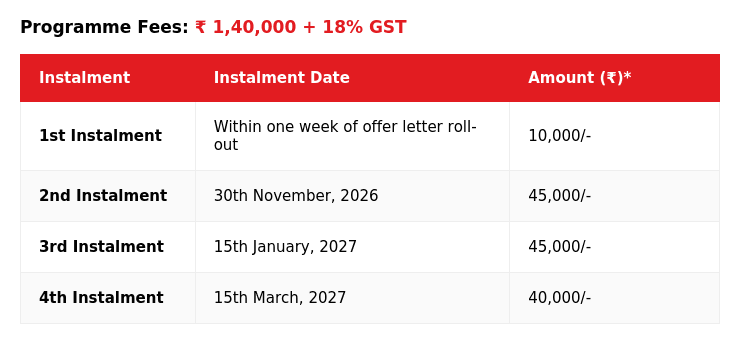
Programme Fees & Instalment Schedule
Total payable is approximately ₹1,40,000 + GST(18%) = ₹1,65,200.
All Fees receipts will be issued by IIT Delhi CEP and can be downloaded from the CEP Portal.
Cybersecurity & AI Security
How To Apply
Eligibility
Bachelor's or Master's degree in with minimum 50% marks and familiarity with any programming language.


upGrad Learner Support
Talk to our experts. We are available 7 days a week, 10 AM to 7 PM

Indian Nationals

Foreign Nationals
Disclaimer
The above statistics depend on various factors and individual results may vary. Past performance is no guarantee of future results.
The student assumes full responsibility for all expenses associated with visas, travel, & related costs. upGrad does not .