3 Types of Artificial Intelligence: ANI, AGI & ASI Guide
By upGrad
Updated on Sep 20, 2026 | 8 min read | 2.36K+ views
Share:

All courses
Certifications
More
By upGrad
Updated on Sep 20, 2026 | 8 min read | 2.36K+ views
Share:
Table of Contents
Key Highlights
Want to go beyond theory and actually build AI systems? Our AI Course in India covers the core concepts, tools, and real-world applications you need to build job-ready AI skills.
Popular AI Programs
There are three main types of artificial intelligence, and these are based on its capabilities and level of intelligence.
In today’s time, every AI system that you interact with is a part of the first category ANI. The other two categories are in theory or in the early research stage. By understanding all the three types of artificial intelligence, you will be able to understand the current technology and where it is heading.
This is a quick breakdown of 3 types of artificial intelligence with examples:
Type |
Also Known As |
Current Status |
Example |
| Artificial Narrow Intelligence (ANI) | Weak AI | Exists today | Siri, ChatGPT, Netflix recommendations |
| Artificial General Intelligence (AGI) | Strong AI | In development / theoretical | None yet, active research goal |
| Artificial Superintelligence (ASI) | Super AI | Hypothetical | None, future concept |
ANI is built to complete a single and specific task but with high efficiency. It operated under predefined constraints and cannot apply its knowledge to contexts outside its designated domain. All the AI applications in today's time is a form of Narrow AI from web searches to autonomous vehicles.
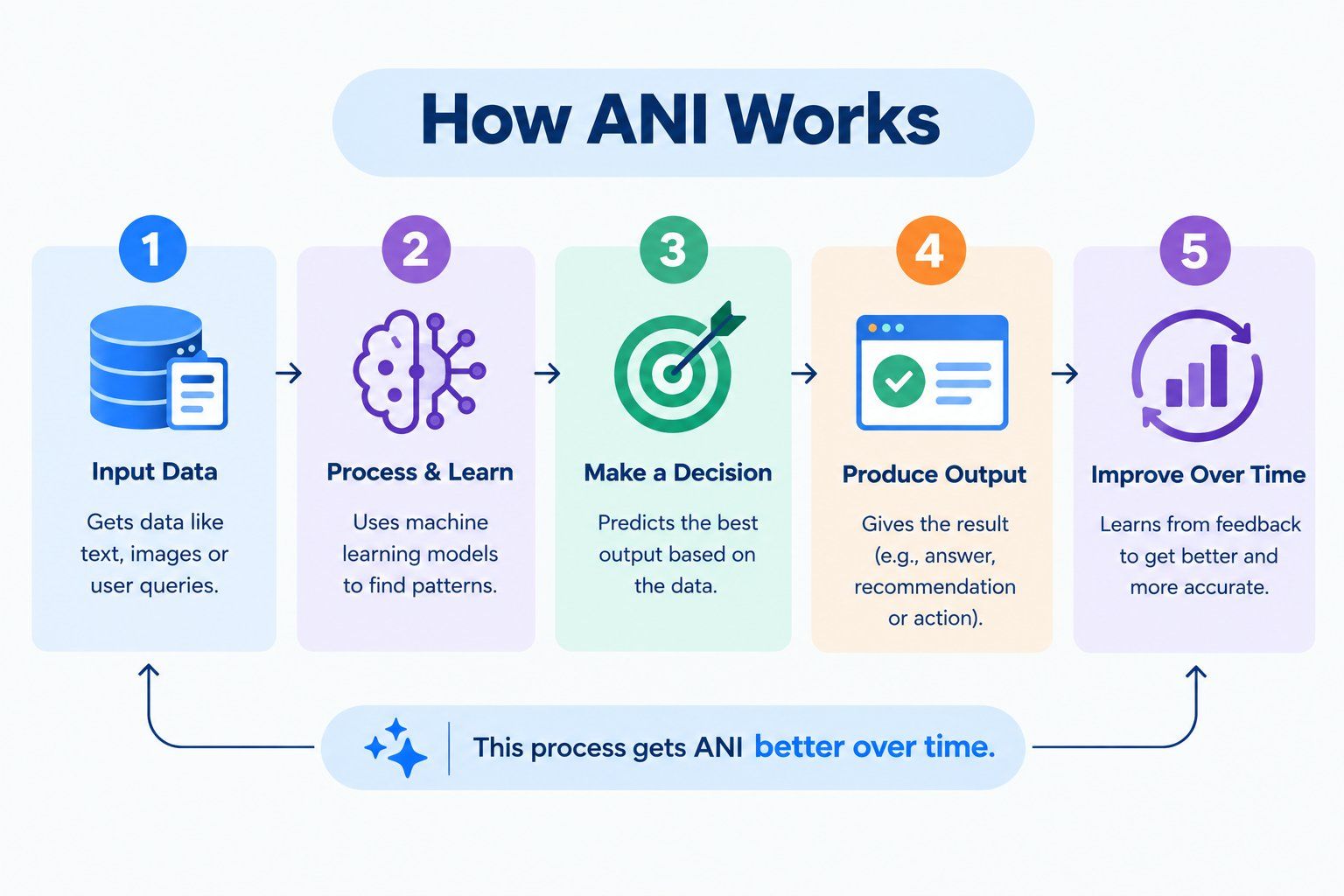
Two methods are used in the functioning of narrow AI systems:
Narrow AI is involved in the daily life of people across multiple industries:
Also read: Types of AI: From Narrow to Super Intelligence with Examples
The AGI, also known as Strong AI or Full AI. It is the idea of a machine that can think and learn across any subject, like the way a person does. It is still theoretical, and AI researchers are working towards this.
The key difference from Narrow AI is flexibility. A Narrow AI is stuck with whatever it was trained on. But an AGI could pick up a new skill as a human, by reasoning through it, not by being fed thousands of examples first.
To achieve human-level intelligence, an AGI system must show some capabilities that modern AI lacks:
Computer scientists and cognitive researchers are exploring multiple paths to build AGI:
Also read: What is Artificial General Intelligence?
Artificial Superintelligence (ASI) is a theoretical form that does not mimic or match human intelligence, but vastly surpasses it across every single domain. This includes scientific creativity, general wisdom, social skills, and strategic planning.
While Narrow AI is a reality today and General AI (AGI) is the next milestone, ASI represents a distant, highly speculative future phase of technological evolution. If achieved, an ASI would possess cognitive capabilities that are as far beyond human intelligence as human intelligence is beyond that of an ant.
The most widely discussed theory of how ASI could come to exist is through a phenomenon known as an intelligence explosion, a concept associated with philosopher Nick Bostrom and futurist Ray Kurzweil.
ASI hypothetical capabilities include:
Ready to lead at the intersection of technology and business? Our Chief Technology Officer & AI Leadership Programme is built for leaders ready to master deep tech, AI, strategy, and boardroom leadership, all in one structured path to becoming an AI-first CTO.
Free Courses
Based on functionality and how it processes the information, AI is divided into four types. Computer scientist Arend Hintze talked about this framework in a 2016 article, he shared how AI is moving from basic reactive machines to systems with human-like consciousness.

These are the main types of AI mentioned:
Reactive machines are the most basic and oldest form of AI. They do not use past experiences and memory to determine current actions. They operate on a cause-and-effect model, looking at the immediate input and react based on the rules it is trained on.
Examples: IBM's Deep Blue, the supercomputer that beat chess grandmaster Garry Kasparov in 1997. It becomes possible because it evaluates every possible move on the board in real time without learning from prior games.
Limited memory AI can look into the past to make better decisions. It stores historical data and observational metrics over a short period to build an understanding of its environment. Almost every AI application comes under this category.
Examples: Autonomous vehicles, which track the speed and direction of surrounding cars over a rolling timeframe and ChatGPT, which remembers the immediate context of your current conversation.
Theory of Mind AI is a theoretical concept that does not exist in reality yet. It talks about AI that can understand human psychology. Means it can recognize that humans have thoughts, emotions, beliefs, and expectations that influence their behavior.
Examples: Hypothetical social companion robots or advanced virtual assistants that could respond to your emotional state by accurately recognizing it in real time.
Self-aware AI is the ultimate, speculative final stage of AI development. This type of AI would possess its own consciousness, self-awareness, and sentient mind. It would not just understand human emotions, as in Theory of Mind, but would actually experience its own internal states.
Examples: This concept exists only in science fiction today, in characters like JARVIS from Iron Man, HAL 9000 from 2001: A Space Odyssey, and Data from Star Trek.
AI Type |
Uses Past Memory? |
Understands Human Emotion? |
Has Its Own Consciousness? |
Current Reality Status |
| Reactive Machines | No | No | No | Fully operational since the 1990s |
| Limited Memory | Yes (short-term) | No | No | Dominant in modern tech (LLMs, self-driving) |
| Theory of Mind | Yes | Yes | No | Theoretical, active research phase |
| Self-Aware AI | Yes | Yes | Yes | Purely science fiction |
Also read: Artificial Intelligence Fields: What They Are and How They Work
AI Courses to upskill
Explore Artificial Intelligence Courses for Career Progression
Understanding the difference between 3 types of artificial intelligence becomes easy when you see them in action. Below are three different scenarios, try reaching the answer and check how many scenarios you have answered correctly.
Scenario 1: The Grandmaster Who Cannot Make Toast
A research team builds a program that beats every human at chess without exception. The model has not lost a match in years and it can run through millions of possible moves in some seconds. But try asking it for something else, like recognizing a face in a photo or figuring out how to boil an egg, and it simply cannot do it. It is because it only follows the data it is trained on.
Scenario 2: The Employee Who Can Do Almost Any Job
Setup: Imagine there is a new hired person and he/she without training on specific tasks, has created drafts of a legal contract, fixes a bug in the software, puts together a marketing plan, and picks up an entirely new skill just by watching a colleague do it once.
When something goes wrong, or new things appear, it solves the problem without being reprogrammed. It adjusts as per the situation.
Scenario 3: The System That Outgrows Its Own Creators
Here is a strange case. Imagine an artificial intelligence starts rewriting its own code to become more capable. Each new version is faster than the previous one. Also, within a short span of time, it is solving problems that have stumped human experts for generations, and doing so in ways researchers can no longer fully follow or explain.
Also read: How to Learn Artificial Intelligence: A Step-by-Step Roadmap
At this point in time, artificial intelligence classification comes down to one practical reality: nearly every tool people use today, whether it is an email spam filter or a phone camera recognizing faces, belongs to the same category. None of these different types of artificial intelligence systems are thinking in the way people often assume. They are identifying patterns, and they can only do that within the specific boundary they were trained for.
The bigger shift worth paying attention to is not happening within Artificial Narrow Intelligence. It is whether Artificial General Intelligence ever moves out of research papers and into something real. That transition, whenever it happens, will change how this entire conversation gets framed.
Have any questions about this topic? Book a free consultation call with our experts and get personalized guidance on the right learning path for you.
ChatGPT falls under Artificial Narrow Intelligence. Despite its conversational ability, it operates within trained language patterns and cannot independently reason across unrelated domains like a truly general system would.
There is no consensus among experts. Predictions range from a few years to several decades, and some researchers argue current approaches may never reach true general intelligence at all.
ASI remains hypothetical, so danger is speculative. Concerns center on control and alignment, ensuring a system far more capable than humans pursues goals that remain compatible with human safety and wellbeing.
Several major AI labs, including OpenAI, DeepMind, and Anthropic, have publicly stated long-term research goals related to building more general and capable AI systems, though none claim to have achieved AGI.
No. Narrow AI systems are architecturally limited to their trained tasks. Reaching AGI would require fundamentally different approaches to learning and reasoning, not simply scaling up existing narrow systems.
Roles involving repetitive data processing, customer support, content drafting, and basic coding are seeing the most impact, since these tasks fit well within what Narrow AI systems are trained to do.
Not exactly. Emotional AI tools today detect surface-level cues like tone or facial expressions. True Theory of Mind would require genuinely understanding beliefs and intentions, which no current system can do.
No, this remains debated. Various benchmarks and tests have been proposed, but there is no single, universally accepted standard for confirming when a system has achieved genuine general intelligence.
Strong foundations in mathematics, statistics, and programming help, along with hands-on experience in machine learning frameworks, data handling, and increasingly, an understanding of how large language models function.
Governments worldwide are introducing frameworks to address AI safety, data privacy, and accountability. The pace and approach vary significantly by country, with some prioritizing innovation and others prioritizing stricter oversight.
Not really. Current systems are firmly Narrow AI, even when they combine multiple capabilities like vision and language. Combining functions doesn't create general reasoning across unrelated domains.
976 articles published
We are an online education platform providing industry-relevant programs for professionals, designed and delivered in collaboration with world-class faculty and businesses. Merging the latest technolo...
Speak with AI & ML expert
By submitting, I accept the T&C and
Privacy Policy
Top Resources
Master's Degree
18 Months
Executive Diploma
12 Months
IIIT Bangalore
Executive Programme in Generative AI & Agentic AI for LeadersIndia’s #1 Tech University
Dual Certification
5 Months