Artificial Intelligence Fields: What They Are and How They Work
By Sriram
Updated on Sep 23, 2026 | 6 min read | 1.84K+ views
Share:

All courses
Certifications
More
By Sriram
Updated on Sep 23, 2026 | 6 min read | 1.84K+ views
Share:
Table of Contents
Artificial intelligence fields are shaping the way businesses, hospitals, schools, banks, and even homes work. From helping doctors detect diseases to enabling voice assistants to answer questions, AI is no longer limited to research labs. It's already part of everyday life, and its influence continues to grow across industries.
Artificial intelligence is a collection of distinct fields, each solving a different kind of problem. Some teach machines to see. Others help them understand language. A few are focused entirely on making decisions in uncertain environments.
This blog breaks down the major artificial intelligence fields, explains what each one actually does, and shows where they're being applied right now.
Explore upGrad's Artificial Intelligence programs to build practical skills in machine learning, natural language processing, computer vision, deep learning, neural networks, and real-world artificial intelligence applications.
Popular AI Programs
AI is broad. That's both its strength and the reason so many people find it confusing.
At its core, AI is about building systems that can perform tasks that would normally require human thinking. But the methods used to do this vary a lot depending on the task. Teaching a machine to recognize a face is a very different problem from teaching it to play chess or translate a sentence.
That's why AI isn't monolithic. It's broken into fields, each with its own set of techniques, tools, and applications.
Here's a high-level look at the main artificial intelligence fields:
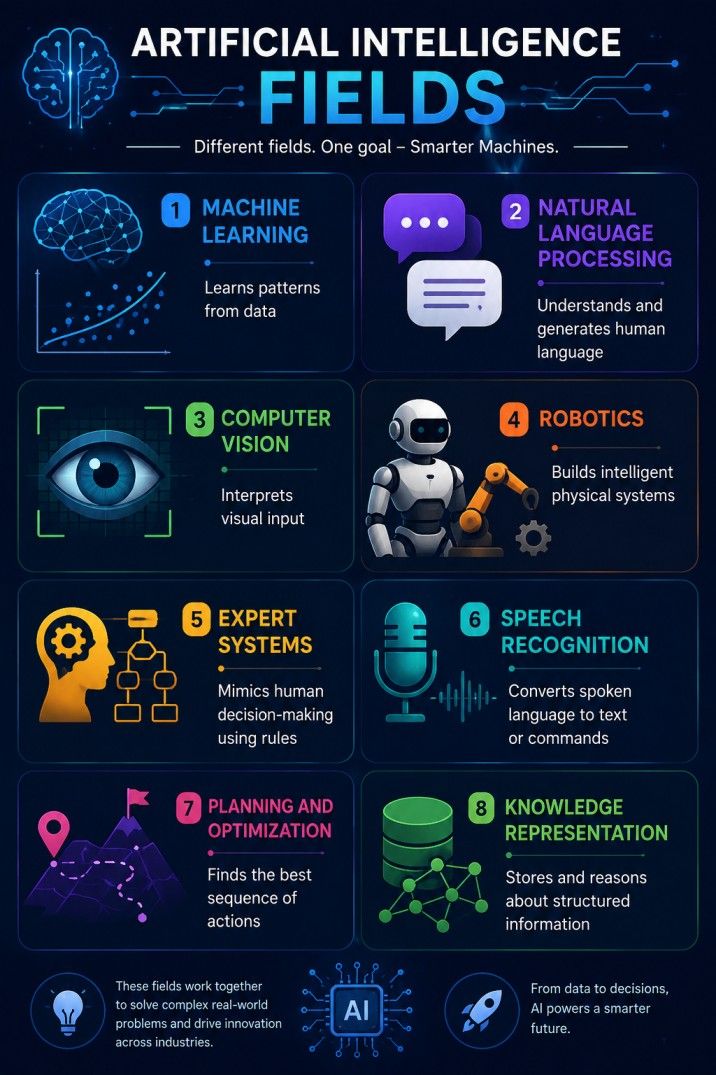
Each of these is a legitimate field of study on its own. And in practice, most real AI systems combine several of them.
Must read: Machine Translation in NLP: Examples, Flow & Models
Free Courses
Artificial intelligence fields refer to the different branches of AI that focus on solving specific types of problems. Each field uses its own techniques, algorithms, and datasets to make machines perform tasks that usually require human intelligence.
Machine learning is probably the most widely discussed of all the artificial intelligence fields, and for good reason.
It's the field that gave us recommendation engines, fraud detection systems, and most of what powers modern AI products. The basic idea is simple: instead of programming rules manually, you give the system data and let it figure out the patterns on its own.
There are three main types:
Machine learning needs a lot of data, and it fails badly when the data is biased, incomplete, or unrepresentative. That's a real challenge in fields like healthcare and hiring, where bad predictions can cause serious harm.
NLP is the field that lets machines work with human language. Reading it, writing it, summarizing it, translating it.
It's what powers chatbots, search engines, grammar tools, and large language models like the ones behind ChatGPT. NLP has improved dramatically over the last few years, mostly because of transformer-based architectures that can process entire paragraphs at once instead of word by word.
Key tasks in NLP include:
NLP Task |
What It Does |
Example |
| Text Classification | Categorizes text into predefined classes. | Determines whether an email is spam or not. |
| Named Entity Recognition (NER) | Identifies important entities such as names, places, organizations, and dates. | Extracts names, locations, and dates from a news article. |
| Sentiment Analysis | Analyzes the emotional tone of text. | Identifies whether a customer review is positive, negative, or neutral. |
| Machine Translation | Translates text from one language to another. | Converts English text into Spanish or Hindi. |
| Question Answering | Finds and returns relevant answers from a given document or knowledge base. | Answers a user's question using information from a company handbook or research paper. |
NLP still struggles with context, sarcasm, and cultural nuance. A model trained on English text won't automatically understand how language works in another cultural setting, even if it's technically accurate.
Also read: 15+ Top Natural Language Processing Techniques To Learn in 2026
Computer vision teaches machines to interpret images and video.
It's one of the oldest artificial intelligence fields, but the biggest breakthroughs came with deep learning in the 2010s. Before that, getting a machine to reliably identify objects in an image was extraordinarily difficult. Now, it's relatively routine.
What can computer vision systems do?
Computer Vision Capability |
Purpose |
Example |
| Object Detection | Detects and classifies objects | Self-driving cars |
| OCR | Reads text from images | Invoice scanning |
| Facial Recognition | Identifies faces | Phone unlocking |
| Object Tracking | Tracks movement | Traffic monitoring |
| Visual Inspection | Detects product defects | Factory quality checks |
Medical imaging is one of the most promising applications. AI systems can now detect early signs of cancer in scans with accuracy comparable to trained radiologists. That doesn't mean they're replacing doctors, but it does mean doctors can catch more with less effort.
One real limitation here is that computer vision models can be fooled. Small, imperceptible changes to an image can cause a model to misclassify it completely. This is called an adversarial attack, and it's an active area of research.
Do read: Computer Vision Algorithms: Everything You Need To Know [2026]
Robotics sits at the intersection of AI and physical systems.
A robot without AI is just a machine following fixed instructions. Add AI, and it can adapt. It can navigate an environment it hasn't seen before, pick up objects of different shapes, and respond to unexpected obstacles.
Fields related to artificial intelligence in robotics include:
Industrial robots have been around for decades. What's changed is the degree of intelligence. Modern systems can work alongside humans, not just on isolated assembly lines. Autonomous vehicles are an extension of this field, applying robotics principles to transportation.
The gap between lab performance and real-world reliability is still wide. A robot that works perfectly in a controlled environment often struggles badly when it encounters something outside its training.
Explore upGrad's Executive Programme in Generative AI for Leaders to learn AI strategy, prompt engineering, large language models (LLMs), AI governance, and real-world business applications for leading AI-driven transformation.
Expert systems were one of the earliest applications of AI, and they're still in use today.
The idea is to capture the knowledge of a human expert and encode it as a set of rules. The system then uses those rules to make decisions or give recommendations. Early medical diagnosis tools and legal research tools were built this way.
Expert systems are reliable and explainable, which makes them useful in regulated industries where you need to know exactly why a decision was made. But they don't learn from new data. Someone has to update the rules manually as the world changes.
That limitation is why expert systems fell out of fashion as machine learning grew more powerful. But they haven't disappeared. Many organizations use hybrid approaches, combining rule-based logic with learned models.
Speech recognition converts spoken language into text or commands a machine can act on.
It's one of the most visible artificial intelligence fields for everyday users. Every time you use a voice assistant, dictate a message, or call customer support and speak to an automated system, you're interacting with speech recognition.
The technology has improved a lot. Background noise, accents, and fast speech used to cause serious problems. Modern systems handle them much better, though they're still not perfect.
Where it's used:
One thing people don't always realize: speech recognition is often the first step in a pipeline. The system converts speech to text, and then NLP takes over to understand what was said. These fields overlap heavily in practice.
Accent bias is a real problem. Models trained primarily on one dialect perform worse for speakers of other dialects. That's not just a technical issue. It has real equity implications, especially for accessibility tools.
Also read: The Role and Application of Machine Learning in Healthcare
This is the field of AI that figures out the best sequence of actions to achieve a goal.
Planning algorithms are what let AI systems play chess, navigate warehouse logistics, schedule flights, and find the fastest delivery routes. It's less visible than NLP or computer vision, but it runs a lot of critical infrastructure.
Optimization problems are everywhere. How do you schedule thousands of shifts for hospital staff while meeting legal requirements and individual preferences? How do you route delivery trucks across a city to minimize fuel and time? These aren't simple problems, and AI-based planning systems handle them far better than manual methods.
There's a difference between classical planning, which works with clear rules and defined goals, and modern approaches that handle uncertainty and partial information. Reinforcement learning bridges these two worlds in some cases.
The Knowledge Representation field deals with how AI systems store, organize, and reason about information.
Think of it as the AI equivalent of having a structured mental model of the world. Humans do this naturally. We know that a dog is an animal, that animals are living things, and that living things need food. We make inferences based on this kind of structured knowledge constantly.
Getting machines to do the same is harder than it sounds. Early approaches used formal logic. More recent ones use knowledge graphs, ontologies, and semantic networks.
This field is deeply connected to fields related to artificial intelligence like NLP and expert systems. It also plays a major role in question-answering systems that need to retrieve and reason about facts, not just pattern-match text.
Must read: Job Opportunities in AI: Salaries, Skills & Careers in 2026
AI Courses to upskill
Explore Artificial Intelligence Courses for Career Progression
Here's where things get practical. These AI fields don't exist in isolation. They're being applied across industries, and the impact is measurable.
Industry |
AI Fields Applied |
Example Use |
| Healthcare | Computer Vision, ML, NLP | Disease detection, clinical notes automation |
| Finance | ML, Planning | Fraud detection, algorithmic trading |
| Education | NLP, ML | Personalized learning, automated grading |
| Manufacturing | Robotics, Computer Vision | Quality control, automated assembly |
| Retail | ML, NLP | Recommendations, customer service bots |
| Agriculture | Computer Vision, ML | Crop disease detection, yield prediction |
| Legal | NLP, Expert Systems | Contract analysis, legal research |
| Transport | Robotics, Planning | Autonomous vehicles, route optimization |
The uses of artificial intelligence in different fields are growing every year. But adoption isn't uniform. Some industries move fast. Others, like healthcare and legal, move slower because the stakes are higher and regulations are stricter.
Do read: AI in Banking and Finance Explained: Trends, Uses, & Impact
If you're thinking about working in AI, the field you focus on matters.
Machine learning engineering is one of the most in-demand roles globally. Data science overlaps heavily with ML. NLP specialists are in demand because of the explosion in large language model applications. Computer vision roles are strong in healthcare, automotive, and security sectors.
Skills that cut across all artificial intelligence fields:
You don't need to master every field. Pick one, go deep, and build practical projects. That's what actually moves careers forward.
Also read: How AI in Healthcare is Changing Diagnostics and Treatment
Not everything in AI is solved. Worth being honest about that.
Generalization is a persistent problem. Most AI systems are good at what they were trained on and brittle outside that range. Explainability is another challenge, particularly in deep learning, where it's difficult to understand why a model made a specific decision. This matters in medicine, law, and finance.
Data quality is often the real bottleneck. An AI system is only as good as the data it's trained on, and real-world data is messy, biased, and often incomplete.
AI also doesn't reason the way humans do. It finds patterns. That's powerful, but it's not the same as understanding. Conflating the two leads to overconfidence in what these systems can actually do.
Also read: The Future Scope of Artificial Intelligence in 2026 and Beyond
The artificial intelligence fields covered here aren't separate tracks that never interact. In practice, they blend. A self-driving car uses computer vision, planning, sensor fusion, and machine learning all at once. A modern chatbot combines NLP, knowledge representation, and ML.
The more interesting work is happening at the boundaries between fields. Researchers are combining reinforcement learning with NLP. Engineers building systems that use knowledge graphs alongside large language models. Practitioners figuring out how to make computer vision work reliably outside of lab conditions.
If you want to understand AI, don't just look at one field. Start with one, but keep the full picture in view.
Also read: 3 Types of Artificial Intelligence Explained with Examples
Artificial intelligence fields cover a wide range of technologies that solve different types of problems. Machine learning, deep learning, natural language processing, computer vision, robotics, expert systems, and reinforcement learning each play a unique role. Together, they power many of the intelligent applications people use every day.
As businesses continue adopting AI, understanding these artificial intelligence fields becomes valuable for students, professionals, and decision-makers alike. Learning the fundamentals today creates a strong foundation for exploring more advanced AI concepts and building practical skills for tomorrow's workplace.
Ready to start your journey? Book a free consultation with upGrad today to find the best path for your career.
Machine Learning is usually the best starting point because it introduces the core concepts used across many artificial intelligence fields. Once you're comfortable with data, algorithms, and model evaluation, it's easier to move into areas like NLP, computer vision, or robotics based on your interests.
Most AI products combine multiple technologies instead of relying on a single branch. For example, a voice assistant uses speech recognition to capture speech, natural language processing to understand requests, and machine learning to improve responses over time. That's why understanding fields related to artificial intelligence is valuable.
Deep learning is a specialized area within machine learning rather than a completely separate discipline. It uses multi-layered neural networks to solve complex tasks such as image recognition, speech processing, and generative AI, especially when large datasets are available.
Modern AI chatbots mainly rely on Natural Language Processing (NLP), deep learning, and machine learning. Large language models help these systems understand context, generate human-like responses, summarize information, and answer questions while continuously improving through better training techniques.
Industries such as healthcare, automotive, finance, manufacturing, and retail combine several AI branches. A self-driving vehicle, for instance, brings together computer vision, robotics, planning algorithms, and machine learning to safely navigate roads and respond to changing conditions.
Regardless of the specialization, professionals benefit from learning Python, statistics, linear algebra, SQL, data preprocessing, and model evaluation. Building practical projects is equally important because employers often value hands-on experience more than theoretical knowledge alone.
Demand varies depending on industry needs and technology trends. Machine learning, NLP, computer vision, and generative AI currently offer the largest number of job opportunities, while robotics and expert systems remain highly valuable in specialized sectors such as manufacturing and healthcare.
Data science focuses on collecting, cleaning, analyzing, and interpreting data to generate insights. Artificial intelligence fields build systems that can learn, reason, or make decisions using that data. The two disciplines overlap, but they serve different purposes within technology projects.
AI systems still struggle with biased datasets, limited explainability, high computing costs, and adapting to unfamiliar situations. These challenges affect the reliability of AI applications, especially in healthcare, finance, and legal services where accurate decisions are critical.
The uses of artificial intelligence in different fields are expected to expand through smarter automation, personalized services, and better decision support. Businesses are increasingly integrating AI into everyday operations, making AI skills relevant across almost every industry and profession.
Absolutely. Most professionals develop expertise in one area before exploring related technologies. Starting with a single specialization, such as machine learning or NLP, and gradually learning fields related to artificial intelligence helps build stronger technical skills and long-term career growth.
730 articles published
Sriram K is a Senior SEO Executive with a B.Tech in Information Technology from Dr. M.G.R. Educational and Research Institute, Chennai. With over a decade of experience in digital marketing, he specia...
Speak with AI & ML expert
By submitting, I accept the T&C and
Privacy Policy
Top Resources
Master's Degree
18 Months
Executive Diploma
12 Months
IIIT Bangalore
Executive Programme in Generative AI & Agentic AI for LeadersIndia’s #1 Tech University
Dual Certification
5 Months