RAG Agents: What They Are, How They Work, and What They Actually Cost
By Sriram
Updated on Jun 22, 2026 | 6 min read | 1.89K+ views
Share:

All courses
Certifications
More
By Sriram
Updated on Jun 22, 2026 | 6 min read | 1.89K+ views
Share:
Table of Contents
RAG agents combine retrieval systems with language models to give you answers grounded in real data, not just what the model memorised during training. RAG stands for Retrieval-Augmented Generation. A RAG agent combines information retrieval with generative AI to answer questions, complete tasks, and support decision-making.
RAG agents are changing how AI systems find, process, and use information. Unlike traditional large language models that rely only on training data, RAG agents can retrieve relevant information from external sources before generating a response. This makes outputs more accurate, current, and context-aware.
This blog covers exactly how RAG agents work, what makes agentic RAG different, and what you should expect to spend if you're building or using one.
Explore upGrad's Data Science, AI, and Machine Learning programs to learn how to build RAG agents, work with LLMs, design AI-powered applications, manage knowledge retrieval systems, and develop real-world generative AI solutions.
Agentic AI Courses to upskill
Explore Agentic AI Courses for Career Progression
IIIT Bangalore
Executive Diploma in Machine Learning and AI360° Career Support
A RAG agent doesn't just answer from memory. It first retrieves relevant information from a knowledge base, then uses a language model to generate a response based on that retrieved content.
Think of it this way. A standard LLM is like someone answering questions from what they studied years ago. A RAG agent is like the same person, but now they can look things up before answering. That's a big deal for businesses.
If you're building a customer support bot, an internal knowledge tool, or a document Q&A system, you don't want the AI to hallucinate or give outdated answers. RAG agents can address that directly.
Why RAG agents are gaining traction:
The retrieval step is what separates them from a plain chatbot. And it's also what drives most of the cost, which we'll cover in detail.
Component |
Function |
| User Query | Receives the question or request |
| Retriever | Finds relevant information |
| Knowledge Base | Stores documents and data |
| Language Model | Generates the final response |
| Orchestration Layer | Coordinates retrieval and generation |
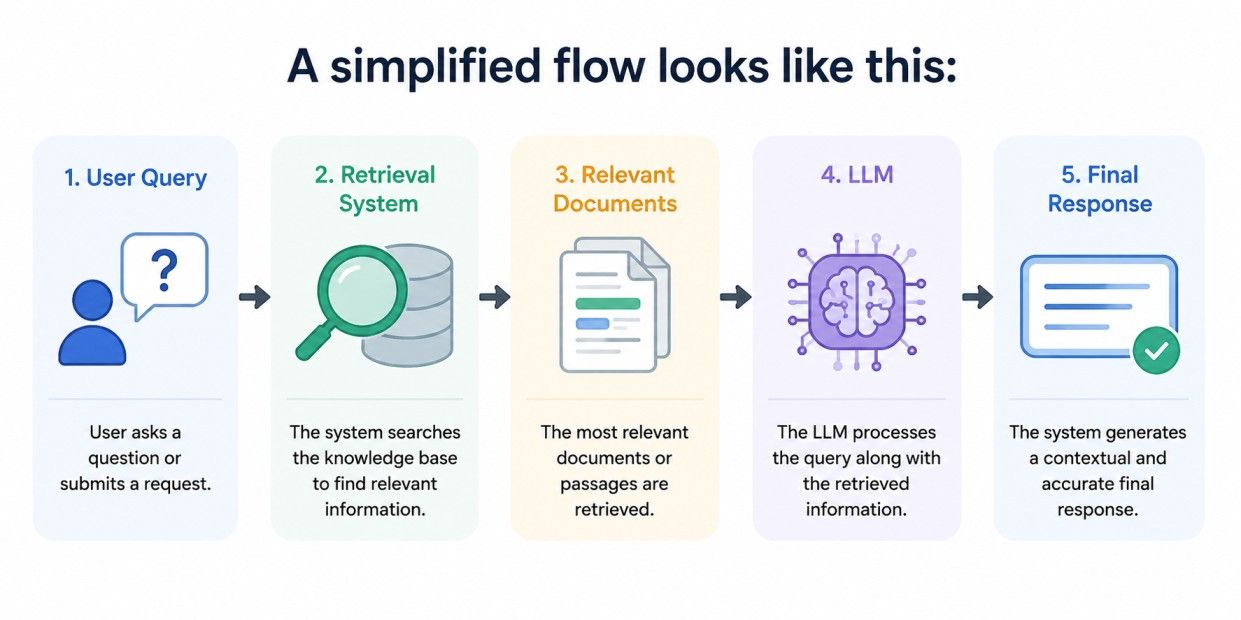
Do read: Agentic RAG Architecture: A Practical Guide for Building Smarter AI Systems
Standard RAG is a one-shot process. Query comes in, documents get retrieved, answer gets generated. Done.
Agentic RAG is more dynamic. The agent can decide which tools to use, when to retrieve more context, and whether the first answer is good enough or needs a follow-up search.
You're essentially giving the retrieval process a brain.
The core difference:
Feature |
Standard RAG |
Agentic RAG |
| Retrieval | Single pass | Multi-step, iterative |
| Decision-making | Fixed pipeline | Agent chooses tools dynamically |
| Context handling | Flat document chunks | Can reason over multiple sources |
| Complexity | Lower | Higher |
| Cost | Lower | Higher |
Agentic RAG systems often use tools like vector search, web browsing, SQL queries, or API calls. The agent decides which tool fits the question. That flexibility is powerful, but it's not free.
For most teams, standard RAG is the right starting point. You don't need agentic RAG unless your use case requires multi-hop reasoning or complex workflows. Jumping straight to agentic setups before you've nailed retrieval quality is a common and expensive mistake.
Must read: How Does Generative AI Work? Key Insights, Practical Uses, and More
The cost of RAG agents isn't just the API bill. It's a combination of infrastructure, compute, storage, and engineering time.
Let's break it down.
Before a RAG agent can retrieve anything, your documents need to be turned into vector embeddings. That process has a cost.
You also need a vector database. Options include Pinecone, Weaviate, Qdrant, and pgvector. Free tiers exist, but production workloads often push you into paid plans ranging from $70(₹6,615) to $300(₹28,350) per month.
Do read: What is RAG in AI and How Retrieval-Augmented Generation Works
Every query runs through a language model. That's where most of the per-query cost sits.
Model |
Input Cost (per 1M tokens) |
Output Cost (per 1M tokens) |
| GPT-4o | $5(₹472.50) | $15(₹1,417.50) |
| GPT-4o mini | $0.15(₹14.18) | $0.60(₹56.70) |
| Claude 3.5 Sonnet | $3(₹283.50) | $15(₹1,417.50) |
| Gemini 1.5 Flash | $0.075(₹7.09) | $0.30(₹28.35) |
If your RAG agent handles 10,000 queries a day with an average context of 2,000 tokens, costs can range from a few dollars to hundreds, depending on model choice.
Agentic RAG costs more per query because multiple retrieval and generation steps happen before a final answer is produced.
This one's often underestimated. Building a production-ready RAG agent isn't a weekend project.
For a team of two engineers, that's a meaningful salary investment before you've paid for a single API call.
Also read: RAG in Generative AI: A Complete Practical Guide
You don't have to build everything yourself. Several platforms now offer managed RAG infrastructure, and they change the cost equation.
Build from scratch:
Use a managed platform:
Platforms like LlamaIndex Cloud, Vertex AI Search, and Azure AI Search offer RAG pipelines with varying levels of abstraction. upGrad's AI and ML programmes cover how to evaluate these trade-offs when designing AI systems for production environments.
For startups and smaller teams, starting with a managed platform and migrating later is often the smarter financial move. You preserve runway and avoid over-engineering early.
Also read: Difference Between RAG and LLM
No two RAG setups cost the same. Getting these trade-offs right is a design decision, not just a cost decision. A well-architected RAG agent can do more for less. Here are the variables that matter most.
Factor |
Cost Impact |
| Query Volume | More queries = higher inference costs |
| Document Size | Larger knowledge bases = higher storage and embedding costs |
| Update Frequency | Frequent updates = more re-indexing expenses |
| Retrieval Depth | More retrieved chunks = higher retrieval costs |
| Model Choice | Larger models cost more than smaller models |
| Caching | Reduces repeated API calls and lowers costs |
| Latency Requirements | Faster responses often require simpler, less costly workflows |
Also read: 5 Significant Benefits of Artificial Intelligence [Deep Analysis]
RAG agents offer significant advantages, but they're not perfect. Understanding both sides helps organizations make better implementation decisions.
Aspect |
Benefits of RAG Agents |
Challenges of RAG Agents |
| Accuracy | Fewer hallucinations through retrieved data | Poor retrieval can reduce answer quality |
| Information Freshness | Access to up-to-date knowledge sources | Outdated knowledge bases can lead to outdated answers |
| Cost | Lower retraining costs | Ongoing storage and maintenance costs |
| Domain Knowledge | Strong expertise in specialized fields | Depends on the quality of source documents |
| Personalization | Context-aware and user-specific responses | Requires additional data management |
| Performance | More relevant and grounded outputs | Retrieval steps can increase latency |
| Scalability | Easy knowledge base updates | Larger datasets require more indexing resources |
| Security | Can work with private enterprise data | Access control and privacy risks must be managed |
The value of RAG agents becomes clear when examining practical applications. They're already being used across industries.
Industry |
Use Case |
Benefit |
| Customer Support | Product docs & FAQs | Faster answers |
| Knowledge Management | Internal documents | Quick information access |
| Healthcare | Clinical data & research | Better decisions |
| Legal | Contracts & case law | Faster research |
| Financial Services | Reports & compliance data | Quicker analysis |
Also read: Generative AI vs Traditional AI: Which One Is Right for You?
You can build a solid RAG agent without burning through your budget. A few practices help a lot.
RAG agents aren't expensive by default. They become expensive when retrieval quality is poor, and you try to compensate with more LLM calls.
RAG agents bridge the gap between generative AI and real-world information. By retrieving relevant content before generating responses, they improve accuracy, relevance, and trustworthiness.
As organizations handle larger volumes of information, the role of RAG agents will continue to expand. Agentic RAG takes this a step further by adding planning, reasoning, and workflow execution capabilities. Together, these approaches are shaping the next generation of intelligent AI systems that can do more than generate text. They can find the right information, understand context, and act on it effectively.
Ready to start your journey? Book a free consultation with upGrad today to find the best path for your career.
A large language model (LLM) generates responses based on patterns learned during training. It doesn't automatically know new information published after its training cutoff. RAG adds a retrieval layer that fetches relevant documents before generating an answer. This helps responses stay grounded in current and domain-specific information rather than relying solely on the model's memory.
A common RAG example is a customer support chatbot connected to a company's product documentation. When a customer asks a question, the system retrieves relevant articles and generates an answer based on that information. This approach improves accuracy and allows businesses to update documentation without retraining the underlying model.
A RAG system focuses on retrieving information and generating answers. Its primary goal is to improve response quality using external knowledge sources. An AI agent goes further. It can plan tasks, make decisions, use tools, call APIs, and perform actions. Agentic RAG combines both capabilities by adding reasoning and workflow management to retrieval-based systems.
The five commonly referenced AI agent categories are simple reflex agents, model-based reflex agents, goal-based agents, utility-based agents, and learning agents. Each type differs in how it makes decisions. Modern agentic RAG systems often combine characteristics from multiple agent categories to solve complex business and research tasks.
Not always. Agentic RAG is more powerful because it can perform multi-step reasoning, use external tools, and retrieve information multiple times during a workflow. However, it also increases complexity, latency, and cost. For many customer support and knowledge management use cases, standard RAG delivers excellent results without additional overhead.
Companies want AI systems that can access current information without constant model retraining. RAG agents solve this challenge by retrieving data directly from connected knowledge sources. They also work well with private documents, internal databases, compliance materials, and proprietary information that public AI models don't have access to.
Yes, if configured with web search tools. A RAG agent can retrieve information from websites, APIs, databases, or internal repositories before generating a response. The retrieval source depends on the system design. Many enterprise deployments restrict retrieval to approved internal knowledge bases for security reasons.
No. RAG agents significantly reduce hallucinations, but they don't remove them entirely. The quality of retrieved documents plays a major role in response accuracy. If the retrieval system surfaces irrelevant or outdated content, the generated answer may still contain mistakes or misleading information.
Retrieval quality is often the hardest part. Many teams focus heavily on choosing a language model while overlooking document chunking, indexing, and search relevance. Even a powerful model will struggle if the retrieval layer provides poor or incomplete context for answering user queries.
Costs vary based on document volume, retrieval frequency, model selection, and infrastructure requirements. Small deployments can be relatively affordable using managed services and lightweight models. Large-scale agentic RAG systems with millions of documents and high query volumes require more investment in storage, compute, monitoring, and engineering resources.
RAG and fine-tuning solve different problems. RAG is ideal when information changes frequently because knowledge can be updated through retrieval rather than retraining. Fine-tuning works better when you need a model to learn specific behaviours, writing styles, or task patterns. Many advanced AI systems use both approaches together.
730 articles published
Sriram K is a Senior SEO Executive with a B.Tech in Information Technology from Dr. M.G.R. Educational and Research Institute, Chennai. With over a decade of experience in digital marketing, he specia...
Speak with AI & ML expert
By submitting, I accept the T&C and
Privacy Policy