LLM Hallucinations: What They Are, Why They Happen, and How to Handle Them
By Sriram
Updated on Jun 23, 2026 | 6 min read | 1.72K+ views
Share:

All courses
Certifications
More
By Sriram
Updated on Jun 23, 2026 | 6 min read | 1.72K+ views
Share:
Table of Contents
LLM hallucinations occur when a large language model generates information that sounds accurate but is actually false, misleading, or completely fabricated. These errors can appear as invented facts, fake citations, incorrect calculations, or fictional events presented with confidence.
A language model doesn't think, reason, or verify facts the way humans do. It predicts the next word based on patterns learned during training. That's the core issue. Sometimes those predictions produce information that sounds convincing but isn't true.
This blog breaks down what causes LLM hallucinations, what types exist, how to detect them, and what you can actually do to reduce them.
Explore upGrad's Data Science, AI, and Machine Learning programs to develop practical skills in large language models (LLMs), generative AI, prompt engineering, NLP, model evaluation, and AI application development. Gain hands-on experience with industry-relevant tools and learn how to build, assess, and deploy AI systems that deliver accurate and reliable outputs.
Popular AI Programs
Here's the thing most people don't realize: LLMs don't "know" facts the way you do. They predict the next most likely word based on patterns in training data. There's no internal fact-checker running in the background.
When a model encounters a question it doesn't have enough data for, it doesn't say "I don't know." It fills the gap with something that statistically sounds right, and that's hallucination.
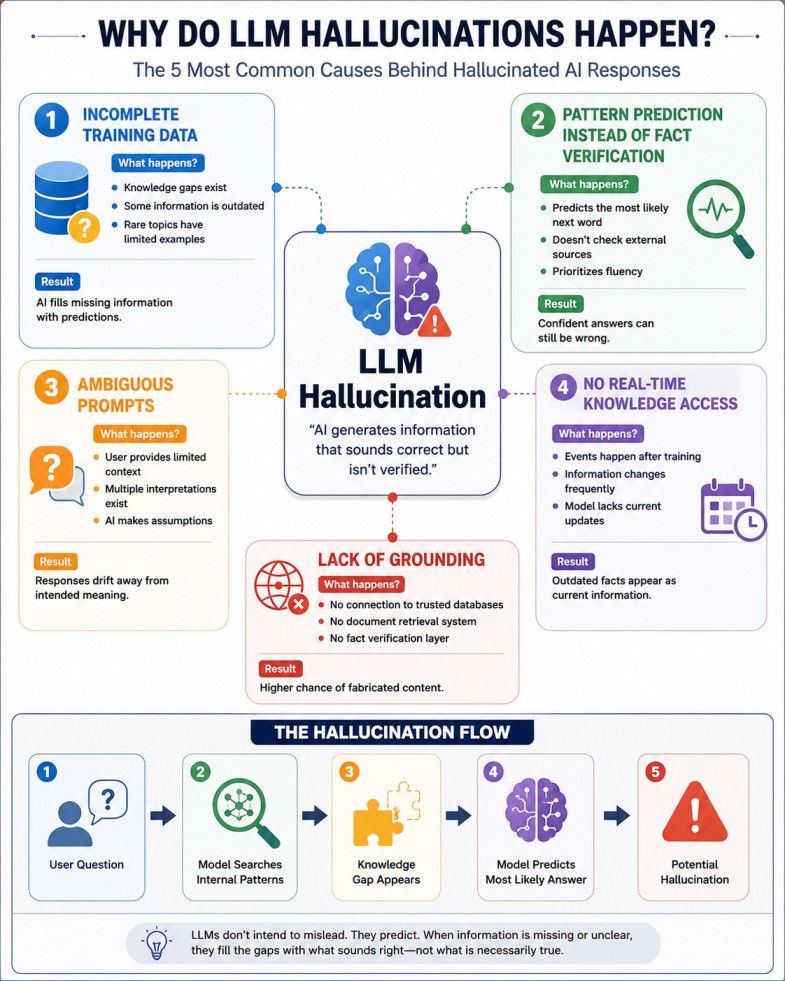
Think about it this way. If you trained someone entirely on textbooks but never let them check facts in real life, they'd still give confident answers even when guessing. That's essentially what's happening here.
The problem gets worse when models are pushed beyond their training distribution, asked about very recent events, or given prompts that require precise factual recall rather than general reasoning.
Do read: Natural Language Processing: The Only Guide You'll Ever Need!
Free Courses
Not all hallucinations look the same. Recognizing the type helps you figure out what went wrong and how to address it.
The model states something false as if it's true. A classic example is an AI confidently naming a published research paper that doesn't exist, complete with a fake author, journal name, and DOI.
The model contradicts information given in the same conversation or document. You provide details in your prompt, and the model ignores them or generates something inconsistent with what you said.
Do read: AI vs. Human Intelligence: Key Differences & Job Impact in 2025
The model presents outdated information as current. If an LLM's training cutoff is mid-2023, it might tell you that a company's CEO is someone who resigned a year ago.
This one's particularly risky in academic or professional settings. The model invents citations, quotes, and links. The sources sound real. They aren't.
Type |
What Happens |
Risk Level |
| Factual | False statements presented as true | High |
| Contextual | Contradicts given information | Medium |
| Temporal | Uses outdated data as current | Medium |
| Source Fabrication | Invents citations and references | Very High |
Must read: How Does Generative AI Work? Key Insights, Practical Uses, and More
AI Courses to upskill
Explore Artificial Intelligence Courses for Career Progression
You can't always catch a hallucination on the first read. That's what makes it tricky. The output looks clean. The tone is confident. The structure is logical. But the facts are wrong.
Here are signs to watch for:
Don't just accept an answer because it sounds authoritative. That's the trap. Cross-check anything factual using a reliable source, especially if it's going into something you'll publish or act on.
One practical habit is to ask the model where it got the information. If it can't point to a real source or gives you something vague, treat the answer with skepticism.
Do read: Generative AI vs Traditional AI: Which One Is Right for You?
You can't eliminate hallucinations entirely. But you can reduce how often they happen and how much damage they do.
RAG connects an LLM to a real-time knowledge source before generating a response. Instead of relying purely on trained parameters, the model pulls from a curated, up-to-date database. The result is more grounded output.
Vague prompts produce vague answers. When you give the model more context, specific constraints, and a clear format, you reduce the room for it to wander into fabrication.
For example: instead of asking "Tell me about AI regulation," try "Summarize the key points of the EU AI Act as of 2024, focusing on high-risk AI systems."
Also read: A beginner’s guide to GitHub
You can instruct the model to say "I'm not sure" rather than guess. It doesn't always work, but it helps filter out low-confidence answers in structured tasks.
If you're using AI for anything that gets published, shared, or acted on, a human review step isn't optional. It's non-negotiable. Think of AI output as a first draft, not a finished product.
Lower temperature settings make models more conservative and less creative, which often means fewer hallucinations. If you're building on top of an LLM API, this is worth experimenting with.
Also read: AI’s Secret Language: What Is Knowledge Representation in AI Really About?
You'd think this would be a fixable bug. It isn't. The architecture of LLMs makes it structurally difficult to separate "things the model knows well" from "things it's guessing about." The model doesn't have an internal confidence meter that triggers a warning. It generates output the same way, whether it's on solid ground or completely making something up.
Researchers are working on several approaches:
Progress is happening. But it's slow, and the problem is deeply tied to how these models work at a fundamental level. Don't expect a complete fix anytime soon.
Must read: Applications of Artificial Intelligence and Its Impact
This isn't just a technical curiosity. Hallucinations have caused real problems already. Lawyers have submitted AI-generated briefs citing cases that don't exist. Journalists have published AI-assisted articles with fabricated quotes. Medical information from AI tools has included incorrect dosages and drug interactions.
The stakes vary by use case, but the pattern is consistent: people trusted the output without verifying it, and the consequences ranged from embarrassing to harmful. That's why understanding LLM hallucinations isn't just useful for developers. It matters to anyone who uses AI tools in their work or learning.
LLM hallucinations aren't a glitch. They're a structural feature of how language models work right now. The model predicts. It doesn't verify. That doesn't mean these tools aren't useful. It means you have to use them with your eyes open. Verify facts. Don't trust citations without checking. Build review steps into your process.
The best way to work with AI is to treat it as a very fast, very fluent collaborator that still needs supervision. Once you accept that, LLM hallucinations become manageable instead of catastrophic.
Ready to start your journey? Book a free consultation with upGrad today to find the best path for your career.
Yes. One of the biggest challenges with LLM hallucinations is that they often appear polished, logical, and convincing. The response may contain realistic details, professional language, and seemingly credible explanations, making errors difficult to spot without verification. This is why factual checking remains essential when using AI-generated content in professional or academic settings.
Yes. Hallucinations are a known limitation of all modern large language models, including advanced AI systems. The frequency varies depending on the model, task complexity, prompt quality, and available context, but no current LLM can completely eliminate hallucinations in every situation.
Language models are trained to generate the most probable next token, not to verify whether information is true. As a result, they often produce fluent and authoritative responses even when the underlying content is incorrect. Confidence in wording is not the same as confidence in factual accuracy.
Yes. Hallucinations are more likely when users ask about niche topics, recent events, obscure facts, unpublished research, or highly specialized domains. Questions requiring precise factual recall typically create more risk than tasks involving summarization, brainstorming, or general language generation.
They can. In software development, models have been known to invent package names, libraries, APIs, and commands that do not exist. Developers who copy AI-generated code without verification may introduce vulnerabilities, install malicious packages, or waste time troubleshooting fabricated dependencies.
Organizations typically use benchmark datasets, human evaluations, fact-checking pipelines, and accuracy metrics to monitor hallucination rates. Many teams also compare AI-generated answers against trusted knowledge sources to identify unsupported claims before outputs reach customers or employees.
You cannot fully eliminate hallucinations with current AI technology. However, you can significantly reduce them by using retrieval-augmented generation (RAG), grounding responses in trusted data sources, improving prompts, lowering temperature settings, and implementing human review processes for critical outputs.
Sometimes, but not reliably. Researchers are developing uncertainty estimation and hallucination-detection techniques that help models flag potentially incorrect outputs. However, self-detection remains imperfect, and external validation is still necessary for high-stakes applications such as healthcare, law, and finance.
No. RAG improves accuracy by providing external documents and real-time information during generation, but it does not guarantee correctness. Models can still misinterpret retrieved content, combine facts incorrectly, or generate unsupported conclusions even when relevant sources are available.
Not necessarily. In some cases, newer models achieve better reasoning and broader capabilities while still exhibiting hallucination issues. Reliability depends on model design, evaluation methods, and deployment safeguards. The focus today is often on mitigation and detection rather than complete elimination.
AI literacy, critical thinking, fact-checking, source verification, and prompt engineering are becoming essential skills. Professionals should learn to validate outputs, identify unsupported claims, and recognize when human expertise is needed instead of relying entirely on automated responses generated by LLMs.
730 articles published
Sriram K is a Senior SEO Executive with a B.Tech in Information Technology from Dr. M.G.R. Educational and Research Institute, Chennai. With over a decade of experience in digital marketing, he specia...
Speak with AI & ML expert
By submitting, I accept the T&C and
Privacy Policy
Top Resources
Master's Degree
18 Months
Executive Diploma
12 Months
IIIT Bangalore
Executive Programme in Generative AI & Agentic AI for LeadersIndia’s #1 Tech University
Dual Certification
5 Months