Types of Disaster Management: A Complete Guide with Examples
By Sriram
Updated on Aug 07, 2026 | 7 min read | 4.44K+ views
Share:

All courses
Certifications
More
By Sriram
Updated on Aug 07, 2026 | 7 min read | 4.44K+ views
Share:
Table of Contents
Key Highlights
Lead with confidence during uncertainty. Explore upGrad's Management Training Programs to build leadership, risk management, and strategic decision-making skills.
Popular Management Programs
The types of disaster management refer to the major stages used to reduce disaster risks and effectively manage emergencies. If you are looking for a number of types of disaster management, then it is four. These include mitigation, preparedness, response and recovery.
These different types of disaster management together help reduce damage, save lives and support faster recovery after a disaster. This classification is widely used by disaster management agencies around the world.
The impact of disasters before they occur. This stage is not about reacting after an emergency, but rather about reducing the chances of severe damage through long-term planning and risk reduction.
Typical mitigation activities include:
It all boils down to planning ahead. Disasters can still occur even if you have strong mitigation measures in place. That’s why governments, companies and communities prepare for emergencies in advance.
Preparation usually includes:
Response begins right away after a disaster strikes. It is intended to save lives, to alleviate suffering and to prevent deterioration. Prompt action during this phase can significantly affect the number of lives saved and the recovery time.
Response Activity |
Purpose |
| Search and rescue operations | Rescue trapped or affected people and move them to safety. |
| Emergency medical assistance | Provide immediate treatment to injured individuals. |
| Evacuation of affected communities | Relocate people from high-risk areas to safe shelters. |
| Distribution of food, water, and shelter | Meet the immediate basic needs of affected populations. |
| Restoration of communication and utilities | Re-establish essential services such as communication, electricity, and water supply. |
When the danger is past, the recovery begins. It's about rebuilding communities, restoring livelihoods and helping people get back to normal life. Recovery may take weeks, months or even years depending upon the magnitude of the disaster.
The recovery activities are:
Also Read: What is Supply Chain Management? Why is it Important?
Free Courses
This is the process of preparing for, responding to, recovering from and reducing the impact of disasters to protect lives, property and the environment.
It includes natural disasters such as floods and earthquakes and human-made emergencies such as industrial accidents. Following structured phases in disaster management reduces risks and improves emergency response.
Disaster management is a planned response to emergencies before, during and after they happen. This includes prevention, preparedness, response and recovery to reduce losses and support faster recovery.
It involves:
A well-planned disaster management system reduces the impact of disasters and improves public safety.
It focuses on protecting people, minimising losses, and improving disaster preparedness.
The key objectives are:
Objective |
Purpose |
| Save lives | Protect people during disasters. |
| Reduce property damage | Minimize damage to infrastructure and assets. |
| Minimize losses | Reduce economic and environmental impact. |
| Improve preparedness | Strengthen planning and emergency readiness. |
| Support recovery | Enable faster relief and rehabilitation. |
| Build resilience | Help communities recover and prepare for future disasters. |
Do read: What is Disaster Management? Importance, Steps & Guidelines
The importance of disaster management lies in reducing disaster risks before emergencies occur and supporting faster recovery afterward.
Its key benefits include:
Understanding what is disaster management helps individuals and communities prepare better and respond effectively during disasters.
Ready to lead with confidence? Enroll in upGrad's Certificate Programme in General Management for Young Leaders (YLP) from IIM Bangalore and build practical leadership, strategic thinking, and decision-making skills.
Management Courses to upskill
Explore Management Courses for Career Progression
IIIT-B & IIM, Udaipur
Chief Technology Officer & AI Leadership ProgrammeThe disaster management phases provide a structured approach to handling disasters from start to finish. While the types of disaster management explain the major categories, the phases show how these activities happen in a continuous sequence. Every phase supports the next, making disaster management an ongoing process rather than a one-time event.
Prevention focuses on stopping disasters from becoming severe wherever possible. While not every disaster can be avoided, many risks can be reduced through careful planning and smarter development.
Common prevention measures include:
For example, restricting construction in flood-prone areas lowers the chances of large-scale property damage during heavy rainfall.
Preparedness helps people know exactly what to do before a disaster occurs. Good planning reduces confusion and speeds up emergency response.
Preparedness activities include:
A school that conducts regular earthquake drills is better prepared to protect students during an actual emergency.
Emergency response begins as soon as a disaster strikes. The priority is to protect lives, provide immediate assistance, and stabilize affected areas.
Response activities include:
Quick coordination among emergency teams often determines how effectively lives and property are protected.
Recovery begins after the immediate emergency has been controlled. It focuses on rebuilding communities and helping affected people regain normal lives.
Recovery efforts include:
Recovery isn't just about rebuilding. It's also an opportunity to improve infrastructure so communities are better prepared for future disasters.
Also Read: Project Management Roles and Responsibilities Explained
The disaster management cycle explains how disaster management never truly ends. Once recovery is complete, lessons learned help improve prevention and preparedness for the next emergency. This continuous cycle strengthens resilience over time.
The disaster management cycle follows these stages:
Each stage depends on the success of the previous one. For example, effective preparedness leads to faster emergency response, while recovery provides valuable insights that improve future planning.

Also Read: 14 Essential Business Management Skills to Learn in 2025
Disaster management is a shared responsibility. Governments, emergency agencies, organizations, and citizens all contribute to reducing disaster risks and responding effectively during emergencies.
1. Government Agencies
Government departments develop disaster policies, allocate funding, coordinate emergency operations, and restore essential services after disasters.
2. National Disaster Management Authorities
National authorities create disaster management frameworks, prepare national response plans, and coordinate large-scale emergency operations across states and regions.
3. Local Governments
Local authorities are often the first to respond. They organize evacuations, manage shelters, and communicate emergency information to residents.
4. Emergency Response Teams
The choice depends on hazard type, geographic location, available resources, and population vulnerability. Authorities conduct risk assessments before selecting appropriate strategies. Knowing how many types of disaster management exist helps planners combine multiple approaches to manage different disaster situations effectively.
These teams include firefighters, police, paramedics, and specialized rescue personnel who carry out search and rescue operations and provide medical assistance.
5. NGOs and Humanitarian Organizations
Non-governmental organizations provide food, shelter, healthcare, counseling, and long-term rehabilitation support, especially where government resources are limited.
6. Community Volunteers
Volunteers help distribute supplies, support evacuations, assist vulnerable groups, and spread awareness before and after disasters.
7. Citizens
Every individual has a role to play. Preparing emergency kits, following official warnings, participating in disaster drills, and supporting community preparedness all contribute to safer communities
Read: 5 Best Ways for Employee Engagement
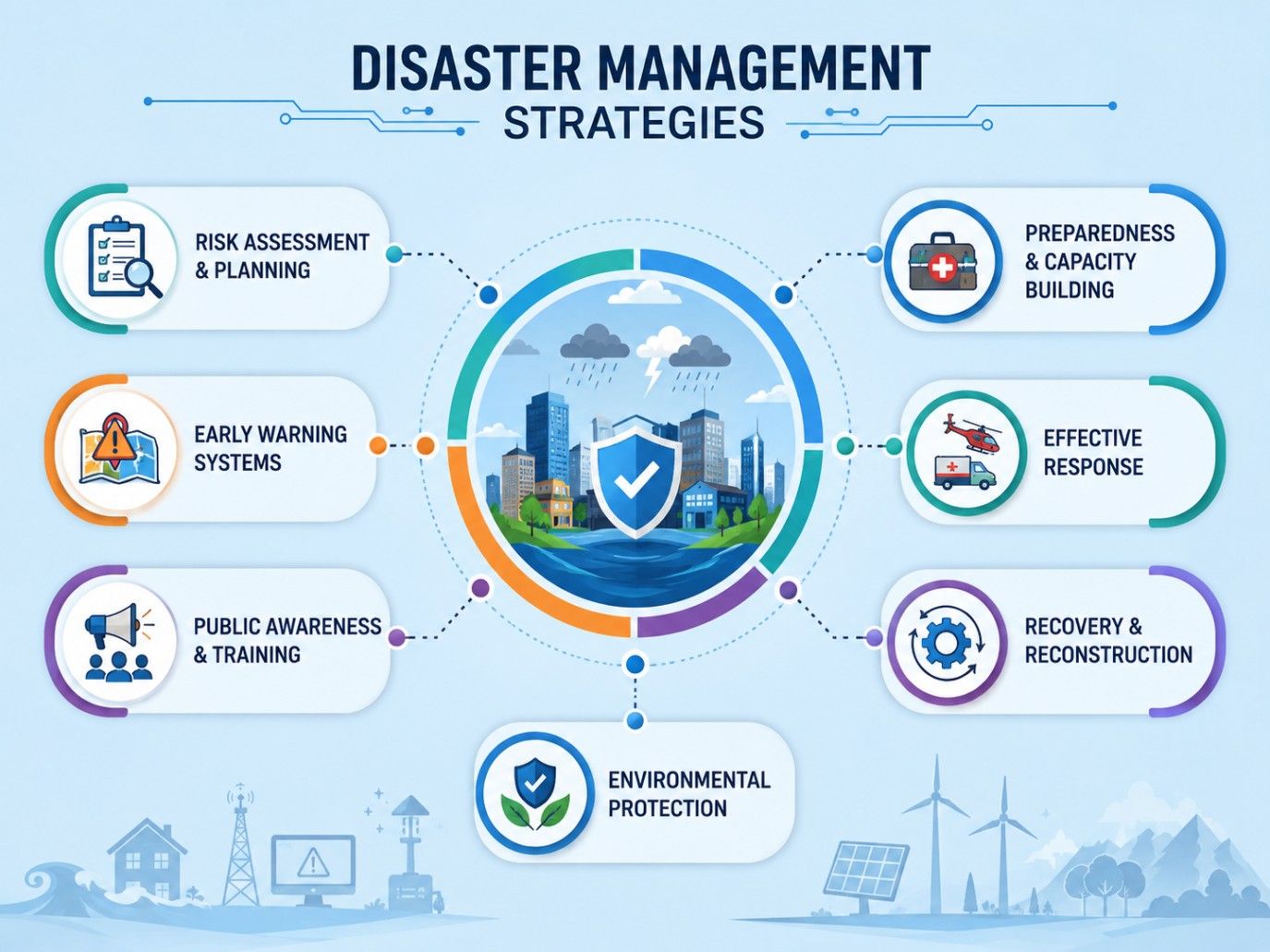
Strong strategies help reduce disaster risks before emergencies occur and improve response when disasters happen. These approaches combine planning, technology, education, and community participation.
Risk Assessment
Risk assessment identifies potential hazards and evaluates their impact. It helps authorities prioritize risks, plan resources, and improve disaster preparedness.
Disaster Risk Reduction (DRR)
Disaster Risk Reduction (DRR) focuses on minimizing risks before disasters occur. It includes safer construction, land-use planning, environmental protection, and public awareness.
Early Warning Systems
Early warning systems provide timely alerts using weather forecasts, satellites, sensors, and mobile notifications. These warnings help communities evacuate safely and reduce casualties.
Emergency Planning
Emergency planning defines evacuation routes, responsibilities, emergency contacts, and response procedures. Regular reviews and disaster drills keep plans effective and improve coordination.
Public Awareness Programs
Public awareness programs educate people about disaster risks through campaigns, workshops, and drills. They encourage better preparedness and safer responses during emergencies.
Climate Adaptation Measures
Climate adaptation measures reduce the impact of climate-related disasters through flood protection, ecosystem conservation, improved water management, and climate-resilient infrastructure.
Also Read: Leadership Styles Cheat Sheet: When to Use Transformational, Servant, or Authoritative Leadership
Disasters cannot always be prevented, but their impact can be significantly reduced through proper planning and timely action. How disaster management reduces risk depends on identifying hazards early, preparing communities, responding quickly, and rebuilding stronger after disasters.
Reducing disaster risk starts long before an emergency occurs. Identifying hazards early helps authorities take preventive measures and protect vulnerable communities.
Key actions include:
Prepared communities are better equipped to respond during emergencies. Proper planning reduces confusion, speeds up evacuation, and minimizes losses.
Preparedness measures include:
A quick and coordinated response limits the impact of disasters. Timely action helps save lives, protect property, and provide immediate relief to affected communities.
This includes:
Recovery is an opportunity to prepare better for future disasters. Rebuilding stronger communities helps reduce risks and improves long-term resilience.
It involves:
Also read : 10 Most Popular Type of Management Style: Understanding and Choosing the Right Approach
Real-world examples show how effective disaster management protects lives and reduces losses across different types of disasters.
Disaster |
Management Approach |
Outcome |
| Earthquake | Rescue, medical aid, reconstruction | Reduced casualties and safer rebuilding |
| Flood | Early warning, evacuation, relief camps | Lower loss of life and property |
| Cyclone | Forecasting, shelters, evacuation | Improved public safety |
| Pandemic | Surveillance, healthcare response, vaccination | Reduced disease spread |
| Wildfire | Fire suppression, evacuation, restoration | Faster containment and ecosystem recovery |
Also read : 10 Most Popular Type of Management Style: Understanding and Choosing the Right Approach
Disaster management isn't without challenges. Identifying these issues helps governments, organizations, and communities improve preparedness, response, and recovery during emergencies.
The most common challenges include:
Also read : What is Decision-making in Management: Explore Types, Tools, & Techniques
Effective disaster management helps reduce the impact of emergencies and supports safer, stronger communities. Its key benefits include:
Also Read: Top Skills You Need to Develop Before Becoming Manager
Strong planning before disasters often determines how successful the response will be. These best practices help governments, organizations, and communities improve disaster preparedness.
1. Develop Emergency Plans
Every organization and community should maintain an emergency response plan that clearly defines roles, evacuation routes, emergency contacts, and resource allocation.
2. Conduct Regular Disaster Drills
Practice builds confidence. Regular drills help people understand emergency procedures and identify weaknesses before an actual disaster occurs.
3. Invest in Early Warning Systems
Reliable forecasting, satellite monitoring, weather radar, and mobile alert systems provide valuable time for evacuation and emergency response.
4. Encourage Community Participation
Local communities often become the first responders. Training volunteers, encouraging public participation, and promoting disaster awareness improve overall preparedness.
5. Strengthen Infrastructure
Resilient buildings, bridges, hospitals, and communication networks continue functioning during disasters, reducing casualties and economic losses.
6. Use Technology for Disaster Response
Modern disaster management relies on technology such as:
These technologies improve decision-making and speed up emergency operations.
Also read : Nature and Scope of Management: Meaning, Functions & Importance
India experiences earthquakes, floods, cyclones, landslides, droughts, and other natural disasters across different regions. To improve preparedness and emergency response, the country has established a structured disaster management framework.
1. Disaster Management Act, 2005
The Disaster Management Act, 2005, provides the legal framework for disaster planning, preparedness, response, and recovery across India. It defines the responsibilities of national, state, and district authorities.
2. National Disaster Management Authority (NDMA)
The NDMA is India's apex body for disaster management. It develops national policies, guidelines, and strategies while coordinating disaster preparedness and risk reduction initiatives.
3. State Disaster Management Authorities (SDMAs)
Each state establishes an SDMA to prepare state-specific disaster management plans, coordinate emergency responses, and work closely with district administrations.
4. National Disaster Response Force (NDRF)
The NDRF consists of specialized rescue teams trained to respond to natural and human-made disasters. These teams conduct search and rescue operations, provide medical assistance, and support relief efforts nationwide.
Understanding the types of disaster management is the first step toward building safer and more resilient communities. From mitigation and preparedness to response and recovery, every stage plays a unique role in reducing disaster risks and protecting lives.
Disasters can't always be prevented, but their impact can be significantly reduced through planning, awareness, strong infrastructure, and coordinated action. Whether you're a student, policymaker, business leader, or concerned citizen, knowing what are the types of disaster management and how they work together helps you make informed decisions before, during, and after emergencies.
Ready to start your journey? Book a free consultation with upGrad today to find the best path for your career.
Disaster planning varies based on local risks and infrastructure. Urban areas focus on high population density, traffic management, and critical infrastructure, while rural regions prioritize accessibility, communication, and community participation. The different types of disaster management are adapted to suit each area's specific challenges and available resources.
Modern disaster management relies on technologies such as artificial intelligence, GIS mapping, drones, satellite imagery, weather forecasting, and mobile alert systems. These tools improve hazard detection, support faster decision-making, and enhance coordination before, during, and after emergencies.
The four main types of disaster management are mitigation, preparedness, response, and recovery. If you want to explain types of disaster management, these stages work together to reduce disaster risks, protect lives, and restore affected communities through continuous planning and coordinated action.
The five common disaster categories are earthquakes, floods, cyclones, droughts, and industrial or technological disasters. Depending on the region, disasters may also include landslides, wildfires, pandemics, and tsunamis, each requiring different preparedness and response measures.
Educational institutions and organizations prepare by conducting evacuation drills, developing emergency response plans, installing warning systems, and training staff. These measures improve readiness and reduce confusion during emergencies while protecting students, employees, and visitors.
For Class 9 students, the types of disaster management include mitigation, preparedness, response, and recovery. Schools often explain types of disaster management using simple examples such as flood preparedness, earthquake drills, and post-disaster rehabilitation to build awareness and safety.
The four stages are mitigation, preparedness, response, and recovery. If you're wondering how many types of disaster management exist, these same four stages form the standard disaster management framework used by governments and emergency organizations worldwide.
India commonly faces earthquakes, floods, cyclones, droughts, landslides, tsunamis, avalanches, heatwaves, cold waves, lightning, biological disasters, and industrial disasters. Authorities apply different types of disaster management strategies depending on the nature and severity of each disaster.
Five major human-made disasters include industrial accidents, chemical spills, nuclear accidents, transportation accidents, and terrorist attacks. These emergencies require specialized planning, strict safety regulations, and coordinated response systems to minimize risks and protect public safety.
Communities are often the first to respond during emergencies. Public participation through awareness programs, volunteer groups, and disaster drills improves preparedness, strengthens local resilience, and supports faster recovery. This also helps explain types of disaster management through practical, real-life actions.
The choice depends on hazard type, geographic location, available resources, and population vulnerability. Authorities conduct risk assessments before selecting appropriate strategies. Knowing how many types of disaster management exist helps planners combine multiple approaches to manage different disaster situations effectively.
727 articles published
Sriram K is a Senior SEO Executive with a B.Tech in Information Technology from Dr. M.G.R. Educational and Research Institute, Chennai. With over a decade of experience in digital marketing, he specia...
Get Free Consultation
By submitting, I accept the T&C and
Privacy Policy
Top Resources
Certification
3 Months
Certification
6 Months
O.P. Jindal Global University
Masters in International Accounting and Finance (Accredited by ACCA, UK)Master's Degree
12 Months