AI in Law: Which Legal Tasks Can AI Handle and What Are the Risks?
By upGrad
Updated on Oct 29, 2026 | 5 min read | 5.91K+ views
Share:

All courses
Certifications
More
By upGrad
Updated on Oct 29, 2026 | 5 min read | 5.91K+ views
Share:
Table of Contents
Artificial intelligence (AI) is transforming the legal profession by speeding up routine tasks, supporting legal research, and changing how law firms work. However, its use also raises concerns about accuracy, data privacy, and client confidentiality.
Quick Insights
Passionate about AI and want to turn your interest in AI into a career skill? Explore upGrad’s Artificial Intelligence courses with hands-on projects, university programs, and career support.
Popular AI Programs
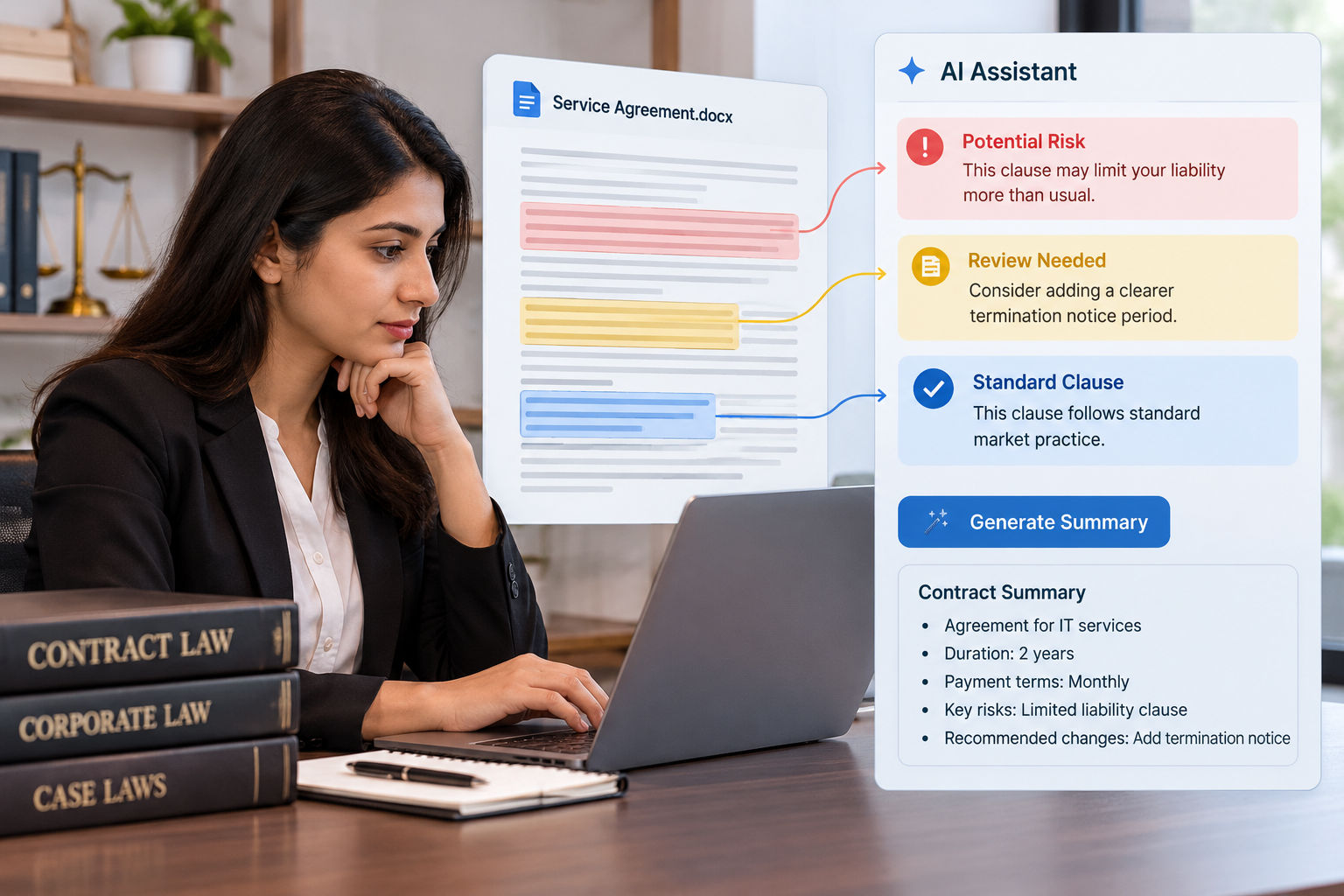
Artificial intelligence is changing how law firms, legal departments, and courts manage their work. It helps legal professionals handle routine tasks, search legal information, and organise documents.
| Area of Law | How AI Is Used |
| Law Firms | Helps with legal research, contract review, document summaries, and preparing first drafts. |
| Courts and Judicial Services | Supports judgment translation, transcription, document analysis, case record management. |
| Corporate Legal Departments | Helps review business contracts, check compliance documents, identify potential issues. |
| Legal Research | Searches case laws, summarises judgments, helps find relevant legal references. |
| Client Services | Supports chatbots, answers routine questions about legal processes, helps organise client information. |
Enroll into IIT Kharagpur’s Executive Post Graduate Certificate in AI-Native Software Engineering Program and transition from traditional architecture to building intelligent, AI-powered systems.
Free Courses
AI tools use different technologies to support legal research, document review, contract analysis, and case management. Each technology serves a different purpose in legal work.
| Technology | How It Is Used in Law |
| Natural Language Processing (NLP) | Helps AI tools analyse legal documents, case laws, and contracts. |
| Machine Learning (ML) | Identifies patterns in legal records and helps classify documents. |
| Generative AI and Large Language Models (LLMs) | Helps draft legal documents, summarise judgments, and answer research questions. |
| Optical Character Recognition (OCR) | Converts scanned legal documents into searchable text. |
| Retrieval-Augmented Generation (RAG) | Helps AI tools generate answers using relevant information retrieved from legal documents or databases. |
| Robotic Process Automation (RPA) | Automates repetitive tasks such as data entry, document filing, and updating case records. |
| Predictive Analytics | Analyses historical legal data to identify patterns and assess potential risks. |
AI Courses to upskill
Explore Artificial Intelligence Courses for Career Progression
AI in law helps with multiple tasks like managing routine work, reviewing large amounts of information, and speed up legal research. However, lawyers still need to check important findings and legal documents.
| Legal Task | How AI Helps |
| Legal Research | Finds relevant case laws, legislation, and legal references. |
| Document Review | Summarises legal documents and extracts important details. |
| Contract Analysis | Identifies key clauses, highlights changes, and flags unusual terms. |
| E-Discovery | Searches digital records and identifies potentially relevant evidence. |
| Due Diligence | Reviews business records and flags possible risks or missing information. |
| Client Communication | Drafts routine emails and answers basic questions about legal processes. |
| Administrative Tasks | Helps organise case files, transcribe meetings, and manage schedules. |
AI tools help lawyers find and understand relevant legal information.
AI helps lawyers review large volumes of documents and find important information.
AI tools help lawyers review contracts and prepare initial drafts.
Explore: Top Free AI Courses with Certificate
E-discovery involves finding digital records that may be useful in a legal case. Due diligence involves checking records before a business deal or other important decision.
AI helps legal teams handle routine communication and daily office work.
Explore: Top 5 Free Law Courses Online
By using AI in law, legal professionals manage routine tasks, review information faster, and organise their work. It can support legal teams by reducing manual effort and leaving more time for complex legal matters.
AI tools can process large volumes of legal information and help lawyers find relevant details quickly.
AI can help law firms reduce time spent on repetitive tasks and manage their workflows more efficiently.
AI can assist lawyers with research, analysis, and preparation, but it does not replace their professional judgment.
Also Read: Corporate Law Subjects List and Syllabus
AI can help legal professionals save time, but it can also lead to errors and other risks. Lawyers must understand these risks and check AI-generated information before using it in legal work.
AI tools can generate incorrect facts, case references, or legal explanations. They may also present false information as if it were correct. If lawyers use this information without checking it, they could make mistakes in legal documents or give clients incorrect advice.
Legal documents often contain sensitive information about clients, cases, and businesses. Uploading this information to AI tools without proper safeguards can expose private data. Lawyers must use secure tools and check how client information is stored and handled.
AI tools can produce biased results because of the data used to train them. They may also provide answers without clearly explaining how they reached a conclusion. This can make it harder for lawyers to identify unfair results and judge whether the information is reliable.
Lawyers remain responsible for their work, even when they use AI tools. They must check AI-generated content, protect client interests, and follow professional rules. Relying on AI without proper review can lead to legal errors and damage client trust.
Dive Deeper: Top 10 Uses of Artificial Intelligence
Subscribe to upGrad's Newsletter
Join thousands of learners who receive useful tips
Legal professionals can use AI to save time and manage routine tasks. However, they must check its output, protect client information, and make important decisions using their own judgment.
Also Read: AI in Data Science
Conclusion:
Use of AI in law is contributing to legal professionals' work. It helps lawyers manage multiple tasks in less time and improve legal research and document review. However, AI also has risks, like incorrect information, data privacy issues, and biased results.
Legal professionals should use AI as a support tool and not a replacement for human judgment. By checking AI-generated information, protecting client data, and reviewing important decisions, lawyers can make better use of AI while maintaining accuracy and client trust.
You can contact our experts to learn about courses in AI and get personalized guidance to start your career in AI.
Related Read:
No. AI can help lawyers with research, document review, and routine tasks, but it cannot replace human judgment. Lawyers are still needed to interpret laws, advise clients, and make important legal decisions.
AI helps legal professionals save time and manage routine work. It can support legal research, contract review, document summarisation, case management, and other tasks.
AI can explain general legal concepts and provide information about laws. However, its answers may be incorrect or incomplete. People should consult a qualified lawyer for advice on their specific legal situation.
AI has several applications in legal work, including:
No. AI can generate incorrect facts, outdated legal information, or false case references. Lawyers must verify its output using reliable legal sources before relying on it.
Yes. Lawyers can use AI to prepare initial contract drafts, review clauses, and compare document versions. They must check the final document to ensure it meets legal requirements and protects their clients' interests.
Law firms can use AI to automate routine tasks, summarise case files, search legal databases, review contracts, and organise documents. They should choose suitable tools and review AI-generated results before using them.
It depends on the tool's security and privacy settings. Legal documents may contain confidential client information. Lawyers should use approved tools, check how data is stored and used, and avoid uploading sensitive information without proper safeguards.
Lawyers remain responsible for reviewing the work they submit or use in their professional practice. They should verify facts, legal references, and conclusions before relying on AI-generated content. Legal responsibility may vary depending on the circumstances and applicable rules.
Yes. AI can help lawyers find relevant case laws, legislation, and judgments. It can also summarise legal documents and compare cases. Lawyers must verify the references and findings using reliable sources.
The main risks include incorrect information, data privacy issues, biased results, and a lack of transparency. Overreliance on AI can also lead to legal errors. Human review and proper safeguards help reduce these risks.
1327 articles published
We are an online education platform providing industry-relevant programs for professionals, designed and delivered in collaboration with world-class faculty and businesses. Merging the latest technolo...
Speak with AI & ML expert
By submitting, I accept the T&C and
Privacy Policy
Top Resources
Master's Degree
18 Months
Executive Diploma
12 Months
IIIT Bangalore
Executive Programme in Generative AI & Agentic AI for LeadersIndia’s #1 Tech University
Dual Certification
5 Months