Agentic AI Engineer: Career Guide
By upGrad
Updated on Sep 29, 2026 | 4 min read | 1.32K+ views
Share:

All courses
Certifications
More
By upGrad
Updated on Sep 29, 2026 | 4 min read | 1.32K+ views
Share:
Table of Contents
Key Highlights
Ready to build skills for a career in AI? Explore agentic AI courses in India to learn AI agents, LLMs, automation, and practical agentic AI development.
Agentic AI Courses to upskill
Explore Agentic AI Courses for Career Progression
IIIT Bangalore
Executive Diploma in Machine Learning and AI360° Career Support
In very simple words, an agentic AI engineer builds AI agents.
Agentic AI engineers create AI systems that have abilities beyond providing a response. They have the ability to divide a goal into sub-tasks, figure out which action to take, communicate with other machines, and learn from feedback for continued progress towards a result.
For example, consider an AI system that does the task of doing competitive research. Such a system might search through available sources, gather relevant information, compare data, prepare a report, and highlight the missing pieces that require more research. This type of agentic AI system is built by an agentic AI engineer.
The role of an agentic AI engineer lies somewhere between software engineering and contemporary AI engineering. On one hand, the person has to have knowledge of how AI models operate. On the other hand, good programming skills and experience in building systems are required, as the agent will run in a technical environment.
This position is not limited to prompt writing. While prompts might play a part in the process, there is a lot more to do like connect models to the tools, design workflows, managing context, testing outputs, and handling failures etc.
The work is more practical than theoretical.
An engineer needs to ask questions such as what should the agent do when a tool fails, how should it handle incomplete information, and when should a human review its decision? Those details determine whether an AI agent works reliably outside a demonstration.
Also read: Future of Agentic AI: How Autonomous AI Will Transform Work
Agentic AI engineers develop systems using their capabilities to undertake multi-step tasks. While the specifics may differ from one organisation to another, the process typically includes model integration, programming, designing workflows, evaluation, implementation, and monitoring.
The engineer first understands the problem. The second step is then determining whether an agent would be the best approach to take. There are some tasks that do not require autonomy, and a workflow might be more reliable than an agent.
After determining the way to go, the engineer plans how the system should be used. It could include picking a language model, crafting instructions, linking tools, establishing rules, incorporating retrieval, and identifying situations where human input is required.
The common responsibilities of an Agentic AI engineer include:
For example, an engineer might build an AI research assistant that connects to company documents, databases, search tools, and reporting software. The agent can then handle most of the research process without needing a person to guide every step.
Agentic AI engineers can build:
System |
What it does |
| AI agents | Complete defined goals through multiple actions |
| Autonomous AI workflows | Execute connected steps with limited intervention |
| Tool-using AI systems | Call APIs, databases, search systems, or software tools |
| Multi-agent systems | Assign different tasks to specialised agents |
| AI-powered assistants | Help users complete complex tasks through interaction |
The important point is that these systems aren't built only around text generation. Their value comes from connecting reasoning with actions.
The average salary of an Agentic AI engineer is an average of ₹12.1 L/yr, ranging from ₹10.2L/yr to ₹13.9L/yr. The top 10% highest-performing and highest-earning people get an average of ₹22.4 L/yr. And the top 1% get an average of ₹40.3 L/yr. Their monthly in-hand salary per month is almost ₹93,400 to ₹95,600.
Experience |
Avg. Salary |
Beginners (1–3 years) |
₹8.7 L/yr |
Mid-level (3–6 years) |
₹11.6 L/yr |
Experienced (6–9 years) |
₹21.8 L/yr |
Source: Ambitionbox
Industry-wise, they are mainly employed in the IT services sector. Here are the top-paying companies for the job role of an Agentic AI engineer.
Company |
Avg. Salary |
TEKsystems |
₹24 L/yr |
SARVAM |
₹19.3 L/yr |
BayOne Solutions |
₹17 L/yr |
Hexaware Technologies |
₹15.8 L/yr |
PwC |
₹9.8 L/yr |
Capgemini |
₹8.3 L/yr |
AgentAnalytics.AI |
₹8 L/yr |
Infosys |
₹6.8 L/yr |
LTM Limited |
₹5 L/yr |
TCS |
₹4 L/yr |
Source: Ambitionbox
Must read: Agentic AI Roadmap: Complete Learning Path for 2026
Here is a practical way to become an Agentic AI engineer:
You have to first start with programming, especially the programming language Python, as it's the language most frameworks use and is beginner-friendly. Learn variables, functions, data structures, object-oriented programming, error handling, files, APIs, and basic software development practices.
You should also become comfortable reading documentation and working with Git. These skills are necessary because agentic applications still need conventional software engineering underneath the AI layer.
Learn the basic ideas behind machine learning, deep learning, natural language processing, and model training. You don't need to become a research scientist before building an agent. You should, however, understand concepts such as training data, inference, model evaluation, embeddings, classification, and neural networks. Cover basic statistics, how neural networks work at a high level, and concepts like overfitting and evaluation metrics.
Explore More: Top Agentic AI Examples Across Industries | 2026 Use Cases
Next, learn how large language models work at a practical level. Learn how tokens, context windows, and temperature work. Practice prompt writing until you can predict how a model will respond to a change. Then study embeddings, vector databases, and retrieval-augmented generation. These let an agent look up facts instead of guessing.
Try different models and observe where they fail.
That experience is needed because an agentic AI engineer needs to design systems around model capabilities and limitations rather than assuming that an LLM will produce the right answer every time.
Once you understand LLM applications, learn how agents use goals, tools, memory, retrieval, planning, and feedback. This is the step that separates the role from general AI work. Study how agents plan, use tools, keep memory and hand tasks to other agents.
Try a framework such as LangGraph, CrewAI or the OpenAI Agents SDK, and read about the Model Context Protocol for connecting tools. Pick one framework and go deep.
Explore agent frameworks and orchestration approaches through small projects.
Also Read: Why AI Is The Future & How It Will Change The Future?
Projects turn theoretical knowledge into evidence of capability.
Start with something manageable, such as a research assistant that gathers information and produces a structured report. Then move toward systems that use multiple tools or complete longer workflows.
Your projects should show what you designed, which tools the agent uses, how you evaluated it, and what happened when something went wrong.
A prototype isn't the finish line. Learn how to evaluate agent responses, test different scenarios, monitor failures, manage access to tools, and deploy applications. Security matters because an agent connected to external systems can take actions that a simple chatbot cannot.
Also Read: Top 15 Agentic AI Books: Best Reads for Every Skill Level
Document your projects clearly. Explain the problem, architecture, workflow, technologies, evaluation approach, and results.
A useful portfolio doesn't need ten projects. Three well-documented projects can show more technical depth than a collection of copied tutorials.
Also Read: Top 10 Agentic AI Project ideas
There is no single requirement needed for every agentic AI engineer role. The requirements might differ from one employer to another based on whether the job is centered on software engineering, machine learning, research, or AI products.
Technical education may offer a good foundation; however, practical skills are essential in this line of work. It is important to show that candidates have the ability to design functional AI systems.
Relevant educational backgrounds include a bachelor's degree in either of these:
Before delving into building an agent, one must be well-versed in programming, API’s, databases, fundamentals of artificial intelligence, and software development.
Understanding of LLM’s and generative artificial intelligence is helpful since modern agentic systems tend to rely on foundation models for reasoning and language generation.
Yes, depending on the role and employer requirements.
A non-CS candidate can build relevant programming and AI skills through structured learning, practical projects, open-source work, and professional experience. The key challenge is filling technical gaps rather than relying on a course certificate alone.
If you're switching careers, start by identifying the fundamentals you don't know yet. Then build projects that prove you can apply them.
Want to build AI skills for real-world business applications? Explore the IIM Kozhikode Professional Certificate Programme in AI for Business Professionals, covering Generative AI and Agentic AI.
Here are the skills required to be an Agentic AI engineer:
Skill area |
What you should know |
Programming |
Python, APIs, Git, software development |
AI and ML |
Machine learning, NLP, model fundamentals |
Generative AI |
LLMs, prompting, embeddings, structured outputs |
Agent development |
Tools, workflows, memory, retrieval, planning |
Software engineering |
Testing, debugging, version control |
Evaluation |
Quality checks, test cases, performance measurement |
Deployment |
Cloud, APIs, monitoring, production basics |
Security |
Permissions, data access, safe tool execution |
System design |
Architecture, trade-offs, failure handling |
Here are the tools, technologies, and frameworks used:
Category |
Common examples |
Language |
Python, TypeScript |
Model providers |
OpenAI, Anthropic, Google, open source models |
Agent frameworks |
LangGraph, CrewAI, AutoGen, OpenAI Agents SDK |
Tool connections |
Model Context Protocol, function calling, REST APIs |
Data and memory |
Postgres, Pinecone, Chroma, Redis |
Evaluation and tracing |
LangSmith, Langfuse, custom test suites |
Deployment |
Docker, AWS, Azure, Google Cloud |
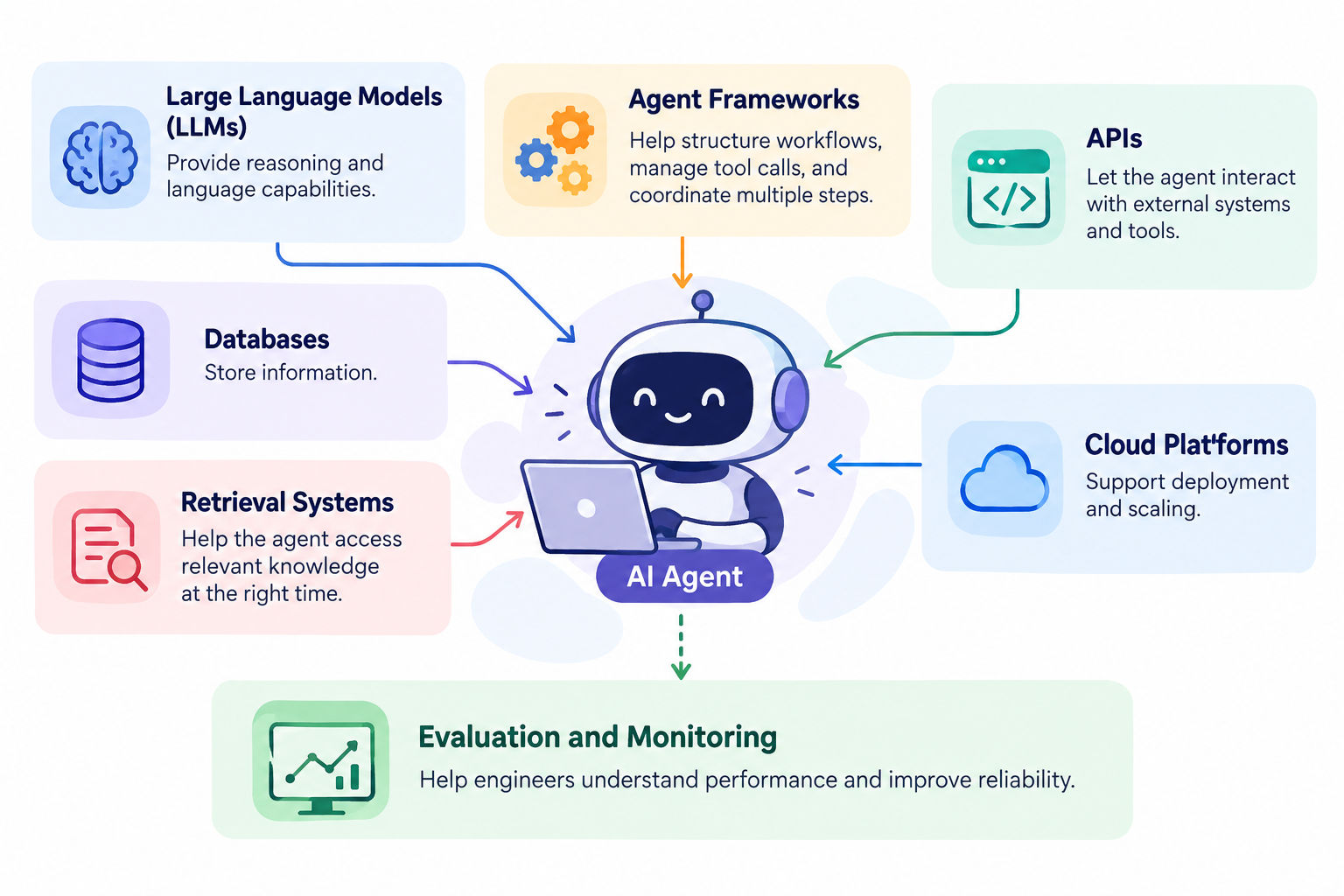
Both roles involve building AI-powered systems; here are the differences .
Area |
Agentic AI Engineer |
AI Engineer |
| Primary focus | AI agents and autonomous workflows | Broader AI applications |
| Core systems | Agents, tool use, multi-step workflows | ML and AI-powered applications |
| Common technologies | LLMs, agent frameworks, APIs, retrieval | ML models, LLMs, APIs, data systems |
| Key concern | Task execution and agent behaviour | Model and application performance |
| Human involvement | Often reduced during task execution | Depends on the application |
AI applications are moving beyond systems that simply generate text or images. Many organisations are exploring systems that can handle several steps, interact with software, retrieve information, and support business workflows.
That shift creates a need for engineers who understand both AI models and software systems.
An agent also introduces engineering problems that a basic chatbot might not have. The system needs rules around tool access, error handling, evaluation, monitoring, and human intervention.
The role is therefore tied to a broader change in how AI applications are being designed. Engineers aren't only integrating models. They're building systems around what those models can do.
Conclusion
An agentic AI engineer combines AI knowledge with software engineering to build systems that can reason through tasks, use tools, and complete multi-step workflows.
The path starts with programming and AI fundamentals, then moves into LLMs, agent development, evaluation, deployment, and security. Practical projects matter because they show whether you can turn those concepts into working systems.
For anyone considering this career, the strongest starting point isn't learning every new AI tool. It's building solid technical foundations and gradually learning how to design reliable agents that solve real problems.
Ready to start your journey? Book a free consultation with upGrad today to find the best path for your career.
An agentic AI engineer may spend time writing code, testing AI-agent workflows, integrating APIs, evaluating model outputs, fixing failures, and improving system performance. Daily work varies by project, but software engineering and AI development usually form the core of the role.
Software developers already have several useful foundations for this field, including programming, APIs, debugging, version control, and system design. They still need to learn LLMs, retrieval, agent workflows, evaluation, and AI-specific failure modes before moving into specialised agentic AI work.
You should be comfortable writing and debugging Python rather than simply copying code from tutorials. Functions, classes, data structures, APIs, error handling, packages, and basic software architecture are useful foundations for building practical AI-agent applications.
Yes, a working understanding of machine learning helps, although you don't necessarily need advanced research-level knowledge. Understanding models, embeddings, inference, evaluation, NLP, and basic deep learning makes it easier to design applications around the strengths and limitations of AI systems.
After learning LLM fundamentals, focus on building applications that use models with tools, retrieval, structured outputs, memory, and workflows. Then learn evaluation and deployment. Building progressively harder projects will help connect individual concepts into working agentic systems.
A chatbot primarily responds to user input, while an AI agent can be designed to pursue a goal through multiple steps. An agent may decide which tool to use, retrieve information, perform an action, evaluate its result, and continue the workflow.
A person from a non-technical background can transition into the field, but they'll need to develop programming and AI foundations first. The transition becomes more practical when learning is paired with projects that demonstrate coding ability and understanding of AI-agent workflows.
A useful portfolio project should show more than a working chatbot interface. Explain the problem, architecture, model choice, tools, workflow, evaluation method, limitations, and results. Projects that demonstrate thoughtful handling of failures can show stronger engineering ability than simple demonstrations.
No. Multi-agent systems are one approach to agentic application design, not a requirement for every project. A well-designed single agent can be more appropriate when the task is straightforward. Engineers should choose the architecture based on the problem rather than adding agents for complexity.
Testing can include predefined scenarios, tool-use checks, output evaluation, failure cases, security tests, and repeated runs with different inputs. The goal is to understand whether the agent completes tasks reliably and behaves appropriately when information, tools, or instructions don't match the expected conditions.
Highlight programming, AI and LLM experience, agent development, APIs, retrieval, deployment, and relevant projects. Describe what you built and what the system achieved instead of only listing tools. Quantifiable project results can make technical experience easier for recruiters to understand.
1008 articles published
We are an online education platform providing industry-relevant programs for professionals, designed and delivered in collaboration with world-class faculty and businesses. Merging the latest technolo...
Speak with AI & ML expert
By submitting, I accept the T&C and
Privacy Policy