AWS Agentic AI: A Beginner’s Guide
By Sriram
Updated on Jun 16, 2026 | 7 min read | 2.52K+ views
Share:

All courses
Certifications
More
By Sriram
Updated on Jun 16, 2026 | 7 min read | 2.52K+ views
Share:
Table of Contents
AWS Agentic AI takes things a step further than your typical Q&A bot. Instead of just answering questions, it can break down a complex goal into smaller steps, figure out what tools it needs, and get the task done with minimal human intervention.
For businesses, this means you can build smarter workflows that handle multi-step tasks like customer service, data management, and infrastructure automation with a lot less manual intervention."
In this blog you will learn what AWS agentic AI is, how AWS agentic AI works, the technologies use, the role of the AWS agentic AI framework, benefits, the challenges of AWS agentic AI and some practical ways to implement.
Curious about AI systems like AWS Agentic AI? Explore upGrad's Agentic AI Courses Online covering agentic AI, machine learning, and emerging technologies for career growth.
Agentic AI Courses to upskill
Explore Agentic AI Courses for Career Progression
IIIT Bangalore
Executive Diploma in Machine Learning and AI360° Career Support
At the heart of AWS agentic AI is an AI systems that can function on their own by using reasoning, planning, memory and taking action within the AWS ecosystem.
Old style AI systems usually just do what they are told. Agentic AI does more than that. It can do things like:
These days companies want artificial intelligence systems that can make decisions on their own use of tools, work with software, and get tasks done with little help from humans. This change has led to the rise of AWS AI, which is a new way of performing tasks that allows companies to build smart agents that can think, plan and act all by themselves.
Traditional AI systems typically respond to prompts. Agentic AI goes further. It can:
Feature |
Traditional AI |
Agentic AI |
| Responds to prompts | Yes | Yes |
| Uses external tools | Limited | Yes |
| Multi-step planning | No | Yes |
| Autonomous actions | Rare | Yes |
| Memory and context | Basic | Advanced |
| Task orchestration | Limited | Extensive |
Also Read: Agentic AI Learning Path: A Complete Guide for Developers and AI Professionals
AWS Agentic AI is built on several core components that work together seamlessly, from foundation models to orchestration layers.
Each piece plays a critical role in enabling intelligent, autonomous, multi-step task execution:
Also Read: AWS Architecture Explained: Function, Components, Deployment Models & Advantages
The user sees one conversation, while the agent performs multiple actions behind the scenes. Imagine a travel planning assistant.
Instead of only answering questions, it can:
This autonomous behavior is what makes AWS agentic AI fundamentally different from traditional AI systems.
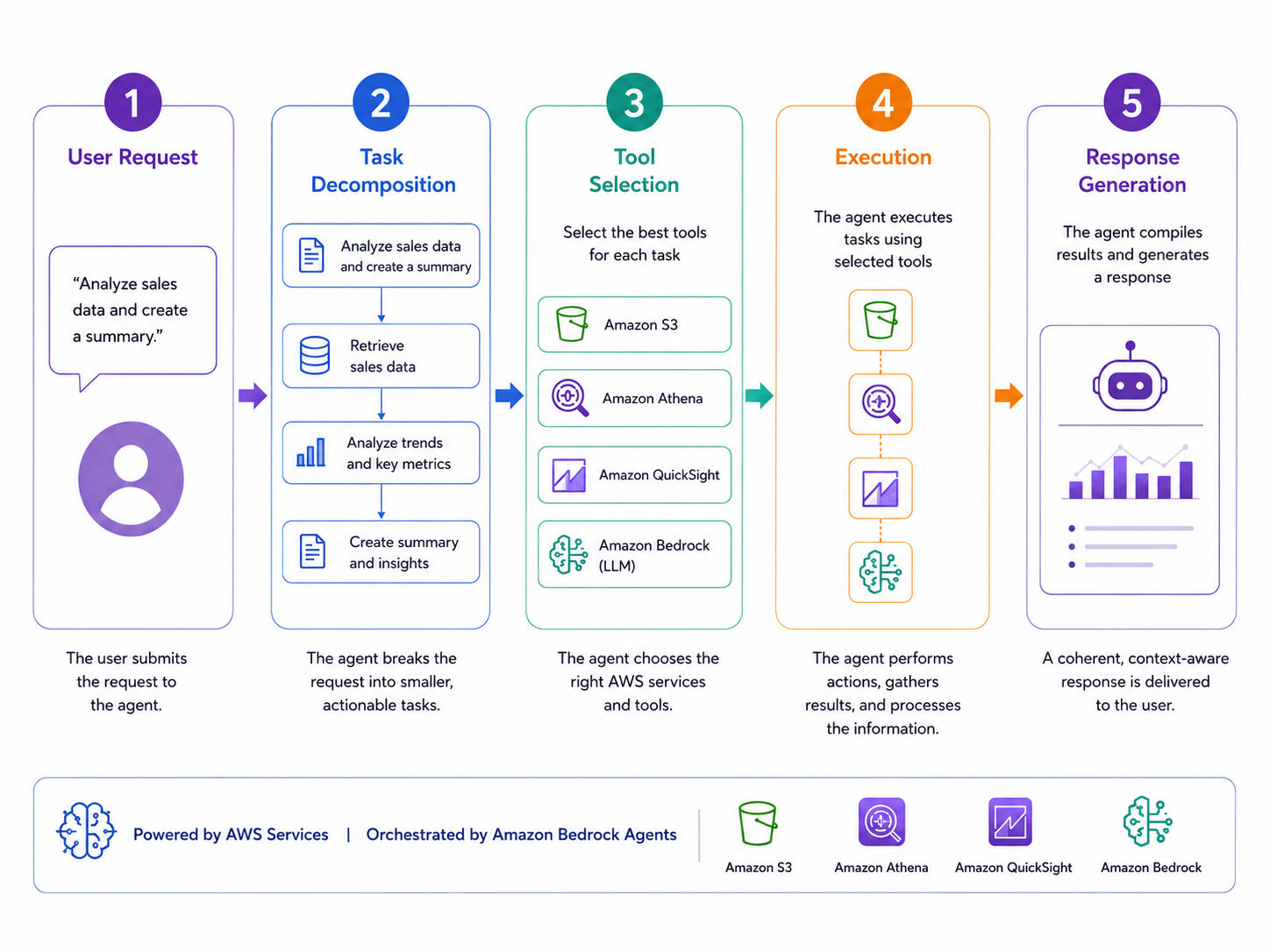
Getting a feel for how AWS Agentic AI actually works can help developers build smarter, more reliable AI solutions.
At a high level, it follows a simple loop: input, reasoning, planning, tool usage, execution, and response.
Instead of asking a straightforward question, the user hands over a goal.
Example: "Analyze last month's sales data and identify the top-performing products."
The agent takes that goal and breaks it down into smaller, manageable tasks.
Task |
Purpose |
| Retrieve sales data | Gather information |
| Clean data | Remove inconsistencies |
| Analyze performance | Generate insights |
| Create summary | Deliver findings |
Next, the agent figures out which tools it actually needs to get the job done. Depending on the task, that could include databases, CRM systems, APIs, internal applications, or analytics platforms.
With the right tools in hand, the agent gets to work, carrying out actions and pulling together the results it needs.
Finally, everything comes together. The agent compiles all the information it's gathered into one clear, useful response for the user.
Amazon Bedrock provides much of the infrastructure powering modern aws agentic ai implementations.
Key capabilities include:
Also Read: What is AWS: Introduction to Amazon Cloud Services
Many organizations spend significant development effort integrating AI with existing systems.
AWS reduces complexity by providing:
This allows teams to focus more on business outcomes and less on infrastructure management.
As organizations scale AI initiatives, the need for more specialized agents increases. This is where the AWS multi-agent AI framework becomes especially valuable.
AWS agentic ai is often used for:
Also Read: Artificial Intelligence in HR: How AI Is Revolutionizing HRM
When we think about intelligence systems, they are getting really good at their tasks. Different jobs need intelligence systems with different skills and knowledge, so different AI systems are needed for different tasks.
This challenge has led to the rise of the AWS multi-agent AI framework. A multi-agent architecture uses multiple specialized agents working together under a coordinated system.
Instead of one AI handling everything, each agent focuses on a specific area.
A common architecture includes:
Agent Type |
Responsibility |
| Supervisor Agent | Coordination |
| Research Agent | Information gathering |
| Analysis Agent | Data interpretation |
| Action Agent | Task execution |
| Validation Agent | Quality checks |
A financial assistant could include:
A supervisor agent routes tasks to the right specialist.
Also Read: Understanding Multi Agent Systems: A Complete Beginner Guide
According to AWS, multi-agent collaboration allows a supervisor agent to coordinate specialized collaborator agents that handle different aspects of a workflow. The supervisor creates plans, delegates tasks, and combines outputs into a final response.
The AWS multi-agent ai framework is most useful when:
For smaller applications, a single-agent design may still be sufficient. The key is balancing complexity with business value.
The growing use of AWS agentic AI is motivated by its ability to automate complex workflows that once required human coordination.
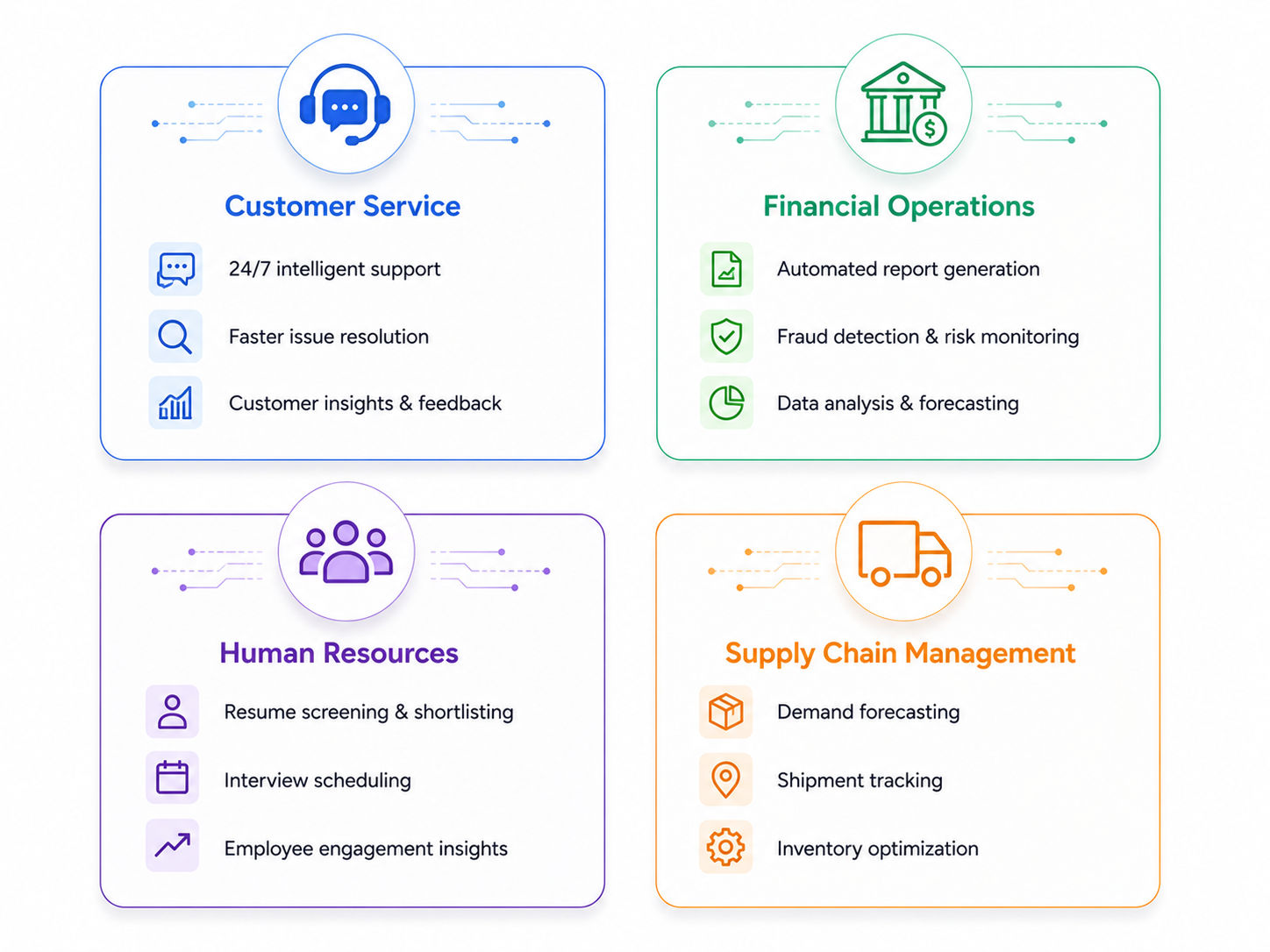
Several industries are now using agents for these workflows. This is because agents that are experts in areas can work well together. They do a job, then one system works alone.
Agents can:
AI agents can:
Applications include:
Agents help:
Challenge |
Impact |
| Security | Data protection concerns |
| Governance | Decision transparency |
| Cost Management | Increased resource usage |
| Monitoring | Complex workflows |
| Reliability | Agent coordination issues |
When implementing AWS agentic AI:
AWS agentic AI represents a significant shift from traditional AI applications toward autonomous systems that can reason, plan, and act. Instead of simply responding to prompts, these agents can complete complex workflows, interact with enterprise systems, and make decisions based on context.
As AI adoption continues to accelerate, understanding AWS agentic AI is becoming an important skill for developers, architects, and business leaders. Organizations that learn how to design effective agentic systems today will be better positioned to benefit from the next generation of AI-powered automation.
Want to explore more about AWS agentic AI? Book your free 1:1 personal consultation with our expert today.
AWS agentic AI refers to AI systems that can think through tasks, plan actions, use tools, and complete workflows with minimal human input. Unlike traditional chatbots, these agents can interact with software, databases, and APIs to accomplish goals. AWS provides services such as Amazon Bedrock Agents to help developers build these intelligent systems more easily.
Generative AI focuses mainly on creating content such as text, images, or code. AWS agentic AI goes beyond generation by allowing AI systems to make decisions, take actions, and complete tasks. This makes agentic AI more useful for business automation and operational workflows.
The AWS multi-agent ai framework is an architecture where multiple specialized AI agents collaborate to solve complex problems. Each agent handles a specific responsibility while a supervisor agent coordinates the overall workflow. This approach improves scalability, flexibility, and performance.
Several AWS services contribute to agentic AI development, including Amazon Bedrock, Bedrock Agents, AgentCore, Knowledge Bases, Lambda, DynamoDB, and API Gateway. Together, these services provide the infrastructure needed to build autonomous AI systems.
Yes. AWS provides managed services that reduce the need for deep infrastructure expertise. Developers can start with simple agents and gradually add advanced features such as memory, orchestration, and multi-agent collaboration. Learning cloud fundamentals and prompt engineering is still helpful.
Organizations use AWS agentic ai to automate workflows, improve productivity, reduce operational costs, and enhance customer experiences. It is particularly valuable in areas such as customer support, finance, HR, and supply chain operations.
A multi-agent design is useful when workflows become too large or complex for a single agent. If tasks require different expertise, tools, or business rules, the AWS multi-agent ai framework often delivers better performance. Smaller use cases may work well with a single agent.
AWS includes security features such as identity controls, encryption, guardrails, monitoring, and governance capabilities. These features help organizations build secure AI applications while meeting compliance requirements. Security planning should still be part of every implementation.
Memory allows agents to remember previous interactions and maintain context across sessions. This helps create more personalized and consistent experiences. Long-term memory can improve decision-making and workflow efficiency.
Financial services, healthcare, retail, manufacturing, logistics, and customer support are among the fastest adopters of AWS agentic AI. These industries benefit from automation, data analysis, and intelligent decision-making capabilities.
The AWS multi-agent ai framework is expected to become a standard approach for enterprise AI applications. As organizations build larger and more specialized systems, multiple agents working together will often outperform single-agent designs. Future developments will likely focus on better orchestration, governance, memory, and scalability.
727 articles published
Sriram K is a Senior SEO Executive with a B.Tech in Information Technology from Dr. M.G.R. Educational and Research Institute, Chennai. With over a decade of experience in digital marketing, he specia...
Speak with AI & ML expert
By submitting, I accept the T&C and
Privacy Policy