Agentic Workflows: A Guide to AI-Powered Autonomous Execution
By Sriram
Updated on Aug 05, 2026 | 7 min read | 2.72K+ views
Share:

All courses
Certifications
More
By Sriram
Updated on Aug 05, 2026 | 7 min read | 2.72K+ views
Share:
Table of Contents
Businesses have spent years making machines do repetitive tasks. Most automation systems still rely on set rules and people to oversee them. This is where workflows that can think and act on their change everything. Of following strict instructions they can look at situations, make choices use tools and adjust what they do based on what happens.
In this guide, you will learn what these smart workflows are, how they work, and why they are becoming crucial in today's companies. You will also see how businesses can use them to automate tasks. Additionally, you will explore the parts, real-life examples, challenges of implementing them, and tips for success.
Explore Agentic AI Courses Online in upGrad and build the skills needed to work with next-generation intelligent systems.
Agentic AI Courses to upskill
Explore Agentic AI Courses for Career Progression
IIIT Bangalore
EPGP in Applied AI and Agentic AIIIIT Bangalore
Executive Diploma in Machine Learning and AI360° Career Support
Agentic workflows are like computer programs that can think for themselves. They use intelligence to plan things think about what to do make choices and then do tasks without people having to get involved very much. This is different from the way of doing things automatically where computers just follow a set of rules.
Agentic workflows can change what they do when things change around them. They use the information they have to figure out what to do next. Agentic workflows are really good, at using the information they have to make decisions.
At the center of these workflows are autonomous AI agents. These agents are powered by an LLM and connected to various Tools & APIs that allow them to interact with software, databases, websites, and business systems.
Also Read: Top Agentic AI Tools in 2026 for Automated Workflows
Agentic workflows work in an organized way to make decisions. This helps the Artificial Intelligence systems go from having a goal to actually finish the task.
The process usually starts when the Artificial Intelligence system gets a task to do. Then it. Looks at the important information, makes a plan based on what it has and does what it needs to do to get the result it wants.
As the Artificial Intelligence system does the tasks, it always checks how things are going find, any problems and makes changes if it needs to. This ability to check progress and change things as it goes allows Agentic workflows to handle tasks, with many steps very efficiently and people do not have to get involved very much.
Agentic workflows can think in a flexible way not just following set rules. They can look at a situation make a decision based on the facts adjust to new information and learn from what happens.
This helps them do tasks that are more complicated and need a human touch like making smart choices in uncertain situations. The system can even get better over time by learning from its experiences.
The following characteristics are what enable agentic workflows to operate effectively and deliver more intelligent, flexible automation.
Also Read: Agentic AI Architecture: Components, Workflow, and Design
1.Goal-Oriented Execution
Rather than following rigid scripts, the system focuses on achieving an outcome.
2. Dynamic Decision Making
The workflow evaluates different paths using Probabilities instead of fixed rules.
3. Real-Time Adaptation
Agents respond to real-time data and changing environments.
4. Continuous Improvement
They use Feedback Loops to evaluate outcomes and improve future performance.
In Gartner’s prediction, the year 2026 task-specific AI agents will be part of 40 percent of the applications that big companies use. This is a change from 2025 when task-specific AI agents were used in less than 5 percent of these applications.
Gartner says this is how task-specific AI agents will become more common, in enterprise applications and it will happen by 2026.
This shift is happening because organizations want automation that goes beyond repetitive tasks and can handle decision-heavy business operations.
Also Read: Future of Agentic AI
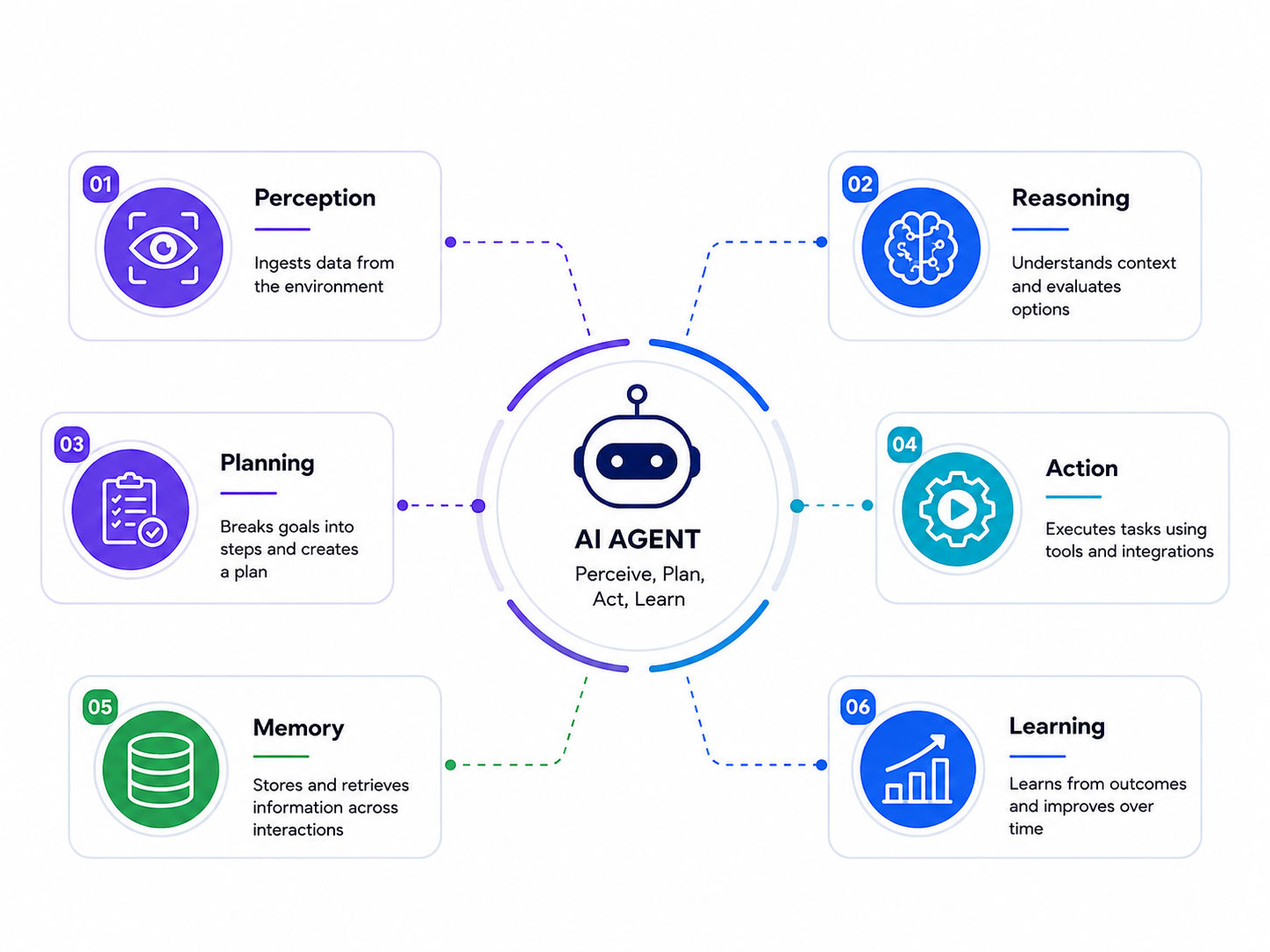
Understanding the building blocks of agentic workflows helps explain why they are more powerful than conventional automation systems.
The LLM acts as the reasoning engine.
It helps agents:
However, the LLM alone is not enough. Agentic systems require additional components to function effectively.
Also Read: What are the Different Types of LLM Models?
Every workflow starts with Structured instructions. Good instructions improve consistency and reduce unexpected behavior.
These define:
Organizations often convert existing standard operating procedures into machine-readable workflows.
Examples include:
Research on SOP automation shows agentic systems can effectively translate workflow documentation into executable actions.
Agents need external capabilities. Without Tools & APIs, an agent can reason but cannot act.
Common Tools & APIs include:
Tool Type |
Purpose |
| CRM APIs | Customer management |
| ERP APIs | Operations management |
| Search APIs | Information retrieval |
| Database APIs | Data access |
| Email APIs | Communication |
| Analytics APIs | Reporting |
Feedback Loops are critical.
They allow agents to:
For example, if an agent sends an invoice and gets an error response, the agent can find out what the problem is and try again with the information. The agent can look at the invoice again. Fix the mistakes. This way, the agent can send the invoice again with the information.
One of the most important concepts is Closing the Loop.
This means the workflow does not stop after taking action. Instead, it verifies whether the desired outcome was achieved.
For example:
Without Closing the Loop, automation remains incomplete.
Traditional systems rely on deterministic code.
Agentic systems combine:
Approach |
Strength |
| Deterministic code | Reliability |
| Probabilities | Flexibility |
The best systems use deterministic code for critical actions and probabilistic reasoning for decision-making. This balance helps organizations move closer to flawless reliability while maintaining adaptability.
The biggest advantage of agentic workflows is their ability to automate work that previously required human judgment.
1.Faster Operations
Agents can execute tasks continuously without waiting for human intervention.
2. Improved Scalability
Organizations can achieve Scaling Operations without increasing headcount at the same rate.
3. Better Decision Making
Access to real-time data improves accuracy and responsiveness.
4. Error Recovery
Agents can self-correct errors using validation mechanisms and Feedback Loops.
5. Reduced Manual Work
Routine decisions become automated while humans focus on strategic tasks.
Also Read: What Is Agentic AI? The Simple Guide to Self-Driving Software
Agentic workflows are already transforming how businesses automate complex tasks, make decisions, and improve efficiency.
The following real-world examples highlight how organizations are leveraging agentic workflows to streamline operations and deliver better outcomes.
An autonomous AI agent can:
Agentic workflows can:
Organizations use AI-driven processes for:
Agents monitor systems and:
Workflows can coordinate:
Not every project succeeds.
Recent Gartner research predicts that more than 40% of agentic AI projects could be canceled due to unclear value, rising costs, and governance issues.
Common reasons include:
Many organizations discover that successful deployment depends more on process design than AI model selection.
Creating successful agentic workflows requires more than connecting an LLM to a few APIs.
Start with measurable outcomes.
Examples:
Clear goals help agents make better decisions.
Many companies begin by converting existing standard operating procedures into workflow logic.
Document current workflows Identify:
High-quality Structured instructions reduce ambiguity.
Include:
Agents need access to operational systems through APIs and scripts.
Examples include:
These integrations enable agents to take action rather than simply generate responses.
Build validation mechanisms.
Agents should:
This helps systems self-correct errors before they impact users.
Organizations should not immediately aim for full autonomy.
A practical model includes:
Level |
Description |
| Observe | Read-only recommendations |
| Advise | Suggestions with approval |
| Act with Approval | Human verification required |
| Autonomous | Independent execution |
This governance approach aligns with recent enterprise recommendations.
Continuous monitoring supports Scaling Operations while maintaining quality.
Track:
Feature |
Traditional Automation |
Agentic Workflows |
| Decision-making | Rule-based | Context-aware |
| Adaptability | Low | High |
| Data handling | Structured only | Structured and unstructured |
| Learning capability | Limited | Continuous improvement |
| Human involvement | Frequent | Minimal human intervention |
As autonomous AI agents become more capable, organizations will increasingly rely on AI-driven processes that coordinate multiple agents across departments.
The long-term goal is not replacing people. It is enabling humans and intelligent systems to collaborate more effectively while automating repetitive decision-making work.
Agentic workflows are an improvement over the old way of doing things with automation. The ability to make decisions in real time allow businesses to automate tasks that once needed manpower to watch over.
To make this work you need to plan it out to have good rules in place to get accurate information and know what you want to achieve. Companies that focus on using workflows in a practical way rather than just getting caught up in the excitement are more likely to get good results.
As artificial intelligence gets better, agentic workflows will become more important, businesses will use workflows to improve how they work to make their operations bigger and deliver better results with minimal human intervention, which is a key part of agentic workflows.
Want personalized guidance on Agentic Workflows learning? Speak with an expert for a free 1:1 counselling session today.
Traditional AI automation follows predefined rules and workflows. Agentic workflows can reason, adapt, make decisions, and adjust actions based on changing circumstances. This flexibility allows them to handle more complex tasks while requiring less manual oversight.
No. Autonomous AI agents are individual decision-making entities. Agentic workflows are broader systems that coordinate agents, tools, APIs, instructions, and feedback mechanisms to achieve larger business objectives.
Most modern implementations use an LLM because it provides reasoning and language understanding capabilities. However, some workflows combine LLMs with deterministic code and specialized machine learning models for better performance and reliability.
They can operate with minimal human intervention, but complete autonomy is not always advisable. Many organizations implement approval checkpoints, governance controls, and monitoring systems to reduce risks while maintaining efficiency.
Customer support, healthcare, finance, logistics, manufacturing, software development, and IT operations are among the industries seeing strong adoption. Any sector with repetitive decision-making processes can benefit from agentic workflows.
Feedback Loops allow agents to evaluate outcomes, identify failures, and make adjustments. This continuous evaluation process improves performance over time and helps systems self-correct errors before they become significant problems.
APIs give agents access to external systems and business applications. They allow workflows to retrieve information, update records, trigger actions, and interact with software platforms in real time.
Yes, when designed properly. The most successful implementations combine deterministic code, structured governance, monitoring systems, and human oversight to improve reliability and reduce operational risks.
They continuously gather information from connected systems, APIs, and databases. This enables agents to make decisions based on current conditions rather than relying on static rules or outdated information.
Common challenges include unclear objectives, poor-quality data, weak governance, integration complexity, and unrealistic expectations. Organizations that start with focused use cases often achieve better results than those attempting large-scale deployments immediately.
In most cases, they are designed to augment human work rather than replace it. They automate repetitive tasks, accelerate decision-making, and free employees to focus on higher-value strategic and creative responsibilities.
An Agentic AI and Gen AI course online teaches you to build intelligent systems using LLMs, Retrieval-Augmented Generation (RAG), prompt engineering, and AI agents that can reason, plan, and automate workflows. upGrad's industry-aligned programmes combine hands-on projects, expert mentorship, and recognized certifications to prepare learners for real-world AI roles.
724 articles published
Sriram K is a Senior SEO Executive with a B.Tech in Information Technology from Dr. M.G.R. Educational and Research Institute, Chennai. With over a decade of experience in digital marketing, he specia...
Speak with AI & ML expert
By submitting, I accept the T&C and
Privacy Policy