Prompt Chaining: A Beginner's Guide to Building Better AI Workflows
By Sriram
Updated on Jun 14, 2026 | 6 min read | 2.61K+ views
Share:

All courses
Certifications
More
By Sriram
Updated on Jun 14, 2026 | 6 min read | 2.61K+ views
Share:
Table of Contents
Prompt chaining is about splitting a task into smaller steps that build on each other instead of jamming everything into one instruction, and the payoff is usually more accurate, consistent, and manageable output. With simple requests, an AI model can usually be handled in one shot. But as soon as a task involves multiple stages, researching, drafting, editing, formatting a single prompt tends to buckle under the weight.
In this guide, we'll cover what prompt chaining actually is, how it works, when it's worth using, and how it compares to a chain of thought prompting. We'll also walk through real examples, common use cases, mistakes people make, and a few best practices all useful whether you're working with ChatGPT, Claude, Gemini, or some other AI system.
Explore Artificial Intelligence Courses from upGrad and increase your generative AI skills.
Generative AI Courses to upskill
Explore Generative AI Courses for Career Progression
IIIT Bangalore
EPGP in Applied AI and Agentic AIIIIT Bangalore
Executive Diploma in Machine Learning and AI360° Career Support
At a basic level, prompt chaining means taking the output from one prompt and feeding it in as the input for the next. Rather than handing an AI model, which is one big, complicated instruction, you split the work into stages and link them together
Think of it like setting up a small workflow. Instead of asking for everything at once
"Research a topic, create an outline, write a blog, edit it, and optimize it for SEO."
you'd break that into separate steps:
Each step picks up where the last one is left off.
Term |
Meaning |
| Prompt Chaining | Linking several prompts together to complete a bigger task |
| Single Prompt | One instruction used to produce one output |
| Workflow | A sequence of connected prompts |
| Intermediate Output | The result produced at each individual step |
Language models tend to do better when a task is clearly structured. There's a fair amount of evidence both from research and from people using these tools day to day that breaking a big problem into smaller stages improves reliability and gives you more control over the result, rather than throwing one massive instruction at the model and hoping it figures everything out.
Read: Prompt Engineering Training: Key Skills & Career Opportunities
Say you want an AI to put together a business report.
That connected sequence each step feeding the next is prompt chaining in action
At this point, prompt chaining isn't really an "advanced trick" for a lot of real-world AI workflows, it's just the standard way of doing things.
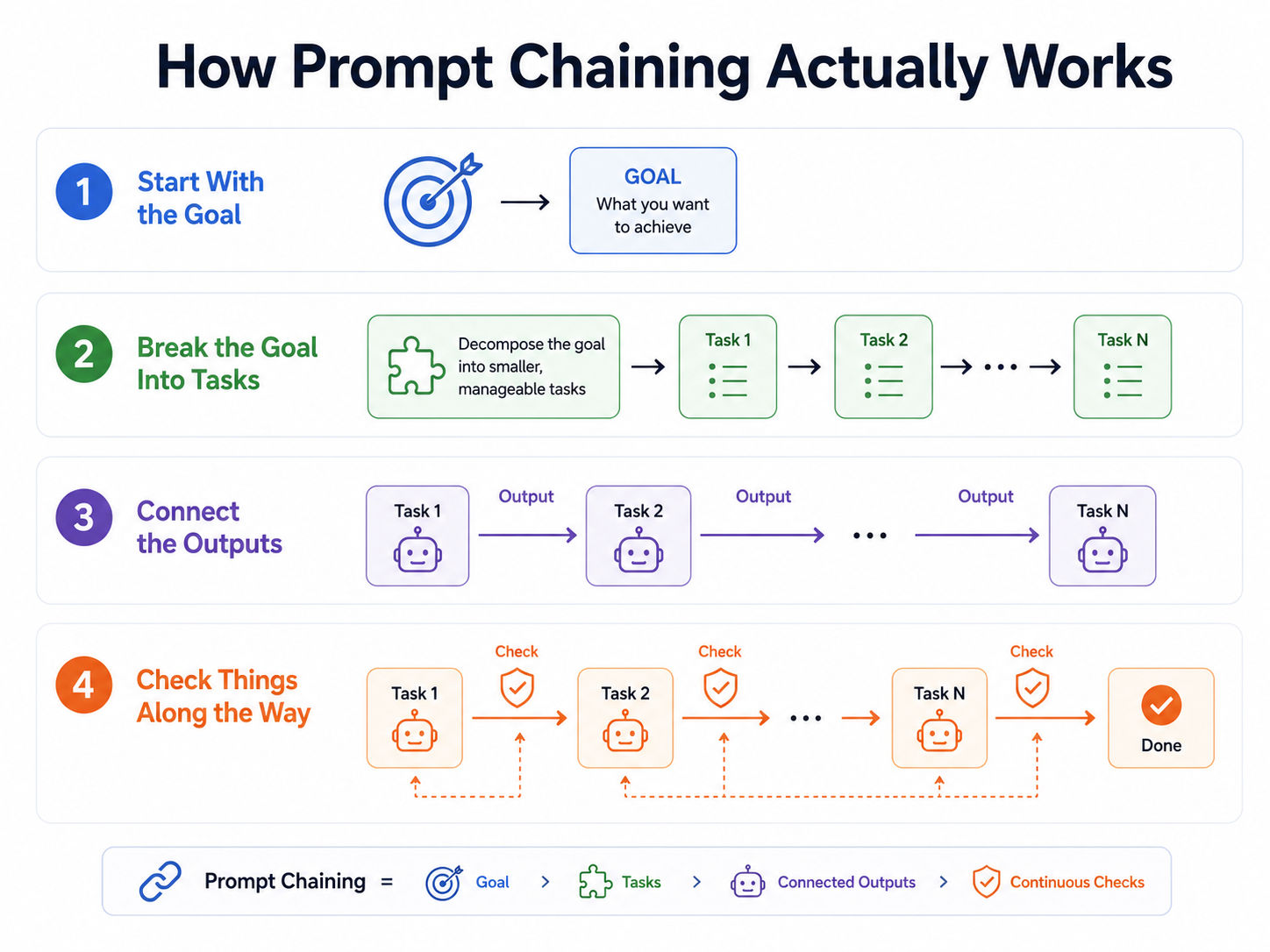
The core idea is pretty straightforward: split the task up, run each piece, and connect the outputs together. Instead of one prompt trying to do everything, each prompt has a single, well-defined job.
Begin by deciding what you actually want at the end a blog post, a market analysis, a working piece of code, a customer support flow, whatever it might be.
Take that goal and split it into smaller pieces. For a blog post, that might look like:
Each step's output becomes the context for the next one:
Research → Outline → Draft → Edit → Final Version
Reviewing outputs between stages lets you catch and fix problems early before they ripple through the rest of the workflow.
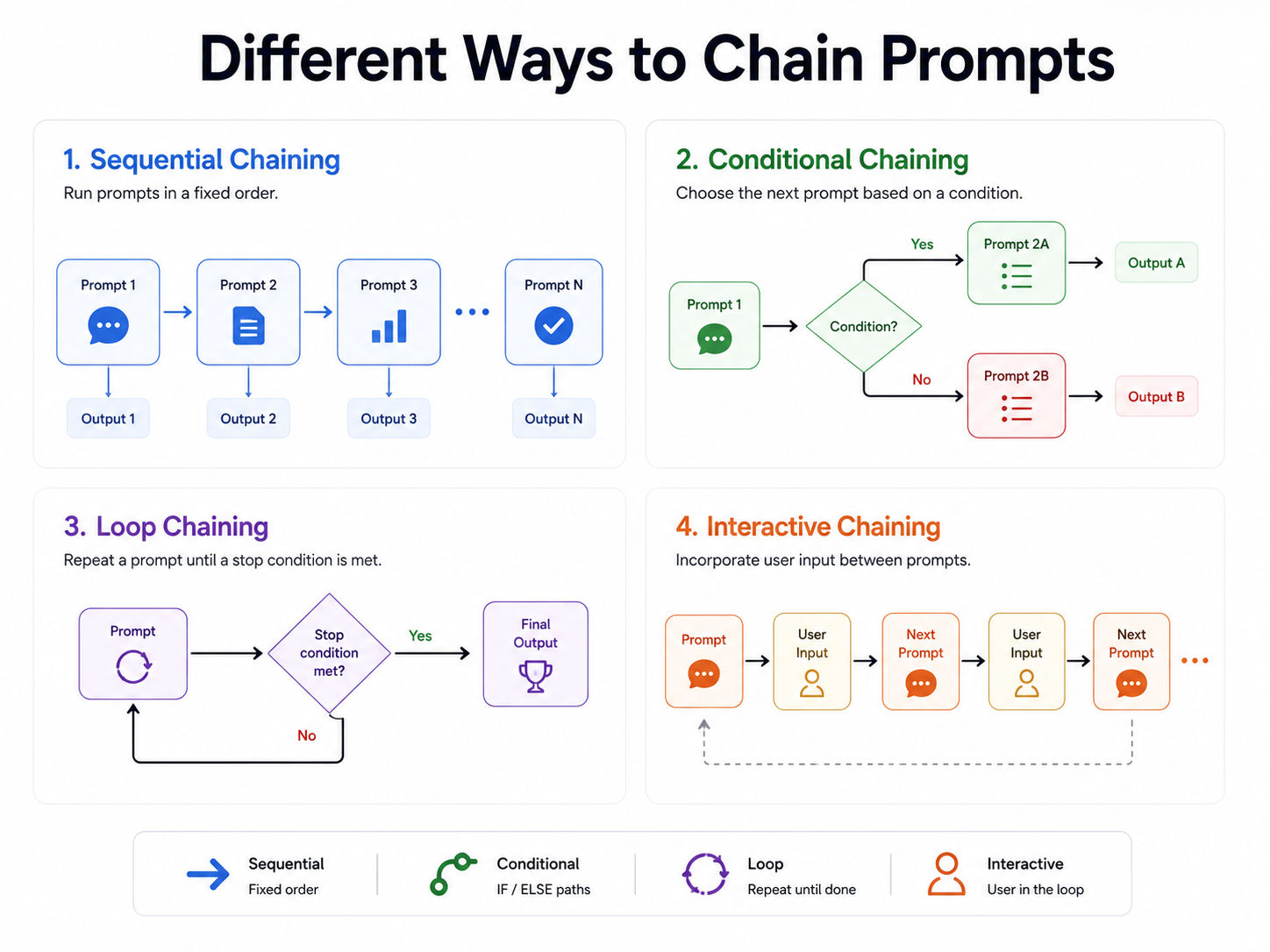
Sequential Chaining
This is the most common pattern each prompt simply follows from the one before it.
Example: Research → Summary → Blog → SEO Review
Conditional Chaining
Here, what happens next depends on the result of the previous step.
Example: If the sentiment comes back positive → generate a marketing message. If it's negative → generate improvement recommendations instead.
Loop Chaining
The same prompt (or set of prompts) repeats until the output meets a certain bar.
Example: Generate code → test it → fix errors → test again, repeating until it passes.
Interactive Chaining
A person reviews the output between steps before the chain continues.
Example: Draft gets created → a human reviews it and gives feedback → that feedback becomes the input for a revision prompt.
Single Prompt |
Prompt Chaining |
| Faster to set up | More controlled |
| Simpler | Better suited to complex tasks |
| Higher chance of mistakes | Easier to troubleshoot |
| Limited visibility into the process | Clear, distinct workflow stages |
A common observation among people who work with these tools regularly is that breaking a task into a chain of focused prompts tends to outperform one giant "mega-prompt" mainly because each step only has to worry about one thing.
Prompt chaining shows up a lot in AI agents, workflow automation, content generation, customer support systems, research tools, and data analysis pipelines. As AI systems get more sophisticated, this kind of structured, step-by-step approach is becoming more and more central to how they're built.
Also Read: Understanding Constructor Chaining in Java with Examples & Implementation
These two terms get mixed up a lot, but they're solving different problems.
What Is Chain of Thought Prompting?
Chain of thought prompting is about getting a model to walk through its reasoning step by step within a single prompt before landing on a final answer. For example:
"Explain your reasoning step by step before giving the answer."
All of that reasoning happens inside one prompt there's no handoff between separate steps.
How That's Different From Prompt Chaining
Prompt chaining, on the other hand, splits the work across multiple prompts. Instead of asking the model to reason through everything internally, you break the actual workflow into separate stages.
Feature |
Prompt Chaining |
Chain of Thought Prompting |
| Number of Prompts | Multiple | Single |
| Goal | Breaking a task into parts | Improving reasoning quality |
| Best For | Workflows | Problem-solving |
| Output Flow | Sequential | Internal reasoning |
| Human Oversight | Easier to add | More limited |
Chain of Thought:
"Calculate next year's revenue growth and explain your reasoning step by step."
→ The model reasons through it internally and gives you one final answer.
Prompt Chaining:
→ The work is spread across four separate prompts.
Definitely, a lot of more advanced AI setups do exactly that.
For instance:
Combining the two often leads to better results on tasks that require both structure and careful reasoning research into chain-of-thought prompting has shown meaningful gains on things like arithmetic and symbolic reasoning tasks.
Reach for prompt chaining when:
Reach for chain of thought prompting when:
Knowing when each one applies is genuinely useful if you're working with AI tools on a regular basis.
Also Read: Chain Rule Derivative in Machine Learning
Prompt chaining has caught on largely because it addresses real limitations that come up with single, one-shot prompts.
What You Gain
Better accuracy: Smaller, focused tasks are simply easier for a model to handle well than one massive instruction covering everything at once.
Easier troubleshooting: When something goes wrong, you can usually point to exactly which step caused it.
More control: Each stage can be reviewed, tweaked, or rerun on its own without redoing the whole thing.
More consistent results: A structured workflow naturally cuts down on randomness.
Content Creation: Research → Outline → Draft → Edit → SEO Optimization
Software Development: Requirements → Code Generation → Testing → Debugging
Customer Support: Classify Query → Retrieve Information → Generate Response
Data Analysis: Collect Data → Analyze Trends → Create Insights → Generate Report
Keep each step focused: One prompt, one job. Avoid stacking multiple objectives into a single step.
Check intermediate outputs: Review results before passing them along to the next stage.
Be specific: Clear, well-defined prompts consistently produce better results.
Don't overload context: Only pass along what's actually relevant to the next step.
Standardize formats where you can: Templates for summaries, JSON, tables, etc., make chains easier to manage.
Mistake |
What it causes |
| Too many steps | Unnecessary complexity |
| Vague prompts | Weak, inconsistent outputs |
| Skipping validation | Errors carry through the whole chain |
| Too much context | Worse performance overall |
Prompt chaining is increasingly baked into AI agents, autonomous systems, and enterprise tools often running quietly in the background to improve reliability. As AI systems keep getting more capable, this approach is likely to stay one of the most practical ways to handle complex, multi-step tasks.
Also Read: Top 5 Free Prompt Engineering Courses with Certificates for 2026
Prompt chaining is one of the most reliable ways to get better results out of AI on complex tasks. Rather than betting everything on one massive prompt, it breaks the work into smaller, connected stages making the whole process easier to manage, debug, and improve.
For beginners, it's a simple way to get more control over what AI produces. For businesses, it opens the door to workflows that scale and are far easier to monitor and refine over time. Understanding how prompt chaining works, how it differs from chain of thought prompting, and when to use each one is quickly becoming a core skill for anyone working seriously with AI whether you're a prompt engineer, developer, content creator, or just someone trying to get more out of these tools.
Want to explore more about Prompt chaining? Book your free 1:1 personal consultation with our expert today.
No. Even simple tasks can benefit from prompt chaining when multiple steps are involved. Content writing, research, planning, and report creation often become easier when divided into smaller prompts. The technique scales from personal use to enterprise applications.
In many cases, yes. Breaking a task into smaller stages reduces complexity and helps the model focus on one objective at a time. This often leads to fewer mistakes and more reliable outputs, especially for multi-step tasks.
Yes. Users can manually create prompt chains by feeding outputs from one prompt into the next. Developers can also automate prompt chaining using APIs, workflows, and AI orchestration tools.
Not exactly. Prompt chaining is a technique used within AI workflows. Workflow automation may include additional components such as databases, APIs, business logic, and external tools alongside chained prompts.
Prompt chaining is widely used in software development, marketing, customer support, research, healthcare documentation, and financial analysis. Any industry that requires structured AI workflows can benefit from it.
Chain of thought prompting encourages AI models to explain reasoning step by step before producing an answer. It is particularly useful for logical reasoning, mathematical calculations, and decision-making tasks where transparency matters.
While it cannot eliminate hallucinations completely, prompt chaining can help reduce them. Validation stages and structured workflows make it easier to catch errors before they affect the final output.
There is no fixed number. Most workflows use between three and ten prompts. The ideal length depends on task complexity, quality requirements, and the level of control needed during execution.
Yes. Many modern AI agents use prompt chaining internally. Tasks are broken into planning, reasoning, execution, and validation stages to improve reliability and achieve more consistent outcomes.
Neither is universally better. Chain of thought prompting improves reasoning within a single prompt, while prompt chaining improves workflow management across multiple prompts. They often work best when combined.
Start with prompt writing fundamentals, task decomposition, and understanding AI limitations. Learning how to structure instructions and evaluate outputs will make prompt chaining much more effective and easier to implement.
695 articles published
Sriram K is a Senior SEO Executive with a B.Tech in Information Technology from Dr. M.G.R. Educational and Research Institute, Chennai. With over a decade of experience in digital marketing, he specia...
Speak with AI & ML expert
By submitting, I accept the T&C and
Privacy Policy