Digital Marketing Strategy Template: Planning, Executing and Measuring Success
By Sriram
Updated on Jul 28, 2026 | 9 min read | 4.5K+ views
Share:

All courses
Certifications
More
By Sriram
Updated on Jul 28, 2026 | 9 min read | 4.5K+ views
Share:
Table of Contents
Key Highlights
Learning how to build a digital marketing strategy template is a valuable first step. Take it further with upGrad's Digital Marketing Course Online and develop practical skills in SEO, social media, paid advertising, analytics, and campaign planning.
Running marketing campaigns without a clear plan often results in inconsistent results. A digital marketing strategy template offers a structured approach to setting goals, understanding your audience, choosing marketing channels, and measuring performance.
Instead of creating a strategy from scratch for each campaign, use a reusable digital marketing strategy template and tailor it to your business goals. It also brings together marketing, content, design, and sales teams from one document.
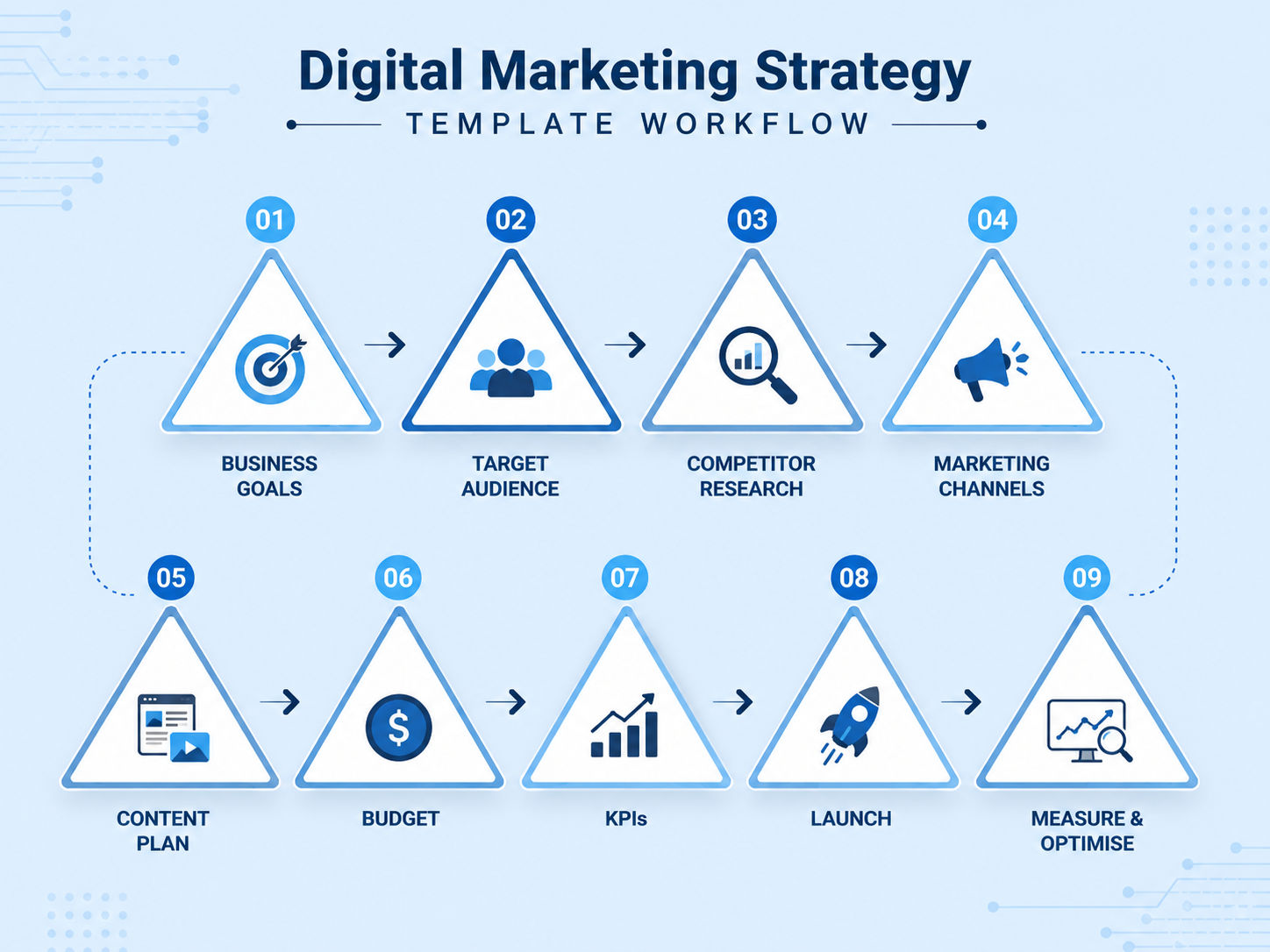
A well-designed digital marketing strategy framework template connects every marketing activity to a measurable business goal, making it easier to monitor progress and optimise campaigns.
A strategy template helps you make informed marketing decisions instead of relying on guesswork. It organises your planning process, prioritises resources, and keeps campaigns focused on achieving business goals.
Component |
Purpose |
| Business goals | Define success and priorities |
| Target audience | Identify ideal customers |
| Marketing channels | Select the right platforms |
| Content plan | Organise campaigns and messaging |
| Budget | Manage marketing spend |
| KPIs | Track campaign performance |
| Timeline | Keep projects on schedule |
Your strategy should evolve as your business grows. Regularly reviewing and updating your digital marketing strategy framework template helps keep your marketing relevant, measurable, and aligned with changing customer needs.
Must Read: 10 Actionable Steps To Create Content Marketing Strategy
Free Courses
A successful strategy doesn't come together by chance. It starts with a clear process that turns business objectives into practical marketing actions. If you skip key steps, even the best ideas can lose direction.
The good news is that you don't need a complex document. A well-structured digital marketing strategy template helps you organise your ideas, stay focused, and make better decisions as your campaigns grow.
Every strategy begins with a goal. Without one, it's difficult to decide which marketing activities deserve your time and budget.
Start by identifying what you want to achieve over the next quarter or year. Your goals should be specific and measurable rather than broad statements like "increase brand awareness."
Examples include:
When building a digital marketing strategy planning template, write your business goals first. Every other section should support these objectives.
Marketing becomes much more effective when you know exactly who you're trying to reach. Instead of targeting everyone, focus on the people most likely to become customers.
Research your audience using existing customer data, surveys, website analytics, and competitor insights. Your template for digital marketing strategy should include audience details that help every team create consistent campaigns.
Include information such as:
Audience Detail |
Example |
| Age group | 25–40 years |
| Location | UK metropolitan cities |
| Occupation | Small business owners |
| Interests | Digital marketing, business growth |
| Pain points | Limited budget, low online visibility |
| Preferred channels | Google Search, LinkedIn, Instagram |
The more detailed your audience profile, the easier it becomes to create content and campaigns that connect with the right people.
You don't need to copy competitors. You need to understand what they're doing well and where opportunities exist.
A competitor review helps you identify gaps that your business can fill. It also prevents you from repeating ineffective strategies.
When creating a digital marketing strategy framework template, review competitors based on:
Look for patterns rather than isolated campaigns. If several competitors succeed with educational blog content while ignoring video tutorials, that could be an opportunity worth exploring
Not every channel suits every business. Trying to maintain a presence everywhere usually spreads your resources too thin.
Select channels that match your audience, goals, and available budget. Your digital marketing strategy template should clearly explain why each channel has been chosen.
Common channel options include:
Marketing Channel |
Best For |
| SEO | Long-term organic traffic |
| PPC | Immediate visibility |
| Email Marketing | Customer retention |
| Social Media | Brand awareness and engagement |
| Content Marketing | Education and lead generation |
| Video Marketing | Product demonstrations and storytelling |
Choose quality over quantity. Two well-managed channels often outperform six neglected ones.
Content connects every marketing channel. Without a plan, publishing becomes inconsistent and difficult to measure.
Your digital marketing strategy planning template should outline what content you'll create, who it's for, and where it will be published.
Consider including:
Create a simple publishing calendar that balances educational, promotional, and engagement-focused content. This keeps your messaging consistent throughout the year.
Even strong marketing ideas require realistic budgeting. Overspending on one channel often means neglecting another that could produce better returns.
Your digital marketing strategy framework template should include estimated costs alongside the people responsible for each activity.
Track areas such as:
A budget doesn't have to be perfect from day one. Review it regularly and shift spending towards activities that deliver stronger results.
Also read: A Beginner’s Guide to Developing a Digital Marketing Strategy
Marketing success isn't measured by activity alone. Publishing more content doesn't automatically lead to better business outcomes.
Every template for digital marketing strategy should include clear Key Performance Indicators (KPIs) that align with your goals.
Goal |
KPI |
| Increase website traffic | Organic sessions |
| Generate leads | Form submissions |
| Improve sales | Revenue and conversion rate |
| Build awareness | Reach and impressions |
| Increase engagement | Click-through rate and time on page |
Choose only a handful of KPIs. Tracking too many metrics often creates unnecessary complexity.
A strategy becomes actionable when every task has a deadline. Timelines help teams stay organised and reduce missed opportunities.
Break large projects into smaller milestones so progress becomes easier to monitor. Your digital marketing strategy planning template should include monthly or quarterly checkpoints rather than one final deadline.
A simple workflow might look like this:
Month |
Activity |
| Month 1 | Research audience and competitors |
| Month 2 | Create content and campaign assets |
| Month 3 | Launch campaigns |
| Month 4 | Measure performance |
| Month 5 | Optimise campaigns |
| Month 6 | Review strategy and update template |
No strategy remains perfect forever. Customer behaviour changes, search algorithms evolve, and new competitors enter the market.
Review your digital marketing strategy template regularly to identify what's working and what needs improvement. Monthly performance reviews and quarterly strategy updates usually provide enough data to make informed decisions without creating unnecessary work.
Small improvements made consistently often deliver stronger long-term results than rebuilding your entire strategy every few months.
Building an effective digital marketing strategy requires strong business and leadership skills. Advance your expertise with MBA from LBS with IIMU Certification – upGrad and learn to make data-driven decisions, develop winning strategies, and lead business growth.
Digital Marketing Courses to upskill
Explore Digital Marketing Courses for Career Progression
MICA Executive Alumni Status
Understanding the theory is helpful. Seeing everything come together in one document makes it much easier to apply. A practical example shows how different sections connect and how a strategy moves from planning to execution.
The example below isn't a fixed format. Think of it as a starting point that you can adapt to your business. A good digital marketing strategy template should always reflect your goals, audience, and available resources.
This sample demonstrates how the major sections fit together. It also shows why a template for digital marketing strategy should be tailored rather than copied word for word.
Section |
Example |
| Business Goal | Increase online sales by 25% in six months |
| Target Audience | Working professionals aged 25–40 interested in online learning |
| Marketing Channels | SEO, Google Ads, LinkedIn, Email Marketing |
| Content Strategy | Weekly blogs, monthly webinars, email newsletters, case studies |
| Budget | £3,500 per month |
| KPIs | Organic traffic, leads, conversion rate, cost per acquisition |
| Timeline | Six-month campaign with monthly reviews |
| Team Members | SEO Specialist, Content Writer, PPC Manager, Designer |
No two businesses market themselves in exactly the same way. That's why your strategy should reflect your priorities instead of following a generic format.
Here are a few ways to customise your template.
A flexible digital marketing strategy framework template grows with your business. You won't need to rebuild it every time your marketing priorities change.
Asl read : Digital Marketing Objectives: Full Guide with Types and Examples [2026]
Many people use these terms interchangeably. They aren't the same. Understanding the difference helps you create better marketing documents and avoid confusion when planning campaigns.
A digital marketing strategy template explains what you want to achieve and why. A marketing plan explains how you'll carry out that strategy through specific campaigns and activities
Key Differences
Although the two documents support each other, they serve different purposes. Knowing when to use each one saves time and keeps your planning organised.
Digital Marketing Strategy Template |
Marketing Plan Template |
| Defines long-term objectives | Lists specific marketing activities |
| Focuses on direction | Focuses on execution |
| Usually reviewed quarterly or annually | Updated more frequently |
| Covers multiple campaigns | Covers individual campaigns |
| Guides marketing decisions | Guides day-to-day implementation |
Think of your strategy as the destination. Your marketing plan is the route you'll take to get there.
A digital marketing strategy planning template usually comes first. Once it's approved, marketers create campaign plans that align with the overall strategy.
Without a strategy, it's easy to launch campaigns that look good individually but don't contribute to larger business goals.
Create a strategy first if you need to:
Create a marketing plan when you're ready to:
Using a template for digital marketing strategy before writing campaign plans creates consistency across every marketing initiative.
Aslo read : Everything You Need to Know About Performance Marketing
Subscribe to upGrad's Newsletter
Join thousands of learners who receive useful tips
Marketing shouldn't exist in isolation. Every campaign should contribute to a wider business objective. If your marketing activities don't support company goals, it's difficult to demonstrate their value.
A well-designed digital marketing strategy template creates a direct connection between business priorities and marketing execution.
Before selecting channels or creating content, identify what success means for your business. Different goals require different marketing approaches.
The table below shows how marketing activities can support common business objectives.
Business Goal |
Marketing Focus |
| Increase brand awareness | SEO, social media, video marketing |
| Generate leads | Landing pages, PPC, email campaigns |
| Improve customer retention | Email marketing, loyalty campaigns |
| Increase online sales | SEO, product pages, remarketing |
| Enter a new market | Local SEO, regional campaigns |
A digital marketing strategy framework template helps document these relationships clearly so every team understands why certain activities take priority.
Also read : 7 Best Lead Generation Techniques That Work
Alignment doesn't happen automatically. Marketing teams need regular communication with sales, product, and leadership teams to stay focused on changing business priorities.
Here are a few practical ways to stay aligned.
Small adjustments like these keep marketing relevant while supporting broader organisational goals.
Also read : Future of Digital Marketing: How It Goes From Here
Creating a strategy is only the first step. Regularly tracking performance helps you understand what's working and where improvements are needed. A good digital marketing strategy template should focus on a few meaningful KPIs that align with your business goals.
Tracking the right KPIs helps you measure campaign performance, identify improvement areas, and determine whether your marketing strategy is achieving its business goals.
To keep your template for digital marketing strategy effective:
If website traffic increases but conversions remain low, review your landing pages, offers, or user experience. A digital marketing strategy framework template should evolve with your business and help drive continuous improvement.
Also read: Digital Marketing Project Ideas for Beginners
Small businesses often work with limited budgets and lean teams. That doesn't mean they need a simpler strategy. It means every marketing decision has to count.
A digital marketing strategy template for small business helps prioritise activities that deliver measurable results instead of trying to compete on every platform.
Small businesses grow faster when they concentrate on a few high-impact channels instead of spreading themselves too thin. The right mix depends on your audience, goals, and resources.
Here are the priorities most small businesses should consider.
Priority |
Why It Matters |
| Local SEO | Improves visibility in local searches |
| Google Business Profile | Attracts nearby customers |
| Content Marketing | Builds trust and organic traffic |
| Email Marketing | Encourages repeat business |
| Social Media | Increases brand awareness and engagement |
A local accounting firm, for example, doesn't need to invest heavily in every social platform. Instead, it could focus on local SEO, educational blogs, and email newsletters to generate qualified leads consistently.
A strategy doesn't have to be complicated. It needs to be practical and easy to maintain.
Keep these tips in mind.
A well-planned digital marketing strategy planning template helps small businesses make smarter decisions without increasing marketing costs.
Also read : Digital Marketing Tutorial: A Step-by-Step Guide To Become an Expert
Ecommerce businesses face different challenges. They're expected to attract visitors, convert them into buyers, and encourage repeat purchases, all while competing with countless online stores.
A digital marketing strategy template for ecommerce should support the complete customer journey rather than focusing only on traffic.
An ecommerce strategy needs to connect marketing activities with sales performance. Every campaign should guide customers towards a purchase.
Your strategy should include the following.
Strategy Area |
Purpose |
| SEO | Improve product visibility |
| Product Content | Help customers make buying decisions |
| Email Automation | Recover abandoned carts and encourage repeat purchases |
| Paid Advertising | Generate immediate traffic |
| Customer Reviews | Build trust and credibility |
| Analytics | Measure conversions and revenue |
Unlike service businesses, ecommerce companies also need to monitor inventory, promotions, and seasonal demand when planning campaigns.
Small improvements throughout the customer journey often produce better results than increasing advertising spend.
Consider these practices.
A strong template for digital marketing strategy keeps these activities organised and aligned with business goals instead of treating them as separate marketing efforts.
Also read : Importance of Digital Marketing: Top 10 Reasons Your Business Needs it
Small planning mistakes can reduce the effectiveness of your marketing efforts. Identifying and fixing them early helps you build a stronger digital marketing strategy template that delivers better results.
Common Mistakes to Avoid
The table below highlights common mistakes in a digital marketing strategy template and the best way to avoid them.
Common Mistake |
Better Approach |
| Setting vague goals | Define measurable objectives |
| Targeting everyone | Focus on specific audience segments |
| Using too many channels | Prioritise high-performing platforms |
| Ignoring competitor research | Review competitors regularly |
| Tracking too many KPIs | Measure only key metrics |
| Never updating the strategy | Review it quarterly |
A few consistent improvements can make your strategy more effective.
Keep your digital marketing strategy framework template updated as your business and customer needs evolve.
Also read: What is Content Marketing? How does it help businesses?
Not every digital marketing strategy template suits every business. Choose one that matches your goals, team size, and available resources. A simple, easy-to-update template is often more effective than a detailed one that's rarely used.
Before choosing a template, make sure it:
The best digital marketing strategy planning template is one that keeps your marketing organised, supports better decision-making, and grows with your business.
A successful marketing strategy doesn't begin with campaigns. It begins with planning. A well-designed digital marketing strategy template gives you a clear framework for setting goals, understanding your audience, selecting the right channels, and measuring meaningful outcomes.
Whether you're running a small business, managing an ecommerce store, or leading a growing marketing team, your strategy should remain flexible. Review it regularly, refine it using performance data, and adapt it as your business evolves. The more intentional your planning becomes, the stronger your marketing results will be.
Ready to start your journey? Book a free consultation with upGrad today to find the best path for your career.
Yes. A digital marketing strategy template provides a flexible structure rather than a fixed plan. Whether you run an eCommerce store, SaaS company, healthcare practice, or local business, you can customise goals, marketing channels, budgets, and KPIs to match your industry and business objectives.
A good template should include enough detail to guide your marketing decisions without becoming difficult to maintain. Focus on business goals, target audience, marketing channels, content plans, timelines, budgets, and measurable KPIs that your team can review and update regularly.
Start by defining your business objectives and understanding your target audience. Once you know what success looks like and who you're trying to reach, it becomes much easier to choose the right channels, allocate budgets, and create campaigns that support those goals.
Yes. A structured template helps you prioritise high-impact activities instead of spreading your budget across too many channels. By tracking key performance indicators and reviewing campaign results consistently, you can optimise spending and improve return on investment over time.
Not necessarily. Small businesses usually benefit from a simpler template focused on essential goals, a limited number of channels, and a manageable budget. Larger organisations often require additional sections for multiple teams, campaigns, reporting structures, and resource planning.
Review campaign performance every month and revisit the overall strategy every quarter. If your business launches new products, enters new markets, or customer behaviour changes significantly, update the strategy sooner to keep it aligned with current priorities.
AI tools can speed up research, generate campaign ideas, identify audience trends, and organise information. However, your business goals, competitive positioning, and strategic decisions should still come from human expertise, since AI can't fully understand every business context.
An effective template connects every marketing activity to a measurable business goal. It clearly defines the target audience, marketing channels, budget, timelines, responsibilities, and KPIs while remaining simple enough for teams to use consistently throughout the year.
A strategy template provides long-term direction for all marketing activities, while a campaign brief focuses on a single campaign. The strategy explains why you're marketing, whereas the brief outlines how one specific campaign will achieve a defined objective.
Yes, provided the template includes channel-specific objectives and KPIs. A single framework can cover SEO, social media, email marketing, paid advertising, and content marketing while allowing each channel to have its own tactics and performance metrics.
If your campaigns stop meeting goals, customer behaviour changes, new competitors enter the market, or your business priorities shift, it's time to revise your template. Regular updates help keep your strategy relevant and support better marketing decisions as your business evolves.
727 articles published
Sriram K is a Senior SEO Executive with a B.Tech in Information Technology from Dr. M.G.R. Educational and Research Institute, Chennai. With over a decade of experience in digital marketing, he specia...
Get Free Consultation
By submitting, I accept the T&C and
Privacy Policy
Level Up Your Digital Marketing Career Today!
Top Resources
MICA
Advanced Certificate in AI-Powered Digital Marketing & Communication from MICAMICA Executive Alumni Status
Certification
5 Specialisation
Classroom
4 Months
Certification
2 Months