Digital Marketing Campaign: Strategy, Types, and How to Measure Success
By Sriram
Updated on Jun 11, 2026 | 6 min read | 7.22K+ views
Share:

All courses
Certifications
More
By Sriram
Updated on Jun 11, 2026 | 6 min read | 7.22K+ views
Share:
A digital marketing campaign is a planned online marketing initiative that promotes a brand, product, or service to a defined audience. It uses channels such as SEO, social media, PPC advertising, and email marketing to achieve specific business objectives, including increasing brand awareness, generating leads, driving website traffic, and boosting sales.
This blog explains what a digital marketing campaign is, how it works, the different types of campaigns businesses use, how to build one effectively, and how to measure digital marketing campaign performance using meaningful metrics.
Looking to build in-demand digital marketing skills? Explore upGrad's Digital Marketing courses and learn how to create, manage, and optimize campaigns that drive measurable business results.
A digital marketing campaign is a planned and coordinated set of online marketing activities designed to achieve a specific business goal within a defined timeframe. These goals may include increasing brand awareness, generating leads, driving website traffic, or boosting sales.
Unlike individual marketing actions, a campaign brings together multiple channels, messages, and creative assets to deliver a consistent experience to the target audience. Businesses often run campaigns across search engines, social media platforms, email, websites, mobile applications, and video-sharing platforms simultaneously.
The core elements of a digital marketing campaign include:
Component |
Purpose |
| Business Objective | Defines the desired outcome |
| Target Audience | Identifies who the campaign is intended for |
| Campaign Message | Communicates the key value proposition |
| Marketing Channels | Determines where the campaign will run |
| Creative Assets | Includes ads, videos, emails, and content |
| Budget Allocation | Controls spending across channels |
| Performance Metrics | Measures campaign effectiveness |
| Timeline | Sets campaign duration and milestones |
The most successful campaigns align business goals with customer needs. When the right message reaches the right audience through the right channels, businesses can improve engagement, increase conversions, and measure results more effectively.
Also read : Top 10 Digital Marketing Examples Which are Inspiring
Free Courses
Businesses use different campaign types depending on their goals, audience behavior, and available resources.Not every campaign aims to generate immediate sales. Some focus on awareness, while others prioritize customer retention or engagement.
Understanding the strengths of each campaign type helps marketers select the right approach.
The table below summarizes common campaign categories.
| Campaign Type | Primary Goal |
| Search Marketing Campaign | Capture demand |
| Social Media Campaign | Increase engagement and awareness |
| Email Marketing Campaign | Nurture leads and customers |
| Content Marketing Campaign | Educate and attract audiences |
| Influencer Campaign | Expand reach and credibility |
| Video Marketing Campaign | Improve engagement and storytelling |
| Retargeting Campaign | Recover lost opportunities |
| Product Launch Campaign | Introduce new offerings |
Search marketing campaigns focus on reaching people who are already looking for information, products, or services online. Because these users demonstrate clear intent, search campaigns often generate highly qualified traffic and can deliver faster results than many other digital marketing approaches.
These campaigns target users actively searching for solutions.
For example, someone searching for "best online MBA program" already shows intent. Search campaigns help businesses appear at that critical moment.
Social media platforms allow brands to engage with audiences where they already spend a significant amount of time. These campaigns help increase visibility, encourage interactions, build communities, and strengthen relationships with potential and existing customers across various digital channels.
These campaigns often focus on:
Content campaigns use blogs, guides, webinars, videos, case studies, and research reports to attract and educate potential customers organically. While they typically require more time to generate results, they help build trust, improve search visibility, establish industry authority, and drive consistent long-term traffic without relying heavily on paid advertising.
Email marketing allows businesses to communicate directly with their audience, making it an effective channel for engagement, nurturing, and retention.
Email remains one of the highest-ROI marketing channels. Businesses commonly use email campaigns for:
Most visitors do not convert during their first visit.
Retargeting campaigns remind users about products or services they previously viewed, helping improve conversion rates.The most effective organizations often combine multiple campaign types rather than relying on a single channel.
Must read : Creative Digital Marketing: What It Is and How to Get Started
Digital Marketing Courses to upskill
Explore Digital Marketing Courses for Career Progression
MICA Executive Alumni Status
Creating a successful digital marketing campaign requires more than choosing a few marketing channels and launching advertisements. It involves setting clear goals, understanding your audience, delivering the right message, and continuously improving performance based on data.
Many campaigns underperform because they lack a clear strategy rather than creative ideas. Following a structured process helps businesses maximize results while minimizing wasted budget and effort.
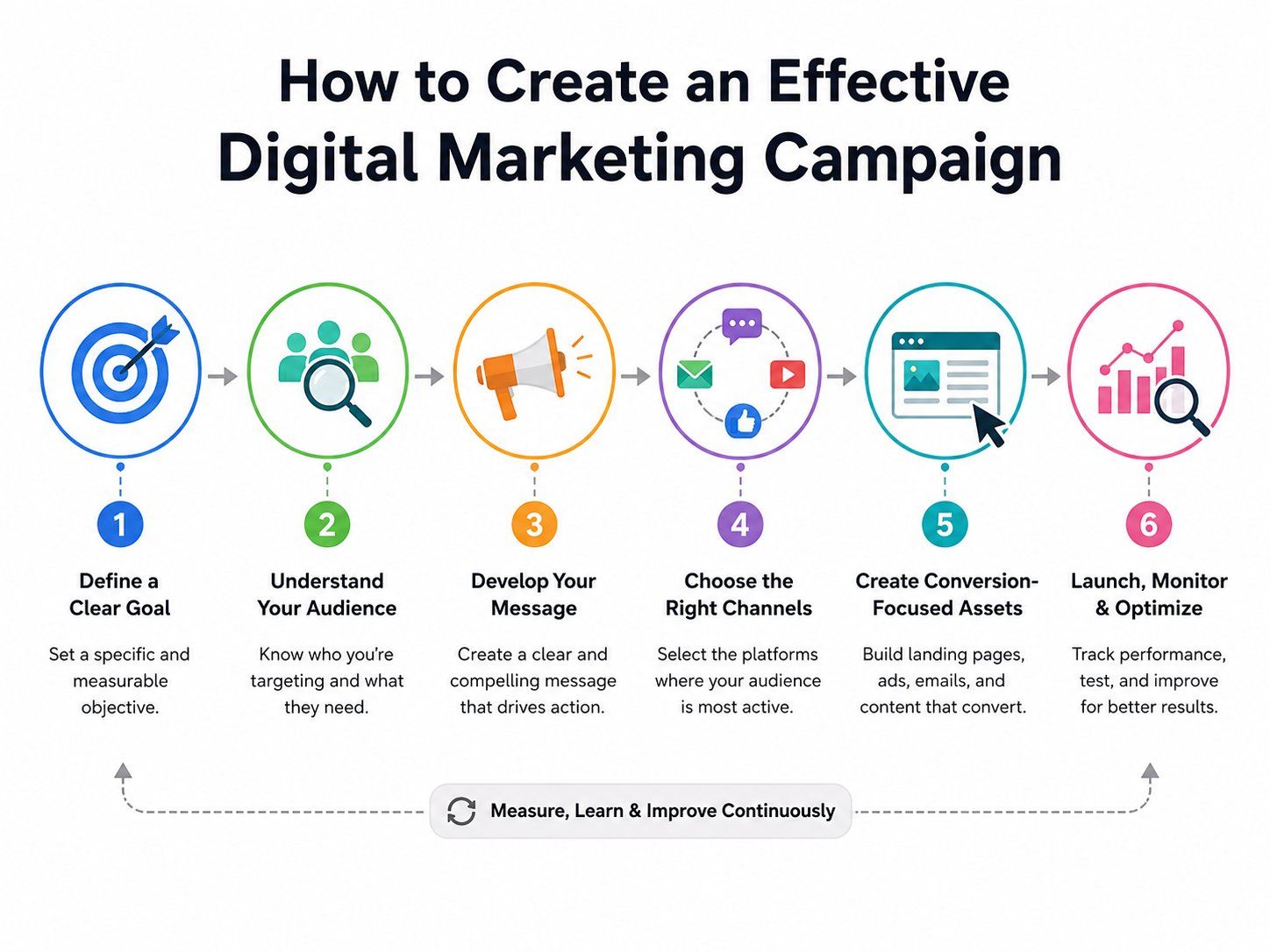
Every digital marketing campaign should begin with a specific and measurable objective. Clear goals provide direction and make it easier to evaluate success.
Examples of campaign goals include:
Avoid vague objectives such as "increase brand awareness" unless they are tied to measurable metrics.
Understanding your audience helps ensure your message reaches the right people through the right channels.
Audience research typically focuses on:
For example, a B2B software company may find LinkedIn and email marketing most effective, while an e-commerce fashion brand may achieve better results through Instagram and short-form video content.
Your campaign message should communicate the value of your offer clearly and consistently.
An effective message answers three key questions:
Clear messaging reduces confusion and helps improve engagement and conversion rates across all campaign channels.
Channel selection should align with both your campaign goals and audience behavior.
The table below shows common channel choices for different objectives.
Campaign Goal |
Recommended Channels |
| Lead Generation | Google Ads, Email, LinkedIn |
| Brand Awareness | Social Media, Video Platforms |
| Product Launch | Search Ads, Social Media, Influencer Marketing |
| Customer Retention | Email Marketing, Mobile Notifications |
Using multiple channels often creates a more consistent customer journey and improves campaign reach.
Campaign assets are the materials that support and promote your message across channels.
Common campaign assets include:
All assets should maintain consistent branding and messaging to create a seamless experience for potential customers.
But that's just the start of a campaign. The continuous monitoring helps marketers to find opportunities to improve results.
Areas that are often tested/optimized are:
Small tweaks in these areas can have a big impact on engagement, conversions and overall campaign performance. Often it’s consistent testing and optimisation that separates average campaigns from highly successful ones.
Also read : Digital Marketing Subjects That Actually Shape Your Career
Running a campaign without measurement creates uncertainty.Businesses need reliable data to understand whether their investment produces meaningful results. The ability to measure digital marketing campaign outcomes accurately often separates successful marketers from those relying on assumptions.
The table below highlights common campaign KPIs.
| Metric | What It Measures |
| Impressions | Visibility |
| Click-Through Rate (CTR) | Ad engagement |
| Conversion Rate | Goal completion |
| Cost Per Lead (CPL) | Lead acquisition efficiency |
| Customer Acquisition Cost (CAC) | Cost of acquiring customers |
| Return on Ad Spend (ROAS) | Advertising profitability |
| Revenue | Business impact |
| Customer Lifetime Value (CLV) | Long-term customer value |
Customers rarely convert after a single interaction with a brand. In most cases, they engage with multiple marketing channels before taking action.
Understanding these touchpoints helps marketers identify which channels contribute to conversions and make more informed budget and optimization decisions.
Someone could:
Without attribution tracking, marketers may mistakenly credit the last touchpoint.
Modern analytics platforms provide insights into which channels are driving conversions.
The following tools help marketers collect and analyze campaign data.
| Tool | Primary Function |
| Google Analytics | Website analytics |
| Google Ads | Ad performance tracking |
| Search Console | Organic search insights |
| HubSpot | Lead management |
| Meta Ads Manager | Social campaign reporting |
| CRM Platforms | Revenue attribution |
Even experienced marketers sometimes misinterpret campaign data.
Common reporting mistakes include the following :
The goal is not simply to collect data but to use data to improve future decisions.
Successful campaigns rarely depend on a single tactic.They result from consistent execution, testing, and adaptation over time.
Businesses that treat campaigns as learning systems often achieve stronger long-term results.
Several best practices consistently appear across high-performing campaigns.
The following practices can improve campaign performance:
Another important practice involves balancing short-term and long-term objectives.
The most effective digital marketing campaign strategies combine creativity, audience understanding, data analysis, and ongoing optimization. When these elements work together, businesses can create campaigns that not only attract attention but also deliver measurable business results.
Digital marketing campaign is a coordinated online marketing effort to reach a specific goal. It helps businesses reach the right audience and drive measurable results. Success is based on clear objectives, audience understanding, channel selection, and ongoing optimisation.
By planning wisely and knowing how to measure the performance of a digital marketing campaign efficiently, businesses can improve campaign results, maximise marketing spends, and help in long-term growth.
Ready to start your journey? Book a free consultation with upGrad today to find the best path for your career.
The ideal duration depends on your goals and channels. Paid advertising campaigns may generate results within days, while SEO and content marketing campaigns often require several months. Most businesses should allow at least 30 to 90 days before making major decisions based on campaign performance. This gives enough time to collect reliable data and identify trends.
A digital marketing strategy is a long-term plan that outlines how a business will achieve its marketing objectives. A digital marketing campaign is a specific initiative executed within that strategy. For example, a company may have a year-long strategy focused on lead generation, while running separate campaigns throughout the year to promote webinars, products, or services.
There is no single best channel for every business. Search advertising often works well for high-intent audiences, while social media can be effective for awareness and engagement. Email marketing remains valuable for nurturing leads and retaining customers. The right channel depends on your audience, goals, budget, and industry.
Campaign budgets vary significantly based on objectives, competition, and target audience size. Small businesses may start with a modest budget to test different channels and messaging. Instead of focusing only on spending more, businesses should prioritize tracking performance metrics and investing in channels that consistently deliver results.
Many campaigns fail because of unclear goals, weak audience targeting, inconsistent messaging, or poor landing page experiences. Some businesses also stop campaigns too early before gathering enough data. Successful campaigns require continuous testing, optimization, and alignment between marketing activities and business objectives.
Small businesses can compete by targeting niche audiences, creating specialized content, and focusing on local or industry-specific opportunities. Large budgets do not always guarantee better results. A well-targeted campaign with relevant messaging often outperforms broader campaigns that try to reach everyone.
The most important metrics depend on your objective. Lead generation campaigns may focus on cost per lead and conversion rates, while awareness campaigns may prioritize reach and engagement. Businesses should avoid relying solely on traffic numbers and instead track metrics that connect directly to revenue or business growth.
Campaign monitoring should occur regularly, especially during the initial launch phase. Many marketers review performance weekly and make adjustments based on data. However, making changes too frequently can make it difficult to understand what is actually driving results. Consistent testing with enough data usually produces better decisions.
AI tools can help marketers analyze data, identify audience segments, automate reporting, generate content ideas, and optimize advertising bids. However, AI works best when combined with human judgment. Businesses still need marketers to understand customer behavior, evaluate insights, and make strategic decisions.
A landing page serves as the destination where users take action after clicking an ad, email, or social media post. Even a strong campaign can underperform if the landing page is unclear or difficult to navigate. Effective landing pages focus on a singleA landing page serves as the destination where users take action after clicking an ad, email, or social media post. Even a strong campaign can underperform if the landing page is unclear or difficult to navigate. Effective landing pages focus on a single objective, provide relevant information, and make conversion simple. objective, provide relevant information, and make conversion simple.
To measure digital marketing campaign ROI, compare the revenue generated against the total campaign cost, including advertising spend, tools, content creation, and operational expenses. Businesses should also consider attribution models because customers often interact with multiple channels before converting. Accurate tracking provides a clearer view of which activities contribute most to business results.
727 articles published
Sriram K is a Senior SEO Executive with a B.Tech in Information Technology from Dr. M.G.R. Educational and Research Institute, Chennai. With over a decade of experience in digital marketing, he specia...
Get Free Consultation
By submitting, I accept the T&C and
Privacy Policy
Level Up Your Digital Marketing Career Today!
Top Resources
MICA
Advanced Certificate in AI-Powered Digital Marketing & Communication from MICAMICA Executive Alumni Status
Certification
5 Specialisation
Classroom
4 Months
Certification
2 Months