KPIs in Project Management: Definition, Examples, Types, and How to Measure Them
By upGrad
Updated on Oct 17, 2026 | 10 min read | 2.3K+ views
Share:

All courses
Certifications
More
By upGrad
Updated on Oct 17, 2026 | 10 min read | 2.3K+ views
Share:
Table of Contents
KPIs in Project Management are basically a way to measure whether a project is actually hitting its goals or drifting off course. Think of it as a compass for managers; it helps them keep an eye on things like time, budget, quality, and how happy stakeholders are, all in real time, so nothing sneaks up on them.
Instead of guessing KPIs give us clear information that helps us make smart decisions during a project. Whether you are managing a software project, a building project, or a marketing campaign, KPIs can really help your project succeed.
In this guide, you'll learn what KPIs in project management are, why they matter, and how to set them effectively. We'll also explore the important KPIs to track, common mistakes to avoid, reporting methods, and dashboards.
Explore upGrad’s management courses online to strengthen your project planning, leadership, and performance evaluation skills. Learn to track key performance indicators, measure project success, and make data-driven decisions to improve business outcomes.
Popular Management Programs
Project success depends on more than completing tasks. Teams also need measurable indicators that show whether the project is progressing as planned. KPIs in project management provide those indicators. They help project managers evaluate performance, make timely decisions, and achieve business objectives using measurable data rather than assumptions.
Key Performance Indicators (KPIs) in project management give us information the teams need to know if the project is on track or not. They help project managers check how things are going using facts and numbers and make decisions to reach business goals.
KPIs make sure project managers are not just guessing they are using data to make choices. This way, KPIs are essential for project success.
They help teams answer important questions such as:
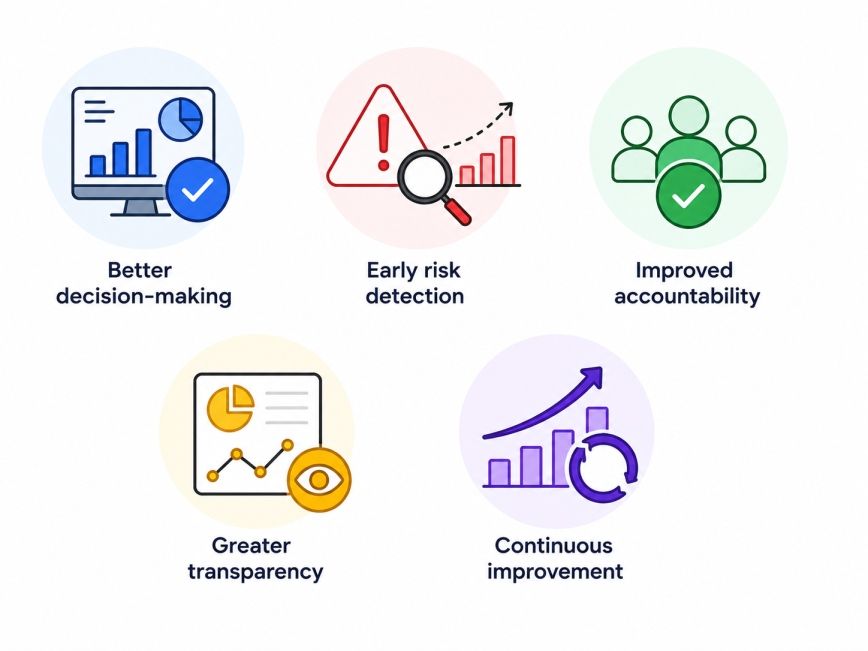
Some of the biggest benefits of project KPIs include:
Benefit |
How it helps |
| Better decision-making | Decisions are based on measurable data instead of opinions. |
| Early risk detection | Potential issues are identified before they become major problems. |
| Improved accountability | Every team member understands performance expectations. |
| Greater transparency | Stakeholders receive regular updates backed by measurable data. |
| Continuous improvement | Teams identify trends and improve future project performance. |
Also Read: What is Project Management Process: Phases and Life Cycle
Free Courses
One common mistake is that people often think that having a lot of KPIs means having more control. The truth is, too many KPIs can be really confusing. The projects that do well are the ones that focus on a few important things that show how the project is doing.
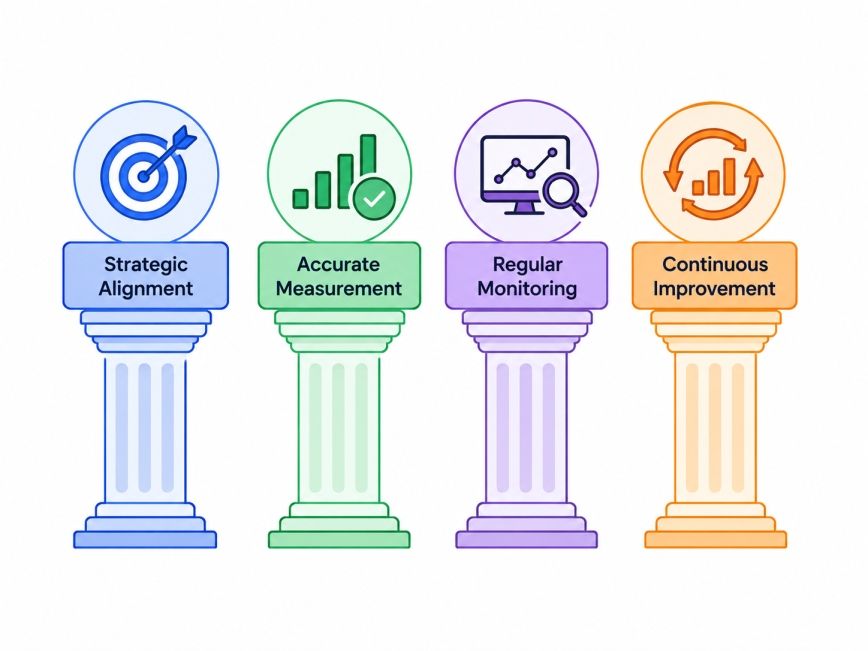
There are four core principles to help achieve this. When these four pillars work together, KPIs become practical management tools rather than static reports.
Pillar |
Purpose |
| Strategic Alignment | Connect KPIs to organizational goals. |
| Accurate Measurement | Use reliable and consistent data sources. |
| Regular Monitoring | Review KPIs throughout the project lifecycle. |
| Continuous Improvement | Adjust KPIs and processes based on lessons learned. |
Management Courses to upskill
Explore Management Courses for Career Progression
IIIT-B & IIM, Udaipur
Chief Technology Officer & AI Leadership ProgrammeIIM Kozhikode
PCP in AI for Business ProfessionalsNot every metric deserves to become a KPI. Many organizations collect hundreds of data points, but only a handful truly indicates project success.
An effective KPI should have the following characteristics:
1. It aligns with business objectives:
Every KPI should contribute to a larger business goal. If a KPI doesn't influence project or organizational success, it may not be worth tracking.
2. It is measurable:
A KPI should rely on numerical or clearly observable data rather than subjective opinions.
For example:
3. It is actionable:
Good KPIs encourage action. If a KPI shows declining performance, the team should know what corrective steps to take.
4. It is realistic:
Setting impossible targets discourages teams. Effective KPIs challenge performance while remaining achievable.
5. It is reviewed regularly:
A KPI loses value if no one monitors it. Most projects review KPIs weekly, bi-weekly, or monthly depending on project complexity.
Also Read: Project Cycle Management: A Complete Guide for Beginners
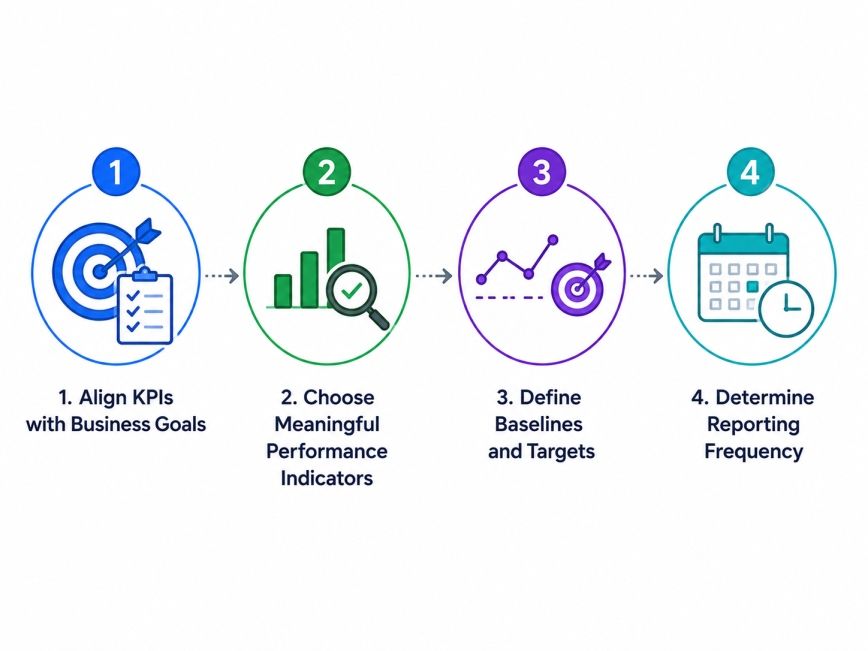
Selecting the KPIs is super important. Tracking them is not enough; you need to choose one. If you choose indicators, it creates extra work and doesn't give much value.
The best project KPIs are tied to project objectives; they use reliable data and check regularly during the project.
The first step is to figure out why the project is happening. Businesses often carry out the project for a reason. This can mean whether it's increasing revenue, improving customer experience, reducing operational costs, or launching a new product.
Your KPIs in Project Management should measure project goals to see if we are getting closer to what the business wants. When we look at our project, this way stakeholders can see how KPIs help the business do well.
For example:
Business Goal |
Project KPI |
| Improve customer satisfaction | Customer Satisfaction (CSAT) score |
| Reduce delivery delays | On-time milestone completion |
| Control project spending | Budget variance |
| Increase product quality | Defect rate |
Not every metric deserves equal attention. Focus on indicators that influence project outcomes rather than tracking every available data point.
Good KPIs typically:
A KPI is really useful when you know what you are trying to achieve. For example, let us say your company has an on-time delivery rate of 82% now. You might want the on-time delivery rate to be 95% by the time the project is finished.
Having targets is helpful because it allows teams to see how much they have improved in a very straightforward way rather than just guessing if the KPI is getting better or not.
For each KPI, define:
Consistent reporting is really important because it helps project managers see what is going on. They can identify trends.
Deal problems when it's still minor. This way project managers can also keep stakeholders informed about what's happening with the project from start to finish.
A simple reporting schedule could look like this:
KPI Type |
Suggested Review Frequency |
| Schedule KPIs | Weekly |
| Budget KPIs | Monthly |
| Quality KPIs | Weekly |
| Risk KPIs | Bi-weekly |
| Stakeholder Satisfaction | Monthly |
Also Read: Top 10 Risk Management Strategies You Need to Follow for Success!
Project success depends on tracking a set of key performance indicators or KPIs across time cost, resources, quality and stakeholder satisfaction. Every project has goals, so the exact mix of KPIs may vary. The core categories of KPIs, such as time, cost, and quality, remain the same across different industries.
We use these performance indicators to make sure our project is doing well in all areas, including delivery speed, cost control, resource efficiency, quality assurance, and stakeholder satisfaction.
Time-based KPIs are used to see if the project is moving along as it should be. These KPIs help the project managers find out if there are any delays and make the project delivery more predictable.
Read For Better Insight: 16 Top Time Management Techniques And Tools For 2026: Features And Benefits
These cost KPIs are really important because they help us make money and not spend much money. We use cost KPIs to stay in control of the budget and make sure the project is profitable.
Read For Better Insight: Budget Management: A Guide to Effectively Manage Your Money
Resource KPIs help us see if we are using time, effort and workforce capacity well in a project. This way we can ensure that no one is overworked or underutilized.
Read For Better Insight: Performance Management: Definition, Process, Benefits & Best Practices (2026 Guide)
Quality KPIs check if project results are up, to the mark and add value to the business. These metrics help cut down on redoing work and boost the quality of what we produce.
Read For Better Insight: What is Customer Value Proposition and How to Execute a CVP Model
We use Stakeholder-focused KPIs to see how well we are meeting those expectations. Stakeholder-focused KPIs are really important for making sure the project does well in long-run and, for keeping our relationships with clients and users strong.
Also Read: Digital Growth Marketing: A Complete Guide to Scaling Businesses in the Digital Age
Tracking KPIs in Project Management is not about gathering numbers. The real value of KPIs comes from looking at data, finding trends, and taking action to fix problems. When we have a structured way to measure, it helps project managers get a clear picture of what is happening with the project from start to finish.
Start with reliable data sources. Inaccurate or incomplete information can lead to poor decisions.
Common sources include:
Each KPI should have a clearly defined formula, so everyone measures performance the same way.
Examples include:
KPI |
Formula |
| Schedule Variance | EV − PV |
| Cost Performance Index | EV ÷ AC |
| Budget Variance | Planned Budget − Actual Cost |
| Resource Utilization | Hours Used ÷ Available Hours × 100 |
Also Read: Earned Value Management for Project Managers: Concepts and Formulas
Looking at a KPI once provides limited value. Monitoring performance over weeks or months reveals trends that may not be obvious in a single report. Trend analysis supports proactive decision-making instead of reactive problem-solving.
Many organizations visualize trends using dashboards, making it easier for stakeholders to understand project health at a glance.
For example:
Project managers often use terms like KPIs, metrics, objectives, and OKRs interchangeably. Although these concepts are related, they are actually different. Understanding the distinction helps teams choose the right measurement framework.
All KPIs are metrics, but not all metrics are KPIs. The metric provides useful information, while the KPI reflects whether the project is achieving a strategic objective.
For example:
KPI |
Metric |
| Measures critical success factors | Measures any activity or performance data |
| Directly linked to business goals | May support operational reporting |
| Requires regular monitoring | May be tracked occasionally |
Objectives define what the project aims to achieve. KPIs measure progress toward those objectives.
Example
Objective: Deliver the project within six months.
KPIs:
Objectives and Key Results (OKRs) focus on ambitious outcomes and measurable results, while KPIs monitor ongoing performance. Many organizations use both frameworks together.
KPI |
OKR |
| Tracks ongoing performance | Drives strategic change |
| Usually remains stable | Changes every planning cycle |
| Focuses on operational success | Focuses on transformational goals |
Also Read: OKRs vs KPIs: Understanding the Difference and How to Use Both
Success criteria define the conditions that determine whether a project is considered successful. KPIs measure progress toward meeting those criteria throughout the project rather than only at the end.
Examples include:
Not all KPIs are the same. Some KPIs help you figure out how things will go in the future. Other KPIs look at what has happened. It is really important to know the difference between leading and lagging KPIs in project management; it helps project managers make balance proactive decisions with performance evaluation.
A good set of KPIs has both leading and lagging KPIs. Leading KPIs gives you a warning if something is not going right. Lagging KPIs tell you if the project did what it was supposed to do.
The table below highlights the differences between leading and lagging KPIs.
Leading KPI |
Lagging KPI |
| Sprint velocity | Project completion rate |
| Planned milestone completion | Schedule variance |
| Risk mitigation progress | Customer satisfaction |
| Resource utilization | Budget variance |
| Test coverage | Defect rate after release |
Learn to leverage artificial intelligence for smarter business decisions with the AI Professional Certificate Programme from IIM Kozhikode. Develop an understanding of AI-driven insights and emerging technologies to improve performance tracking, optimise workflows, and support strategic decision-making.
Collecting KPI data is only useful if stakeholders can understand KPI data quickly. This is where dashboards and structured reporting come in to help with KPI data. A designed dashboard shows project performance in a simple way that is easy to see, which helps you make decisions faster about the project's performance.
Good reporting also helps to create transparency with KPI data. Everyone, from project managers to executives, gets to see the KPI data and information so they can deal with problems before the problems get worse, with the project performance and KPI data.
A good dashboard should show things, like the KPI that really matters. It does not need a lot of charts. The dashboard should focus on the things that help project goals.
A project management KPI dashboard typically includes:
Dashboard Component |
Purpose |
| Project status | Overall health indicator |
| Schedule progress | Tracks timeline performance |
| Budget performance | Compares planned and actual costs |
| Risk summary | Shows active project risks |
| Resource utilization | Displays workload distribution |
| Quality metrics | Highlights defects and rework |
| Stakeholder updates | Reflects satisfaction and engagement |
Below is an example of a simple project dashboard. This type of dashboard provides an instant overview without requiring stakeholders to interpret lengthy reports.
KPI |
Target |
Current |
Status |
| On-time milestones | 95% | 92% | Amber |
| Budget utilization | ≤100% | 97% | Green |
| Defect rate | <2% | 1.4% | Green |
| Resource utilization | 80–90% | 88% | Green |
| High-priority risks | <5 | 6 | Red |
| Stakeholder satisfaction | ≥4.5/5 | 4.6 | Green |
Reporting should help people make decisions, not overwhelm them with data. It's also important to make reports that fit the audience. Different people involved in the project need different levels of information. So, customizing reports improves communication and avoids unnecessary complexity.
Follow these best practices:
For example:
Audience |
Reporting Focus |
| Project Team | Tasks, milestones, blockers |
| Project Manager | Schedule, budget, risks |
| Executives | Business impact, ROI, strategic goals |
| Clients | Deliverables, timelines, quality |
Well-designed KPIs are not helpful if they are not implemented correctly. Many organizations gather a lot of performance data. Find it hard to use it to take action.
Here are common mistakes to watch out for. They can help project managers build a KPI framework that leads to decisions.
A common mistake is measuring everything. When teams monitor dozens of KPIs, important information gets buried under unnecessary data.
Instead, focus on indicators that directly influence project objectives. As a general guideline, most projects perform well with a focused set of 8-15 core KPIs.
Vanity metrics look impressive but rarely influence project success. These metrics may describe activity but don't indicate whether the project is progressing effectively.
Choose KPIs that support decision-making rather than simply reporting workload.
Examples include:
A KPI without a clear definition creates confusion. Documenting these details ensures consistency across reporting periods.
Every KPI should specify:
Sometimes projects focus on operational metrics while ignoring strategic priorities. For example, a team may celebrate completing tasks quickly, even though customer satisfaction continues to decline. KPIs in Project Management should always connect back to broader business objectives.
Before introducing a KPI, ask: "How does this measurement contribute to project success?"
If the answer isn't clear, consider its inclusion.
Inconsistent reporting makes trend analysis difficult. These inconsistencies reduce stakeholder confidence and make comparisons unreliable. Establishing standardized reporting processes improves accuracy and supports better decision-making throughout the project lifecycle.
For example:
Although many apply KPIs in Project Management across the industries, individual projects require customized performance indicators. Selecting KPIs based on project type ensures that reporting reflects actual business priorities.
Software teams often focus on delivery speed, product quality, and customer experience.
Common KPIs include:
Agile teams measure progress differently from traditional projects.
Useful KPIs in Project Management include:
KPI |
Purpose |
| Sprint Burndown | Tracks remaining work |
| Velocity | Measures delivery capacity |
| Cycle Time | Measures work completion speed |
| Lead Time | Tracks request-to-delivery duration |
| Escaped Defects | Measures product quality |
Also Read: Sprint Planning in Agile Methodology: Its Importance and Benefits
Client-facing projects require a balance between operational performance and relationship management. Unlike internal projects, client projects often place greater emphasis on communication quality and stakeholder satisfaction.
Useful KPIs include:
KPIs in project management provide a structured way to measure progress, evaluate performance, and keep projects aligned with business goals. The right KPIs help teams identify risks early, improve decision-making, and deliver better outcomes. By selecting meaningful indicators, reviewing them consistently, and refining them over time, project managers can build a performance-driven approach that supports long-term project success.
KPIs (Key Performance Indicators) in project management are measurable values that help assess whether a project is progressing toward its objectives. They provide data-driven insights into areas such as schedule, cost, quality, risks, and stakeholder satisfaction. Tracking the right KPIs enables project managers to make informed decisions and improve project outcomes.
The most important project management KPIs depend on the project's objectives. However, commonly used KPIs include schedule variance, budget variance, Cost Performance Index (CPI), milestone completion rate, defect rate, resource utilization, risk resolution time, and stakeholder satisfaction. Selecting a focused set of KPIs provides a balanced view of project performance.
There is no fixed number of KPIs for every project. Most project managers track between 8 and 15 meaningful KPIs that align with business goals. Monitoring too many indicators can make reporting difficult and reduce focus, while too few may not provide enough insight into project health.
A metric measures any aspect of project performance, while a KPI measures a critical factor directly linked to project success. For example, the number of meetings conducted is a metric, whereas on-time milestone completion is a KPI because it reflects progress toward project objectives.
Project performance is measured by collecting reliable project data, calculating KPI values using predefined formulas, comparing actual results with targets, and monitoring trends over time. Reviewing KPIs regularly helps identify issues early and enables project managers to take corrective action before problems affect delivery.
KPIs measure ongoing project performance and operational success, while OKRs (Objectives and Key Results) focus on achieving ambitious strategic goals within a defined period. Many organizations use both frameworks together, with OKRs setting direction and KPIs tracking continuous performance throughout the project lifecycle.
Leading KPIs predict future performance and help teams prevent issues before they occur. Examples include sprint velocity and risk mitigation progress. Lagging KPIs measure completed outcomes, such as budget variance, customer satisfaction, and project completion rate. Using both provides a complete picture of project health.
A project KPI dashboard should display the most important performance indicators in one place. Typical elements include schedule progress, budget status, quality metrics, resource utilization, active risks, milestone completion, and stakeholder satisfaction. A simple visual dashboard allows stakeholders to understand project status quickly and make faster decisions.
The review frequency depends on the project and the KPI being tracked. Schedule and quality KPIs are often reviewed weekly, while budget and stakeholder satisfaction may be reviewed monthly. Consistent reporting ensures timely decision-making and helps teams identify trends before they become significant issues.
Project management KPIs often fail because they are poorly defined, misaligned with business objectives, or measured inconsistently. Tracking too many KPIs, relying on vanity metrics, or failing to assign ownership can also reduce their effectiveness. A focused, well-managed KPI framework delivers more meaningful insights.
Organizations can strengthen their KPI framework by aligning indicators with business goals, using SMART KPIs, assigning clear ownership, standardizing reporting methods, and reviewing performance regularly. Continuous evaluation and refinement ensure that KPIs remain relevant as project requirements and organizational priorities evolve.
1141 articles published
We are an online education platform providing industry-relevant programs for professionals, designed and delivered in collaboration with world-class faculty and businesses. Merging the latest technolo...
Get Free Consultation
By submitting, I accept the T&C and
Privacy Policy
Top Resources
Certification
3 Months
Certification
6 Months
O.P. Jindal Global University
Masters in International Accounting and Finance (Accredited by ACCA, UK)Master's Degree
12 Months