What is Customer Value Proposition and How to Execute a CVP Model
By upGrad
Updated on May 08, 2026 | 484 views
Share:

All courses
Certifications
More
By upGrad
Updated on May 08, 2026 | 484 views
Share:
Table of Contents
The customer value proposition (CVP) is a strategic statement that summarizes why a consumer should buy a product or use a service. It answers one simple question: "Why should a customer buy from you instead of someone else?"
Customers make decisions fast. Research shows that people form a first impression of a website in 0.05 seconds. If your value proposition is unclear, they leave. A strong CVP keeps them reading, builds trust quickly, and moves them closer to a decision.
In this blog, you’ll learn what a customer value proposition is, why it matters, how to build one, and see practical examples. By the end, you’ll have a clear framework to create a CVP that resonates with your audience and strengthens your business strategy.
If you want to learn how to create stronger brand messaging, improve customer communication, and build marketing strategies, explore the Digital Marketing Courses by upGrad.
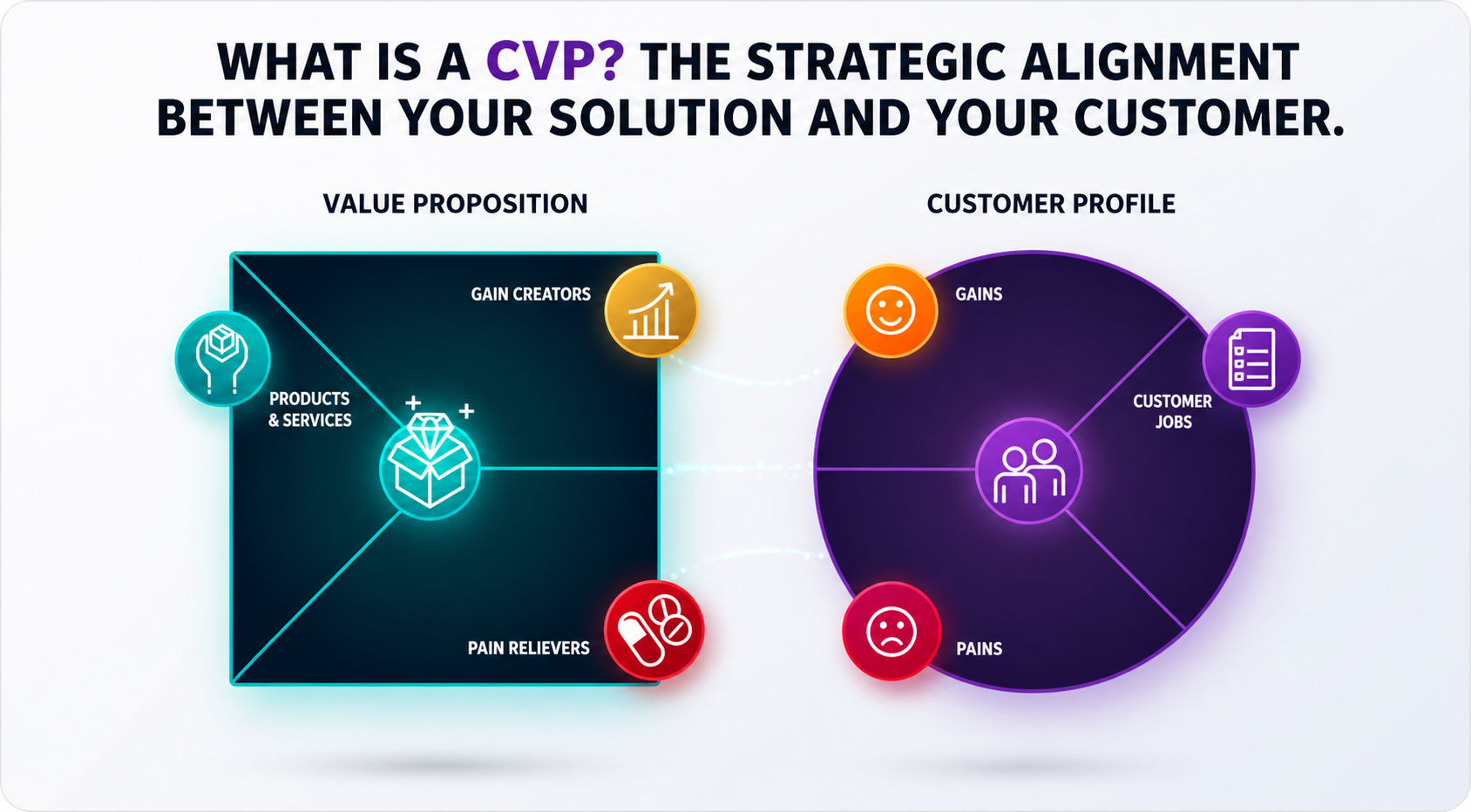
Most companies think they have a clear value proposition, but most do not. They often rely on vague phrases like "we deliver quality solutions for business growth," which are too broad to be effective.
In a hyper-competitive 2026 market, a strong customer value proposition must do the opposite: it must be hyper-specific. It should speak directly to one type of customer with one clear, measurable outcome.
No market is empty. Whatever you sell, someone else is likely selling a similar version of it. A clear customer value proposition gives buyers a definitive reason to choose you. It eliminates comparison paralysis by making the unique benefit of your product obvious from the first interaction.
Your customer value proposition model is not just a marketing tool; it is an internal compass. It guides product teams on which features to prioritize, sales teams on how to frame conversations, and support teams on what success looks like for the user.
When every department understands the CVP, decisions become faster and more consistent.
Landing pages and ads perform significantly better when anchored to a strong CVP. Instead of listing technical specifications, you describe the transformation in the customer’s life. This clarity builds immediate trust.
Long-term loyalty follows when a brand consistently delivers the promise made in its customer value proposition. When expectations meet reality, retention rates soar.
The table below highlights the key business benefits of a strong Customer Value Proposition and explains how it directly contributes to growth, customer retention, and better brand positioning.
| Business Benefit | How a Strong CVP Achieves It |
| Lower Acquisition Cost | Clear messaging attracts higher-quality leads. |
| Higher Retainment | Customers stay because the promised value is delivered. |
| Brand Authority | Specificity makes you the "go-to" expert in a niche. |
| Product Focus | Prevents feature creep by focusing only on what adds value. |
Also read: 23+ Best Online Courses (2026) Increase Your Salary by 10x
Free Courses
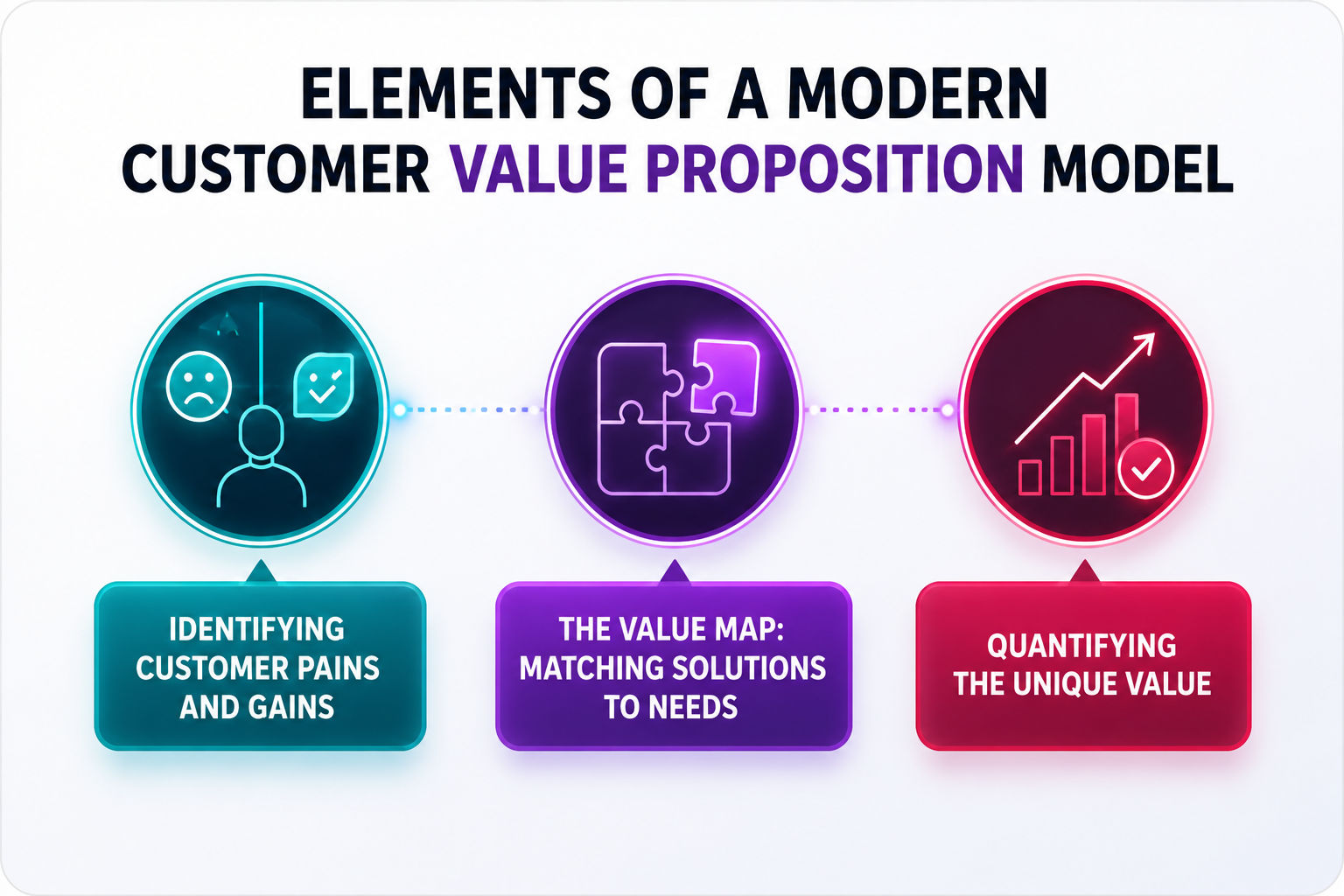
This model is typically built on the "Jobs to be Done" theory, which suggests that customers don't buy products; they "hire" them to do a specific job. To build a successful CVP, you must analyze three specific areas: customer gains, customer pains, and your specific value map.
Identifying Customer Pains and Gains
A great customer value proposition begins with empathy. You must identify the pains your customers face, such as high costs, wasted time, or emotional stress. Simultaneously, you look at the gains, the positive outcomes or dreams they hope to achieve. Your product must act as both a pain reliever and a gain creator. Without this balance, your value proposition will feel incomplete or purely functional.
The Value Map: Matching Solutions to Needs
The second half of the customer value proposition model is your value map. This is where you list your product's features and directly map them to the pains and gains you identified earlier. For example, if a customer’s pain is "complex data entry," your feature "AI-automated spreadsheets" becomes the direct pain reliever. This alignment ensures that your marketing is always rooted in solving real human problems.
Quantifying the Unique Value
The final element is quantification. In 2026, "fast" or "cheap" is not enough. You need to prove the value. A high-performing customer value proposition example often includes data, such as "reduce operational costs by 30%." This specificity provides the logic that backs up the emotional appeal of your brand.
Also read: What is a Digital Marketing Funnel? How to Create One?
Digital Marketing Courses to upskill
Explore Digital Marketing Courses for Career Progression
MICA Executive Alumni Status
Studying a successful customer value proposition example is the fastest way to understand how to apply these theories. The best brands don't just state what they do; they state how they make your life better.
Let's look at three distinct examples that have mastered the customer value proposition in the current market.
Stripe does not just say "we process credit cards." Their customer value proposition is "Financial infrastructure for the internet." This targets developers and high-growth startups who need more than just a payment button. They need a scalable, dependable foundation. It positions Stripe as an essential partner rather than just a utility.
Slack’s CVP evolved from "Be less busy" to "Where work happens." This is a classic customer value proposition example that focuses on the "Job to be Done." The job isn't sending messages; the job is organizing a digital workspace. By focusing on the outcome of a more organized team, Slack became the default choice for remote companies worldwide.
Airbnb provides a brilliant customer value proposition example for the consumer market. Their message "Belong anywhere" moves past the functional act of booking a room. It addresses a psychological need for local, authentic experiences. They aren't competing with hotels on price; they are competing on the feeling of connection.
| Brand | Unique Differentiator | Emotional Outcome |
| Stripe | Developer-first API | Scalability and Trust |
| Slack | Channel-based organization | Productivity and Peace |
| Airbnb | Unique local homes | Belonging and Adventure |
Also read: 10 Best Digital Marketing Blogs to Read in 2025
Many professionals confuse a customer value proposition with a Unique Selling Proposition (USP). While they are related, they serve different strategic purposes. Understanding this distinction is key to creating a balanced marketing strategy. A USP is about your product's distinct features, while a CVP is about the customer's total benefit.
A USP is product-centric. It answers the question: "What makes this product different from every other product on the shelf?" For example, if you are a coffee brand, your USP might be "the only coffee roasted at 4,000 feet." This is a unique feature, but it doesn't necessarily explain the value to the consumer.
The customer value proposition is customer-centric. It takes the USP and explains why the customer should care. Using the coffee example, the CVP would be "Enjoy a smoother, less acidic morning cup with high-altitude roasted beans." The CVP bridges the gap between a unique feature and a personal benefit.
| Factor | Unique Selling Proposition (USP) | Customer Value Proposition (CVP) |
| Perspective | Brand's POV ("We have this...") | Customer's POV ("I get this...") |
| Scope | Specific and narrow | Broad and holistic |
| Goal | To differentiate | To connect and convert |
Also read: Digital Marketing KPIs: Complete Guide to Track Growth
The customer value proposition is the most critical element of your business strategy. It is the core promise that determines whether a prospect becomes a customer. By moving away from generic marketing language and focusing on a specific customer value proposition model, you can create a message that resonates in an increasingly noisy world.
Keep testing, keep refining, and always lead with the outcome. If you can clearly articulate how you solve a customer's biggest problem better than anyone else, your business will find success in any market.
Want to build stronger marketing and branding skills? Book a free consultation call with upGrad to explore programs that match your career goals and experience level.
A customer value proposition is a statement that explains the core benefit your product or service delivers to a specific type of customer. It answers why a customer should buy from you instead of a competitor. It is typically one to three sentences and focuses on outcome, not features.
A tagline is a short, catchy phrase used for branding and recall. A CVP customer value proposition goes deeper. It explains the specific problem you solve and the outcome you deliver. A tagline may not say anything about value. A CVP always does.
A CVP should be short enough to read in 10 seconds or less. Most effective CVPs are one to two sentences. The goal is clarity, not completeness. If someone has to read it twice to understand it, it needs to be simplified.
Yes. A company that serves multiple customer segments can have a unique CVP for each. The core of the business might be the same, but the pain points and outcomes differ by audience. Each CVP should speak directly to its own segment without overlapping.
The Value Proposition Canvas is a customer value proposition model that maps your product's benefits against your customer's needs. On one side, you capture what the customer is trying to do, what frustrates them, and what they hope to gain. On the other side, you map how your product relieves pain and creates those gains. The fit between both sides defines your CVP.
An effective customer value proposition example is clear, specific, and outcome-driven. It speaks to a real pain that the target customer recognizes. It avoids industry jargon and marketing fluff. Brands like Slack, Stripe, and Airbnb are often cited as strong examples because their CVPs are memorable and backed by consistent product delivery.
You can test a CVP by placing it on a landing page and measuring bounce rate and conversion. You can also run A/B tests with two versions. Qualitative feedback works too. Share it with five to ten people from your target audience and ask if it describes a real problem they have and whether it makes them curious to learn more.
They are related but not identical. A brand promise is a broad commitment about the experience and values your company stands for. A customer value proposition is narrower. It focuses on specific, functional value delivered to a specific customer. Your CVP supports your brand promise and makes it concrete.
Many startups use Steve Blank's formula: "We help [customer] to [solve problem] by [unique approach]." This CVP customer value proposition formula is popular because it forces teams to be specific about who they serve, what problem they solve, and how their approach differs. It works well for pitch decks, landing pages, and investor conversations.
A CVP should be reviewed whenever your market shifts, your product evolves significantly, or customer feedback suggests it is no longer resonating. For most businesses, an annual review is a good baseline. The CVP does not need to change often, but it should always reflect what customers actually value most right now.
A positioning statement is an internal document that defines where your brand sits in the market relative to competitors. It is not typically shown to customers. A customer value proposition is external-facing. It is what you communicate directly to your audience. Think of positioning as the strategy and the CVP as the execution of that strategy in customer language.
1008 articles published
We are an online education platform providing industry-relevant programs for professionals, designed and delivered in collaboration with world-class faculty and businesses. Merging the latest technolo...
Get Free Consultation
By submitting, I accept the T&C and
Privacy Policy
Level Up Your Digital Marketing Career Today!
Top Resources
MICA
Advanced Certificate in AI-Powered Digital Marketing & Communication from MICAMICA Executive Alumni Status
Certification
5 Specialisation
Classroom
4 Months
Certification
2 Months