Programmatic Advertising: What It Is and How It Actually Works
By upGrad
Updated on May 08, 2026 | 7 min read | 1.93K+ views
Share:

All courses
Certifications
More
By upGrad
Updated on May 08, 2026 | 7 min read | 1.93K+ views
Share:
Table of Contents
Programmatic advertising refers to the automated, AI-powered process of buying and selling digital ad inventory in real time. It replaces traditional manual negotiations with instant, data-driven auctions. By using demand-side platforms (DSPs) and audience insights, it delivers highly targeted ads across channels such as display, video, mobile, and social media, often within milliseconds.
This blog covers everything you need to know. You'll understand how programmatic advertising works end to end, what the key platforms are, why advertisers prefer it over traditional buying, and how to use it without wasting your budget.
Explore upGrad’s Marketing programs to learn how programmatic advertising works, build practical skills in audience targeting and campaign optimization, and make smarter data-driven advertising decisions with confidence.
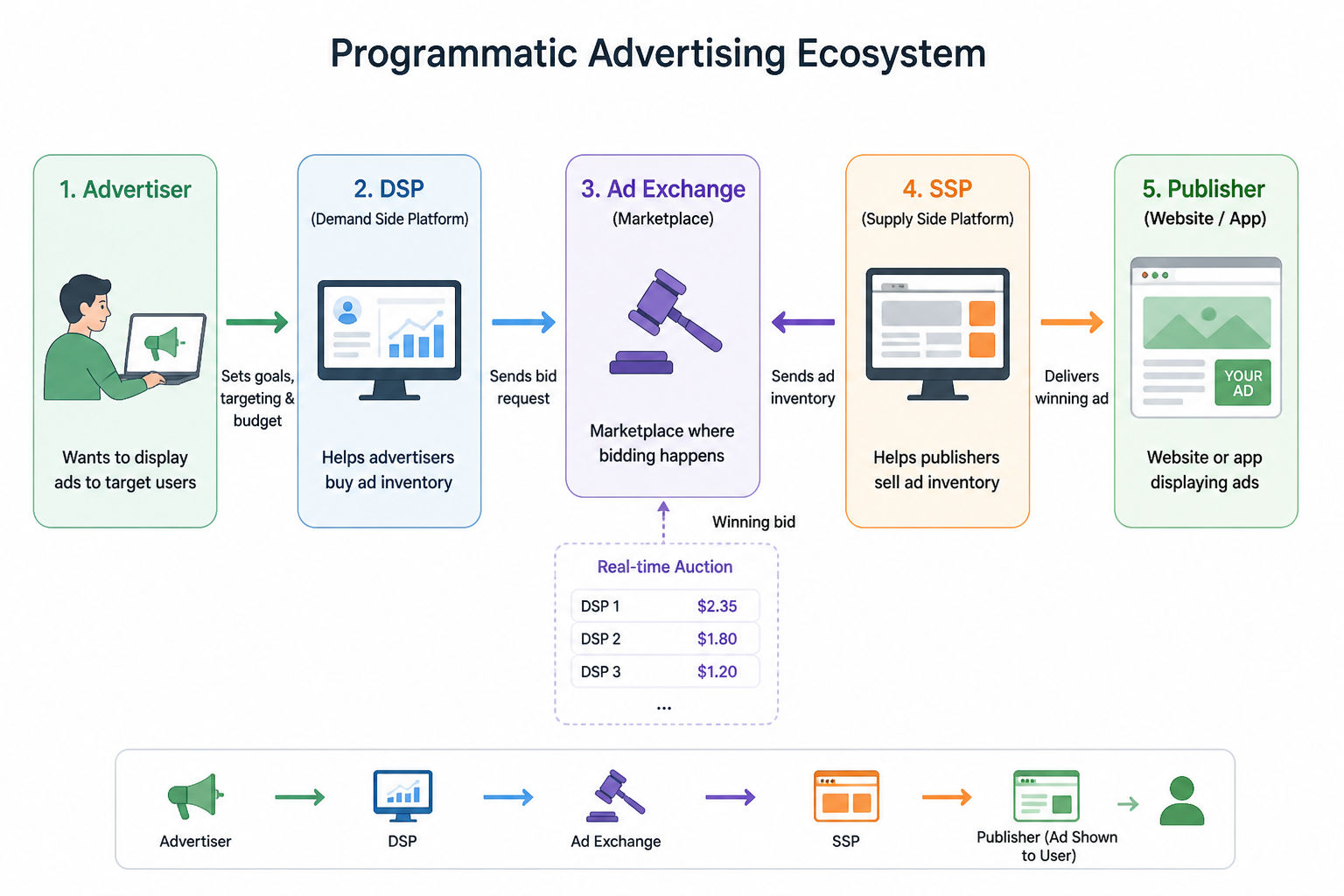
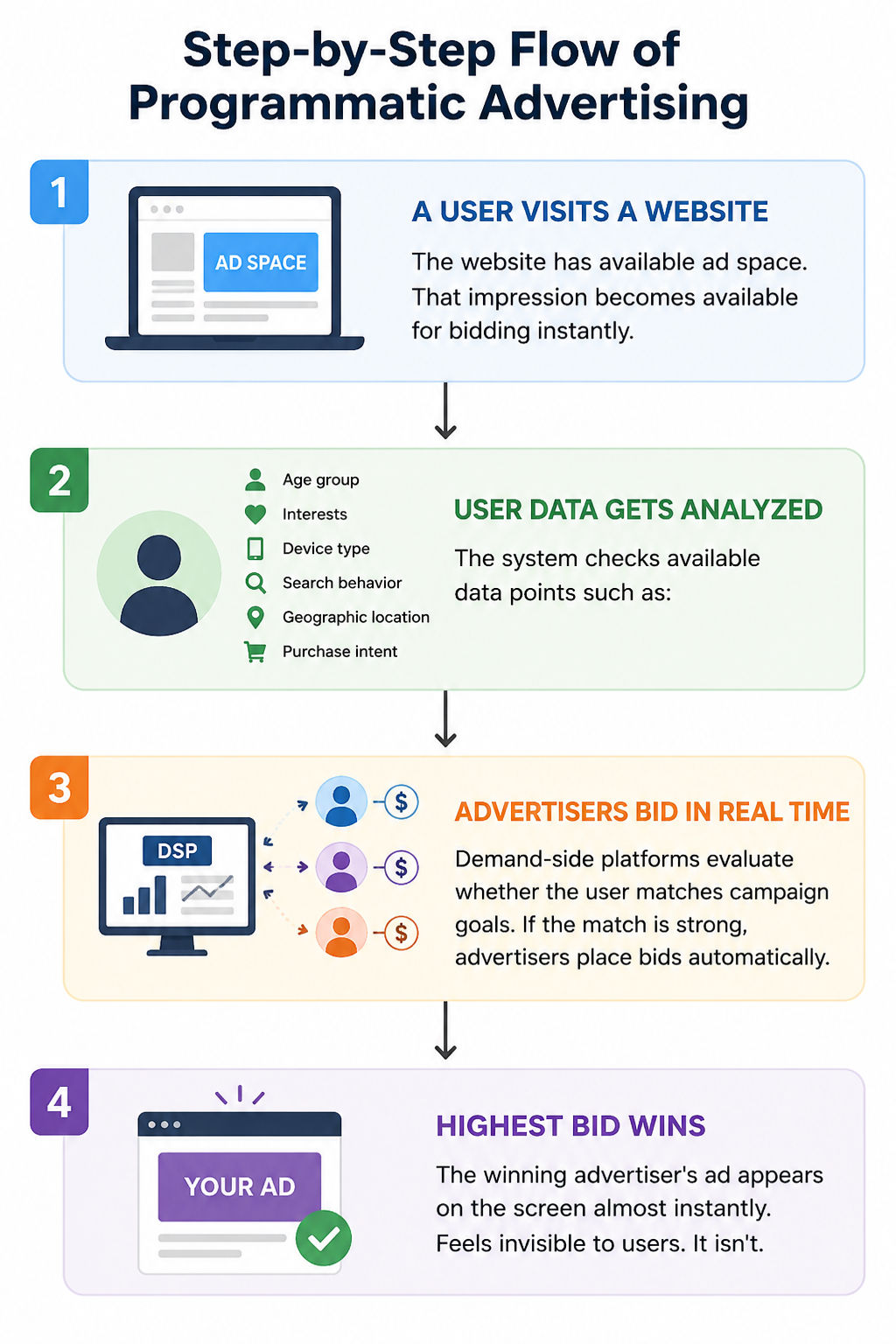
Programmatic advertising is technology-driven ad buying. When a user loads a webpage, an auction happens in the background before the page even finishes loading. An advertiser wins that auction, and the ad appears. The whole thing takes about 100 milliseconds.
Do Read: Google Display Network: An Ultimate Guide
Don't confuse programmatic with display advertising. Display is a format. Programmatic is a buying method. You can buy display ads programmatically, but programmatic also covers video, audio, connected TV, and even digital out-of-home.
These five components work together every time an ad loads. You don't see the process. But it's happening constantly, across billions of impressions every day.
Free Courses
Traditional buying is slow. You agree on a price, place an order, and hope the audience is right. Programmatic is entirely different from that. You define the audience first, and the system finds where they are.
Traditional Advertising |
Programmatic Advertising |
| Manual negotiation with publishers | Automated auction-based buying |
| Fixed pricing (CPM or flat rate) | Real-time, dynamic pricing |
| Broad audience targeting | Precise, data-driven targeting |
| Slow setup (days or weeks) | Near-instant campaign launch |
| Limited performance data | Granular real-time reporting |
Also read: 3 Ways to Reach Your Programmatic Media-Buying Goals across All Channels
Digital Marketing Courses to upskill
Explore Digital Marketing Courses for Career Progression
MICA Executive Alumni Status
Brands choose different buying models based on campaign goals and inventory quality. Large brands often combine multiple models within one campaign because premium placements improve visibility while open exchanges increase reach at lower costs, which helps marketers balance scale, cost efficiency, and audience quality without relying on one inventory source alone.
Type |
Meaning |
| Real-Time Bidding | Open auction where advertisers compete for impressions |
| Private Marketplace | Invite-only auctions with premium publishers |
| Programmatic Direct | Fixed-price deals between advertiser and publisher |
| Preferred Deals | Priority access before inventory enters auctions |
Which type should you use? That depends on your goal. Start with an open auction to test. Move to PMPs or guaranteed deals once you know what's working.
Deal Type |
Best For |
Price Level |
| Open Auction | Scale, awareness | Lowest |
| Private Marketplace | Quality, brand safety | Medium |
| Preferred Deal | Priority access | Medium-High |
| Programmatic Guaranteed | Committed partnerships | Highest |
Also read: A 7-Step Guide to Google Advertising
Let‘s find out the benefits and limitations it has
Benefits of Programmatic Advertising |
Limitations / Challenges |
| Better Audience Targeting: Targets users based on behavior, interests, location, device usage, and purchase intent. | Privacy Regulations: Strict laws like GDPR and CCPA limit how user data can be collected and used. |
| Real-Time Campaign Optimization: Campaigns can adjust instantly based on performance metrics and conversions. | Lack of Transparency: Advertisers may struggle to understand bidding fees, inventory quality, and where budgets are spent. |
| Cost Efficiency: Reduces wasted spend through automated bidding and precision targeting. | Ad Fraud: Fake clicks, bot traffic, and low-quality impressions can waste advertising budgets. |
| Cross-Channel Reach: Enables campaigns across mobile, desktop, apps, video platforms, and smart TVs. | Brand Safety Concerns: Ads may appear beside harmful, offensive, or low-quality content without proper controls. |
| Data-Driven Decisions: Provides insights into creatives, devices, audiences, and placements that perform best. | Complex Platform Management: Requires ongoing monitoring, optimization, and platform expertise to maintain performance. |
| Scalability: Businesses can start with smaller budgets and scale campaigns efficiently as they grow. | Dependence on Quality Data: Poor audience data or weak targeting signals can reduce campaign effectiveness. |
| Automation Saves Time: Automated bidding and ad buying reduce manual campaign management efforts. | Learning Curve: Understanding DSPs, SSPs, bidding strategies, and analytics can overwhelm beginners. |
| Dynamic Ad Placements: Ads can appear across multiple relevant websites and apps automatically. | Low-Quality Inventory Risks: Cheap inventory may deliver weak engagement or poor conversion results. |
The best practices include:
Also Read: Advertising vs Public Relations: Differences Between Advertising & Public Relations
Programmatic isn't just banner ads. The format landscape has expanded significantly.
Don't try to run all of these at once. Pick the format that matches where your audience spends time and what action you want them to take.
Also read: Marketing Vs Advertising – Which is More Effective?
You don't need a massive budget, you only need a clear goal and a basic setup. Programmatic advertising rewards attention. The more you optimize, the better the results get.
Step 1: Define your audience: Be specific. Age, location, interests, intent signals, device type. Vague targeting wastes money fast.
Step 2: Choose a DSP: For beginners, Google Display and Video 360 or The Trade Desk are good starting points. If you're a small business, Google Ads' programmatic options are more accessible.
Step 3: Set your budget and bidding strategy: Start with a CPM or CPC model. Set daily caps. Don't let the system run unchecked.
Step 4: Build your creatives: Have multiple ad sizes ready. At minimum: 300x250, 728x90, 160x600 for display. For video, 15-second and 30-second cuts.
Step 5: Launch, monitor, and optimize: Check performance daily for the first two weeks. Watch your viewability rate, CTR, and conversion rate. Kill placements that aren't delivering. Increase bids on what is.
Do Read: What is MBA in Digital Marketing? Scope, Career option and Salary
Programmatic advertising continues to evolve with changing consumer behavior, stronger privacy regulations, and AI-powered targeting systems. As brands shift more budgets toward automated digital channels, programmatic advertising is becoming central to modern marketing strategies.
Artificial intelligence is expected to drive advancements in predictive targeting, automated bidding, creative optimization, fraud detection, and personalized ad delivery. At the same time, channels like Connected TV (CTV) and retail media networks are growing rapidly, offering advertisers better targeting through first-party data in a cookieless environment.
As digital advertising becomes more data-driven and automated, understanding programmatic advertising is increasingly becoming an essential skill for marketers across media planning, performance marketing, and digital strategy roles.
Programmatic advertising has become a core part of digital marketing because it combines automation, audience targeting, and real-time optimization into one system. Brands can reach the right users faster and more efficiently across websites, apps, streaming platforms, and digital media channels.
Still, automation alone doesn’t create successful campaigns. Smart targeting, strong creatives, clean data, and constant testing matter just as much. The marketers who understand both the technology and the strategy behind programmatic advertising will stay ahead as digital advertising keeps evolving.
Ready to start your journey? Book a free consultation with upGrad today to find the best path for your career.
Programmatic advertising feels confusing at first because the ecosystem includes DSPs, SSPs, exchanges, audience data, and bidding systems all working together. Still, beginners usually understand the basics quickly once they focus on campaign flow instead of memorizing technical jargon. Most marketers learn through hands-on platform practice.
You don’t always need enterprise-level budgets. Smaller businesses can start with modest spending through self-serve DSPs or agency-managed campaigns. The real challenge isn't budget size. It's targeting quality, creative performance, and campaign optimization. Poor strategy can waste even large budgets surprisingly fast.
Google Ads mainly runs inside Google's ecosystem, including Search, YouTube, and Display Network inventory. Programmatic advertising extends beyond one company’s network and gives advertisers access to multiple publishers, apps, exchanges, connected TV platforms, and data sources through automated buying systems and real-time bidding.
Ad fraud remains a major issue because fake traffic, bots, and low-quality inventory still exist across some ad exchanges. Advertisers sometimes pay for impressions or clicks generated by non-human activity. That’s why experienced marketers use verification tools, supply-path controls, and trusted inventory partnerships aggressively.
Not really. Automation handles repetitive campaign tasks like bidding and inventory buying, but strategy still needs human decision-making. Media buyers now spend more time analyzing data, improving targeting, evaluating creative performance, and solving campaign problems instead of manually negotiating placements with publishers.
E-commerce, streaming platforms, fintech, travel, gaming, healthcare, and retail brands benefit heavily because they generate large amounts of customer behavior data. Programmatic advertising works especially well for businesses needing audience targeting at scale while tracking conversions, engagement, or repeat customer actions across devices.
Companies usually look for platform knowledge, analytical thinking, reporting skills, campaign optimization experience, and audience targeting understanding. Familiarity with DSPs like DV360 or Amazon DSP helps significantly. Communication skills matter too because many roles involve explaining performance insights to clients or internal teams.
The industry is shifting toward first-party data, contextual targeting, retail media networks, and privacy-focused identity solutions. Advertisers now rely more on customer-owned data from websites, loyalty programs, and CRM systems instead of depending entirely on third-party cookie tracking across the open internet.
Viewers are spending more time on streaming platforms and smart TVs instead of traditional television channels. That shift has increased demand for connected TV inventory because brands want premium video placements with better audience targeting, measurable engagement data, and stronger personalization than traditional TV advertising allows.
Some campaigns generate clicks and impressions immediately, but strong optimization usually takes several days or weeks. Platforms need time to gather performance signals, test audience quality, and refine bidding strategies. Rushing decisions too early often hurts long-term campaign efficiency and conversion quality.
AI is becoming central to media buying, audience prediction, fraud detection, creative testing, and bidding automation. The industry is moving toward smarter decision-making systems that reduce manual optimization work while improving targeting precision. At the same time, advertisers increasingly demand transparency and trusted inventory sources.
972 articles published
We are an online education platform providing industry-relevant programs for professionals, designed and delivered in collaboration with world-class faculty and businesses. Merging the latest technolo...
Get Free Consultation
By submitting, I accept the T&C and
Privacy Policy
Level Up Your Digital Marketing Career Today!
Top Resources
MICA
Advanced Certificate in AI-Powered Digital Marketing & Communication from MICAMICA Executive Alumni Status
Certification
5 Specialisation
Classroom
4 Months
Certification
2 Months