Digital Marketing KPIs: What to Track and Why It Actually Matters
By upGrad
Updated on May 07, 2026 | 7 min read | 2.31K+ views
Share:

All courses
Certifications
More
By upGrad
Updated on May 07, 2026 | 7 min read | 2.31K+ views
Share:
Table of Contents
Digital marketing KPIs are the specific values used by marketing teams to measure and track the performance of their online campaigns. Effective digital marketing KPIs give you the data needed to stop guessing and start making decisions that lead to real business growth to see if your efforts are actually generating money.
This blog covers everything you need to know about digital marketing KPIs. You'll learn exactly how to identify and track the right metrics for your business goals, understand how to pick the right ones for your goals, and avoid the common mistakes that waste time and budget. By the end of this article, you'll have a clear roadmap to evaluate your marketing performance and improve your return on investment.
Explore upGrad’s Marketing programs to build practical skills in strategy, campaign execution, analytics, and decision-making, so you can turn data into clear, effective action.
A Key Performance Indicator (KPI) is a measurable value that shows how effectively a company is achieving its core business objectives. Defining what digital marketing KPIs are requires you to look at your specific goals. Every business has different priorities, so a startup might focus on brand awareness while an established e-commerce site focuses purely on sales volume. Most successful teams use the SMART framework, meaning their indicators are specific, measurable, achievable, relevant, and time-bound.
Don't fall into the trap of tracking everything just because a software tool gives you a dashboard. Pick five or six critical numbers that truly move the needle for your department.
Also Read: Digital Marketing Types: Top 12 Digital Marketing Types You Should Know
While all KPIs are metrics, not every metric is a KPI. Think of a metric as a count of something, like how many people clicked a link, while a KPI tells you if those clicks actually matter for your bottom line. If you're running a campaign to sell shoes, your KPI might be the conversion rate, while the number of likes on a post is just a secondary metric.
The distinction matters because tracking the wrong things wastes time. A metric becomes a KPI only when it's connected to a goal that actually affects the business.
| Aspect | Metric | KPI |
| Focus | General data points | Specific business goals |
| Action | Observation | Decision making |
| Importance | Low to Medium | High |
| Example | Total Page Views | Cost Per Acquisition |
Free Courses
No KPIs means no clarity. Without clear key performance indicators and marketing metrics, you won’t know if that growth actually helps your business. Too many KPIs can confuse you, too few can blind you. The goal is in balance. KPIs help you:
Do Read: Digital Marketing Tutorials: A Complete Guide
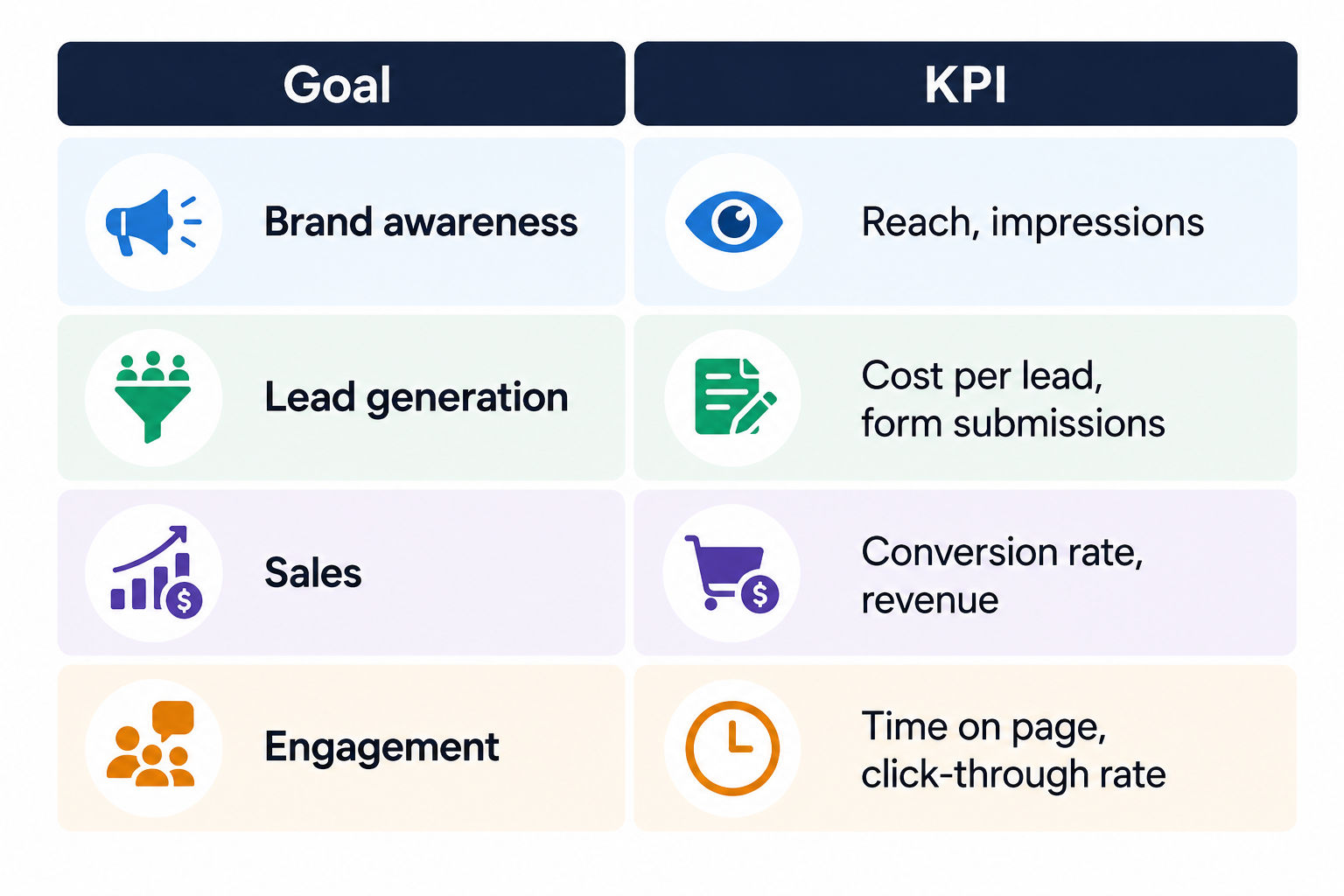
Start with goals and not with tools. Ask yourself these questions first. Then map KPIs to that goal and make sure that your KPIs match intent.
For example:
Digital Marketing Courses to upskill
Explore Digital Marketing Courses for Career Progression
MICA Executive Alumni Status
Let’s break down the most important KPIs in digital marketing across key areas.
KPI Category |
What It Tells You |
Key KPIs |
Insight / Action |
| Traffic KPIs | Shows if people are discovering your website | Website visits, Unique users, Traffic source split | High traffic alone isn’t enough. Always connect it with conversion data to understand real impact. |
| Conversion KPIs | Measures actions that directly impact business outcomes | Conversion rate, Cost per acquisition, Sales or revenue | Low conversion rate signals a problem. Check landing pages, offers, or targeting. Fixing this can significantly improve results without increasing spend. |
| Engagement KPIs | Reveals how users interact with your content | Bounce rate, Average session duration, Pages per session | Low engagement means users aren’t finding value or relevance. Use this to refine content and user experience. |
| Advertising Metrics | Tracks performance of paid campaigns | Click-through rate, Cost per click, Return on ad spend | Small optimizations like better creatives or targeting can improve performance quickly. |
| Email Marketing KPIs | Shows how well your email campaigns perform | Open rate, Click rate, Unsubscribe rate | Falling open rates suggest weak subject lines. Low clicks point to content issues. |
| Social Media KPIs | Measures content performance and audience connection | Engagement rate, Follower growth, Shares and saves | Focus on meaningful interactions, not vanity metrics. Consistency drives long-term growth. |
Different channels need different KPIs. But at the end of the day, all KPIs roll up to one thing: business performance. So instead of separating channels and performance, connect them. Track what happens at the channel level. Then tie it to revenue, cost, and growth. Let’s break it down.
SEO KPIs
SEO takes time. These KPIs help you track long-term growth:
If rankings go up but traffic doesn’t, your titles aren’t strong enough. That’s a content problem, not an SEO one.
Paid Advertising Metrics
Paid campaigns move fast. Money goes out quickly, So your KPIs need to catch problems early.
| KPI | What It Tells You |
| Cost Per Click (CPC) | How much each ad click costs |
| Return on Ad Spend (ROAS) | Revenue earned per rupee spent on ads |
| Conversion Rate | Percentage of ad clicks that result in a goal action |
| Quality Score | Google's rating of your ad relevance and landing page |
| Impression Share | How often your ads appear vs. how often they could |
If ROAS drops, don’t panic. Check targeting first. Then creatives. Then landing page.
Email Marketing KPIs
Email still delivers strong returns. When done right.
Track:
Low opens? Fix subject lines.
Low clicks? Fix content.
High unsubscribes? You’re sending the wrong message.
Social Media KPIs
Likes don’t matter much. Engagement does. Focus on:
If people don’t engage, they don’t care. Simple as that.
Financial Performance KPIs
Channel metrics are useful. But they don’t tell the full story unless you connect them to money. This is where real performance shows.
If CAC is higher than CLV, your growth isn’t sustainable. Fix that first.
Lead Generation KPIs
For longer sales cycles, leads matter more than instant sales. Track how users move through the funnel:
If you generate leads but sales don’t grow, your lead quality is weak.
Must Read: Digital Marketing Placements: Start Your Career the Right Way
Not all KPIs deserve your attention. Some drive outcomes. Others just support them. Track fewer things. Track the right things.
If your goal is growth, focus on CAC and conversion rate.
If your goal is retention, look at CLV and NPS.
If your goal is awareness, track reach and share of voice. Everything else is secondary. Here’s a quick view:
KPI |
Why It Matters |
Who Tracks It |
| Customer Acquisition Cost (CAC) | Controls spending efficiency | Paid teams |
| Customer Lifetime Value (CLV) | Predicts long-term revenue | Growth teams |
| Conversion Rate | Measures Effectiveness | All marketers |
| Return on Investment (ROI) | Connects marketing to profit | Leadership |
| Bounce Rate | Signals content relevance | Content teams |
| Net Promoter Score (NPS) | Measures loyalty | Brand teams |
Knowing which digital marketing metrics and KPIs exist is one thing. Setting up a framework you'll actually use is another. Here's a straightforward process to get there.
Step 1: Start With the Business Goal
Don't start with the data. Start with the question: what does success look like this quarter? Is it more leads, higher revenue, better retention, or brand awareness?
Your KPIs should answer that question directly. If a metric doesn't connect back to the goal, it's noise.
Step 2: Pick 3 to 5 KPIs Per Goal
More isn't better. Teams that track 20 KPIs are usually tracking none of them well. Focus is the point.
Step 3: Set Benchmarks
A number without context means nothing. An email open rate of 22% is good in some industries and poor in others. Know the benchmarks for your sector before you judge your numbers.
Step 4: Review Regularly
KPIs aren't a set-it-and-forget-it system. Weekly reviews for tactical campaigns. Monthly reviews for channel-level performance. Quarterly reviews for strategy adjustments.
Marketing performance isn't static. Your tracking shouldn't be either.
| Review Cadence | What to Look At | Who Should Be in the Room |
| Weekly | Paid spend, CTR, conversion rate changes | Campaign managers |
| Monthly | Channel-level KPIs, CAC, CLV trends | Marketing leads |
| Quarterly | Overall ROI, funnel health, goal progress | Marketing + leadership |
Even experienced teams get this wrong. Here are the mistakes that show up most often. Marketing performance means nothing if it can't be tied to something the business actually cares about.
Mastering digital marketing KPIs is the difference between a successful strategy and a wasted budget. You need to pick the indicators that align with your specific business goals and monitor them consistently. Whether you're looking at SEO growth, social media engagement, or advertising efficiency, the data should drive your next move. Start by selecting a few core metrics today and build a dashboard that gives you a clear view of your marketing performance.
Ready to start your journey? Book a free consultation with upGrad today to find the best path for your career.
Similar Reads
Digital Marketing Eligibility: Who Can Apply and What You Need to Know
How To Boost Your Career With Digital Marketing Certification?
upGrad Learning Centre: Transform Your Career with Digital Marketing Courses
Mica Digital Marketing Syllabus – Advanced Certificate Digital Marketing and Communication
Top 10 Digital Marketing Certifications To Enhance Your Skills in 2026
What is MBA in Digital Marketing? Scope, Career option and Salary
Small businesses usually focus on high-impact digital marketing KPIs like Customer Acquisition Cost and Conversion Rate. Since budgets are tight, you need to know exactly how much you spend to get a single sale. Tracking organic traffic and social media engagement is also helpful for building a brand without spending a fortune on ads.
Fewer is usually better. Most teams track between 3 and 7 KPIs per channel or goal. Tracking too many dilutes focus and makes it harder to act on insights. Choose a primary KPI that measures the main outcome, plus a few supporting ones that signal whether you're on track to hit it.
All KPIs are metrics, but not all metrics are KPIs. A metric is any data point you can measure, like page views or impressions. A KPI is a metric that's tied to a specific business goal. Digital marketing metrics and KPIs work together: metrics provide context, KPIs drive decisions.
If you're just starting out, focus on conversion rate, cost per acquisition, organic traffic, email open rate, and return on ad spend. These five KPIs cover the most common marketing goals and give a clear picture of whether your budget is being used effectively. Build from there as your campaigns grow in complexity.
For e-commerce, the most relevant KPIs include cart abandonment rate, revenue from organic search, ROAS (return on ad spend), average order value, and customer lifetime value. These directly connect to revenue, which is the primary goal of most online stores. Tracking them together gives a full picture of funnel health.
Each channel has its own set of meaningful key performance indicators. SEO teams focus on rankings, organic traffic, and backlinks. Paid teams watch CPC, ROAS, and conversion rate. Email marketers care about open rate and click-to-open rate. Social teams measure engagement rate and referral traffic. The channel determines which numbers actually reflect success.
Stakeholders usually care most about business outcomes, not channel-specific advertising metrics. Lead with ROI, CAC, and total revenue attributed to marketing. You can include channel metrics like CPC or CTR as context, but always frame them in relation to the business goal. The cleaner the connection to revenue, the stronger the report.
Paid campaign metrics should be reviewed weekly because spend accumulates fast. Channel-level marketing metrics for marketing performance should be checked monthly to spot trends. Overall strategy and goal progress reviews work best quarterly. The cadence should match how quickly the data changes and how fast you can act on it.
Some KPIs overlap, like conversion rate and CAC, but B2B and B2C marketing cycles are fundamentally different. B2B typically has longer sales cycles, so KPIs like MQL-to-SQL rate and pipeline influenced by marketing matter more. B2C focuses more on immediate conversions, ROAS, and customer retention metrics. Align your KPIs to your actual buying journey.
Google Analytics 4 covers website and traffic KPIs well. Google Search Console handles SEO performance. Meta Ads Manager and Google Ads dashboards manage paid KPIs. HubSpot or similar CRMs connect marketing to sales data. For a unified view, dashboards like Looker Studio let you pull multiple sources together into one report.
Start by benchmarking against your own historical data, then compare to industry averages for your sector. A target should stretch your team without being unrealistic. If you're consistently hitting every KPI by the middle of the quarter, your targets are probably too easy. If you're always falling short, revisit the baseline assumptions behind each goal.
987 articles published
We are an online education platform providing industry-relevant programs for professionals, designed and delivered in collaboration with world-class faculty and businesses. Merging the latest technolo...
Get Free Consultation
By submitting, I accept the T&C and
Privacy Policy
Level Up Your Digital Marketing Career Today!
Top Resources
MICA
Advanced Certificate in AI-Powered Digital Marketing & Communication from MICAMICA Executive Alumni Status
Certification
5 Specialisation
Classroom
4 Months
Certification
2 Months