Digital Growth Marketing: A Complete Guide to Scaling Businesses in the Digital Age
By Sriram
Updated on Jun 16, 2026 | 7 min read | 4.5K+ views
Share:

All courses
Certifications
More
By Sriram
Updated on Jun 16, 2026 | 7 min read | 4.5K+ views
Share:
Table of Contents
Digital growth marketing is a data-driven approach that focuses on acquiring, engaging, and retaining customers throughout their journey. Unlike traditional marketing, which often stops at conversion, growth marketing uses analytics, experimentation, and A/B testing to optimize user experiences, increase customer lifetime value, and drive sustainable business growth.
In this blog, you'll learn how digital growth marketing works, its key channels, frameworks, metrics, and practical strategies businesses use to achieve sustainable growth. Whether you're a marketer, developer, or business professional, this article explains both the "how" and the "why" behind growth-focused marketing.
Looking to build in-demand digital marketing skills? Explore upGrad's Digital Marketing courses and learn how to create, manage, and optimize campaigns that drive measurable business results.
Digital marketing has evolved beyond ads and content creation. Businesses now optimize the entire customer journey using data and experimentation. Digital growth marketing combines analytics, technology, and customer insights to improve acquisition, engagement, retention, and revenue. Unlike traditional campaigns, growth marketing continuously tests and refines strategies to deliver long-term business growth.
The table below highlights the differences between traditional digital marketing and growth-oriented approaches.
| Aspect | Traditional Marketing | Growth Marketing |
| Focus | Awareness | Full customer lifecycle |
| Metrics | Traffic and impressions | Revenue and retention |
| Approach | Campaign-based | Experiment-driven |
| Decision Making | Intuition | Data-driven |
| Optimization | Periodic | Continuous |
For example, A SaaS company may already receive thousands of visitors every month. Yet small improvements in onboarding or email automation can generate more revenue than increasing traffic alone. This practical mindset sits at the heart of digital growth marketing.
Free Courses
Growth marketing views the customer journey as a system, not a series of campaigns. Each stage affects the one that follows. This helps companies identify bottlenecks and optimize the areas that make the biggest difference. Small improvements tend to add up over time.
The most popular framework is the AARRR model, or Pirate Metrics
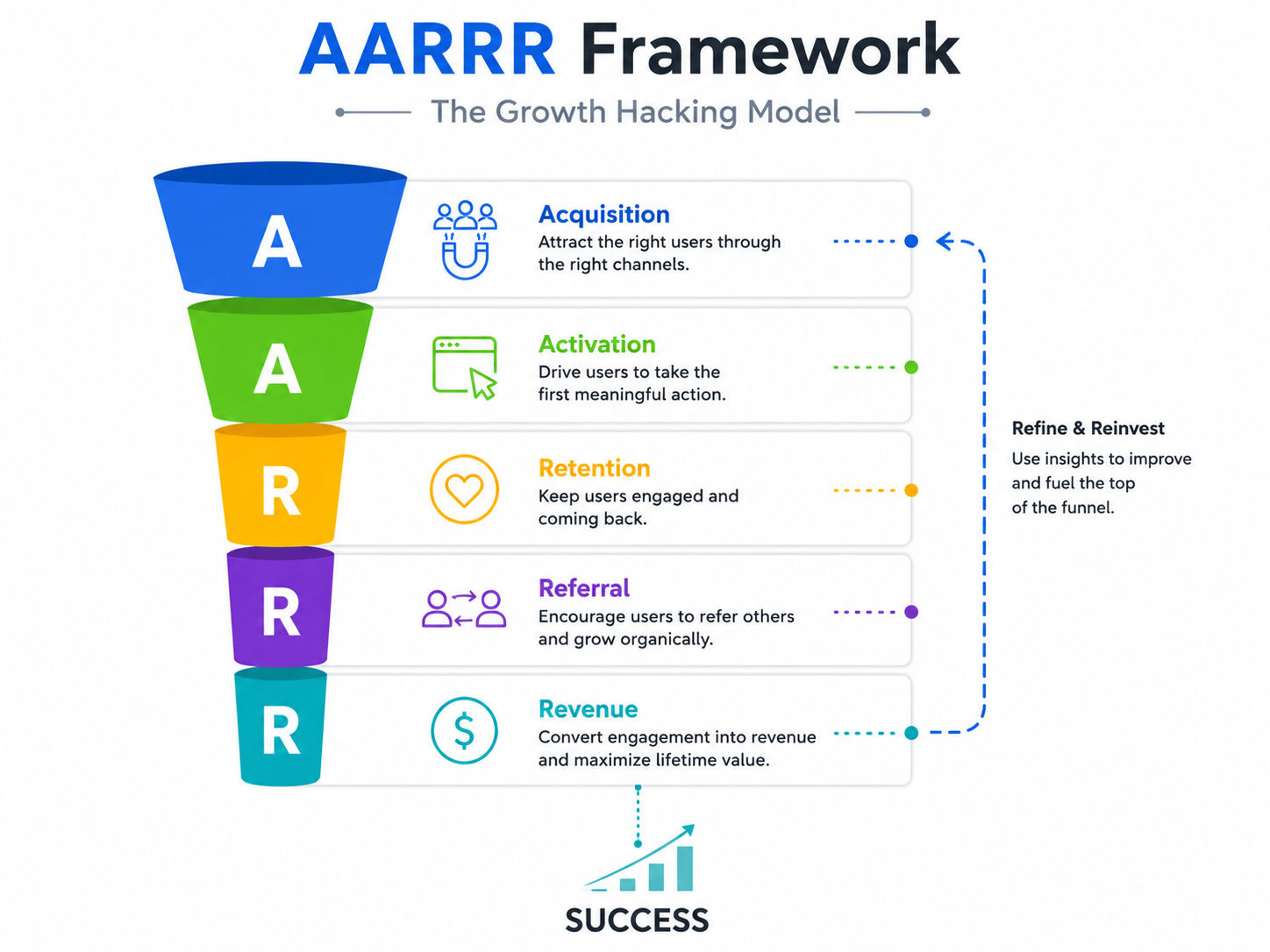
Acquisition is about attracting users through channels such as:
Traffic is not success. It’s quality of traffic than quantity.
Activation measures whether users experience value quickly after joining.
For example, a project management app may define activation as creating the first project within ten minutes of signup.
Retention is often a key determinant of long-term business success.
If a company is acquiring 10,000 users a month, but losing the vast majority of those users after a week, that’s a growth problem, not an acquisition problem.
Common retention strategies are:
Revenue optimization involves improving monetization through:
Satisfied customers frequently become growth channels themselves through referrals and word-of-mouth marketing. Successful digital growth marketing strategies optimize each stage instead of focusing on only one.
Also read : Digital Marketing Subjects That Actually Shape Your Career
Digital Marketing Courses to upskill
Explore Digital Marketing Courses for Career Progression
MICA Executive Alumni Status
Businesses rarely rely on a single channel to achieve growth. Sustainable growth usually comes from combining multiple channels based on customer behavior, business goals, and market trends. The right mix of channels helps businesses acquire, engage, and retain customers more effectively.
SEO remains one of the highest ROI channels because it attracts users with strong purchase intent. For instance, someone searching for "best CRM software" is often closer to making a buying decision than a casual browser.
A strong SEO strategy typically includes:
Paid advertising platforms such as Google Ads and social media ads help businesses scale quickly and reach targeted audiences. However, paid growth becomes costly when customer acquisition costs exceed customer lifetime value.
Growth teams regularly test:
Continuous experimentation helps improve campaign performance while reducing marketing costs.
Email marketing remains one of the most profitable digital channels for businesses. It enables brands to communicate directly with customers and nurture long-term relationships.
Email workflows can help businesses:
When used strategically, these channels work together to create a scalable and sustainable digital growth marketing strategy.
Many modern software companies use their product as the primary acquisition channel.
Freemium models, free trials, and collaborative features often encourage organic growth.
The table below shows common growth channels and their primary goals.
| Channel | Primary Goal |
| SEO | Organic acquisition |
| Paid Ads | Rapid scaling |
| Retention and engagement | |
| Social Media | Brand visibility |
| Referral Programs | Customer acquisition |
| Product-Led Growth | Organic expansion |
Successful digital growth marketing rarely depends on one channel. Diversification reduces risk and improves resilience.
Must read : Creative Digital Marketing: What It Is and How to Get Started
Measuring the right metrics prevents teams from optimising vanity numbers. High traffic or large follower counts may look impressive, but they do not always translate into revenue. Growth teams focus on metrics tied directly to business outcomes.
The following metrics play a central role.
CAC measures how much a company spends to acquire a customer.
Formula: CAC = Total Marketing Spend ÷ Number of Customers Acquired
Lower CAC generally improves profitability.
LTV estimates the revenue generated by a customer over their relationship with a business.
A healthy business often maintains:
LTV > CAC
Conversion rate measures the percentage of users who complete a desired action on a website, app, or campaign. It helps businesses understand how effectively they turn visitors into customers or leads.
Common conversion actions include:
A higher conversion rate indicates better user experience and marketing performance, making it one of the most important metrics in digital growth marketing.
Retention indicates how many users continue using a product over time.
Retention often predicts long-term growth better than acquisition.
The table below summarizes key growth metrics.
| Metric | Why It Matters |
| CAC | Measures acquisition efficiency |
| LTV | Indicates long-term value |
| Conversion Rate | Tracks user actions |
| Retention Rate | Measures customer loyalty |
| Churn Rate | Shows customer loss |
| ROAS | Evaluates advertising performance |
Strong digital growth marketing strategies prioritize metrics connected to revenue rather than vanity indicators.
Also read: Content Calendar: What is it & How to Create One?
Growth marketing follows a structured process that helps businesses identify opportunities, test ideas, and scale successful initiatives. Instead of relying on assumptions, teams use data and experimentation to drive sustainable growth.
Start by identifying what the business wants to achieve. Growth goals should be measurable and aligned with business outcomes.
Examples include:
Clear objectives provide direction and help teams measure success effectively.
Identify points of customer dropoff or friction in the journey.
Commonbottlenecks include:
This identification of issues is the basis to prioritize areas of highest growth potential.
Formulate testable hypotheses from insights.
For example:
"“If we can reduce the checkout process from five steps to three, we could see conversion rates increase.”
A good hypothesis links a proposed change to an expected outcome.
Test one thing at a time, using methods such as A/B testing.
Examples of experiments are:
Controlled experiments help teams understand what truly impacts user behavior.
Run experiments, and analyze the results using relevant metrics.
Major factors include:
Accurate data enables businesses to make better decisions.
If an experiment is successful, roll it out across channels or customer segments.
For example, if a redesigned landing page improves conversions by 15%, use the same design principles on other pages.
Scaling proven strategies to grow and minimize risk.
Growth marketing is a continuous process. Customer behavior, technology, and market trends are always changing.
Teams should regularly do:
Continuous optimization helps businesses maintain long-term competitive advantage.
Ultimately, digital growth marketing succeeds through experimentation, data analysis, and continuous improvement. The businesses that learn and adapt quickly are often the ones that achieve sustainable growth.
Digital growth marketing extends beyond acquiring traffic or running campaigns. It combines data, experimentation, customer understanding, and technology to drive sustainable business growth.
Organizations that embrace testing, optimize the full customer journey, and focus on meaningful metrics are better positioned to compete in today's digital economy. As customer expectations evolve, growth marketing will remain a critical capability for businesses across industries.
Ready to start your journey? Book a free consultation with upGrad today to find the best path for your career.
Traditional digital marketing often focuses on generating traffic and leads, while digital growth marketing looks at the entire customer lifecycle. It combines acquisition, engagement, retention, and revenue optimization using data and experimentation. The goal is not just to attract customers but also to maximize their long-term value and improve business growth continuously.
Almost every industry can benefit from digital growth marketing, including SaaS, e-commerce, healthcare, education, and fintech. Businesses with digital customer interactions gain the most because they can track user behavior, test strategies, and optimize experiences based on real data rather than assumptions.
A growth marketer typically needs skills in analytics, SEO, paid advertising, email marketing, and conversion optimization. Basic knowledge of data analysis and A/B testing is also valuable. Since growth marketing relies heavily on experimentation, curiosity and problem-solving skills are equally important.
The timeline depends on the channels and business goals. Paid campaigns may generate results within days, while SEO and content marketing often require several months. Digital growth marketing works best when businesses focus on consistent optimization rather than expecting immediate outcomes.
Yes. Small businesses often benefit significantly because growth marketing emphasizes efficient use of resources. Simple actions like improving landing pages, automating emails, or optimizing local SEO can deliver measurable improvements without requiring large marketing budgets.
Customer data helps businesses understand user behavior, identify bottlenecks, and personalize experiences. However, collecting data alone is not enough. Companies must analyze it effectively and maintain transparency to build trust while complying with evolving privacy regulations.
Acquiring new customers usually costs more than retaining existing ones. Loyal customers tend to purchase repeatedly, recommend brands to others, and generate higher lifetime value. This is why digital growth marketing places equal emphasis on retention and acquisition.
A/B testing compares two versions of a webpage, email, or advertisement to determine which performs better. Even small changes, such as modifying a call-to-action button or headline, can significantly improve conversion rates and user engagement over time.
Common challenges include poor data quality, limited budgets, unclear goals, and lack of cross-functional collaboration. Businesses may also struggle to interpret analytics correctly. Successful growth teams focus on testing systematically and learning from both successes and failures.
727 articles published
Sriram K is a Senior SEO Executive with a B.Tech in Information Technology from Dr. M.G.R. Educational and Research Institute, Chennai. With over a decade of experience in digital marketing, he specia...
Get Free Consultation
By submitting, I accept the T&C and
Privacy Policy
Level Up Your Digital Marketing Career Today!
Top Resources
MICA
Advanced Certificate in AI-Powered Digital Marketing & Communication from MICAMICA Executive Alumni Status
Certification
5 Specialisation
Classroom
4 Months
Certification
2 Months