Stages of Digital Marketing: A Complete Practical Guide
By Sriram
Updated on Jun 17, 2026 | 5 min read | 4.56K+ views
Share:

All courses
Certifications
More
By Sriram
Updated on Jun 17, 2026 | 5 min read | 4.56K+ views
Share:
Table of Contents
It involves identifying a specific target audience and using digital channels such as search engines, social media, and email to move them from discovering a brand to completing a purchase. The approach depends heavily on data, ensuring the right message reaches the right user at the right time, improving relevance, engagement, and overall conversion efficiency across marketing campaigns.
In this blog, you will understand how each stage connects, how the funnel behaves in real campaigns, and how marketers apply these steps in practical scenarios. You will also see how strategy changes across stages instead of treating digital marketing as one fixed process.
Explore Online Digital Marketing Courses from upGrad and gain a deeper understanding of how businesses in India are leveraging digital channels.
The stages of digital marketing describe how users move step by step from discovering a brand to becoming a customer. It is not just about running ads or posting content. It follows a structured journey that matches user intent at each level, starting from awareness and moving toward conversion.
This structure helps marketers plan campaigns more effectively by mapping actions to user behavior. Instead of random execution, every step serves a purpose. The sequence of digital marketing funnel stages ensures better targeting, reduced waste, and clearer decision-making across the entire marketing process.
Digital marketing funnel stages:
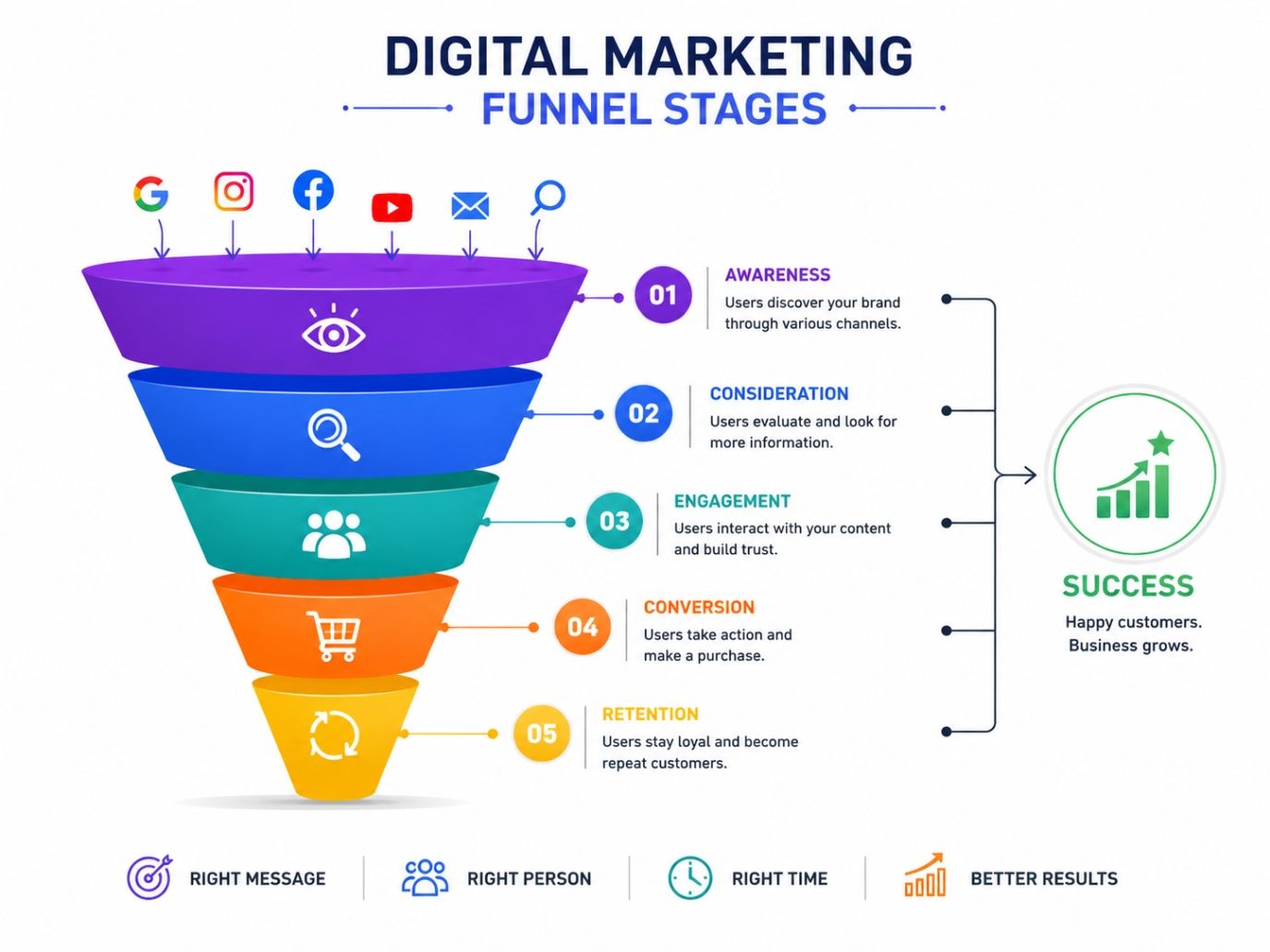
A simple breakdown looks like this:
What makes this structure powerful is alignment. Each stage requires different content, platforms, and messaging. For example, a YouTube video works better in awareness, while a landing page performs better in conversion.
Free Courses
The awareness stage is the entry point of the stages of digital marketing, where users first discover a brand, product, or idea. The main goal here is to get noticed rather than sell anything. At this point, users are usually just recognizing a problem or exploring general information, not comparing options or making decisions.
This stage sets the foundation for all later funnel activity because without visibility, nothing else in the journey begins.
Awareness Stage Breakdown:
Section |
Details |
| User Behavior | - Users don’t know the brand yet- They are identifying a problem or need- They consume general informational content- They are not comparing or making decisions yet |
| Key Focus Areas | - Building visibility across digital platforms- Educating users about a topic or problem- Creating attention-grabbing but useful content- Avoiding direct sales messaging- Reaching a broad yet relevant audience |
| Common Channels Used | - SEO blogs and informational articles- Social media posts, reels, and short videos- Display ads and banner campaigns- YouTube educational content- Influencer collaborations and shoutouts |
Also read : Digital Marketing Subjects That Actually Shape Your Career
Digital Marketing Courses to upskill
Explore Digital Marketing Courses for Career Progression
MICA Executive Alumni Status
The acquisition stage comes after awareness and is an important part of the stages of digital marketing. Here, the focus shifts from just building visibility to capturing user interest and bringing them into owned platforms like websites, apps, or email lists. At this point, users have already shown some level of intent through engagement or clicks, and the goal is to convert that attention into measurable actions.
Acquisition Stage Breakdown :
Section |
Details |
| User Behavior | - Users have shown some interest in the brand- They may have clicked, visited, or engaged with content- They explore more specific information- They are moving closer to intent |
| Key Focus Areas | - Driving traffic to websites or apps- Converting visitors into leads or subscribers- Encouraging sign-ups or downloads- Using SEO and landing pages for targeted intent- Capturing user data for retargeting |
| Common Channels Used | - Search engine optimization (SEO) landing pages- Paid search ads (Google Ads, Bing Ads)- Retargeting campaigns- Email sign-up forms and lead magnets- App install campaigns |
Also read: Content Calendar: What is it & How to Create One?
The engagement stage is where users start interacting more deeply with a brand after initial awareness. In the stages of digital marketing, this stage marks the shift from passive interest to active evaluation. Users are no longer just browsing-they are exploring content more intentionally to understand value and relevance.
At this stage, content needs to go deeper. Users expect clarity, proof, and useful insights that help them make better decisions.
Engagement Stage Breakdown :
Section |
Details |
| User Behavior | - Users interact more actively with content- They read blogs, watch reviews, and explore details- They compare options and evaluate relevance- They are building intent but not ready to convert |
| Key Focus Areas | - Delivering in-depth and useful content- Building trust through proof and clarity- Encouraging repeat engagement- Reducing confusion in decision-making- Strengthening interest into intent |
| Common Engagement Tools | - Email newsletters- Webinars or live sessions- Case studies- Retargeting ads- Product comparison pages |
The consideration stage happens when users start seriously evaluating different options. In the stages of digital marketing, this is where users compare brands, features, pricing, and trust factors before making a final decision.
At this point, users already understand their problem and are now focusing on finding the best possible solution.
Consideration Stage Breakdown
Section |
Details |
| User Behavior | - Users compare multiple solutions or brands- They read reviews and detailed comparisons- They evaluate pricing, features, and credibility- They shortlist options before deciding |
| Key Focus Areas | - Highlighting unique value and differentiation- Providing comparison content- Building credibility through testimonials- Addressing objections and doubts- Strengthening trust signals |
| Common Consideration Tools | - Comparison landing pages- Customer reviews and testimonials- Case studies and success stories- Product demos- Detailed FAQs and guides |
The conversion stage is the most action-focused part of the stages of digital marketing. This is where users finally complete a desired action such as buying a product, signing up, or subscribing to a service.
At this stage, the intent is already strong. The main job of marketing is to remove friction and make the decision as easily as possible.
Conversion Stage Breakdown
Section |
Details |
| User Behavior | - Users have strong intent to act- They are ready to purchase or sign up- They respond to offers, pricing, and trust signals |
| Key Focus Areas | - Landing page optimization- Clear and strong call-to-action buttons- Pricing transparency- Fast website performance- Trust signals like reviews and guarantees |
| Common Optimization Elements | - Simplified checkout flows- Limited-step sign-up forms- A/B testing of landing pages- Urgency and offer positioning |
Also read: Content Calendar: What is it & How to Create One?
The retention stage focuses on keeping users engaged after they have converted. In the stages of digital marketing, this stage ensures that customers do not drop off after their first action and instead continue interacting with the brand.
Retention is critical because it directly impacts customer lifetime value and reduces the need for constant new customer acquisition.
Retention Stage Breakdown
Section |
Details |
| User Behavior | - Users have already converted- They continue engaging with the brand- They may become repeat customers or loyal users |
| Key Focus Areas | - Email follow-ups and ongoing communication- Loyalty and reward programs- Personalized recommendations- Product updates and feature engagement |
| Common Retention Tools | - Email marketing campaigns- Subscription renewal offers- Personalized product suggestions- Customer loyalty programs |
Also Read: Digital Marketing Scope in India – The Perfect Career Move
The future of digital marketing is moving toward smarter automation, deeper personalization, and content that feels more human than promotional. Instead of broad campaigns, brands will rely on real-time data and user behavior to decide what message to show, when, and where.
The future of digital marketing depends on how well you use AI to reduce guesswork.
This changes how SEO and content strategy work completely.
In the future of digital marketing, one message for everyone will stop working.
Brands will need faster storytelling, not longer explanations.
The future of digital marketing will reward brands that feel real, not just visible.
The stages of digital marketing form a continuous system rather than isolated steps. Each stage depends on the one before it and influences the one after it.
When businesses understand this flow, they stop treating marketing as random campaigns and start building structured growth systems. The funnel becomes a way to map user behavior, not just track performance.
Ultimately, success comes from balancing all stages instead of over-focusing on one. Awareness brings users in, engagement builds trust, conversion drives action, and retention sustains growth.
Want personalized guidance on Digital Marketing Business in India? Speak with an expert for a free 1:1 counselling session today.
The stages of digital marketing guide how you move a person from awareness to conversion. It usually starts with discovery through search or social media, then interest building, engagement, and finally action. Each stage connects smoothly, so your message stays consistent and helps users trust your brand step by step.
The 5 stages of digital marketing are awareness, consideration, conversion, retention, and advocacy.
You need all stages to avoid losing potential customers mid-journey.
The stages of digital marketing help small businesses avoid random marketing efforts. Instead of posting without direction, you guide users from discovery to purchase. For example, a local bakery can use Instagram for awareness, WhatsApp for engagement, and offers for conversion, making every step measurable and more predictable.
The first stage in digital marketing is awareness. This is where users discover your brand for the first time through search engines, ads, or social media. Without awareness, no one enters your funnel. You should focus on clear messaging and visibility so people quickly understand what you offer and why it matters.
The 7 stages of digital marketing expand the funnel into a more detailed journey. It includes awareness, interest, consideration, intent, conversion, loyalty, and advocacy. This model helps you track user behavior more closely. For example, intent can be captured through email signups or product page visits before final purchase happens.
You measure each stage of digital marketing using different metrics. Awareness uses reach and impressions, engagement uses clicks and time on page, conversion uses sales or signups, and retention uses repeat visits. Tracking these helps you understand where users drop off and where your marketing needs improvement for better results.
The 9 stages of digital marketing break the journey into deeper actions: awareness, reach, engagement, consideration, intent, evaluation, conversion, loyalty, and advocacy. This model helps in advanced tracking. For example, evaluation happens when users compare your product with competitors before deciding, which is often influenced by reviews and testimonials.
The stages of digital marketing improve ROI by reducing wasted effort. Instead of running broad campaigns, you target users based on where they are in the funnel. For example, awareness ads focus on reach, while conversion campaigns focus on purchase-ready users. This alignment helps you spend less and get more qualified leads.
The 11 stages of digital marketing include awareness, discovery, interest, engagement, consideration, intent, evaluation, conversion, onboarding, loyalty, and advocacy. This model gives a full customer lifecycle view. For example, onboarding ensures users understand your product after purchase, which reduces churn and increases long-term satisfaction and repeat usage.
Social media supports every stage of digital marketing. Instagram and YouTube help in awareness through reach, while LinkedIn and blogs support consideration through detailed content. Messaging apps help in conversion and retention. The key is matching content type with stage so users don’t feel pushed but naturally guided forward.
Beginners can start by mapping one simple funnel using the stages of digital marketing. For example, use SEO or reels for awareness, blogs for consideration, and WhatsApp or landing pages for conversion. Track results weekly. Focus on one stage at a time instead of trying to optimize everything together from the start.
727 articles published
Sriram K is a Senior SEO Executive with a B.Tech in Information Technology from Dr. M.G.R. Educational and Research Institute, Chennai. With over a decade of experience in digital marketing, he specia...
Get Free Consultation
By submitting, I accept the T&C and
Privacy Policy
Level Up Your Digital Marketing Career Today!
Top Resources
MICA
Advanced Certificate in AI-Powered Digital Marketing & Communication from MICAMICA Executive Alumni Status
Certification
5 Specialisation
Classroom
4 Months
Certification
2 Months