RAG in Generative AI: A Complete Practical Guide
By Sriram
Updated on Jun 18, 2026 | 5 min read | 7.2K+ views
Share:

All courses
Certifications
More
By Sriram
Updated on Jun 18, 2026 | 5 min read | 7.2K+ views
Share:
Table of Contents
RAG in generative AI is a technique that connects large language models to external, trusted knowledge sources. Instead of depending only on static training data, it first retrieves relevant documents and then uses them to generate responses. This approach improves accuracy, keeps answers up to date, adds context, and reduces hallucinations in real-world AI applications.
In this blog, you’ll understand how it works, why it matters, where it is used, and what challenges show up in real implementations.
Build practical expertise by exploring our Generative AI and move forward in your AI career with confidence.
Generative AI Courses to upskill
Explore Generative AI Courses for Career Progression
IIIT Bangalore
Executive Diploma in Machine Learning and AI360° Career Support
RAG in generative AI works by combining information retrieval with text generation. Instead of directly answering from model memory, it first pulls relevant data and then builds a grounded response using that context.
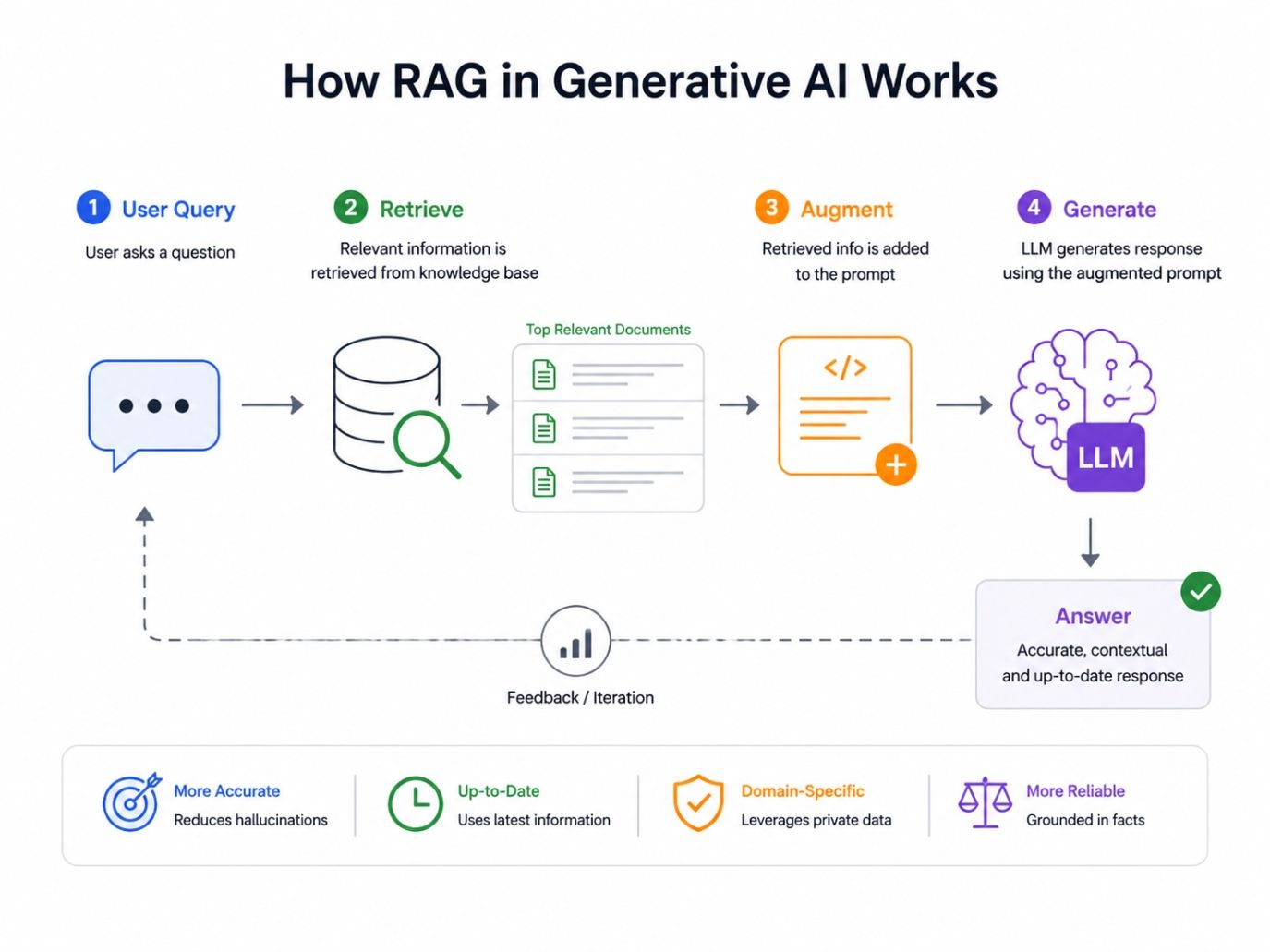
The step-by-step process can be understood in four simple stages.
The user query is processed and converted into embeddings. These embeddings capture meaning, not just words, helping the system understand intent.
The system searches a vector database to find the most relevant documents or text chunks based on semantic similarity.
Retrieved information is cleaned and combined with the user query to create a structured prompt for the language model.
The LLM generates the final answer using both the query and retrieved context, followed by basic formatting or refinement if needed.
Also Read: LLM vs Generative AI
RAG in generative AI is built using multiple interconnected components that work together to bring accuracy and context into LLM responses. Each component plays a specific role in how information is stored, retrieved, and generated.
Understanding these building blocks helps in designing better RAG pipelines and debugging issues in real-world systems. Below is a clear breakdown of the core components and their function in the workflow.
Here’s a clear table that breaks down the main building blocks of RAG in generative AI systems and what each one does in practice:
Component |
What It Does |
Why It Matters |
| Data Sources | Stores raw knowledge like PDFs, APIs, docs, or web content | Provides the foundation of all responses |
| Chunking Layer | Splits large documents into smaller text pieces | Improves retrieval accuracy and context matching |
| Embedding Model | Converts text into vector representations | Helps the system understand semantic meaning |
| Vector Database | Stores and indexes embeddings for fast search | Enables efficient similarity-based retrieval |
| Retriever | Finds the most relevant chunks based on query similarity | Ensures the model gets useful context |
| Re-ranker (optional) | Reorders retrieved results based on relevance | Improves precision of selected context |
| LLM (Generator) | Generates final response using retrieved context | Produces human-like, grounded answers |
| Output Layer | Formats and refines the final response | Ensures readability and usability |
In RAG in generative AI, each component plays a connected role. If one part is weak, the overall system performance drops, especially in retrieval quality and response accuracy.
Also Read: Difference Between RAG and LLM
In generative AI, RAG is often used in real-world systems where accuracy and fresh information are more important than creative answers. It connects language models with trusted data sources to provide grounded answers.
Here are the main use cases in a simplified form.
Generative AI RAG enables employees to search internal company data using natural language. Instead of manually browsing through files and folders, users get direct answers from documents, wikis and databases.
RAG chatbots find answers in up-to-date FAQs and product documentation. As a result, they give better and more consistent responses than rule-based chatbots.
RAG in generative AI retrieves relevant clauses and policies to generate answers in legal workflows. This reduces mistakes and helps ensure that responses are based on verified documents.
RAG systems assist in retrieving medical information from research papers and clinical guidelines. This allows healthcare professionals to find trusted knowledge more quickly.
Developers can inquire about APIs, errors, setup steps, etc. RAG collects pertinent documents and offers straightforward, simple explanations without the need to rummage through files.
Also Read: Generative AI Fundamentals: A Practical Guide to Understanding How Modern AI Works
RAG in generative AI is powerful in theory, but real-world systems face practical issues around data quality, retrieval accuracy, and system performance. Most problems are not caused by the model itself but by how data is structured and retrieved.
Below is a clear breakdown of common challenges and how teams optimize them in production.
Challenge |
Optimization Approach |
| Weak or noisy chunking | Use optimal chunk sizes with overlap and structure-aware splitting |
| Irrelevant document retrieval | Use hybrid search (keyword + vector search) |
| Slow response time | Apply caching and optimize vector search indexes |
| Outdated knowledge base | Regularly update and sync data sources |
| Poor ranking of results | Use re-ranking models for better ordering |
| Semantic mismatch | Improve embedding models and fine-tune domain data |
| Evaluation difficulty | Test both retrieval accuracy and final output quality |
| Data drift in production | Continuous monitoring and periodic re-indexing |
In RAG in generative AI, the biggest performance gains usually come from improving retrieval quality rather than upgrading the language model. This is why most production teams focus heavily on chunking, ranking, and data maintenance.
Also Read: Easy Guide to the Generative AI Course Syllabus
RAG in generative AI is now a core architecture for building accurate and reliable AI systems. It connects static language models with dynamic, real-world knowledge by combining retrieval and generation. This helps reduce hallucinations, improve accuracy, and enables the use of private or domain-specific data in practical applications.
Its performance depends more on retrieval quality, data design, and system tuning than model size. When implemented well, RAG in generative AI turns LLMs into trustworthy knowledge systems that can scale across real business use cases.
Want to explore more about Generative AI? Book your free 1:1 personal consultation with our expert today.
RAG improves accuracy by grounding responses in real documents instead of relying only on model memory. When a user asks a question, the system pulls relevant internal data first. This reduces hallucinations and improves trust. In most enterprise setups, rag in generative ai ensures answers stay aligned with updated company knowledge.
Maintaining a RAG system is not a one-time task. You need to continuously update documents, improve chunk quality, and monitor retrieval errors. Small issues in data formatting can reduce answer quality quickly. Teams also struggle with balancing speed and accuracy when scaling systems under real production traffic.
Evaluation goes beyond checking final answers. You need to test retrieval relevance, context quality, and response accuracy separately. Many teams use human evaluation along with automated scoring methods. A good approach is to track whether the system retrieves the right documents before judging the output generated by the model.
Yes, RAG can work with private data if the architecture is designed properly. Most companies use secure vector databases, access control layers, and encrypted storage. The model only sees retrieved snippets, not full databases. This setup allows controlled access without exposing sensitive internal systems or raw datasets.
Vector databases store embeddings that represent documents in numerical form. When a query comes in, it is also converted into an embedding and matched against stored vectors. This makes semantic search possible instead of keyword search. Without this layer, RAG systems would fail to retrieve contextually relevant information.
Latency can be reduced by caching frequent queries, optimizing embedding models, and limiting retrieval size. Some systems also use precomputed responses for common questions. Another practical approach is using faster vector search algorithms. Even small optimizations help because every step in the pipeline adds processing time.
RAG is not always the right choice. If your application does not require external knowledge or relies on very stable rules, a simpler model works better. For example, basic classification tasks do not need retrieval. In such cases, rag in generative ai adds unnecessary complexity without real benefit.
RAG depends heavily on the freshness of its data sources. If documents are outdated, the system may still retrieve them. To manage this, teams use versioning, metadata filters, and regular data refresh cycles. Conflicting information is usually resolved through ranking models that prioritize more recent or reliable sources.
Hybrid search combines keyword-based search and vector similarity search. This helps improve retrieval accuracy when semantic matching alone is not enough. For example, technical terms or product codes often work better with keyword matching. Many modern systems use hybrid search to improve overall relevance in real-world queries.
RAG supports multilingual use cases by using multilingual embedding models. These models map different languages into a shared semantic space. This allows a query in one language to retrieve relevant documents in another. It is useful in global applications where users interact with the same knowledge base across regions.
It depends on the use case. RAG works better when data changes frequently because you can update documents without retraining models. Fine-tuning is useful for behavior control but not for fresh knowledge. In many real systems, rag in generative ai is preferred because it is faster to update and easier to maintain at scale.
727 articles published
Sriram K is a Senior SEO Executive with a B.Tech in Information Technology from Dr. M.G.R. Educational and Research Institute, Chennai. With over a decade of experience in digital marketing, he specia...
Speak with AI & ML expert
By submitting, I accept the T&C and
Privacy Policy