Generative AI Architecture: A Beginner’s Guide
By Sriram
Updated on Jun 17, 2026 | 7 min read | 2.36K+ views
Share:

All courses
Certifications
More
By Sriram
Updated on Jun 17, 2026 | 7 min read | 2.36K+ views
Share:
Table of Contents
Generative AI architecture is what makes tools work that can make text, images, code, videos, and other things. Generative AI architecture is used by things like ChatGPT and Gemini and image generators and coding assistants. Every generative AI system uses a plan that helps it understand what people put in deal with the information and make things that make sense.
In this blog, you’ll learn what generative AI architecture is, how it works. You will also learn about models of generative AI architecture. If you are a student, a developer, businessperson, or an AI enthusiast, this article will help you understand the basic parts of modern generative AI systems.
Ready to go beyond using AI tools and start building them? Explore upGrad's Agentic AI Courses Online covering generative AI.
Generative AI Courses to upskill
Explore Generative AI Courses for Career Progression
IIIT Bangalore
Executive Diploma in Machine Learning and AI360° Career Support
Generative AI architecture is the framework that makes up the models and processes that let AI systems create things. This framework is what decides how the data moves through the system and how the models are trained and what they produce.
You can think of AI architecture as a plan for a generative AI system. Like a house needs a plan before it can be built, a generative AI system needs an architecture that decides how the information is used.
Key Components of Modern AI Architecture
Component |
Description |
| Foundation Models | Large, pre-trained models that serve as the base for other applications to build upon |
| Core Technology | Typically built using transformers and neural networks |
| Data Processing | Models analyze vast amounts of data to identify patterns |
| Output Generation | Patterns identified are used to generate new content (text, images, etc.) |
Also Read: Generative AI Fundamentals: A Practical Guide to Understanding How Modern AI Works
Without a foundation, even the best AI model can have trouble with accuracy. It can also struggle with speed and reliability.
A good design helps Artificial Intelligence systems:
Also Read: Easy Guide to the Generative AI Course Syllabus
The transformer architecture really helped make AI better. This is why we have language models today. Most research says transformer-based systems are now the way to develop modern generative AI.
The transformer architecture made a difference. Generative AI improved a lot because of it. It is used a lot in AI development.
Layer |
Purpose |
| Data Layer | Collects and prepares training data |
| Model Layer | Learns patterns and relationships |
| Training Layer | Optimizes model performance |
| Inference Layer | Generates responses in real time |
| Application Layer | Delivers outputs to users |
Also Read: What is a Transformer Model?
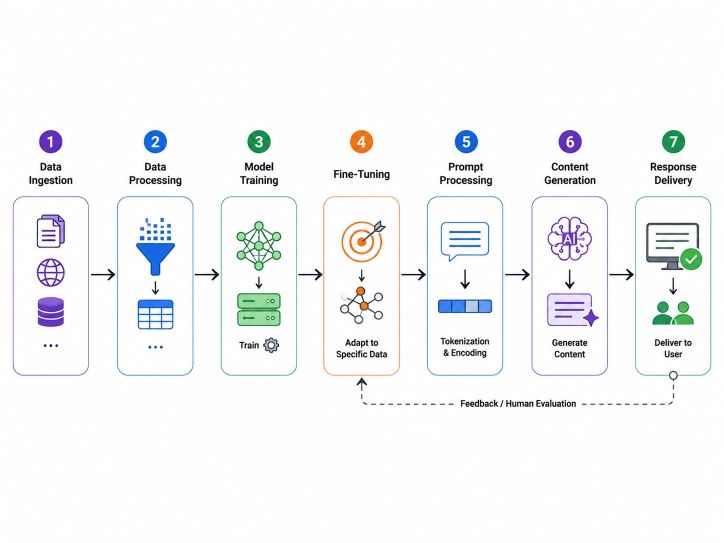
Understanding the workflow makes generative AI architecture easier to grasp.
The system gathers large volumes of structured and unstructured data.
Examples include:
The data undergoes:
This ensures that the model receives consistent inputs.
During training, the model learns patterns from data. It predicts missing words, identifies relationships, and gradually improves through repeated optimization cycles.
Many organizations find fine-tune pre-trained models for specific tasks.
Examples include:
When a user submits a query, the model converts it into machine-readable representations.
The architecture analyzes:
The model predicts the most probable next token repeatedly until a complete response is generated.
The final output is returned to the user through:
Modern generative AI systems are now using something called Retrieval-Augmented Generation (RAG)
RAG systems do not just rely on the data they were trained on. They actually look up relevant information before creating an answer. This helps make sure the answers are accurate and have the current information.
The main parts of a RAG system are:
This workflow explains how modern generative AI architecture powers today's intelligent applications.
Stage |
Activity |
| Input | User enters prompt |
| Processing | Prompt analysis |
| Retrieval | External information lookup |
| Generation | AI creates response |
| Output | Response delivered |
Also Read: Difference Between RAG and LLM
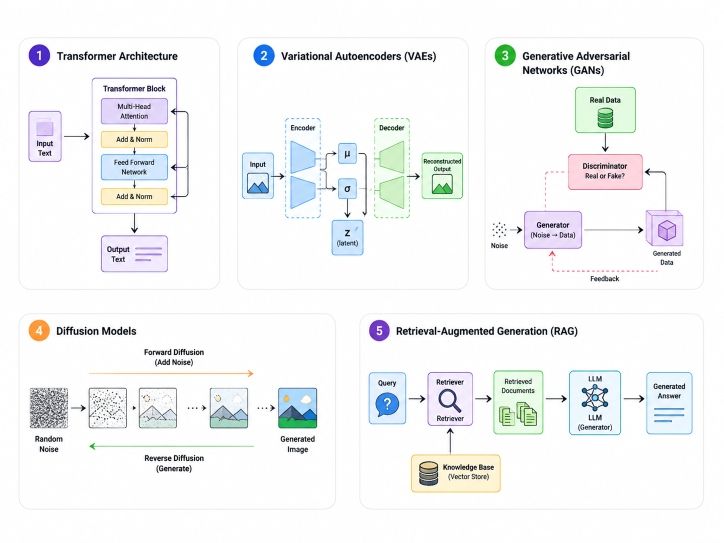
Different use cases require different architectural approaches.
The transformer is currently the most widely used generative AI architecture.
Advantages include:
Most modern LLMs use transformer-based architectures.
VAEs generate new data by learning compressed representations.
Common applications include:
GANs use two competing neural networks:
The generator creates content while the discriminator evaluates quality.
Popular use cases include:
Diffusion models have become popular for image generation.
They work by gradually removing noise from random inputs to create realistic outputs.
Applications include:
RAG combines retrieval systems with language models.
Benefits include:
Many organizations now use RAG as a production-ready architecture for generative AI applications.
Despite rapid progress, generative AI architecture still faces several challenges.
AI systems sometimes generate incorrect information confidently. This remains one of the biggest concerns for businesses and users.
Read: AI Hallucination: What It Is, Why It Happens, and How to Prevent It
Training large models requires:
Organizations must ensure:
Many AI models operate as black boxes. Understanding why a model generated a specific response can be difficult.
Models may inherit biases from training data. Developers continuously work to reduce these issues.
People are starting to think that the next big thing in AI for businesses is going to be a system that brings together language models, retrieval systems, and specialized agents.
As language models and other technologies get better, the way we build AI systems will become more accurate, scalable, and practical for real-world use
The future of generative AI architecture is moving toward:
Generative AI architecture is the framework that powers modern AI systems capable of creating text, images, code, and other forms of content. It combines data pipelines, neural networks, attention mechanisms, training infrastructure, and inference engines into a unified system.
Understanding generative AI architecture helps professionals move beyond simply using AI tools and begin understanding how they work behind the scenes. As AI adoption grows across industries, knowledge of these architectures will become increasingly valuable for developers, business leaders, and technology professionals alike.
Want to explore more about Generative AI architecture? Book your free 1:1 personal consultation with our expert today.
Generative AI architecture is a structure that allows AI systems to create new content. It includes data pipelines, machine learning models, training processes, and output-generation mechanisms. Together, these components help AI understand inputs and generate useful responses.
Transformer architecture enables AI models to understand context more effectively. It uses attention mechanisms to focus on relevant information, which improves response quality. Most modern large language models rely on transformers because of their scalability and performance.
Traditional AI mainly focuses on classification, prediction, or decision-making. Generative AI architecture is designed to create new content such as text, images, audio, or code. This makes it more suitable for creative and conversational applications.
The main layers typically include data collection, embeddings, foundation models, training infrastructure, inference systems, and application interfaces. Each layer contributes to the overall content-generation process and user experience.
Embeddings transform text, images, or other data into numerical vectors that machines can understand. They help models recognize relationships between concepts and improve contextual understanding during content generation.
No. Generative AI architecture powers many applications beyond chatbots. These include image generation tools, video creation platforms, coding assistants, recommendation engines, virtual tutors, and content automation systems.
Retrieval-Augmented Generation helps models access external information during response generation. This reduces reliance on training data alone, improves factual accuracy, and allows systems to provide more up-to-date answers.
Some key limitations include hallucinations, computational costs, privacy concerns, model bias, and explainability challenges. Developers continue to improve architectures to address these issues and increase trustworthiness.
Industries such as healthcare, finance, education, retail, software development, and customer service benefit significantly. These sectors use generative AI to improve productivity, automate tasks, and enhance customer experiences.
Yes. Beginners can start by understanding neural networks, transformers, embeddings, and large language models. A foundational understanding of machine learning concepts makes learning generative AI architecture much easier.
The future includes multimodal systems, AI agents, improved reasoning, efficient small models, and advanced retrieval techniques. These developments aim to create AI systems that are more accurate, secure, explainable, and useful across industries.
727 articles published
Sriram K is a Senior SEO Executive with a B.Tech in Information Technology from Dr. M.G.R. Educational and Research Institute, Chennai. With over a decade of experience in digital marketing, he specia...
Speak with AI & ML expert
By submitting, I accept the T&C and
Privacy Policy