A Complete Guide to AI Architecture
By Rahul Singh
Updated on May 07, 2026 | 10 min read | 5.56K+ views
Share:

All courses
Certifications
More
By Rahul Singh
Updated on May 07, 2026 | 10 min read | 5.56K+ views
Share:
Table of Contents
AI architecture is the blueprint that defines how an AI system is designed, built, and managed. It covers the full flow, from data ingestion and processing to model execution and final outputs.
It includes both the internal model structure and the larger system setup like cloud or hybrid infrastructure. This ensures the system can scale, stay secure, and handle data properly while delivering reliable results.
In this blog, you will learn what AI architecture means, how it works, key components, types of AI ML architecture, real-world use cases, and how to get started.
Build practical AI and ML skills and start creating real applications. Explore upGrad’s Artificial Intelligence courses to learn AI architecture, machine learning, and generative AI tools, and move toward roles in AI development and cloud-based ML systems.
Popular AI Programs
Think of it like a building structure. If the structure is weak, everything built on top of it fails. In AI systems, poor architecture leads to slow performance, high costs, and inaccurate results.
The goal of AI architecture is to manage the full lifecycle of an AI project. It connects raw data to useful insights. When the design is clear, different tools and components work together smoothly. This leads to faster development and more reliable systems.
Many beginners think AI is only about building models. In reality, the model is just one part of the system.
You also need to handle:
This is why AI architecture is critical in real-world projects. It gives you a clear structure to build, scale, and maintain systems effectively.
Also Read: Top 5 Machine Learning Models Explained For Beginners
A strong AI system must grow with demand. As users increase, your system must handle more data and requests without slowing down.
Good AI architecture supports this by using modular components. You can upgrade parts of the system without rebuilding everything.
Cloud-based systems also help you:
Reliability ensures your system keeps working without failure. If an AI system stops, it can impact business operations.
A well-designed architecture includes:
Performance is equally important. Efficient data flow between components ensures fast responses.
This means:
Also Read: Machine Learning Tutorial: Basics, Algorithms, and Examples Explained
Free Courses
When we dive into the specifics of AI architecture, we see that it is divided into several distinct layers. Each layer has a specific job to do. If one layer fails, the entire pipeline stops working. Understanding these layers is the first step toward becoming a skilled machine learning engineer.
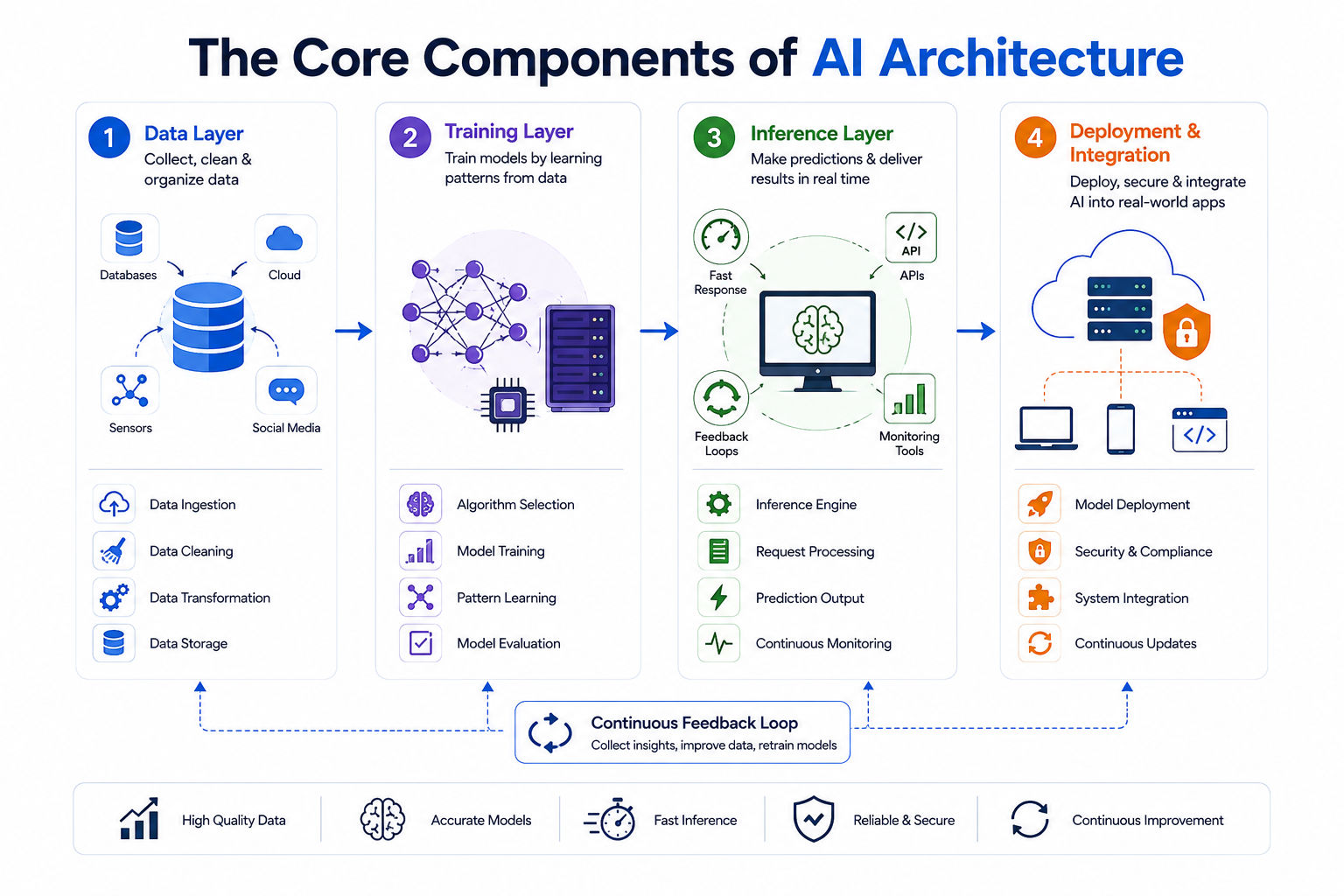
The first layer is the data layer. This is where the system ingests raw information from various sources. These sources might include databases, social media feeds, or physical sensors.
The data layer is responsible for cleaning and organizing this information. Raw data is often messy and full of errors. The system must filter out the noise to ensure the model learns from high-quality facts.
Also Read: Artificial Intelligence Tools: Platforms, Frameworks, & Uses
The training layer is where the actual learning happens. This is the heart of AI ML architecture. Engineers select a specific algorithm and feed it the organized data. The system then builds a model by identifying patterns within that data. This process requires a massive amount of computing power. Modern systems often use specialized chips to speed up this phase.
Once a model is trained, it moves to the inference layer. This is where the model is put to work. When a user asks a question, the inference layer processes that request using the trained model. It generates a prediction or an answer and sends it back to the user. This layer must be incredibly fast to provide a smooth user experience.
Also Read: Types of AI: From Narrow to Super Intelligence with Examples
The final piece of AI ML architecture is deployment. This is the process of making the system available to the public. It involves setting up servers, ensuring security protocols, and integrating the AI with other apps.
Modern teams use automated tools to deploy new versions of their models without any downtime. This allows for continuous improvement based on real-world feedback.
Also Read: How to Build Your Own AI System: Step-by-Step Guide
AI Courses to upskill
Explore Artificial Intelligence Courses for Career Progression
Different types of AI architecture are used depending on scale, speed, and deployment needs. You choose the right setup based on how much data you handle, how fast decisions are required, and where the system runs.
Each type solves a different problem. Understanding them helps you design better AI ML architecture for real-world use cases.
In centralized AI architecture, all data processing and model execution happen in one central system or server.
This setup is simple to manage because everything is controlled in one place. It works well when your data is limited and tasks are not distributed.
You will often see this in:
However, as data grows, this model struggles to scale. It can also become a single point of failure.
Also Read: Top 20 Challenges of Artificial Intelligence: Key Issues and Solutions for 2026
Distributed AI architecture spreads processing across multiple systems or nodes. Instead of relying on one server, tasks are handled in parallel.
This improves performance and allows the system to scale easily. It is commonly used in large AI ML architecture setups where data is massive and processing needs are high.
You will see this in:
Edge AI architecture runs models directly on devices instead of sending data to the cloud. This reduces latency and allows real-time decision-making.
It is useful when speed is critical or when data cannot be sent to external servers.
Common use cases include:
Hybrid AI architecture combines both cloud and edge systems. Some processing happens on devices, while more complex tasks run in the cloud.
This approach gives you the benefits of both speed and scalability. It is widely used in modern AI ML architecture designs.
You will see this in:
It allows flexibility and better resource management.
Type |
Best for |
Strength |
Limitation |
| Centralized | Small systems | Easy to manage | Low scalability |
| Distributed | Large systems | High performance | Complex setup |
| Edge | Real-time apps | Low latency | Limited power |
| Hybrid | Mixed workloads | Balanced approach | Requires integration |
Also Read: Reinforcement Learning Examples Explained for Beginners
Designing AI architecture means planning how data flows, how models learn, and how systems deliver results. You need a clear structure so your system stays scalable, reliable, and easy to improve.
Start by understanding what you want to solve. A clear problem helps you choose the right approach.
You should focus on:
For example, predicting sales requires different data and models than detecting fraud.
Your data defines the quality of your AI system. You need to decide where it comes from and how it will be used.
You may work with:
Good data selection improves model performance and reduces errors.
Also Read: How to Learn Artificial Intelligence and Machine Learning
Now choose the right model based on your problem.
You can use:
The model should match your use case, data type, and performance needs.
This step connects everything into a working system. Your pipeline defines how data moves through the system.
It includes:
A well-designed pipeline ensures smooth data flow and reduces delays.
Once your model is ready, you need to make it usable in real applications.
You can deploy using:
Deployment turns your model into a working product.
After deployment, you need to track performance and keep improving the system.
You should monitor:
Regular updates help your AI architecture stay effective over time.
Also Read: 5 Must-Know Steps in Data Preprocessing for Beginners!
To build and manage AI ML architecture, you can use:
These tools help you train models, build pipelines, and deploy AI systems efficiently.
AI architecture is the backbone of any intelligent system. It connects data, models, and infrastructure into a unified flow that delivers reliable results.
If you design it well, your system stays scalable, fast, and efficient as it grows. Focus on structure, not just models, so you can build AI solutions that work in real-world environments and handle increasing demands with ease.
Want personalized guidance on AI and upskilling? Speak with an expert for a free 1:1 counselling session today.
AI architecture is the overall design of an AI system. It defines how data flows, how models are trained, and how outputs are delivered. A well-planned structure helps systems stay scalable, efficient, and reliable in real-world applications.
The five common layers include data ingestion, data processing, model training, deployment, and monitoring. Each layer plays a role in transforming raw data into useful outputs while ensuring system performance and continuous improvement over time.
Common types include centralized, distributed, edge, and hybrid architectures. Each type is used based on system size, speed requirements, and deployment needs, helping organizations build flexible and scalable AI solutions.
AI architecture helps businesses build systems that can scale, perform efficiently, and handle large amounts of data. It ensures smooth integration between components and reduces long-term maintenance and operational issues.
An AI architecture diagram gives a visual representation of system components and data flow. It helps teams understand how different parts interact and makes it easier to design, debug, and improve AI systems.
AI ML architecture refers to how machine learning systems are structured, including data pipelines, models, and deployment layers. It focuses on how data is processed and used to train models for predictions.
You need programming, data engineering, machine learning knowledge, and system design skills. Understanding cloud platforms and data pipelines also helps in building scalable and efficient systems.
It is used in healthcare, finance, e-commerce, robotics, and many other industries. These systems rely on structured design to handle data, train models, and deliver accurate outputs.
It uses distributed systems, data pipelines, and cloud infrastructure to process large datasets efficiently. This allows systems to scale and maintain performance even with high data volume.
Common tools include TensorFlow, PyTorch, cloud platforms, and data processing frameworks. These tools help build, train, and deploy models within a structured architecture.
Recent trends focus on scalable systems, real-time processing, edge computing, and integration with multi-agent systems. There is also a growing focus on security, data governance, and efficient resource management.
98 articles published
Rahul Singh is an Associate Content Writer at upGrad, with a strong interest in Data Science, Machine Learning, and Artificial Intelligence. He combines technical development skills with data-driven s...
Speak with AI & ML expert
By submitting, I accept the T&C and
Privacy Policy
Top Resources
Master's Degree
18 Months
Executive Diploma
12 Months
IIIT Bangalore
Executive Programme in Generative AI & Agentic AI for LeadersIndia’s #1 Tech University
Dual Certification
5 Months