The Complete Guide to AI in Music
By Rahul Singh
Updated on May 06, 2026 | 9 min read | 4.28K+ views
Share:

All courses
Certifications
More
By Rahul Singh
Updated on May 06, 2026 | 9 min read | 4.28K+ views
Share:
Table of Contents
AI in music is changing how songs are created, produced, and shared. Generative tools like Suno and Udio can turn simple text prompts into full songs. AI also helps with mixing, mastering, and finding samples, making music creation easier for beginners.
This shift opens new creative possibilities but also raises concerns. Copyright and ownership are still unclear, especially as AI-generated tracks grow rapidly on streaming platforms, pushing the need for better transparency and fair usage rules.
In this blog, you will learn what AI in music really means, how it works, where it is being used today, and what it means for the future of the music and Artificial Intelligence industry.
Popular AI Programs
The core concept of AI in music refers to using smart computer algorithms to compose, perform, or master audio tracks. These digital systems learn from massive databases containing millions of existing commercial songs.
By analyzing these huge datasets, they learn the fundamental rules of rhythm, pitch, and harmony. Once the computer deeply understands these basic musical rules, it can easily generate entirely new sounds from scratch.
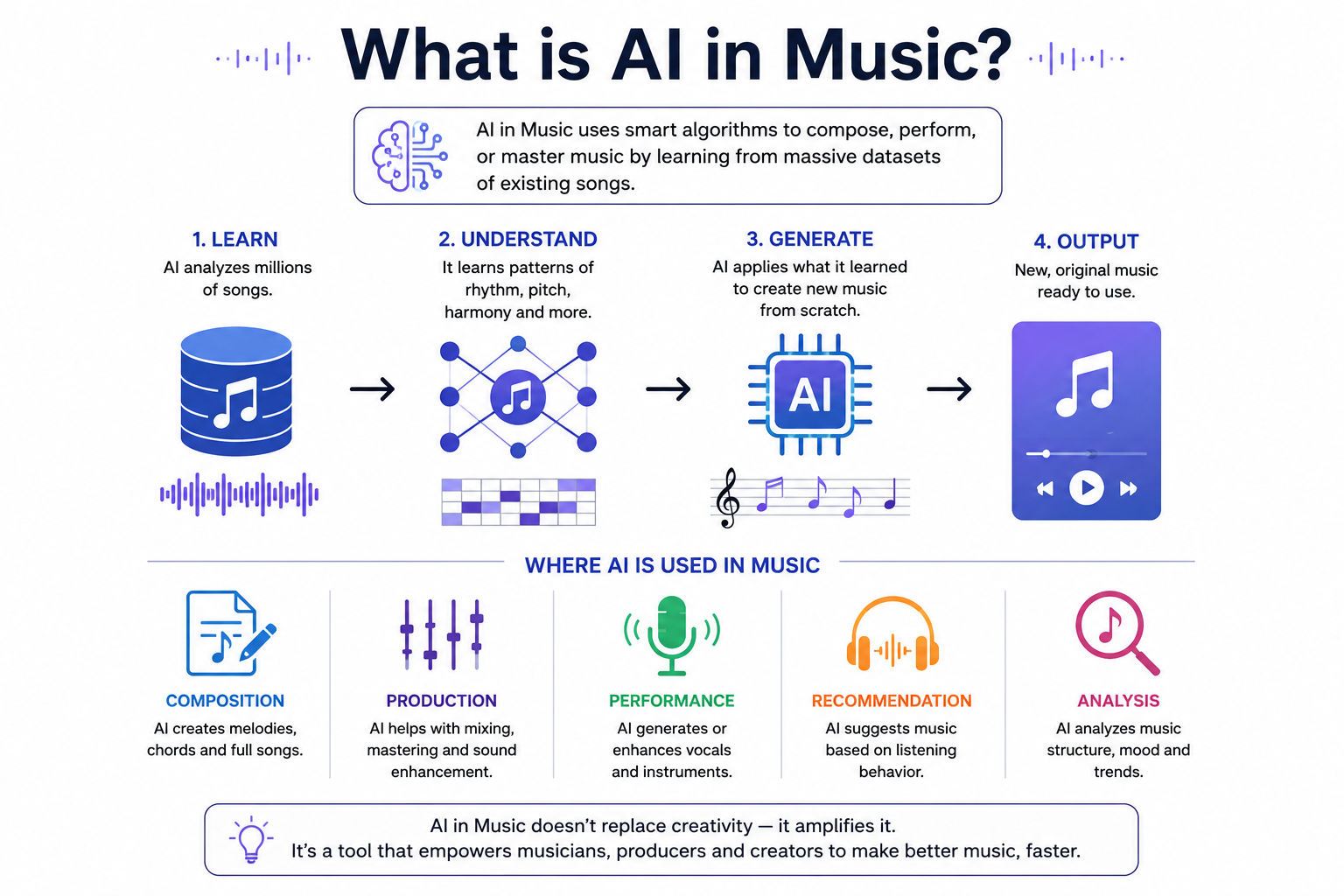
Machine learning is the powerful engine driving these modern audio tools. Instead of a human programmer writing strict mathematical rules for a song, the software essentially teaches itself. Audio engineers feed the computer thousands of classical, pop, jazz, and rock tracks. The algorithm studies this raw data and identifies repeating structural patterns.
Here are the main musical elements these algorithms analyze:
Once the model is properly trained, the system can accurately predict what musical note should logically come next in a sequence. This incredible predictive power allows the software to assist human producers in writing catchy chorus hooks or fixing completely off-key vocal performances.
Also Read: How Does Spotify Use Machine Learning Models To Recommend Music?
Not all artificial intelligence tools function in the exact same way. The technology usually falls into a few distinct categories based on the final creative goal. Some digital tools are built to create brand new art, while others strictly analyze existing files to fix technical errors.
Below is a quick breakdown of how these distinct tools function:
| Algorithm Type | Primary Function | Ideal User |
| Generative AI | Creates new melodies and beats from scratch | Songwriters facing a creative block |
| Analytical AI | Studies audio for mixing and mastering improvements | Audio engineers and studio producers |
| Recommendation AI | Suggests new tracks based on listening habits | Everyday casual music consumers |
You simply input a few basic parameters, and the algorithm does the heavy lifting instantly. This design makes AI in music highly accessible for absolute beginners working from a home studio.
Also Read: Free AI Tools You Can Use for Writing, Design, Coding & More
Free Courses
AI in music is already part of everyday music workflows. It supports creators, producers, and platforms at every stage, from idea generation to distribution. You see it in how songs are made, how audio is refined, and how listeners discover new tracks.
AI tools can now generate music from simple inputs like text, mood, or style. This makes composition faster and more accessible, especially when you need quick results.
You can create background scores, instrumental tracks, or even full songs with structure. Tools like Suno and Udio allow you to turn prompts into complete tracks within minutes.
This is widely used in:
It helps you move from idea to output without starting from scratch.
Also Read: The Ultimate Guide to Gen AI Tools for Businesses and Creators
AI in music is also used to improve sound quality and speed up production. Tasks that once required expert skills can now be handled with smart tools.
You can use AI for:
These tools analyze audio and make adjustments automatically. This saves time and reduces the need for deep technical knowledge.
For beginners, this lowers the barrier to entry. For professionals, it speeds up workflows.
Streaming platforms rely heavily on AI in music to keep users engaged. They analyze your listening behavior and suggest songs you are likely to enjoy.
You get:
This makes music discovery more relevant and personalized. It also helps artists reach the right audience without manual promotion.
Also Read: Artificial Intelligence Tools: Platforms, Frameworks, & Uses
AI can now generate voices and sounds that closely match real recordings. This opens new creative options for music production.
You can:
This is useful for demos, experimentation, and production. At the same time, it raises questions about ownership and ethical use, especially when replicating real artists.
Area |
Example Use |
| Film & Media | Background scores |
| Gaming | Dynamic soundtracks |
| Social Media | Short-form music clips |
| Education | Learning music basics |
AI Courses to upskill
Explore Artificial Intelligence Courses for Career Progression
The rapid, global adoption of this technology reaches far beyond the quiet recording studio. The integration of AI in music is causing massive structural shifts across the entire global entertainment industry.
The biggest current debate surrounding this technology involves international copyright law. When a machine creates a hit song, it is incredibly difficult to determine who actually owns the final product. Is it the user who wrote the text prompt? Is it the software developer who coded the tool? Or does the copyright belong to the original human artists whose data trained the algorithm in the first place?
Also Read: Types of AI: From Narrow to Super Intelligence with Examples
On the consumer side of the business, the impact is entirely positive. Global streaming services rely heavily on machine learning to keep their users highly engaged. Every single time you skip a track, like a song, or replay an entire album, a silent algorithm takes detailed notes. It builds a highly accurate digital profile of your specific artistic tastes.
Key impacts on the commercial industry include:
Here is a look at how different industry players generally view the technology:
| Industry Role | Primary Viewpoint | Main Career Concern |
| Independent Artist | Sees a fast, cheap, and powerful production tool | Fears massive market oversaturation |
| Record Executive | Sees a smart way to spot viral trends early | Worries deeply about copyright lawsuits |
| Casual Consumer | Enjoys much better automated song recommendations | Generally unconcerned with the technology |
Also Read: Top 20 Challenges of Artificial Intelligence: Key Issues and Solutions for 2026
AI in music is moving fast. What you see today is just the beginning. Tools are getting smarter, faster, and easier to use. At the same time, new questions around creativity, ownership, and control are becoming more important.
You will see AI move from a support tool to an active creative partner. It will shape how music is created, performed, and experienced across platforms.
AI will create music instantly based on your input. You will not need pre-made tracks. Music will adapt in real time.
Examples:
Also Read: Beginner Guide to the Top 15 Types of AI Algorithms and Their Applications
Artists will work with AI systems as creative partners. Instead of replacing musicians, AI will help them explore new ideas.
You will see:
This changes how you approach creativity.
Future tools will focus on simplicity. You will not need technical skills to create music.
You may:
Also Read: How to Build Your Own AI System: Step-by-Step Guide
Even with AI, human skills remain important. Technology can assist, but it cannot replace creative intent.
You should focus on:
AI in music opens new paths for creators and professionals.
You can build projects faster and reach audiences without large production setups.
Also Read: Comprehensive Artificial Intelligence Syllabus to Build a Rewarding Career
There are also risks you need to consider.
You need to use AI carefully and combine it with your own creative judgment.
AI in music is transforming the industry in powerful ways. It makes music creation more accessible, faster, and more innovative. At the same time, it raises important questions about creativity, ethics, and ownership.
For beginners, this is a great time to explore music using AI tools. For professionals, it offers new ways to enhance creativity and productivity. The key is to use AI as a support system, not a replacement for human expression.
Want personalized guidance on AI and upskilling? Speak with an expert for a free 1:1 counselling session today.
AI is used to create songs, generate melodies, and improve production quality. It also powers recommendation systems on streaming platforms. AI in music helps automate tasks like mixing and mastering while enabling faster content creation and personalized listening experiences.
The best tools depend on your goal. Platforms like Suno, Udio, and others focus on generating full songs, while some tools specialize in editing or mastering. AI in music tools are evolving fast, so you should choose based on features, ease of use, and output quality.
Many artists and producers have experimented with AI in music. Some use it for composition, while others use it for production or sound design. Even major artists and independent creators are exploring AI as a creative partner.
It is generally legal to create songs using AI, but ownership and copyright rules are still unclear. Many regions do not grant full copyright to purely AI-generated works, especially if there is no human input.
AI in music is growing because it reduces time, cost, and technical barriers. Anyone can now create music without advanced skills. The rise of easy-to-use tools has made music creation more accessible to a wider audience.
AI models analyze patterns in existing music and map text prompts to musical structures. They generate melodies, lyrics, and arrangements based on learned data, allowing you to create songs from simple descriptions.
Yes, you can generate a full song using AI tools. Many platforms allow you to input a prompt or style and produce complete tracks. This makes AI in music accessible even if you have no prior music production experience.
AI in music can lead to copyright issues, loss of originality, and over-reliance on automation. There are also concerns about misuse of artist voices and training data. These risks require careful and responsible use of AI tools.
It can be difficult to detect AI-generated music. Some signs include unnatural vocals or repetitive patterns, but detection is not always accurate. Platforms are now adding labels and verification systems to improve transparency.
AI cannot fully replace human musicians. It lacks emotional depth and personal experience. Instead, AI in music works as a tool that supports creativity and speeds up production while artists provide direction and meaning.
Recent trends include real-time music generation, AI-human collaboration, and growth in AI-generated content on streaming platforms. AI music uploads are increasing rapidly, raising concerns about quality, royalties, and transparency.
98 articles published
Rahul Singh is an Associate Content Writer at upGrad, with a strong interest in Data Science, Machine Learning, and Artificial Intelligence. He combines technical development skills with data-driven s...
Speak with AI & ML expert
By submitting, I accept the T&C and
Privacy Policy
Top Resources
Master's Degree
18 Months
Executive Diploma
12 Months
IIIT Bangalore
Executive Programme in Generative AI & Agentic AI for LeadersIndia’s #1 Tech University
Dual Certification
5 Months