Asset Management: Meaning, Types, Process, Benefits, Strategy & Best Practices
By upGrad
Updated on Oct 16, 2026 | 5 min read | 2.77K+ views
Share:

All courses
Certifications
More
By upGrad
Updated on Oct 16, 2026 | 5 min read | 2.77K+ views
Share:
Table of Contents
Key Takeaway
Explore upGrad’s management courses online to build essential skills in strategic planning, financial decision-making, and business operations to manage organisational resources effectively and advance your career.
Popular Management Programs
Asset management means tracking, maintaining, and optimizing the things a business owns so they keep generating value.
The core objective is to get the most out of every asset while spending the least amount possible on upkeep. A factory that tracks machine hours can schedule maintenance before a breakdown happens. A software company that tracks its licenses avoids paying for tools nobody uses.
An asset can be almost anything that provides value to an organization. That value might be financial, operational, or strategic. Instead of reacting when equipment fails or licenses expire, organizations using asset management plan ahead, monitor performance, and make data-driven decisions that reduce unexpected costs.
Assets aren't just machines and buildings, though. Businesses typically manage four broad categories:
Asset Type |
Examples |
Why It Matters |
| Physical Assets | Buildings, machinery, vehicles | Support day-to-day operations |
| Financial Assets | Stocks, bonds, investments | Generate financial returns |
| Digital Assets | Images, videos, documents | Protect and organize digital content |
| IT Assets | Computers, servers, software licenses | Keep technology reliable and secure |
| Infrastructure Assets | Roads, bridges, utilities | Support public services and long-term development |
Think about a manufacturing company. It owns machines, vehicles, software licenses, and office buildings. If those assets aren't maintained properly, production slows down, repair costs rise, and business suffers. Good asset management helps avoid those problems by tracking each asset from purchase to retirement and making informed decisions at every stage.
Asset management isn't limited to large enterprises. Small businesses, educational institutions, hospitals, and government organizations also rely on structured asset management to improve efficiency and control expenses.
Poor asset tracking costs money in ways that don't always show up right away. A missing maintenance schedule turns into an expensive emergency repair. An unused software license quietly drains the budget every month.
Getting this right fixes it, by giving you visibility into what you own and how it's performing.
Business Challenge |
Benefit |
| Unexpected equipment failure | Preventive maintenance scheduling |
| Overspending on unused tools | Utilization tracking |
| Compliance audits | Accurate documentation |
| Slow decision making | Real time performance data |
| Short asset lifespan | Better maintenance planning |
Businesses that manage assets well tend to see lower operating costs and fewer compliance headaches. It's not glamorous work, but it's the kind of work that protects margins.
Well-managed assets contribute to better operational and financial performance. The benefits go beyond maintenance because they influence planning, budgeting, compliance, and productivity.
Some of the biggest advantages include:
The value becomes even clearer as organizations grow. Managing ten assets manually might seem manageable. Managing ten thousand without a structured system quickly becomes overwhelming.
Also read: What is Production Management? Definition, Functions, Importance, and Scope
Not every business needs the same approach. A logistics company cares about vehicles. A media company cares about digital rights. Here's how the main types break down.
Category |
Focus Area |
Typical Users |
| Physical | Equipment, machinery, vehicles | Manufacturing, logistics |
| Financial | Investments, portfolios, cash | Banks, investment firms |
| IT | Hardware, software licenses | IT departments |
| Digital | Media files, brand content | Marketing teams |
| Infrastructure | Roads, utilities, facilities | Government, utilities |
Most mid sized companies end up using more than one type at once. A retail chain, for instance, might combine the physical category for store equipment with the digital category for its product images and marketing files.
Do read: Henri Fayol's 14 Principles of Management with Examples
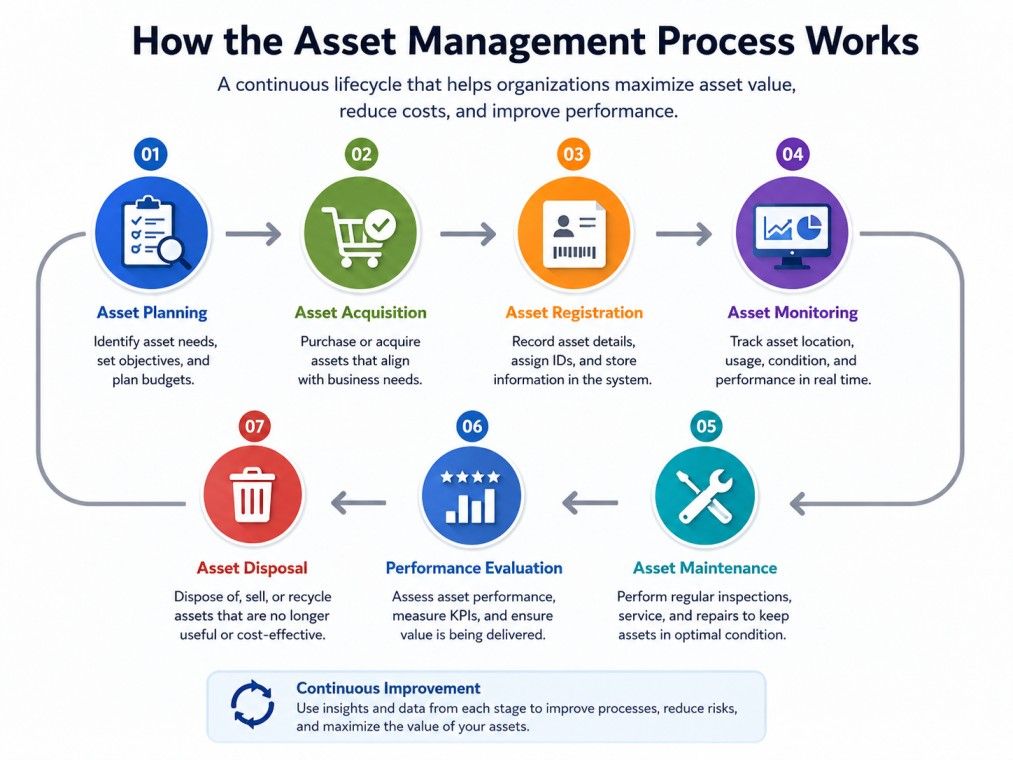
Every asset goes through a lifecycle. Understanding this cycle is where most asset management strategy actually begins.
Free Courses
Managing assets without a strategy is like driving without a destination. You might keep things running, but you won't know whether your assets are helping the business grow or quietly draining resources.
A good asset management strategy connects everyday activities, such as maintenance, inspections, and tracking, with larger business goals. It helps teams decide where to invest, what to replace, and how to get the most value from every asset over time. The strategy doesn't have to be complicated. It just needs to be practical and reviewed regularly.
Before creating an asset management strategy, decide what success looks like for your organization.
Ask yourself a simple question. What should your assets help the business achieve? The answer will guide every decision, from purchasing equipment to planning maintenance and replacements.
Your objectives could include:
When the objectives are clear, it's much easier to prioritize investments and measure results.
Also read: Scope and Types of Corporate Finance in Details
You can't manage what you can't see.
Start by creating a single, reliable inventory of all your assets. Include essential details such as the asset name, ID, purchase date, location, assigned department, current condition, and maintenance history. Even if you're managing a relatively small number of assets, accurate records save time, reduce duplicate purchases, and make audits far less stressful.
Not every asset carries the same level of risk. Some machines are critical to daily operations, while others can be repaired or replaced without causing major disruptions.
Look for potential issues before they become expensive problems. An ageing machine might require frequent repairs, a software license could be nearing expiry, or outdated equipment may no longer meet safety or compliance standards. Identifying these risks early helps you plan maintenance, upgrades, and replacements with fewer surprises.
Must read: What is Capacity Planning? Definition, Methods, Types, Goals, Benefits
A good strategy isn't built on budget alone. People, time, technology, and spare parts all play an important role.
Think about whether you have enough trained staff to maintain equipment, realistic maintenance schedules, and the right tools to support daily operations. Poor planning often leads to delayed repairs, longer downtime, and rising maintenance costs that could have been avoided.
Once your strategy is in place, don't leave it untouched. Review performance regularly using key metrics such as:
These numbers highlight what's performing well, reveal assets that need attention, and help you make better decisions as business needs change.
Do read: Business Planning Process: Everything You Should Know
An asset management strategy shouldn't stay the same forever. Equipment wears out, technology advances, and business priorities evolve over time.
Set aside time to review your strategy on a regular basis. Update maintenance schedules, replace assets that no longer deliver value, and refine your goals as your organization grows. Small adjustments made consistently are usually more effective than waiting years to make major changes.
Here is the checklist you need to tick for applying this strategy correctly in every step:
Step |
Why It Matters |
| Define business objectives | Align assets with organizational goals |
| Create a complete asset inventory | Improve visibility and control |
| Assess asset risks | Reduce unexpected failures and costs |
| Allocate resources | Support efficient maintenance and operations |
| Track KPIs | Measure asset performance and progress |
| Review the strategy regularly | Keep the plan aligned with changing business needs |
Learn to apply artificial intelligence to business decision-making with the AI Professional Certificate Programme from IIM Kozhikode. Develop an understanding of AI-driven insights and emerging technologies to improve operational efficiency, support data-driven strategies, and make smarter business decisions.
Management Courses to upskill
Explore Management Courses for Career Progression
IIIT-B & IIM, Udaipur
Chief Technology Officer & AI Leadership ProgrammeIIM Kozhikode
PCP in AI for Business ProfessionalsThis kind of system is the software or platform that stores, tracks, and reports on your assets. Think of it as the control center for everything discussed above.
Core components usually include a central asset repository, tracking tools, maintenance scheduling, and reporting dashboards.
Small teams sometimes get by with spreadsheets for a while. It works for less data. Once you're managing hundreds of assets across multiple locations, manual tracking turns into a full time job nobody signed up for. That's usually the point where teams switch to dedicated software.
You can't improve what you don't measure. These are the numbers most teams track to judge whether their efforts are actually working.
KPI |
What It Measures |
| Asset Utilization | How much an asset is actually used |
| Downtime | Time an asset spends non operational |
| Maintenance Cost | Total spend on upkeep |
| Asset ROI | Financial return generated |
| Asset Lifespan | Expected vs actual useful life |
| Failure Rate | Frequency of breakdowns |
Tracking even three or four of these consistently gives you a much clearer picture than tracking none at all.
Must read: Top 16 Primary Goal of Financial Management
Even organizations with structured processes encounter challenges. Assets age, technology changes, business priorities shift, and unexpected failures still occur. The key is identifying problems early and responding before they affect productivity or increase costs.
Nothing about this is perfect in practice. Even well run teams run into the same handful of problems repeatedly.
Challenge |
Solution |
| Poor asset visibility | Centralized digital inventory |
| Inaccurate records | Scheduled audits every quarter |
| High maintenance costs | Preventive maintenance programs |
| Compliance risks | Standardized documentation processes |
| Asset loss or theft | Barcode or RFID tracking |
Asset loss deserves a specific mention here. It sounds like a small problem until you're auditing a warehouse and realize a dozen laptops walked out the door over the past year without anyone noticing.
Also read: What is Strategic Financial Management? Importance, Functions, and Career Opportunities
Rolling out asset management across a whole organization takes more than buying software. It takes a plan people will actually follow. A system is only as good as the people using it correctly.
Step |
Key Focus |
Examples |
| Assess Current Assets | Build a complete inventory | Asset name, location, condition, purchase date, maintenance history |
| Define Clear Objectives | Set measurable goals | Lower maintenance costs, improve utilization, strengthen compliance |
| Select the Right Processes | Standardize workflows | Maintenance schedules, inspections, approvals, reporting |
| Deploy an Asset Management System | Centralize asset information | Import records, assign roles, automate reminders, dashboards |
| Train Employees | Improve consistency | Asset registration, reporting, system usage, documentation |
| Monitor and Improve | Review and optimize | Track KPIs, maintenance costs, user feedback, process updates |
Do read: What is Corporate Finance: Definition, Functions & Real-World Examples
A thoughtful rollout helps organizations avoid confusion, reduce disruptions, and build processes that continue delivering value over time.
Trying to manage every asset at once often creates unnecessary complexity. Many organizations begin with one department or asset category, refine the process, and then expand across the business.
A few habits separate the teams who manage assets well from the ones constantly firefighting.
None of these are complicated. They're just easy to skip when things get busy, which is exactly when they matter most.
Every organization depends on assets to operate efficiently. Managing those assets well requires more than keeping an inventory. It involves planning, monitoring, maintaining, evaluating, and improving every stage of the asset lifecycle.
A structured asset management approach helps reduce costs, improve performance, extend asset life, and support better business decisions. Whether an organization manages a handful of assets or thousands spread across multiple locations, consistent processes and reliable data make a measurable difference. As technology continues to improve, businesses that invest in effective asset management will be better prepared to adapt, grow, and create long-term value.
Ready to start your journey? Book a free consultation with upGrad today to find the best path for your career.
Fixed asset management focuses on long-term physical assets such as buildings, machinery, and vehicles. Asset management is a broader discipline that also includes financial, digital, and IT assets. Businesses often combine both approaches to improve visibility, reduce costs, and maximize asset value throughout its lifecycle.
Yes. A well-planned asset management approach reduces unnecessary purchases, minimizes equipment downtime, and extends asset life through preventive maintenance. It also improves budgeting by providing accurate data on asset performance, repair expenses, and replacement schedules, leading to better financial decisions over time.
The internationally recognized standard is ISO 55001, which provides a framework for establishing, implementing, and improving an asset management system.
The decision usually depends on maintenance costs, asset age, reliability, performance, and expected remaining lifespan. If repair expenses begin to exceed the value or efficiency of the asset, replacement often becomes the more cost-effective option for long-term operations.
Depreciation tracks how an asset's value decreases over time because of usage, wear, or obsolescence. Understanding depreciation helps businesses estimate replacement timelines, prepare budgets, calculate financial statements accurately, and make informed investment decisions without relying solely on the original purchase price.
Yes. Maintaining accurate asset records, service histories, inspection reports, and maintenance schedules makes it easier to meet industry regulations. This is especially valuable in sectors such as healthcare, manufacturing, energy, and transportation, where compliance failures can result in penalties or operational disruptions.
Predictive maintenance uses condition monitoring and performance data to identify potential equipment failures before they occur. Instead of following fixed maintenance schedules, businesses can service assets only when needed, reducing downtime, lowering maintenance costs, and improving overall operational efficiency.
A good asset management solution should include centralized asset records, maintenance scheduling, barcode or QR code support, reporting dashboards, mobile access, user permissions, and integration with existing business systems. The right software should simplify operations rather than add unnecessary complexity.
No. Small and medium-sized businesses also benefit from asset management by keeping accurate records, preventing unnecessary purchases, and planning maintenance effectively. Even simple tracking methods can improve resource utilization and support better financial planning as the business grows.
Frequent equipment breakdowns, missing or duplicate assets, rising maintenance costs, poor inventory visibility, and inaccurate records are common warning signs. If teams spend more time searching for assets than using them, it's usually time to improve asset management practices.
Modern asset management is evolving with technologies such as IoT sensors, digital twins, predictive analytics, cloud platforms, and AI-assisted monitoring. These innovations provide real-time visibility into asset health, support proactive maintenance, and help organizations make faster, data-driven decisions while improving long-term asset performance.
1320 articles published
We are an online education platform providing industry-relevant programs for professionals, designed and delivered in collaboration with world-class faculty and businesses. Merging the latest technolo...
Get Free Consultation
By submitting, I accept the T&C and
Privacy Policy
Top Resources
Certification
3 Months
Certification
6 Months
O.P. Jindal Global University
Masters in International Accounting and Finance (Accredited by ACCA, UK)Master's Degree
12 Months