Project Controlling: Process, Types, Framework, and Examples
By Sriram
Updated on Sep 04, 2026 | 12 min read | 6.95K+ views
Share:

All courses
Certifications
More
By Sriram
Updated on Sep 04, 2026 | 12 min read | 6.95K+ views
Share:
Table of Contents
Key highlights
Looking to build strong project management skills? Explore upGrad's management training programs and take the next step in your career.
Popular Management Programs
Project controlling is the set of processes used to monitor a project against the approved plan, identify deviations, and initiate responses.
In other words, it answers questions such as:
The process of initiating begins with establishing an initial scope, budget, schedule, quality, and resource allocation baseline. Once work begins, actual progress is compared with these targets.
The goal is not to control every decision. It is to give teams clear information to spot problems, understand why they happened, and take the right action.
Projects rarely follow their original plans perfectly. A small delay in one activity can create delays in all subsequent activities. In the same way, one unexpected expense can cause a big problem for the rest of the budget.
Effective project controlling helps teams:
Also read: Top Productivity Hacks to Boost Efficiency and Success
Free Courses
Different types of project controlling focus on key areas such as cost, schedule, scope, quality, resources, and risk, helping teams monitor performance and manage issues effectively.
Cost control involves comparing actual project spending with the approved budget.
A project team may track:
In the case of a spending overrun, it is necessary to analyze the reasons for it. These may be higher material costs, additional work, or a lack of resources due to their inefficient use, or an unplanned
Schedule control deals with determining if project activities and milestones are completed according to the plan.
By comparing schedule dates and activities completion, the team may note discrepancies and address them accordingly.
I think that schedule control is essential when a project’s delayed activity may have a ripple effect on the succeeding events because it provides the team with a possibility to intervene at an early stage and prevent further issues.
Scope control ensures that the project scope is completed without unnecessary additions.
A serious problem associated with project management is scope creep. Scope creep occurs when new elements are introduced into the project that were not planned for the initial delivery of products and services. These additions often have negative implications on the cost, time, resources, and quality of the project.
however, through the use of an effective change control procedure, one can decide whether a change request should be approved, denied, deferred, or implemented.
Quality control evaluates if the produced project deliverables meet the quality standards.
For example, it can assess how many of the presented products will satisfy the customer’s requirements. In general, quality control procedures depend on the project’s nature, such as construction, software development, and others.
Quality problems identified early are usually easier and less expensive to correct than issues discovered near project completion.
Risk control involves monitoring identified risks and checking whether planned responses are working.
New risks can also emerge while the project is underway. A risk that seemed unlikely during planning may become more significant later.
Regular reviews help teams update risk responses and take action before threats seriously affect project objectives.
Resource control deals with the management of people, equipment, materials, technology, and other resources. This concept is generally concerned with the following issues:
• Are people available in sufficient numbers?
• Is the equipment used properly?
• Will a shortage of materials delay the work?
These are some examples of questions that can be addressed using the process of resource control
Ready to lead with confidence? Enroll in upGrad's Certificate Programme in General Management for Young Leaders (YLP) from IIM Bangalore and build practical leadership, strategic thinking, and decision-making skills.
Management Courses to upskill
Explore Management Courses for Career Progression
IIIT-B & IIM, Udaipur
Chief Technology Officer & AI Leadership ProgrammeIIM Kozhikode
PCP in AI for Business ProfessionalsThe project control process deals with the project control cycle, which is not a one-time event but a continuous cycle. Teams develop plan, gather information, and compare the results with projections in order to finalize the project control process.
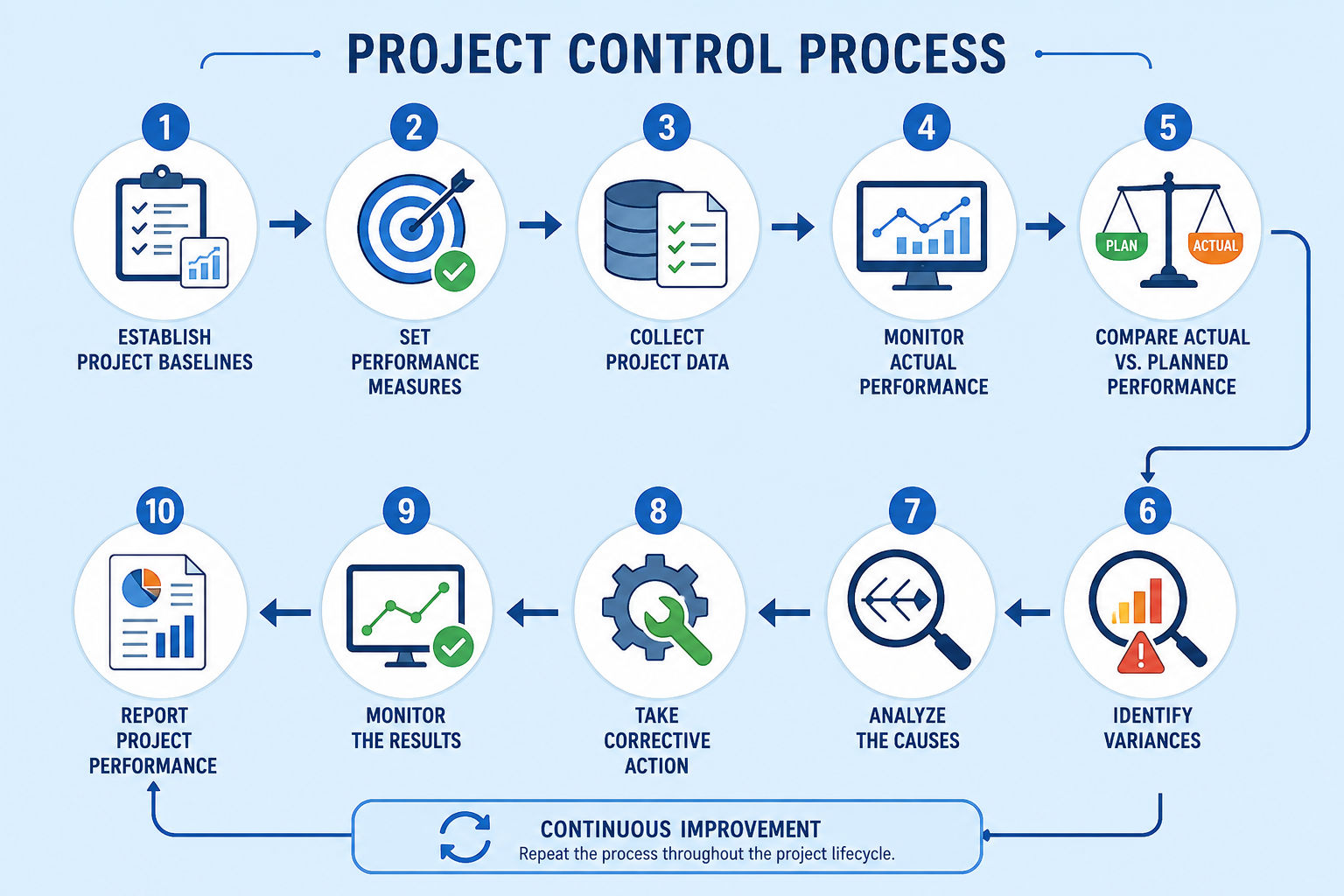
The main steps are:
1. Establish Project Baselines
Start with approved baselines for scope, schedule, cost, and other important project requirements. These baselines provide a reference point for measuring performance.
2. Set Performance Measures
Define the metrics that will be used to evaluate progress. These could include cost variance, schedule variance, milestone completion, resource utilization, defect rates, or other project-specific KPIs.
3. Collect Project Data
Gather accurate information about what is actually happening. This may include expenses, work completed, hours used, resource consumption, quality results, and milestone status.
4. Monitor Actual Performance
It is essential to frequently evaluate the collected data not at the end of the completion of the project but periodically in the course of the project. The frequency depends on the size, risk, and intricacy of the particular project.
5. Compare Actual Results With the Plan
Comparing reality with the plan displays whether the project is underperforming, overachieving, spending less, spending more, or performing right on track.
6. Identify Variances
A variance is the difference between planned and actual performance. Not every variance requires immediate action, so teams need to assess its size, cause, and potential impact.
7. Analyze the Cause
Finding the reason behind a problem is important. For example, a schedule delay could result from insufficient resources, supplier issues, poor estimates, technical problems, or a change in scope.
8. Take Corrective Action
In such a way, after the root cause of the recognized problem has been identified and analyzed, the course of action that the team members are going to take in order to resolve the issue should be determined. Thus, corrective action can comprise a reallocation of resources, reprioritization of tasks, schedule adjustment, reduction of costs, or resolution of a specific quality concern.
9. Monitor and Control the Results
In this stage, it is essential to evaluate whether the implemented corrective measures have actually improved the situation. In some cases, a promising solution may turn out to be ineffective in practice.
10. Report Project Performance
It includes the presentation of relevant information concerning the performance to project managers, sponsors, clients, and stakeholders. In this way, it becomes possible to ensure the project management’s success and effective decision-making.
The said cycle is the basis of controlling projects’ work because of the connection between the presented information and its practical application.
A project controlling framework generally stipulates the processes, where by which the project’s performance is planned, monitored, assessed, and controlled in general.
The framework provides an avenue for tying together the cost, time, scope, and risk of a project to provide a complete picture of its overall performance. It also shows how each of the elements can impact the other.
For example, when new features and functionalities are added to a project, it can lead to an increase in its scope, which in turn raises the cost and extends the time needed to complete the project.
A typical framework may include:
The framework provides a common ground for assessing the project’s performance.
It enables the groups to understand what needs to be tracked, define the key performance indicators, determine the accountability, and establish the escalation procedure if any of the indicators is not met.
For example, if the project implementation is delayed, it will help to identify the cause of the delay (resources, procurement, scope changes, technical challenges, etc.) and resolve the issue. Hence, the framework suggests a more integrated approach to project management.
Also read: Top 5 Project Management Tools in 2026
Project control in project management can be defined as processes used to assess project performance and progress, compare them to the initial plan and baselines, and take necessary corrective actions.
It is applied throughout the project cycle. Project teams develop project deliverables and performance baselines during the initiation and planning stages. Throughout the implementation, execution, and monitoring phases, they control the project’s performance, assess deviations, take corrective measures, and update project files.
Project control can support areas such as:
The project manager’s responsibility is fulfilled through overall project delivery while the project control activity ensures the provision of information that allows understanding of the situation in which the project is performing correctly.
Project control and project management activities complement each other, but they are not entirely interchangeable.
Project control and project management work together, but they are not interchangeable.
Aspect |
Project Management |
Project Control |
| Main focus | Overall project delivery | Monitoring and controlling performance |
| Scope | Broad | More focused |
| Responsibility | Project manager and project team | Project controls professionals and project team |
| Activities | Planning, execution, coordination, leadership | Tracking, analysis, reporting, forecasting, corrective action |
| Goal | Deliver the project successfully | Keep project performance aligned with the approved plan |
A project manager may decide that a milestone needs to be moved because of a major business change. The project control function can provide the schedule and cost analysis needed to understand the impact of that decision.
In practice, the two functions support each other. Good management needs accurate project information, while effective controls need decisions and action from project leadership.
Also read: Top 10 Simple Ways to Improve Your Time Management Skills | upGrad blog
Real-world examples make the concept easier to understand. The specific controls used will depend on the type and size of the project.
A construction company has set a budget and a timeline for the project completion within twelve months. In this case, it would be reasonable to monitor the costs of materials, labor, and equipment, and compare them to the schedule.
By doing this, if the cost of steel increases, the project manager can assess the impact on the budget and decide whether it is required to change the purchase schedule or not.
In addition, comparing the projected progress of work and actual results helps understand if the project is progressing on schedule.
An IT company is working on a customer-facing mobile application. The team follows the progress of each sprint, the cost of development, number of defects, resource utilization, and requirement changes. Hence, the project manager can respond if something goes wrong, for instance, one feature takes much longer than expected and may impact the delivery date or need more resources than allocated.
Read: Distributor and Consumer Management System for Modern Businesses
One company has initiated a three-month digital marketing campaign, which has a specific budget and deliverables. It is possible to apply project controlling in this case, as this method helps manage the project within the framework of approved budgets and plans.
In particular, it will allow the team to monitor budget expenditures, project content, implementation schedule, and alignment with key indicators. If one of the steps in the campaign is delayed, project controlling will allow the team to understand what consequences it will have for other steps.
A company is developing a new consumer product. The company has a process consisting of several stages of design and testing.
The team is able to track progress, test results, resources, and spending. If testing reveals a design problem, the team can evaluate the impact on time and budget before making changes to the design.
Also read: Top 4 Functions of Management Process Explained
Project planning control is about ensuring that the project plan is realistic, measurable, and flexible enough to respond to project realities.
Planning provides the basis for control; without objectives, it is impossible to measure or judge performance .
Project planning control typically involves:
For instance, if a project initially requires ten people and is supposed to be completed within six months, but two specialists become unavailable, the project manager should recalculate the work plan. He/she could look at the resource plan and see what changes need to be made.
The two concepts overlap, but their emphasis is slightly different.
Aspect |
Project Planning Control |
Project Controlling |
| Main focus | Keeps the project plan realistic and up to date | Checks actual project performance against the plan |
| Focus areas | Scope, schedule, budget, resources, and risks | Cost, schedule, scope, quality, resources, and risks |
| Purpose | Creates and maintains a clear reference plan | Finds deviations and supports corrective action |
| When used | Mainly during planning and as the plan changes | Throughout project execution |
| In simple terms | Sets the reference point | Checks how actual progress compares with it |
Also Read: Basic Components of Supply Chain Management
Teams use different tools depending on the project's complexity, industry, and reporting needs.
Tool/Technique |
Purpose |
| Gantt Charts | Show project activities on a timeline and help track task duration, dependencies, milestones, and delays. |
| Milestone Tracking | Helps to control important project milestones and check whether key deliverables are progressing as planned. Earned Value Management |
| Earned Value Management (EVM) | scope, schedule, and cost data in order to assess project performance and progress in relation to the allocated budget |
| Variance Analysis | Compares planned performance with actual results to identify differences in cost, schedule, resources, or other project areas. |
| Budget Tracking | Monitors project spending and helps identify potential budget overruns early. |
| KPI Dashboards | Displays important project metrics, such as costs, schedule status, risks, milestones, and overall performance, in one place. |
| Risk Registers | Records identified risks, their potential impact, probability, owners, and planned responses. |
| Project Management Software | Helps teams assign tasks, track deadlines, monitor progress, manage resources, and create reports. |
| Progress Reports | Provide stakeholders with updates on project status, completed work, issues, risks, and upcoming activities. |
Also read: Management Process: Definition, Features & Function
Effective project controlling helps teams keep track of progress, costs, resources, and potential problems.
Read: 6 Types of Supply Chain Models To Know
Effective controls do not have to mean endless spreadsheets or meetings. The focus should be on collecting useful information and acting on it.
The best controls are practical. If a reporting system takes more time to maintain than the value it provides, it may need to be simplified.
Project controlling helps teams track project performance and spot problems before they grow. By monitoring cost, schedule, scope, quality, resources, and risks, teams can compare actual results with the plan and take corrective action when needed.
Good project control gives managers the right information to make timely decisions. Project planning control sets realistic targets and baselines, while project controlling checks progress against them. Together, these practices help teams manage changes, solve issues early, and keep projects on track.
Ready to start your journey? Book a free consultation with upGrad today to find the best path for your career.
The five broad stages are setting standards, measuring actual performance, comparing results with the plan, identifying deviations, and taking corrective action. In project work, these stages help teams notice gaps early and decide whether changes are needed to keep performance aligned with expectations.
Common examples include baseline management, change requests, status reporting, risk logs, quality checklists, and responsibility matrices. These controls give teams a clear way to record decisions, manage changes, and check whether project work is moving in the expected direction
Seven commonly discussed approaches are Waterfall, Agile, Scrum, Kanban, Lean, Six Sigma, and PRINCE2. These are project management methodologies rather than types of project control. The right approach depends on factors such as project complexity, flexibility, team structure, and how frequently requirements may change.
Yes, project control can be a good career for people who enjoy working with numbers, schedules, analysis, and problem-solving. Roles can span construction, engineering, infrastructure, energy, and technology, with opportunities to move into senior planning, cost, scheduling, or controls positions.
Project controls remain useful wherever organisations manage large, complex, or costly projects. Professionals who understand scheduling, cost data, forecasting, reporting, and project performance can support better decisions, particularly across construction, infrastructure, engineering, and other project-based industries.
Useful skills include analytical thinking, attention to detail, communication, Excel, scheduling, cost awareness, forecasting, and reporting. Understanding how project information connects is equally important. Professionals also need to explain numbers clearly so managers can understand what the data means for the project.
Yes. Project controls can work with Agile projects when adapted to shorter planning and reporting cycles. Instead of relying only on long-term forecasts, teams can review sprint progress, spending, capacity, risks, and changes regularly and use that information to adjust upcoming work.
Project control gives managers reliable information about what is happening on a project. Instead of relying on assumptions, they can use current data to understand trends, investigate unusual results, assess possible impacts, and decide whether corrective action, additional resources, or a change in direction is required.
A project controls analyst usually works with project data, schedules, costs, forecasts, and reports. Their work helps teams understand current performance and identify potential issues. Depending on the organisation, they may also support data collection, reporting cycles, forecasting, and communication with project stakeholders.
Project management can be stressful, especially when deadlines are tight, priorities change, or teams face budget and resource constraints. However, the level of pressure varies by industry, project size, organisation, and role. Good planning, communication, realistic expectations, and strong support can make the workload easier to manage.
Yes, although some employers prefer or require a relevant degree. Experience in areas such as construction, engineering, finance, accounting, scheduling, estimating, or data analysis can provide a useful entry point. Practical project knowledge, technical skills, and relevant certifications can also strengthen a candidate’s profile.
724 articles published
Sriram K is a Senior SEO Executive with a B.Tech in Information Technology from Dr. M.G.R. Educational and Research Institute, Chennai. With over a decade of experience in digital marketing, he specia...
Get Free Consultation
By submitting, I accept the T&C and
Privacy Policy
Top Resources
Certification
3 Months
Certification
6 Months
O.P. Jindal Global University
Masters in International Accounting and Finance (Accredited by ACCA, UK)Master's Degree
12 Months