Managerial Economics: Meaning, Scope, Nature, Principles, and Importance
By upGrad
Updated on Aug 31, 2026 | 7 min read | 2.46K+ views
Share:

All courses
Certifications
More
By upGrad
Updated on Aug 31, 2026 | 7 min read | 2.46K+ views
Share:
Table of Contents
Managerial economics connects economic theory when taking decisions, managers apply quantitative methods in practical realities to run business, giving managers a way to think about abstract economic concepts and practical management and optimize in resource allocation, increase profit, and navigate market risk rather than relying on guesswork.
This blog will walk you through what managerial economics actually means, how it differs from economics in the academic sense, where it applies inside a business, and why it becomes such a core skill for anyone in a decision-making role today.
Explore Management Courses and Online MBA Courses from upGrad and discover how managerial economics turns economic theory into decisions that actually move a business forward.
Popular upGrad Programs
At its core, managerial economics is about borrowing the tools of economic theory of supply, demand, cost behavior, market structure and pointing them at real business problems.
It's less interesting in abstract models of "the economy" and more interested in questions like: should we raise prices this quarter? Is it worth hiring five more people? Why did sales drop last month?
Consider it as the translator that sits between economic theory and the boardroom. It helps answering a few of the recurring questions, such as:
Check this out: Career Options in Economics: A Complete Guide for 2026
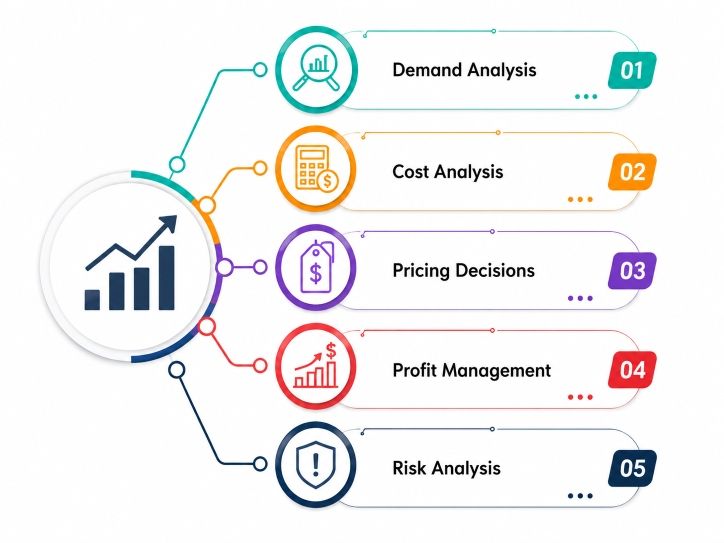
Element |
Purpose |
| Demand Analysis | Understand customer behavior |
| Cost Analysis | Evaluate production expenses |
| Pricing Decisions | Determine optimal prices |
| Profit Management | Improve profitability |
| Risk Analysis | Reduce business uncertainty |
Do read: Scope of MA Economics: Career Options, Jobs & Future 2026
Free Courses
If there's one thing that defines managerial economics, it's just how broadly it applies. There's barely a business function where economic reasoning doesn't show up somewhere.
Before a company ramps up, production, hires aggressively, or launches into a new market, someone needs a reasonable estimate of what demand will look like.
Get this wrong in either direction too optimistic or too conservative, and a business ends up either sitting on excess inventory or scrambling to meet demand it didn't see coming.
Every manager eventually must reckon with the difference between fixed costs (the ones you're paying regardless of output) and variable costs (the ones that scale with production).
A manufacturer, for instance, might run the numbers to see whether ramping up production actually brings the average cost per unit down, or whether it's already past the point of diminishing returns.
This is one of the most visible applications. Whether it's competitive pricing to match the market, premium pricing to signal quality, penetration pricing to win market share fast, or the dynamic pricing airlines and ride-hailing apps use to adjust fares in real time, all of it draws on the same underlying logic.
Beyond simply "sell more, spend less," profit management is a more deliberate look at where revenue can grow, where costs can be trimmed without hurting quality, and which investments are actually worth pursuing.
Big-ticket decisions about a new plant, new equipment, new technology, and entry into a new market all need to be weighed against their expected payoff. This is where managerial economics meets long-term financial planning.
No one has a crystal ball, so managers lean on tools like scenario planning, probability estimates, and sensitivity analysis to narrow down the range of what might happen and prepare accordingly.
Taken together - demand, cost and production, pricing, profit, and capital budgeting these five areas, map out where managerial economics does its heaviest lift inside a real organization.
Also Read: An Introduction to Principles of Management: What you need to know?
Recommended Courses to upskill
Explore Our Popular Courses for Career Progression
IIIT Bangalore
Executive Diploma in Machine Learning and AI360° Career Support
O.P.Jindal Global University
MBA from O.P.Jindal Global UniversityLive Case Studies and Projects
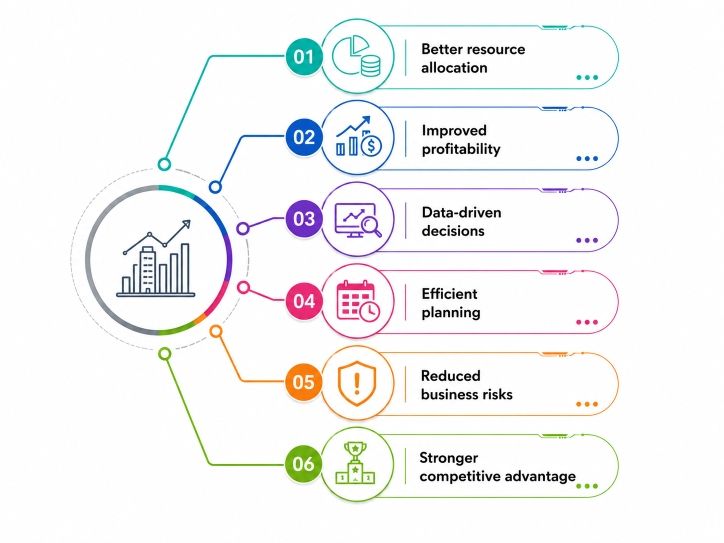
Managers often face complex situations where multiple options exist. Managerial economics provides a logical framework for choosing the best alternative.
As markets become more competitive and customer preferences change rapidly today, organizations began to rely heavily on managerial economics.
Some major benefits include:
Also Read: Top 10 Management Skills Required to Become a Successful Manager
A handful of core ideas show up repeatedly, almost like guardrails for decision-making.
Every choice means giving something else up. Before committing one path, it's worth asking what's being sacrificed by not taking the other.
Rather than getting lost in total costs and total revenue, the smarter approach looks at what changes the additional cost and additional benefit of one more unit, one more hire, one more dollar spent.
Resources should flow toward wherever they generate the most value at the margin, rather than being spread evenly out of habit.
A decision that looks great in the short term can turn out poorly over five years, and the reverse is just as true. Good managers weigh both timeframes instead of fixating on one.
A dollar today isn't worth the same as a dollar five years from now, so future costs and revenues get adjusted back to present value before they factor into a decision.
Nothing in business is guaranteed. This principle is really a reminder to build that uncertainty into the decision rather than pretend it isn't there.
Also Read: Management process: Definition, Features & function
To fully understand “What is managerial economics?” it is important to examine its nature. The nature reflects; its characteristics, objectives, and methods used in solving business problems.
Unlike traditional economics, managerial economics focuses on practical business situations; it is rather an action-oriented decision-making process.
Managers use economic concepts to solve issues such as:
At certain point organizations face choices. Managerial economics provides structured methods for evaluating alternatives.
Examples include:
Many concepts are borrowed from economics, including:
These concepts are adapted for business use.
The nature of managerial economics is interdisciplinary.
It combines:
Discipline |
Contribution |
| Economics | Theoretical foundation |
| Statistics | Data analysis |
| Mathematics | Quantitative models |
| Finance | Investment decisions |
| Management | Strategic implementation |
Resources are always limited.
Managerial economics helps managers:
Businesses make decisions today based on expectations about the future.
Managerial economics supports:
Also Read: What is Decision-making in Management: Explore Types, Tools, & Techniques
Subscribe to upGrad's Newsletter
Join thousands of learners who receive useful tips
The importance of managerial economics has increased significantly because organizations now operate in highly competitive markets.
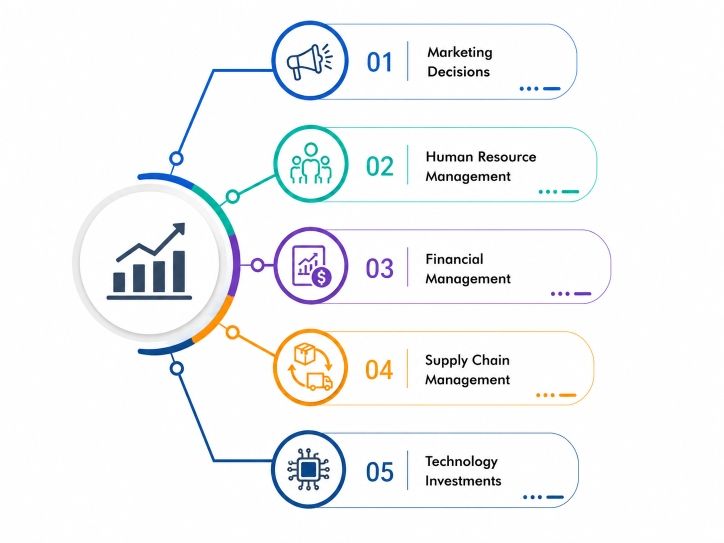
Managerial economics is not limited to theory. It influences everyday business decisions across industries.
Marketing teams use economic analysis to understand:
Organizations make workforce decisions using economic principles.
Examples include:
Financial managers apply managerial economics when:
Businesses use economic models to:
Before adopting new technologies, firms analyze:
Also Read: What Is a Business Management Degree and How Can It Benefit Your Career in 2026?
Industry |
Application |
| Retail | Pricing strategy |
| Manufacturing | Cost optimization |
| Banking | Risk assessment |
| Healthcare | Resource allocation |
| Technology | Investment decisions |
Managerial economics isn't an abstract academic exercise; it's a working toolkit. It takes the theory of economics and turns it into something usable: a way to allocate resources sensibly, cut through uncertainty, protect profitability, and plan for the long haul.
Whatever the decision, pricing a product, forecasting next quarter's demand, evaluating a big investment, or simply trying to manage risk a little better managerial economics gives managers a structured way to think it through rather than leaving it to guesswork. In a business environment that keeps getting more competitive, that structure is often what separates the companies that grow with intention from the ones that just react.
Want to explore more about Managerial economics? Book your free 1:1 personal consultation with our expert today.
Managerial economics refers to the application of economic concepts, theories, and analytical tools to business decision-making. It helps managers solve practical business problems involving pricing, production, investment, and resource allocation. The goal is to improve efficiency and support informed decisions.
In MBA programs, managerial economics is a core subject that teaches students how economic principles influence business decisions. It focuses on demand analysis, pricing, forecasting, market structures, and strategic planning. The subject helps future managers develop analytical and decision-making skills.
The three broad areas often associated with managerial economics are demand analysis, cost and production analysis, and pricing and profit management. These areas help managers understand markets, optimize operations, and improve business performance. Together, they support effective decision-making.
The six principles are opportunity cost, incremental analysis, equi-marginal principle, time perspective, discounting principle, and risk and uncertainty analysis. These principles provide a framework for evaluating business alternatives. They help managers allocate resources efficiently and maximize value.
The four main types are microeconomics, macroeconomics, international economics, and public economics. Microeconomics focuses on individual consumers and firms, while macroeconomics studies the economy as a whole. International and public economics examine global trade and government policies respectively.
The five major areas within the scope of managerial economics are demand analysis, cost and production analysis, pricing decisions, profit management, and capital budgeting. These functions support strategic and operational decision-making. They are essential for business growth and sustainability.
Managerial economics helps organizations make rational decisions based on data and economic analysis. It improves forecasting, resource allocation, pricing strategies, and investment planning. As a result, businesses can reduce uncertainty and achieve better outcomes.
Economics primarily studies how resources are allocated in society, while managerial economics applies economic concepts to solve business problems. Managerial economics focuses on practical decision-making within organizations. It serves as a bridge between economic theory and management practice.
Managerial economics examines customer demand, market competition, production costs, and consumer behavior. This information helps businesses determine optimal pricing strategies. Effective pricing can increase both sales and profitability.
Yes, entrepreneurs use managerial economics to assess market opportunities, estimate demand, control costs, and evaluate investment decisions. It provides a structured approach to business planning. This reduces uncertainty and improves the chances of long-term success.
Modern businesses use managerial economics for dynamic pricing, AI-driven demand forecasting, subscription models, digital advertising optimization, and platform economics. Companies increasingly rely on data analytics and economic models to make real-time decisions. This makes managerial economics highly relevant in today's technology-driven markets.
1141 articles published
We are an online education platform providing industry-relevant programs for professionals, designed and delivered in collaboration with world-class faculty and businesses. Merging the latest technolo...
Get Free Consultation
By submitting, I accept the T&C and
Privacy Policy
Top Resources
Certification
3 Months
Certification
6 Months
O.P. Jindal Global University
Masters in International Accounting and Finance (Accredited by ACCA, UK)Master's Degree
12 Months