Career Options in Economics: A Complete Guide for 2026
Updated on Sep 18, 2026 | 9 min read | 40.71K+ views
Share:

All courses
Certifications
More
Updated on Sep 18, 2026 | 9 min read | 40.71K+ views
Share:
Table of Contents
This guide explores the diverse career options in economics, covering high-demand roles, expected salaries, essential skills, and educational pathways. It highlights economics job opportunities across finance, policy, research, consulting, and international sectors, helping students and graduates make informed decisions and build a successful, future-ready career in economics.
Do you wish to become industry-ready in 2026? Check out upGrad’s Management Programs and find a program that interests you!
Popular upGrad Programs
If you’re exploring careers in economics, you’ll be glad to know that the subject opens doors to a wide range of opportunities across industries. From finance and consulting to research and policy-making, the scope is vast. Below, we’ve outlined the most rewarding career options in economics along with their skills and salary insights.
One of the most respected career options in economics, economists study data, policies, and market trends to predict social and financial outcomes. Their work shapes government decisions, corporate planning, and global trade. Economists are employed by research institutions, universities, central banks, and international organizations.
Key Skills: Data analysis, critical thinking, statistical software (R, Stata, SPSS).
Average Salary Range: ₹8–20.5 LPA
Do read: Scope of MA Economics: Career Options, Jobs & Future 2026
A common path for graduates exploring career opportunities in economics, financial analytics refers to evaluating company performance and investment prospects. They help businesses and investors make profitable choices in stocks, bonds, and mergers. This role is especially popular in corporate finance and investment banking.
Key Skills: Financial modeling, Excel, market research.
Average Salary Range: ₹4–10 LPA
Ready to start? A course in Financial Analysis from upGrad can give you the tools you need to break into this rewarding career.
Among the modern career fields in economics, data analytics has gained massive importance. Data analysts apply economic theories to big data, helping businesses identify patterns and forecast outcomes. With additional technical training, many transition into data science roles.
Key Skills: SQL, Python, data visualization (Excel, Tableau, Power BI).
Average Salary Range: ₹5–10 LPA
You should pursue career in economics after graduation if you are interested in governance and development, becoming a policy analyst is one of the most impactful career options in economics. Policy analysts design, evaluate, and improve government and NGO programs, contributing to areas like education, healthcare, and sustainability.
Key Skills: Policy research, writing, analytical reasoning.
Average Salary Range: ₹4–10 LPA
Investment banker is among the highest-paying career options after economics graduates. Professionals in this field help businesses raise capital, manage mergers, and oversee financial transactions. While competitive, it offers exceptional growth opportunities.
Key Skills: Corporate finance, negotiation, financial analysis.
Average Salary Range: ₹6–18.3 LPA
As a growing career field in economics, market research combines economic knowledge with consumer insights. Market Research Analysts study customer behavior and market demand to help companies launch better products and campaigns.
Key Skills: Survey design, statistical tools, presentation skills.
Average Salary Range: ₹3–6 LPA
Also Read: How To Do Market Research – [Ultimate Guide]
If you are mathematically inclined, actuarial science is one of the most rewarding career opportunities in economics. Actuaries assess risks for insurance and pension companies, ensuring financial security for clients and businesses.
Key Skills: Probability, statistics and data analysis, financial risk modeling.
Average Salary Range: ₹5–26.3 LPA
Consulting is a popular choice among students considering careers in economics. Business consultants use economic insights to solve organizational problems, cut costs, and develop long-term strategies. Many work with top consulting firms or start independent practices.
Key Skills: Problem-solving, communication skills, industry expertise.
Average Salary Range: ₹3-27.5 LPA
For learners passionate about teaching and research, academia remains a fulfilling career option in economics. Professors and researchers contribute to policy discussions, publish academic work, and guide future economists.
Key Skills: Subject expertise, teaching, research methodology.
Average Salary Range: ₹2.2–30 LPA
International trade is one of the fastest-growing career fields in economics. Specialists advise businesses and governments on global trade laws, tariffs, and export-import strategies, making them key players in globalization.
Key Skills: International economics, law, communication.
Average Salary Range: ₹7–15.8 LPA
Economics and commerce often overlap in skills and job opportunities. Reviewing career options after BCom can help you compare and choose wisely.
Statistics-based roles are strong career opportunities in economics, particularly for those who enjoy working with data. Statisticians design studies, analyze results, and provide insights for businesses, healthcare organizations, and governments.
Key Skills: Statistical programming, data modeling.
Average Salary Range: ₹3–8 LPA
Risk analysis is another sought-after career option in economics, especially in banking and insurance. Risk analysts predict financial uncertainties and recommend safe investment strategies to protect organizations.
Key Skills: Risk assessment, quantitative analysis, forecasting.
Average Salary Range: ₹5–14 LPA
For students interested in social impact, becoming a development officer is a meaningful career opportunity in economics. These professionals work with NGOs, the United Nations, and other global organizations on projects like poverty reduction, education, and sustainable development.
Key Skills: Policy knowledge, project management, research.
Average Salary Range: ₹1.8–10 LPA
Some economics graduates choose to pursue law degrees and specialize in corporate or financial law. By combining economics with legal knowledge, they advise businesses on contracts, mergers, taxation, and regulatory compliance. This role is ideal for those interested in both finance and legal frameworks. Corporate law is considered one of the high-paying career opportunities in economics for graduates with strong analytical skills.
Key Skills: Law, finance, economic reasoning, negotiation, regulatory understanding.
Average Salary Range: ₹4–12.5 LPA
Entrepreneurship is one of the most flexible career options in economics. Economics graduates have an advantage in understanding market demand, pricing strategies, and resource allocation, which are essential for running successful ventures. Many start their own businesses or consult startups, applying economic principles to practical decision-making.
Key Skills: Business strategy, leadership, decision-making, financial planning.
Average Salary Range: ₹3–31 LPA
Want to master economics? Enroll in upGrad's Economics Masterclass Online Courses and learn from industry leaders to enhance your skills!
Free Courses
A master's degree in economics is useful because career options after master in economics opens doors to many opportunities and help you secure jobs in diverse industries, such as finance, consulting, government, research and technology. If you like working with data in decision making or if you are interested in making public policy, then economics is a good field for you.
Masters in economics career options offer a lot of room to grow with high paying jobs and a chance to become an expert in new areas of the global economy. You can specialize in economics and make a good career out of it.
Career |
Average Expected Salary (India) |
| Economist | ₹8–18 LPA |
| Data Analyst | ₹6–15 LPA |
| Financial Analyst | ₹6–16 LPA |
| Policy Analyst | ₹7–15 LPA |
| Business Consultant | ₹10–25 LPA |
| Risk Analyst | ₹7–18 LPA |
| Market Research Analyst | ₹5–12 LPA |
| Academic Researcher | ₹6–12 LPA |
| Investment Analyst | ₹8–20 LPA |
| Economic Consultant | ₹8–20 LPA |
Having a postgraduate degree really helps us get jobs in economics; you can aim for leadership and work in special positions. Because companies and governments need people who are good at analyzing and critical thinking. Graduates can explore many kinds of jobs, in economics both in private and government sectors, and we can also expect to grow in your careers over time.
Let us talk about each job role of masters in economics career options, responsibilities and skills you will learn.
Economists study the current market trend, consumer behavior and regulations in economic policy, helping organizations and governments in making informed decisions. Economists are one of the most preferred career options among economics graduates who enjoy research, problems solving and working with economic data which impact financial and policy decision making.
Skills You Will Earn:
Job Opportunities:
These roles involve analyzing economic trends, advising policymakers, preparing forecasts, and supporting strategic business decisions.
A Data Analyst collects raw information and turns it into something that actually makes sense for a company. This helps the company in strategic decision-making.
With increasing usage of raw data by numerous companies now. It’s a great opportunity for individuals who are good, with data, and identifying issues.
Data Analyst is one of the jobs that is rapidly growing, for skills like analytics and quantitative.
Skills You Will Earn:
Job Opportunities:
Data Analysts help these organizations identify trends, improve operations, and make data-driven decisions that enhance business performance.
Financial Analysts study financial data and investment opportunities to help organizations and investors make good decisions. In this profession, you will need skills like analyzing and planning. Financial Analysts combines analytical expertise with financial planning and investment management.
Their responsibilities include evaluating investments, preparing financial reports, assessing risks, and supporting corporate financial strategies.
Skills You Will Earn:
Job Opportunities:
Policy Analysts analyze economic and social policies to see how well the policy work and recommend ways to make them better. This profession is great for graduates who want to pursue administration, governance, and policy development, and who have long plans for careers in economics. Policy Analysts provide evidence-based recommendations to help make policies better.
Skills You Will Earn:
Job Opportunities:
Business Consultants are helpful to organizations. They find solutions to the problems that companies are facing and make them work better. Business Consultants also help companies make plans for the future so they can keep growing.
If you like thinking about business and solving problems, being a Business Consultant is a job to consider. Business Consultants work with companies to make their work easier and faster. They help companies find ways to grow and become better by making plans and putting them into action.
Skills You Will Earn:
Job Opportunities:
Risk Analysts find out what could go wrong with a company's money and operations. They look at the problems that could happen and figure out how to deal with them. As companies start to use data and must follow more rules, being a Risk Analyst is a great job for people who study economics.
The job of a Risk Analyst involves keeping an eye on money problems, making sure the company is doing what it is supposed to do and coming up with plans to avoid losing money. Risk Analysts do this to help the company perform better. Risk Analysts have to be good at managing risks and operational risks.
Skills You Will Earn:
Job Opportunities:
Market Research Analysts look at what customers do, what is happening in the market, and what other companies are doing. This helps businesses make decisions about marketing and the products they make. It is a good career option for students who study economics because they can work in many different types of businesses.
Market Research Analysts do things like ask people question to figure out what customers like and give businesses ideas that help them make products and come up with marketing plans. Market Research Analysts do this kind of work to help businesses understand what people want and make choices.
Skills You Will Earn:
Job Opportunities:
Academic Researchers do a lot of work to help people understand economics better. They do research. Teach students and they also write papers about what they have learned. This is a job for students who want to learn more about economics after they finish school.
Academic Researchers study the economy, write, and teach. They make sure that the people in policy making are using good information to make their decisions. Academic Researchers are always trying to learn more, about economics so they can help people make choices.
Skills You Will Earn:
Job Opportunities:
Investment Analysts evaluates markets and chances to invest to help companies and people get the most money back while staying safe. This job is good for people who just graduated and want to work with money and stocks.
Investment Analysts check out stocks and bonds tell people what they think is an investment to watch how the market is doing and help the people in charge of the investments. They really like Investment Analysts because they are good at helping people make money and not lose it. Investment Analysts are very important when it comes to investing.
Skills You Will Earn:
Job Opportunities:
Economic Consultants give expert advice to clients about government regulation and help them run good business. Economic Consultants are very important because they help companies make decisions in compliance to the law.
They understand trends and market conditions, and they use this knowledge to help organizations make informed decisions about what to do next.
Skills You Will Earn:
Job Opportunities:
After graduating, career options after masters in economics become vast, you can work in a finance company, government, etc. With advanced knowledge of economics, you can become a leader in research or work with countries policy makers.
You can earn certificates and experience by working in numerous niches such as data, finance, or analyzing risk for better scope and compensation.
Career |
Skills You Will Earn |
Job Opportunities |
| Economic Research Analyst | Econometrics, research, forecasting, statistical software | Research institutes, think tanks, financial institutions |
| Banking Professional | Financial analysis, credit evaluation, banking regulations | Public and private sector banks, RBI, financial institutions |
| Actuarial Analyst | Probability, risk management, statistical modeling, predictive analytics | Insurance companies, consulting firms, pension funds |
| Quantitative Analyst | Mathematics, programming, financial modeling, machine learning | Investment banks, hedge funds, fintech companies |
| Public Finance Specialist | Budget planning, taxation, fiscal policy, government finance | Government departments, public sector organizations |
| Corporate Strategist | Strategic planning, business analysis, competitive intelligence | Large corporations, consulting firms, multinational companies |
| International Trade Analyst | Trade policy, economic regulations, global markets, negotiation | Export firms, government agencies, international organizations |
| Development Economist | Social impact analysis, project evaluation, development planning | NGOs, World Bank projects, development agencies |
| Financial Consultant | Wealth management, investment planning, financial advisory | Financial advisory firms, banks, consulting companies |
| ESG Analyst | Sustainability reporting, environmental economics, compliance, data analysis | ESG consulting firms, multinational corporations, investment firms |
Recommended Courses to upskill
Explore Our Popular Courses for Career Progression
IIIT Bangalore
Executive Diploma in Machine Learning and AI360° Career Support
O.P.Jindal Global University
MBA from O.P.Jindal Global UniversityLive Case Studies and Projects
Career options in humanities with economics combined provide a strong foundation in analytical thinking, communication, and social sciences. This interdisciplinary background prepares students for diverse professions across government, education, media, business, and development sectors. It creates flexible economics student career options that balance quantitative skills with a deep understanding of society and human behavior.
A humanities background with economics offers a wide range of careers in economics after graduation, especially for students interested in public policy, communication, education, and development. By building analytical and research skills alongside domain expertise, graduates can access rewarding career opportunities for economics students in both public and private sectors while exploring diverse career paths in economics.
Career |
Average Expected Salary (India) |
| Civil Services Officer | ₹8–20 LPA |
| Journalist (Business & Economy) | ₹4–12 LPA |
| Policy Research Associate | ₹6–14 LPA |
| Social Sector Consultant | ₹6–15 LPA |
| Human Resource Analyst | ₹5–12 LPA |
| Market Intelligence Analyst | ₹6–14 LPA |
| Public Relations Executive | ₹4–10 LPA |
| Economic Content Writer | ₹4–9 LPA |
| Development Program Manager | ₹8–18 LPA |
| Teacher/Lecturer | ₹4–12 LPA |
Career |
Skills You Will Earn |
Job Opportunities |
| Civil Services Officer | Public administration, governance, policy analysis, leadership | UPSC, State PSCs, government departments |
| Journalist (Business & Economy) | Research, communication, economic reporting, content creation | Newspapers, digital media, television channels, business publications |
| Policy Research Associate | Policy evaluation, report writing, economic analysis, stakeholder engagement | Think tanks, NGOs, research organizations |
| Social Sector Consultant | Project management, impact assessment, community development | NGOs, CSR departments, international organizations |
| Human Resource Analyst | Workforce analytics, organizational behavior, communication, recruitment | Corporate companies, consulting firms, HR agencies |
| Market Intelligence Analyst | Consumer insights, competitor analysis, market forecasting | FMCG, retail, consulting, technology companies |
| Public Relations Executive | Communication, media management, branding, stakeholder relations | PR agencies, corporations, government organizations |
| Economic Content Writer | Research, content writing, SEO, economic communication | EdTech companies, media houses, digital agencies |
| Development Program Manager | Leadership, budgeting, project implementation, monitoring & evaluation | NGOs, UN projects, social enterprises |
| Teacher/Lecturer | Teaching, curriculum development, research, mentoring | Schools, colleges, universities, coaching institutes |
Postgraduate study often expands the range of roles available in economics. Understanding the scope of MA in Economics helps clarify how advanced education impacts career options.
To excel in careers in economics, certain skills are essential. These abilities not only help you perform well in specific roles but also make you adaptable across multiple career options in economics. Here’s a detailed look at the key skills you need:

Economics involves interpreting numbers and spotting patterns. Strong analytical thinking and mathematical skills allow you to solve complex problems, forecast trends, and make data-driven decisions.
It’s not enough to collect data—you must also understand and communicate it. Being able to translate numbers into clear, actionable insights is crucial for roles like economist, data analyst, or financial analyst.
Understanding core business economic theories and models helps you evaluate real-world markets, policies, and financial systems. This knowledge is vital for all career fields in economics, from policy analysis to investment banking.
Strong written and verbal communication skills help you explain your findings clearly to colleagues, clients, or policymakers. Effective communication ensures that your economic insights are understood and applied correctly.
Modern economics relies heavily on research and data analysis. Familiarity with tools like R, Stata, SPSS, or Python helps you analyze datasets, build models, and generate reports efficiently.
Economists frequently encounter complex challenges. A problem-solving mindset enables you to approach issues logically and devise practical solutions, whether in government, private, or NGO sectors.
Critical thinking allows you to question assumptions, assess different perspectives, and make balanced decisions. It is essential for policy analysts, researchers, and consultants who work on real-world economic problems.
Small errors in analysis can lead to large financial or policy mistakes. Attention to detail ensures accuracy in research, forecasting, and reporting, which is crucial in roles like risk analyst or actuary.
Economics professionals often provide insights that guide key decisions. Strong decision-making skills help you evaluate options and recommend choices that are backed by data and sound reasoning.
Many economics careers involve juggling multiple projects or deadlines. Good time management ensures that research, reports, and analyses are completed on schedule without compromising quality.
Subscribe to upGrad's Newsletter
Join thousands of learners who receive useful tips
The scope of careers in economics in India is vast, offering opportunities across government, private, and international sectors. With the economy growing and new industries emerging, economics graduates are in high demand. Here’s a closer look:
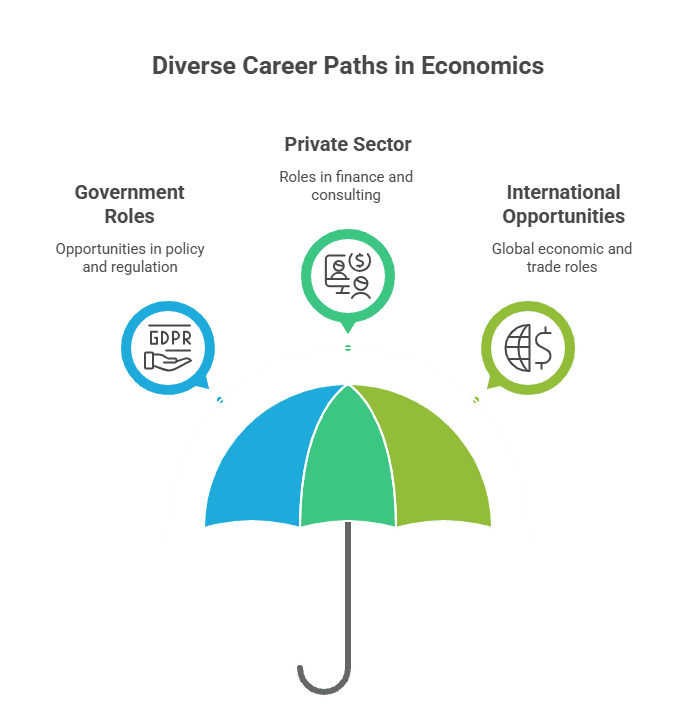
Economics graduates can work in key government organizations, shaping policies and contributing to national development. Popular opportunities include:
Government roles offer stability, social impact, and a chance to influence large-scale economic policies.
The private sector offers a wide range of career opportunities in economics for those interested in finance, business strategy, and analytics. Common paths include:
Private sector roles often provide higher salaries and faster career growth for skilled graduates.
Economics graduates can also pursue careers on a global scale. Career fields in economics at international organizations include:
These opportunities allow graduates to work on international policies and gain exposure to global economic issues.
Wondering how economics graduates compare with BA graduates in terms of pay? Explore our comprehensive breakdown on the Salary of BA graduates.
The average salary in India for various economics-related roles varies based on experience, industry, and location. Below is an overview of typical annual salaries:
Career Option |
Average Salary in India (per year) |
| Economist | ₹8–20.5 LPA |
| Financial Analyst | ₹4–10 LPA |
| Data Analyst | ₹5–10 LPA |
| Policy Analyst | ₹4–10 LPA |
| Investment Banker | ₹6–18.3 LPA |
| Market Research Analyst | ₹3–6 LPA |
| Actuary | ₹5–26.3 LPA |
| Business Consultant | ₹3-27.5 LPA |
| Professor/Researcher | ₹2.2–30 LPA |
| International Trade Specialist | ₹7–15.8 LPA |
| Statistician | ₹3–8 LPA |
| Risk Analyst | ₹5–14 LPA |
| Development Officer (NGOs/UN) | ₹1.8–10 LPA |
| Corporate Lawyer | ₹4–12.5 LPA |
| Entrepreneur | ₹3–31 LPA |
Source: Glassdoor
Conclusion
A career in economics is broad, impactful, and highly rewarding. It offers diverse career opportunities in economics, allowing you to work across sectors such as finance, government, consulting, research, international organizations, and emerging fields like data analytics and climate economics.
Economics equips you with a strong analytical foundation, critical thinking abilities, and problem-solving skills that are essential for understanding complex systems, evaluating policies, and making informed decisions. These capabilities are not only valuable in traditional roles like economist or financial analyst but also in innovative career fields in economics, including fintech, international trade, and development economics.
You can also connect with upGrad’s counselors for personalized career guidance. Visit your nearest upGrad career center for a one-on-one session.
Graduates can work as financial analysts, policy analysts, data analysts, market researchers, or continue with an MA or MBA. Internships and certifications in data analytics or financial modeling enhance employability and practical experience.
An MBA is optional but can be beneficial for roles in management, consulting, or finance. Work experience and additional certifications can also help advance your career without pursuing an MBA.
Key skills include analytical thinking, proficiency in statistical tools, critical thinking, problem-solving, strong communication, and a solid understanding of economic theories. Familiarity with software like Excel, Python, or R is an added advantage.
Yes. Gain practical experience through internships, entry-level roles, or freelance projects. Certifications in financial modeling, data analysis, or project management can improve employability.
Yes. Careers in public policy, development economics, or NGOs allow you to contribute to social development, working as policy analysts, economic advisors, or research associates.
Absolutely. Economics graduates possess strong analytical and statistical skills, which are foundational in data science. By learning programming languages like Python or R and gaining knowledge in machine learning, you can transition into data science roles in various industries.
Banking, finance, consulting, government, public policy, research, academia, and international organizations are major employers. Emerging fields like fintech, data analytics, and environmental economics also offer growth opportunities.
An MA in Economics provides in-depth knowledge of economic theories, quantitative methods, and policy analysis. It opens doors to specialized roles in research, academia, and high-level consulting positions, often leading to higher salaries and career advancement.
In a corporate setting, economists analyze market trends, assess economic conditions, and provide insights to inform business strategies. They may work in areas like pricing, market research, risk assessment, and financial planning to support decision-making processes.
Engage in internships, participate in research projects, attend workshops and seminars, and join economics clubs or societies. These activities provide hands-on experience, enhance your resume, and help build a professional network in the field.
After 12th, you can go for a BA or BSc in Economics. These degrees lead to jobs in banking, analytics, public policy, and more. With the right skills and internships, you can get into finance, data science, research, or even civil services.
Challenges include staying updated with rapidly changing economic conditions, dealing with complex data analysis, and the pressure of making impactful decisions. Additionally, roles in policy-making or research may involve navigating political dynamics and resource constraints.
Yes, an economics degree from India is recognized globally. Many international organizations, such as the United Nations, World Bank, and International Monetary Fund, hire economists from diverse backgrounds. Proficiency in foreign languages and understanding global economic policies can enhance international career prospects.
Networking is crucial in economics, as it helps you connect with professionals, learn about job opportunities, and gain insights into industry trends. Attending conferences, joining professional associations, and engaging on platforms like LinkedIn can expand your professional network.
Economic consultants analyze data to provide insights and recommendations on economic and business issues. They may work on projects related to market analysis, policy evaluation, financial modeling, or litigation support, serving clients in both the public and private sectors.
Yes, part-time and freelance opportunities exist in areas like data analysis, market research, content writing on economic topics, and consulting. Platforms like Upwork or Freelancer offer avenues to find such projects, allowing flexibility and diverse work experiences.
Women have significant opportunities in economics careers across various sectors. Organizations are increasingly promoting diversity and inclusion, leading to more leadership roles for women in economics. Networking, mentorship, and continuous skill development can further enhance career prospects.
Regularly read economic journals, follow reputable economic blogs, attend webinars and conferences, and participate in online courses. Engaging with current economic research and discussions helps you stay informed about trends and developments in the field.
Data analysis is fundamental in economics as it enables professionals to interpret trends, forecast economic conditions, and inform policy decisions. Proficiency in statistical tools and software allows economists to analyze large datasets and derive meaningful insights.
To specialize in environmental economics, pursue courses or certifications focusing on environmental policies, sustainable development, and ecological economics. Gaining experience through internships or projects related to environmental issues and staying informed about global environmental challenges can also be beneficial.
65 articles published
Nitin Gurmukhani is a seasoned professional specializing in Digital Marketing Professional with experience in Performance Marketing (Google Ads, Facebook Ads, Linkedin Ads, Youtube Ads), SEO (Search E...
Get Free Consultation
By submitting, I accept the T&C and
Privacy Policy
Top Resources
Certification
3 Months
Certification
6 Months
O.P. Jindal Global University
Masters in International Accounting and Finance (Accredited by ACCA, UK)Master's Degree
12 Months