Biological Neural Networks: Structure, Working & AI Applications
Updated on Aug 11, 2026 | 16 min read | 61.82K+ views
Share:

All courses
Certifications
More
Updated on Aug 11, 2026 | 16 min read | 61.82K+ views
Share:
Table of Contents
Quick Overview:
Interested in how biological neural networks inspire modern AI? Explore Artificial Intelligence Courses in India by upGrad to learn neural networks, deep learning, and machine learning through hands-on projects and real-world applications.
Popular AI Programs
A biological neural network is a system of interconnected neurons in the brain and nervous system that enables cognition, memory, perception, movement, and decision-making. These neurons communicate through electrical and chemical signals to process information efficiently within living organisms.
A biological neural network is made up of billions of neurons organized in layered and distributed structures. These networks continuously adapt through experience and synaptic plasticity, where neural connections strengthen or weaken based on activity and learning.
Ready to turn AI concepts into business impact? The IIM Kozhikode Strategic AI for Business Professionals – Leadership for an AI-First World program helps you understand AI technologies, develop AI-driven strategies, and lead digital transformation with confidence.
Key Features of Biological Neural Networks
Also Read: What Is a Neural Network and How Does It Work?
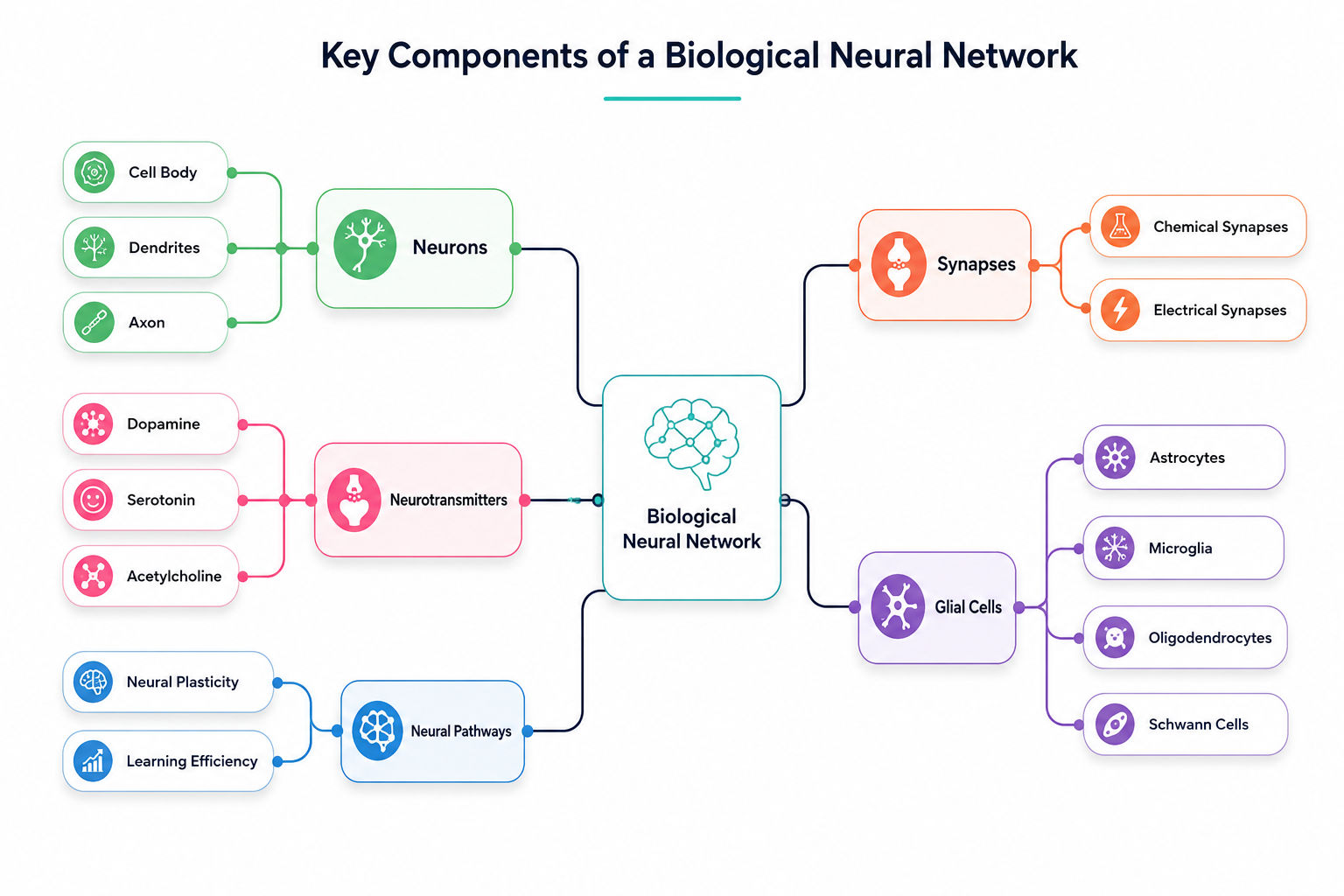
Biological Neural Networks consist of several interconnected elements that work together to process, transmit, and store information. These components enable efficient communication and support learning and adaptation across the nervous system.
Neurons
Each biological neuron serves as the core processing unit. The structure of biological neurons in neural network design typically includes:
A biological neuron communicates using action potentials and neurotransmitter release, ensuring fast and consistent information flow.
Synapses
Synapses serve as connection points between neurons.
Synaptic strength plays a key role in learning.
Neurotransmitters
Neurotransmitters enable chemical communication within Biological Neural Networks. Key examples include:
Glial Cells
Glial cells support and protect neurons. They include:
Neural Pathways
Neural pathways are chains of interconnected neurons that carry information across the system. Frequent activation strengthens these pathways through neural plasticity and supports long-term learning.
Must Read: A Beginner’s Introduction to AI: History, Pros, Cons & More
A biological neural network enables the brain and nervous system to process information, learn from experience, and respond to the surrounding environment. Understanding the structure of biological neural network systems helps explain how artificial neural networks are designed to recognize patterns and make decisions.
The key functions of a biological neuron in deep learning and biological neural networks include:
These functions form the foundation of the biological neural network in soft computing, where AI systems are inspired by the way the human brain processes information, adapts to new inputs, and improves performance through learning.
Free Courses
A Biological Neural Network operates through a series of coordinated steps that enable information processing, learning, and adaptation. Each stage plays a role in how signals move and how the system evolves with experience.
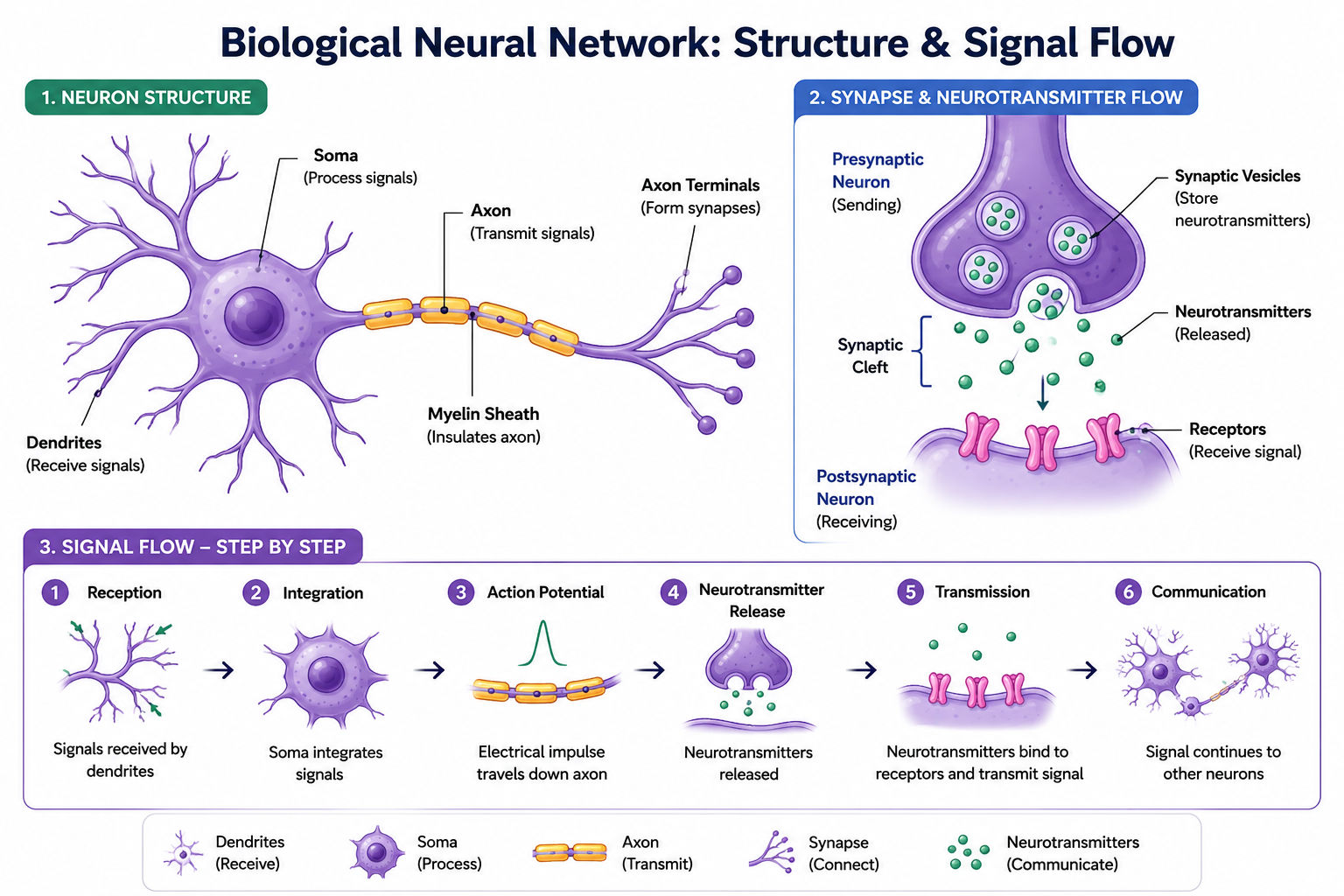
1. Signal Reception and Integration
Each biological neuron in a neural network receives input through dendrites. These incoming signals, excitatory or inhibitory, undergo summation inside the soma. Depending on the intensity and frequency of signals, the structure of biological neuron in neural network design determines whether the threshold for activation is met.
2. Action Potential Generation
When activation reaches the required threshold, the neuron produces an action potential. This electrical pulse travels along the axon due to controlled ion exchange, ensuring precision in signal transmission. The predictable electrical behavior of a biological neuron in soft computing is used as a computational model for problem-solving.
3. Synaptic Transmission
The action potential reaches the synaptic terminal, triggering the release of neurotransmitters into the synaptic cleft. These chemical messengers bind to receptors on the next neuron, continuing the communication chain within the biological neural network in soft computing and real organisms alike.
4. Learning Through Synaptic Plasticity
The Biological Neural Network learns by adjusting synaptic strength. Processes such as long-term potentiation, long-term depression, and Hebbian learning reinforce frequently used pathways and weaken less active ones.
5. Network Adaptation
Throughout life, the network adjusts connectivity to store memories, refine skills, and respond to new environments. The structural flexibility of interconnected biological neurons contributes to problem-solving and cognitive growth, a core principle replicated in neural network optimization techniques.
Also Read: Types of AI: From Narrow to Super Intelligence with Examples
A biological neural network processes information through interconnected neurons that communicate using electrical and chemical signals. Each neuron receives signals through dendrites, processes them in the cell body (soma), and transmits impulses along the axon to other neurons through synapses.
Neurotransmitters released at synaptic junctions enable continuous communication across the nervous system, supporting learning, memory, perception, and decision-making.
Lets understand it better with a diagram:
A biological neural network learns by strengthening or weakening the connections between neurons based on experience, a process known as synaptic plasticity. Every time we learn a new skill, recognize a pattern, or remember information, the connections within the structure of biological neural network systems become more efficient.
The learning process typically involves the following steps:
This learning mechanism has inspired biological neuron in deep learning models, where artificial neural networks adjust connection weights during training to improve prediction accuracy. Similarly, the biological neural network in soft computing serves as the foundation for intelligent systems that can learn from data, recognize patterns, and make decisions over time.
AI Courses to upskill
Explore Artificial Intelligence Courses for Career Progression
Biological neural networks operate throughout the nervous system, shaping intelligence, behavior, and perception. The structure of biological neural network classifications ensures coordinated processing across various functions, from motor reflexes to higher-order cognition. Understanding these systems also supports models like BNN in machine learning, where bio-inspired mechanisms guide computational intelligence.
1. Central Nervous System Networks
These networks are located in the brain and spinal cord. They manage cognition, learning, emotional regulation, spatial awareness, and the integration of complex information. The same capabilities that inspire biological neuron in AI applications.
2. Peripheral Nervous System Networks
These networks function outside the brain and spinal cord. They enable sensory perception, motor coordination, and reflex actions by linking the body with the central nervous system.
3. Sensory Neural Networks
These networks process inputs from the eyes, ears, skin, and other sensory organs. They convert external physical stimuli into neural signals for interpretation.
4. Motor Neural Networks
Motor networks coordinate muscle activity. They govern voluntary actions such as movement and posture, as well as involuntary responses like breathing.
5. Cognitive Neural Networks
These networks support advanced mental functions. They facilitate reasoning, decision-making, memory formation, attention, and language processing, the critical references for biological neural network in machine learning research.
Must Read: Discover How Neural Networks Work to Transform Modern AI!
Examples show how neural systems function in both complex and simple organisms and help researchers explain biological neural network behavior through real structures.
1. Human Brain Networks
The human brain represents the most advanced biological neural network. It contains around 86 billion interconnected neurons distributed across specialized regions responsible for perception, memory, movement, and reasoning. Forming the largest and most advanced biological neural network diagram seen in any organism.
2. Reflex Arcs
Reflex arcs are simple neural pathways that produce rapid, involuntary responses. They bypass the brain and rely on the spinal cord to ensure immediate action during events such as touching a hot surface.
3. Cortical Networks
Cortical networks operate in the cerebral cortex. They manage functions such as sensory interpretation, attention regulation, decision-making, and conscious thought.
4. Neural Circuits in Animals
Many animals exhibit well-mapped neural circuits. A widely studied example is C. elegans with 302 neurons. Its simple yet complete neural map makes it valuable for understanding neural architecture and modelling.
Also Read: Neural Network Architecture: Types, Components & Key Algorithms
A clear understanding of biological neural networks supports cross-disciplinary innovation. It enables breakthroughs in medicine, computing, robotics, and adaptive systems by translating natural intelligence principles into practical, high-impact technologies.
1. Advancements in AI and Machine Learning
Biological neural network insights drive innovation across deep learning, recurrent architectures, and neuromorphic computing. These models emulate natural information processing and inspire more adaptive machine intelligence systems.
2. Medicine and Neuroscience
Research on biological neural networks aids in diagnosing and treating neurological disorders. It also supports advancements in neuroplasticity studies, brain injury rehabilitation, and mental health therapies.
3. Cognitive Computing
Understanding how natural intelligence operates enables the development of systems that reason, adapt, and manage complex decision flows. This knowledge strengthens human–machine interaction capabilities.
4. Neuroprosthetics
Brain–computer interfaces apply biological neural network principles to restore sensory and motor capabilities. They assist patients with paralysis, limb loss, or neurological impairments.
5. Robotics and Autonomous Systems
Bio-inspired neural models guide autonomous decision-making in robotics. They enhance motion control, perception, and situational responsiveness for real-time applications.
Biological neural networks have become a strategic reference point for next-generation AI innovation. Their structure, timing mechanisms, and adaptive capabilities inspire advanced computational models designed to improve accuracy, efficiency, and real-time responsiveness. Techniques like BNN in machine learning take advantage of biologically aligned learning systems and temporal processing:
1. Neuromorphic Computing
Neuromorphic systems replicate the structural and functional characteristics of biological neural networks. These chips enable energy-efficient, event-driven processing ideal for low-latency applications.
2. Spiking Neural Networks
Spiking neural networks use time-based spikes that resemble natural action potentials. They support more biologically aligned computation and improve temporal pattern recognition.
3. Brain-Inspired Learning Models
Various learning frameworks, including reinforcement learning, evolutionary algorithms, and Hebbian learning, draw from biological neural principles to create adaptive, self-improving AI systems.
Biological neural networks are highly efficient at learning, adapting, and recognizing patterns. However, like any system, they have both strengths and limitations. Understanding these characteristics helps explain how the human brain works and why biological neural networks inspire modern AI models.
Biological neural networks deliver unmatched cognitive flexibility and environmental responsiveness. Their architecture enables continuous learning, adaptive behavior, and multi-dimensional information processing, positioning them far beyond artificial systems in natural intelligence tasks.
Despite their sophistication, biological neural networks have innate constraints that influence their performance, reliability, and long-term stability. Understanding these limitations provides insights into how they differ from artificial systems.
Subscribe to upGrad's Newsletter
Join thousands of learners who receive useful tips
The biological neural network is central to how living organisms learn, adapt, and respond to their environment. Its structure and dynamic functioning continue to guide innovations in computing and cognitive modelling.
Studying these natural systems helps explain how intelligence emerges and why biological processes remain far more efficient than engineered solutions.
A clear understanding of the difference between artificial neural network and biological neural network supports more informed research and system design. As both fields progress, the interaction between biological neural network and artificial neural network research will shape future advancements in AI, neuroscience, and intelligent systems.
Get personalised guidance through upGrad’s free counselling and explore nearby offline centers for hands-on support.
A biological neural network in machine learning serves as a natural blueprint for designing intelligent systems. By studying how neurons communicate through synapses and firing rates, researchers develop adaptive algorithms for perception, reasoning, and decision-making in areas such as robotics and automation.
A biological neural network is a naturally evolved system of interconnected neurons that processes and transmits information through electrochemical signals. It supports functions such as perception, motion, memory, and cognition and provides ideas for developing adaptive artificial systems.
The main components of a biological neural network include neurons, dendrites, cell bodies, axons, synapses, and neurotransmitters. Dendrites receive signals, the cell body processes them, and axons transmit signals to other neurons through synaptic connections.
The structure of a biological neuron includes dendrites for receiving input, a soma for processing, and an axon for output transmission. This structure enables neurons to communicate across interconnected networks and provides a model for artificial systems used in classification and pattern recognition.
A biological neuron in AI research provides insights into natural communication and learning mechanisms. Researchers study these behaviours to develop connection patterns, activation mechanisms, and adaptive models that can improve how artificial systems learn and respond to changing information.
A biological neural network diagram shows neurons, synaptic connections, and signal flow visually. It helps students understand how biological neurons communicate and helps researchers study similarities between biological neural networks and artificial neural network architectures.
Biological neural networks can process information in parallel, adapt to changing conditions, and perform complex tasks with relatively low energy consumption. These characteristics have inspired research into brain-inspired computing and neuromorphic systems.
ChatGPT is powered by artificial neural network models based on the Transformer architecture. These models process patterns in language and generate responses based on the information learned during training.
Common neural network types include feedforward neural networks, convolutional neural networks (CNNs), recurrent neural networks (RNNs), and Transformers. Each architecture is designed to handle different data types and learning requirements.
The structure of biological neural networks supports learning through neuroplasticity, where connections between neurons can strengthen, weaken, form, or change over time. This allows the brain to adapt based on experience and retain learned information.
There is no single best neural network for every task. The appropriate architecture depends on the problem and type of data. CNNs are commonly used for image-related tasks, RNNs for sequential data, and Transformers for language and other complex sequences.
The structure of biological neural networks supports adaptation through changing synaptic connections. Frequently used pathways can become stronger, while less-used connections may weaken. This process allows the brain to adjust its responses as experiences and tasks change.
Biological neural networks involve complex chemical interactions, nonlinear behaviour, and constantly changing connections. Computational models simplify many of these processes into mathematical representations, making it difficult to reproduce the full complexity of biological neural activity.
Biological neural networks combine signals from different senses, including vision, hearing, and touch. The brain processes these signals together to create a unified perception of the surrounding environment and support appropriate responses.
ANNs are general artificial neural network models that can handle different types of structured data. CNNs are designed to identify spatial patterns and are widely used for images. RNNs process sequential information and are suited to data where the order of inputs matters.
Experience can change the strength and effectiveness of connections between neurons. Frequently used pathways may become stronger, while others may weaken. This neural plasticity supports learning, memory, skill development, and adaptation.
Researchers use brain imaging, electrophysiology, and computational modelling to study neuron interactions and neural pathways. Mapping these networks helps researchers understand how different neural structures contribute to cognition, perception, learning, and other functions.
Artificial neural networks are inspired by certain principles of biological neural networks. Both use interconnected processing units to identify patterns and produce responses, but artificial networks use mathematical computations rather than the electrochemical processes found in biological neurons.
The human brain performs complex processing while consuming relatively little energy compared with many computing systems. Distributed processing and efficient neural signalling contribute to this performance and have inspired research into energy-efficient neuromorphic computing.
Research into biological neural networks influences areas such as neuromorphic computing, spiking neural networks, and adaptive learning systems. Studying how biological neurons communicate and learn can provide ideas for building AI systems that respond and adapt more effectively.
911 articles published
Pavan Vadapalli is the Director of Engineering , bringing over 18 years of experience in software engineering, technology leadership, and startup innovation. Holding a B.Tech and an MBA from the India...
Speak with AI & ML expert
By submitting, I accept the T&C and
Privacy Policy
Top Resources
Master's Degree
18 Months
Executive Diploma
12 Months
IIIT Bangalore
Executive Programme in Generative AI & Agentic AI for LeadersIndia’s #1 Tech University
Dual Certification
5 Months