What Is Process Management? Types, Lifecycle, and Examples
By upGrad
Updated on Sep 03, 2026 | 8 min read | 3.5K+ views
Share:

All courses
Certifications
More
By upGrad
Updated on Sep 03, 2026 | 8 min read | 3.5K+ views
Share:
Table of Contents
Key Highlights
Want to build stronger skills in planning, decision-making, and managing business operations? Explore the Management Course from upGrad and take the next step towards becoming a more effective business professional.
Popular Management Programs
Process management is the organized activity of planning, arranging, monitoring as well as improving business processes in an attempt to achieve the objectives of an entity with efficacy.
A business process is basically a group of activities that are carried out with the aim of attaining a particular outcome.
For example, recruitment process may involve the identification of vacant position to onboarding of the shortlisted candidate. Each procedure plays a role and it is critical to have them in a coordinated manner in order to obtain the intended result.
Within the domain of management, process management is concerned with making sure that activities are well defined, coordinated and monitored.
It is not just about getting the work done, rather it is about understanding how the work gets done as well as coming up with better ways of doing it.
The main objectives of process management include:
One of the important role of managers in process management is they are the ones to manage the way people, resources and activities combine.
A manager might notice that customer complaints are taking too long to resolve. The manager can look at the whole process, not just ask workers to speed up. Maybe complaints are being shared by too many people, approvals are taking too long, or employees don't have clear guidelines.
By looking at the whole process the managers can find the actual reason and make a better decision.
A well-managed process links the day-to-day work to broader business goals. For example, when an organization wants to improve customer satisfaction, it can review its complaint handling, response and follow-up processes.
For example, a company focused on reducing costs might look at purchasing, inventory or expense approval processes.
This helps managers move beyond individual tasks and focus on how different activities contribute to overall performance.
Free Courses
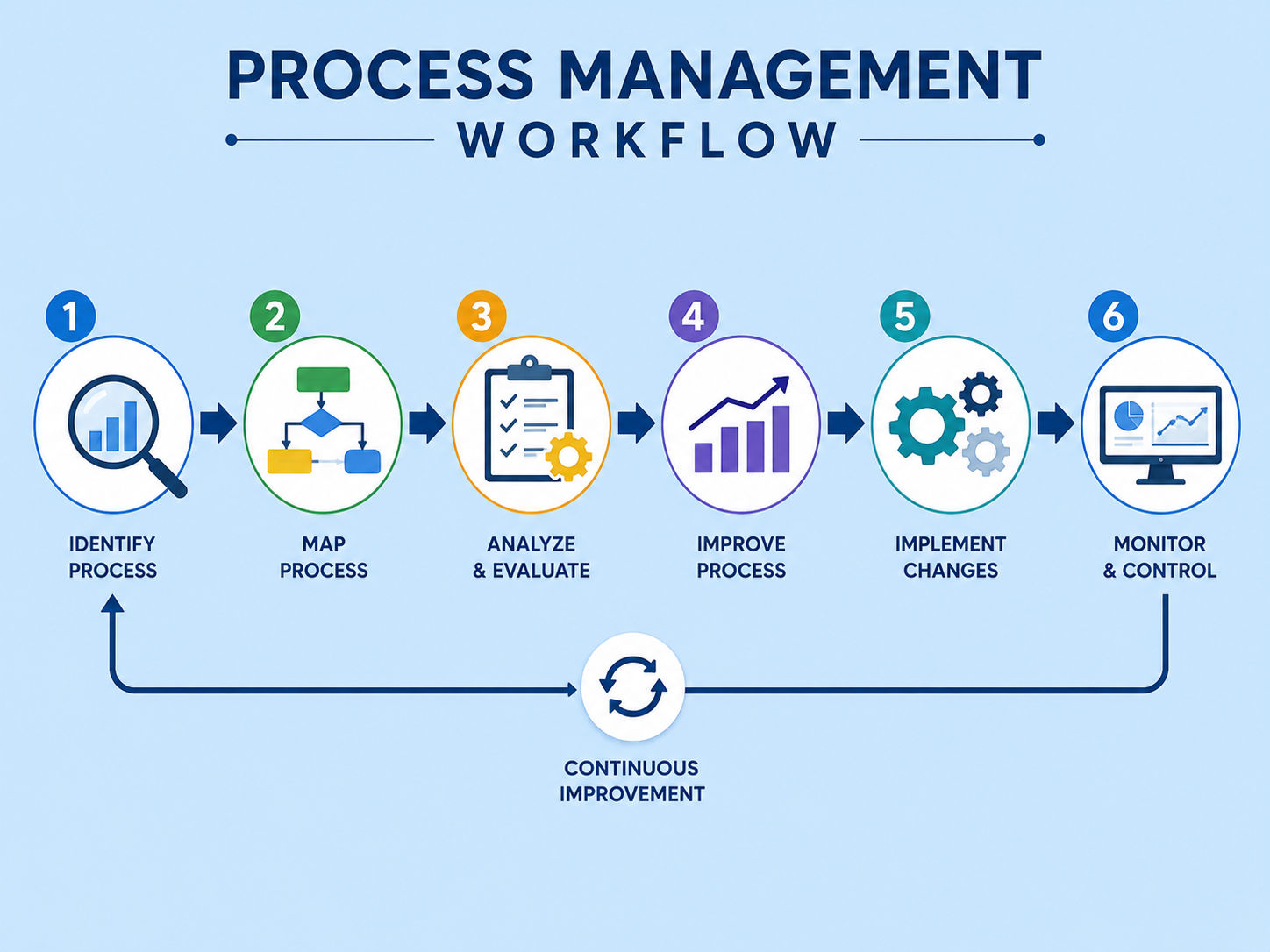
Process management follows a practical cycle. Managers first understand how work is currently being performed, then identify areas that need attention and introduce suitable improvements.
The process generally works through the following steps:
Management Courses to upskill
Explore Management Courses for Career Progression
IIIT-B & IIM, Udaipur
Chief Technology Officer & AI Leadership ProgrammeIIM Kozhikode
PCP in AI for Business ProfessionalsProcess management matters because organisations depend on processes to keep their daily operations moving. Even a strong business strategy can struggle when the underlying processes are unclear or poorly coordinated.
Here are some key reasons why process management is important.
Well-organised processes help employees spend less time dealing with confusion, repeated work, and unnecessary delays.
When responsibilities and activities are clearly defined, work can move more smoothly.
A consistent process ensures that similar tasks are handled in a similar way. This is especially helpful for organisations with multiple teams, branches or locations.
For example, a standard onboarding process can guarantee that all new employees receive the information, documents and support they need.
A bottleneck occurs when one part of a process causes the activities that follow to slow down.
For example, a purchase request may move quickly through a department but be waiting for approval for several days. Process management helps managers to find the location of such delays and to ask why.
Unclear processes can result in duplicate work, missed steps, and avoidable mistakes. Reviewing processes regularly helps managers remove unnecessary activities and establish clearer ways of working.
People, time, money and other resources are scarce. Managers can see where resources are being used and if they could be allocated more effectively by managing processes.
When the responsibilities are well-defined, employees understand who is responsible for each part of a process. This cuts down on confusion and makes it easier to coordinate between teams.
Processes turn business plans into everyday actions. When those processes are aligned with organisational priorities, employees can work towards common goals more effectively.
Take your management skills to the next level with upGrad’s Master of Business Administration from Paris School of Business with IIM Lucknow Certification.
Process management is not a one-time exercise. It follows a continuous cycle in which organisations examine how work is done, make improvements, and review the results.
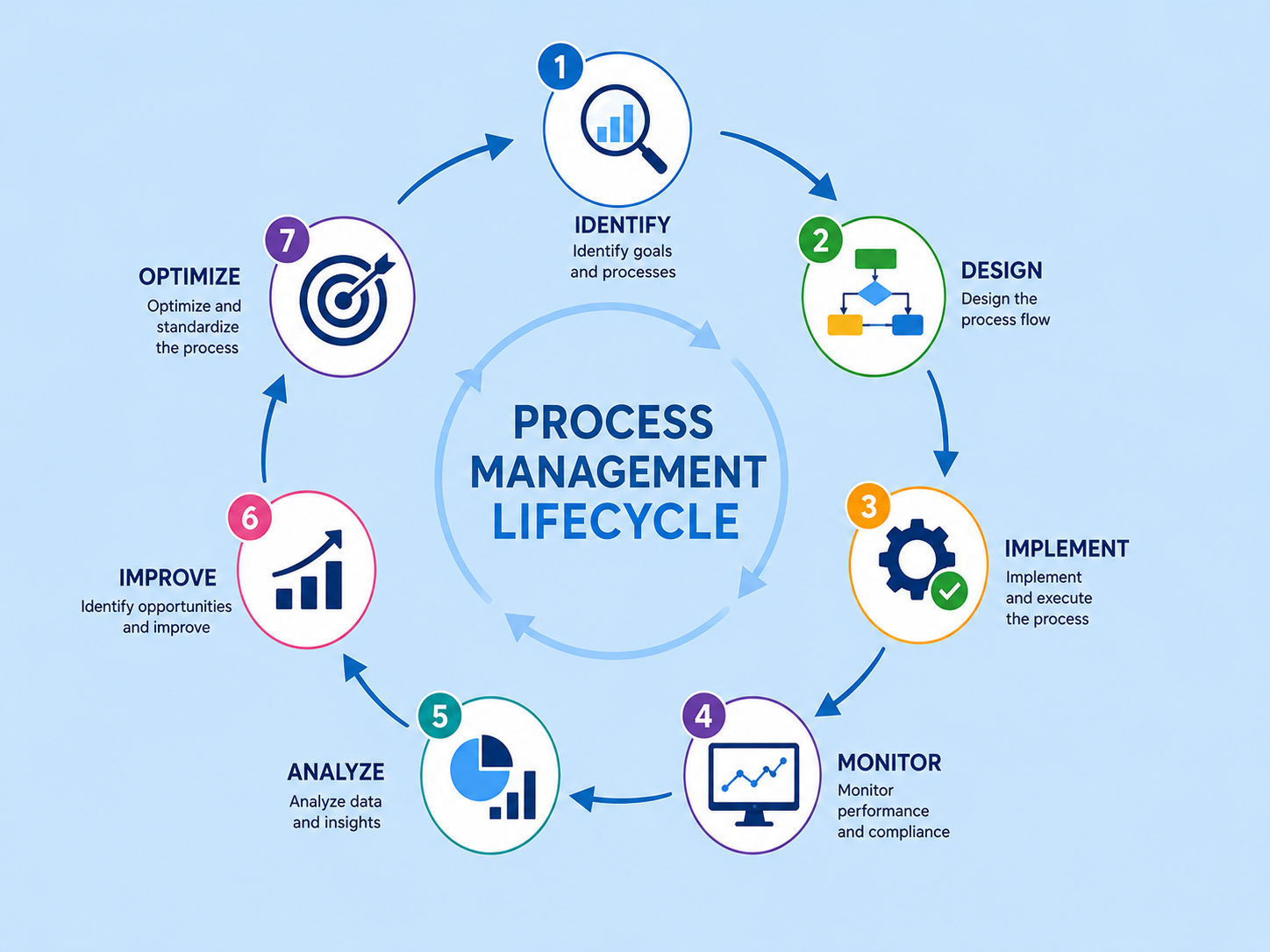
Begin by identifying the important processes within the organization. Managers need to understand what the process achieves, who is involved in the process, and where the process starts and ends.
This step provides a clear picture of current work.
The next step is to take a close look at the existing process. Managers can look for delays, unnecessary activities, repeated work, communication gaps, and resource-related issues.
Employees’ input is valuable at this stage, as they often experience process-related problems firsthand.
Once weaknesses are identified, managers can work out a better way of doing things. The new process needs to be workable, easy to understand and in line with business needs.
The goal is not to make the process complicated. A good process is usually one that helps people achieve the required outcome with fewer obstacles.
The redesigned process is introduced to the people responsible for carrying it out. Managers may need to provide training, clarify responsibilities, and communicate the expected changes.
A phased implementation can be useful when a process affects several teams.
Also read: Top 4 Functions of Management Process Explained
Managers should track how the revised process performs after implementation. Useful indicators may include completion time, error rates, costs, productivity, or customer feedback.
Monitoring helps determine whether the changes are actually producing better results.
Business needs change over time. A process that works well today may become less effective as the organisation grows, customer expectations change, or new challenges emerge.
Continuous improvement allows managers to keep processes relevant and effective instead of treating them as permanent and unchangeable.
Also Read: Basic Components of Supply Chain Management
Process management can be approached in different ways depending on an organisation’s goals and day-to-day needs. The main types include:
Type of Process Management |
What It Focuses On |
Example |
| Strategic Process Management | Aligning business processes with long-term organisational goals and priorities. | Improving processes to support business expansion. |
| Operational Process Management | Managing routine activities that keep the business running smoothly. | Managing orders, inventory, or daily customer requests. |
| Administrative Process Management | Organising internal activities and support functions across the organisation. | Managing leave requests, expenses, and employee records. |
| Cross-Functional Process Management | Coordinating activities that involve multiple teams or departments. | Managing an order from sales through finance and delivery. |
Also read: Management Process: Definition, Features & Function
Managing processes effectively requires more than documenting how work should happen. Managers also need to ensure that processes remain practical and useful.
Every process should have a clear purpose. Managers should know what the process is expected to achieve and how its success will be judged.
Employees should understand their responsibilities at each stage. Clear ownership reduces confusion and makes it easier to address problems.
When the same activity is performed regularly, standardisation can improve consistency. However, processes should still allow reasonable flexibility when circumstances require it.
A well-designed process is of little use if employees do not understand it. Managers should explain processes in simple terms and provide guidance when changes are introduced.
Managers should regularly review whether processes are delivering the expected results. Tracking performance can reveal issues that may otherwise remain unnoticed.
Read: 6 Types of Supply Chain Models To Know
Delays can develop as organisations change. A process that was efficient a year ago may become a problem as workloads, teams, or customer expectations change.
Employees who work with a process every day often have useful ideas for improving it. Listening to their experiences can help managers identify practical solutions.
Processes should be reviewed periodically rather than only when something goes wrong. Regular reviews help organisations adapt to changing business needs.
Read: Distributor and Consumer Management System for Modern Businesses
Process management is part of almost every business function. It helps managers organise routine activities, spot delays, and make everyday work easier.
Recruitment involves several steps, from identifying a vacancy to onboarding a new employee.
Reviewing the process helps HR managers reduce delays and improve coordination.
Expense approvals and invoice processing need clear responsibilities. A well-managed process helps finance teams avoid confusion, errors, and unnecessary waiting.
A complaint may move through receiving, assigning, resolving, and following up. Managers can review each step to improve response times and customer experience.
Order fulfilment involves checking stock, preparing orders, and arranging delivery. Managing these steps properly helps reduce delays and keep operations running smoothly.
Patient registration and appointment handling are common examples. Clear processes help staff manage information accurately and reduce unnecessary waiting for patients.
Read: What is Logistics Management? Understanding Its Types, Functions, Processes, and More
As businesses evolve, the way they manage everyday processes is changing too. New technologies and better use of data are helping managers make faster decisions and improve how work gets done.
Future Trend |
How It Can Help |
| Data-Driven Decisions | The information that gets managers up-to-date can help them identify areas of improvement and make better decisions. |
| AI Support | Using AI, it becomes possible to detect patterns and recurring problems, making it easier to focus on what needs improvement in the company. |
| More Automation | By removing routine, boring processes, it becomes possible to let employees focus on more creative, communicative, and effective procedures. |
| Real-Time Monitoring | Accessing information about the state of the process quickly allows managers to detect any delays and quickly find ways to solve them. |
| Greater Flexibility | Flexibility in the procedures allows the organisation to be prepared for changes in customer demands, the market situation, and strategic goals. |
| People and Technology | Making processes efficient could be facilitated by technology, but it also relies on effective leadership, managerial and communicative skills, and employee engagement. |
What is process management? It is a concept primarily aimed at making day-to-day operations simpler and more organised. By analysing processes, managers can remove unnecessary steps that slow progress, resolve issues, and use employees’ time and efforts more efficiently.
Good process management is an ongoing effort, not a one-time task. As business needs change, processes may need to change too.
Regularly reviewing and improving them helps organisations stay organised, work efficiently, and keep moving towards their goals.
Ready to start your journey? Book a free consultation with upGrad today to find the best path for your career.
Process management means overseeing how work moves through an organisation, from the starting point to the desired outcome. It involves understanding responsibilities, maintaining consistency, reviewing results, and making sensible changes when a process no longer supports business needs or team performance.
L1, L2, L3, and L4 describe different levels of detail in a business process hierarchy. L1 gives the broadest view, L2 breaks it into major processes, L3 explains detailed workflows, and L4 focuses on specific tasks or work instructions.
The five commonly recognised management functions are planning, organising, staffing, directing, and controlling. Together, they help managers decide what needs to be achieved, arrange resources, guide employees, and check whether work is progressing as expected.
In an organisation, process management provides a clear way to oversee recurring business activities. It helps managers connect people, responsibilities, resources, and expected outcomes so that work does not depend entirely on individual preferences or informal ways of doing things.
Managers can assess a process by looking beyond whether tasks are completed. They can consider turnaround time, quality, resource use, customer feedback, errors, and employee concerns. Comparing these indicators with expected results gives managers a clearer picture of where attention may be needed.
The seven basic management skills are commonly described as communication, planning, decision-making, delegation, problem-solving, motivation, and time management. These skills help managers coordinate people, handle workplace challenges, make informed choices, and keep everyday responsibilities moving in the right direction.
The five pillars of managing are often presented as planning, organising, leading, controlling, and motivating. Different management frameworks may use slightly different terms, but the underlying idea remains similar: managers set direction, organise resources, guide people, monitor progress, and encourage performance.
A process describes the broader flow of activities required to achieve an outcome, while a procedure explains how a particular activity should be performed. In simple terms, a process shows the bigger picture, whereas a procedure provides more detailed instructions for carrying out specific work.
Organisations document processes to create a shared understanding of how important work should be handled. Clear documentation can make training easier, reduce dependence on individual knowledge, support accountability, and provide managers with a useful reference when reviewing or changing the way work is performed.
These process levels allow managers to look at operations from different angles. Senior leaders can focus on broad business functions, while managers can examine major workflows and detailed activities. This layered view makes it easier to connect strategic priorities with what employees actually do.
No. Processor management is generally associated with managing a computer's processor and belongs to operating-system or computing concepts. Process management in business is different; it focuses on organising and improving the flow of work, responsibilities, and activities within an organisation.
1171 articles published
We are an online education platform providing industry-relevant programs for professionals, designed and delivered in collaboration with world-class faculty and businesses. Merging the latest technolo...
Get Free Consultation
By submitting, I accept the T&C and
Privacy Policy
Top Resources
Certification
3 Months
Certification
6 Months
O.P. Jindal Global University
Masters in International Accounting and Finance (Accredited by ACCA, UK)Master's Degree
12 Months