Software Configuration Management: Process, Activities, Lifecycle and Examples
By Sriram
Updated on Aug 12, 2026 | 10 min read | 4.34K+ views
Share:

All courses
Certifications
More
By Sriram
Updated on Aug 12, 2026 | 10 min read | 4.34K+ views
Share:
Table of Contents
Key Highlights
Ready to strengthen your leadership and decision-making skills? Explore upGrad's Management Training Programs to develop practical management knowledge and prepare for real-world business challenges.
Popular Management Programs
Software configuration management is a structured way to identify, control, track, and audit software components such as code, configurations, documentation, and test files.
It helps teams manage changes, maintain correct versions, and keep development, testing, and deployment configurations consistent.
A configuration item is any component that needs controlled identification and management. The exact list depends on the project.
Configuration item |
Example |
| Source code | Application modules |
| Requirements | Functional requirements |
| Documentation | Technical specifications |
| Test assets | Test cases and scripts |
| Configuration files | Application settings |
| Build assets | Build scripts and dependencies |
| Release assets | Deployment packages |
The scope should match the project's needs. A small application won't need the same level of control as a large financial platform with many services and dependencies.
The goal is not to create paperwork. It's to make changes easier to understand and control.
Software configuration management (SCM) is a discipline in software engineering that assists teams in managing software components throughout the process of development, testing, release and maintenance. It keeps track of changes, versions, dependencies, and configurations to help teams stay consistent.
In software engineering, configuration management aids developers, testers, release teams and managers by providing them a clear version history and visibility to changes.
How SCM Supports Software Development Teams
Key activities include:
This helps teams resolve version conflicts, maintain consistent configurations, and quickly trace problems after deployment.
Also Read: Guide to Product Data Management: Features, Tools, Challenges, and Career Opportunities
Software projects involve frequent code changes, multiple contributors, different environments, and regular releases. Without proper control, even a small configuration change can cause testing, deployment, or versioning problems.
Software configuration management helps teams keep software versions consistent, track changes, and quickly identify what caused an issue.
Key Benefits of SCM
Common Problems and How SCM Helps
Problem |
How SCM Helps |
| Unknown file versions | Tracks revisions and versions |
| Uncontrolled changes | Uses defined change-control procedures |
| Configuration drift | Compares actual and approved configurations |
| Difficult rollback | Maintains previous versions |
| Poor traceability | Records configuration and change history |
Also Read: What is Customer Relationship Management? A Complete Guide
Free Courses
The software configuration management process provides a repeatable way to control changes from identification through verification.
A typical workflow looks like this.
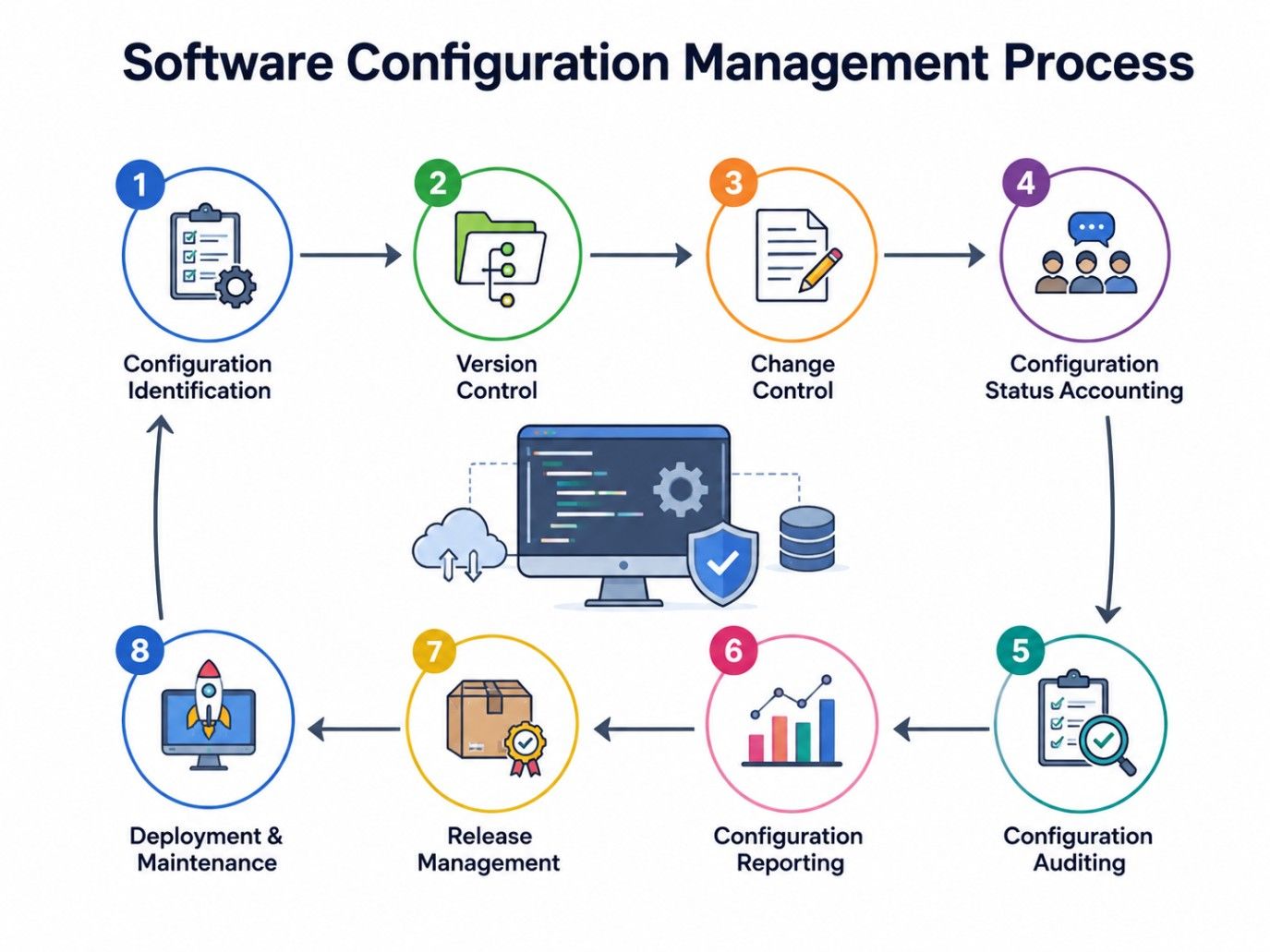
Software configuration management activities cover the practical work required to keep software configurations controlled.
Common activities include:
For example, creating a baseline has little value if the team doesn't track changes against it. Likewise, version control becomes less useful if nobody knows which version was approved for release.
Good SCM connects the activities.A team should also review whether its process works in practice. If developers regularly bypass a procedure, the problem may be an overly complicated workflow rather than careless behavior.
Read: What is Logistics Management? Understanding Its Types, Functions, Processes, and More
Management Courses to upskill
Explore Management Courses for Career Progression
IIIT-B & IIM, Udaipur
Chief Technology Officer & AI Leadership ProgrammeIIM Kozhikode
PCP in AI for Business ProfessionalsThe software configuration management lifecycle follows a project from planning through maintenance.

SCM doesn't end when the first release goes live. Production fixes, dependency updates, configuration changes, and new features create new versions that also need control.
The team decides what needs to be controlled and how it will be managed.
This includes:
The plan should match the project's size and complexity.
Developers create and modify configuration items during development. Version control records revisions and connects changes with branches, features, or releases. This gives the team a clear history of what changed.
Testing should use a known and controlled configuration. Teams track the versions of code, dependencies, and configuration files used during testing. This makes results easier to reproduce and investigate.
Before deployment, the team verifies the approved configuration. The release should include the correct source code, dependencies, configuration files, and other required assets. A defined baseline helps confirm that everything matches the approved version.
SCM continues after deployment. Teams track patches, bug fixes, dependency updates, and configuration changes as new versions are created. This keeps the software history accurate throughout its lifecycle.
Build practical business and leadership skills with the Master of Business Administration from Paris School of Business with IIM Lucknow Certification. Explore the program to strengthen your understanding of management and prepare for real-world business challenges.
These components and principles help teams maintain control over software changes throughout the development lifecycle. The table below summarises their purpose and role in effective software configuration management.
Component / Principle |
Description |
| Configuration Items | Individual components placed under configuration control, such as source files, requirements, test scripts, database definitions, build scripts, and deployment assets. |
| Baselines | Approved reference configurations that provide a stable point for comparing changes and reproducing known software states. |
| Controlled Change | Ensures changes follow a defined process from request to implementation, based on their risk and impact. |
| Version Integrity | Ensures every controlled version is clearly identifiable and maintains a reliable configuration history. |
| Traceability | Connects changes with their reasons, implementation, testing, and release, making defect investigation easier. |
| Consistency | Keeps development, testing, and production configurations controlled to reduce environment-related issues. |
| Accountability | Maintains clear records of important configuration changes and their technical history. |
| Reproducibility | Enables teams to recreate an approved software state for testing, debugging, audits, or rollback. |
Read: Distributor and Consumer Management System for Modern Businesses
A software configuration management plan describes how a project will identify, control, track, and audit its configurations.
It doesn't have to be a huge document. The team should be detailed enough to understand its responsibilities and procedures.
A practical plan can cover:
Plan area |
What it defines |
| Scope | Items covered by SCM |
| Roles | Responsibilities |
| Identification | Naming and identification rules |
| Version control | Revision procedures |
| Change control | Review and approval process |
| Baselines | When approved states are created |
| Audits | How configurations are checked |
| Reporting | Information that should be recorded |
| Tools | Systems used for SCM |
The plan should also explain how urgent changes are handled.
Software configuration management tools help teams store, track, compare, and control software configurations.
Common tool categories include:
Version control systems are often central to SCM because they preserve revision history and support collaboration. Other tools can connect configuration changes with testing, builds, deployment, and issue tracking.
Read: What is Supply Chain Management: Components, Process & Benefits
Following effective SCM practices helps teams manage software changes consistently and reduce configuration-related errors. These practices also improve traceability, collaboration, and the reliability of software releases.
Read: 6 Types of Supply Chain Models To Know
Real-world examples show how SCM helps teams control changes, maintain version history, and troubleshoot issues efficiently.
1. E-Commerce Payment Feature
Imagine an e-commerce team developing a new payment feature.
This process reduces guesswork and makes troubleshooting faster.
2. Production Configuration Change
Consider a production application that requires a database connection setting to be changed.
If an issue occurs later, the team can quickly identify what changed, when it changed, and which release included it.
Also Read: Basic Components of Supply Chain Management
SCM becomes harder when projects grow, environments differ, and changes happen quickly.
Configuration drift is one common problem. A development environment might use one dependency version while production uses another.
Untracked changes create another problem. Someone may make a quick production fix and forget to record it.
Version conflicts can also appear when several developers modify connected components simultaneously.
Teams can reduce these problems by:
Configuration management in software engineering works best when these controls become part of everyday development instead of being added just before release.
Version control is an important part of SCM, but the terms don't mean exactly the same thing.
Software Configuration Management |
Version Control |
| Broader management discipline | Specific revision-tracking practice |
| Covers identification, baselines, changes, status, and audits | Primarily records file revisions |
| Can cover code, documentation, configurations, and releases | Often focuses on source code and related files |
| Defines how configurations are controlled | Provides mechanisms for storing and comparing versions |
When the process fits the project, SCM gives teams better control over software change.
The main benefits include:
Teams know what they're working with, which version was approved, what changed, and what should be released.
That becomes increasingly useful as projects gain more contributors, dependencies, environments, and releases.
Software configuration management gives software teams a controlled way to manage versions, configuration items, changes, baselines, and releases.The process doesn't need to be complicated. It needs to be clear enough that people can follow it consistently.
When teams identify what matters, track changes, maintain known configurations, and verify releases, they gain better visibility into the software they're building. That control makes development easier to manage and problems easier to investigate.
Ready to start your journey? Book a free consultation with upGrad today to find the best path for your career.
Software configuration management is the practice of controlling and tracking software components and their changes throughout a project. It helps teams maintain reliable versions of code, configurations, documentation, and other assets while preserving traceability between changes, releases, and approved software states.
The five commonly cited pillars are planning, configuration identification, configuration control, status accounting, and configuration audit. Together, they provide a framework for deciding what should be controlled, managing approved changes, recording configuration information, and verifying that the actual state matches the documented state.
SCM tools are software applications that help teams manage versions, changes, repositories, and configuration information. Common examples include Git, GitHub, GitLab, and Subversion, while broader configuration tools can manage infrastructure and deployment settings. The right toolset depends on the project's workflow, assets, and level of control required.
An SCM audit is a formal check that verifies whether software configuration information matches the approved state and whether required controls were followed. It can identify unauthorized modifications, missing configuration items, incorrect versions, or documentation gaps, giving teams evidence that a release or system matches its intended configuration.
Not exactly. Software configuration management focuses specifically on controlling software products and their related components. Configuration management is a broader discipline that can cover software, hardware, systems, and other product elements. In software projects, SCM applies configuration management concepts directly to development and software delivery.
Start with the assets and workflow rather than choosing a tool by popularity. Consider repository support, version tracking, branching, access controls, integrations, automation, audit history, and team size. A simple project may need only version control, while larger environments may require an integrated SCM toolset.
Microsoft's System Center Configuration Manager, commonly known as SCCM, is now called Microsoft Configuration Manager. Microsoft uses this name for the product that manages devices and applications across organizational environments. It shouldn't be confused with software configuration management, which is a broader software engineering practice.
SCM covers the identification, versioning, control, and tracking of software configurations, while change management focuses on evaluating and governing proposed changes. They overlap closely, but change management is concerned mainly with the decision and approval around a change, whereas SCM also tracks the resulting configuration state.
SCM tools can connect source changes with builds, testing, deployment, and release workflows. This gives DevOps teams a clearer record of what changed and which version moved through the delivery pipeline. Configuration management tools can also help maintain consistent settings across development, testing, and production environments.
If you're referring to the original NIST Cybersecurity Framework, its five functions were Identify, Protect, Detect, Respond, and Recover. NIST CSF 2.0 added Govern, so the current framework has six functions. These cybersecurity functions shouldn't be confused with the five pillars of configuration management.
Yes. SCM can help teams detect configuration drift by providing an approved reference state against which current configurations can be compared. When differences appear, teams can investigate whether they came from an authorized change, an environment-specific requirement, or an untracked modification that needs correction.
724 articles published
Sriram K is a Senior SEO Executive with a B.Tech in Information Technology from Dr. M.G.R. Educational and Research Institute, Chennai. With over a decade of experience in digital marketing, he specia...
Get Free Consultation
By submitting, I accept the T&C and
Privacy Policy
Top Resources
Certification
3 Months
Certification
6 Months
O.P. Jindal Global University
Masters in International Accounting and Finance (Accredited by ACCA, UK)Master's Degree
12 Months