Types of Control in Management: Process and Examples
By Sriram
Updated on Aug 10, 2026 | 10 min read | 4.42K+ views
Share:

All courses
Certifications
More
By Sriram
Updated on Aug 10, 2026 | 10 min read | 4.42K+ views
Share:
Table of Contents
Key Highlights:
Build practical skills in planning, decision-making, leadership, and business management with an upGrad Management Course. Learn from industry-relevant content and prepare to take on real-world management challenges.
Popular Management Programs
Control in management refers to the different ways in which managers oversee work, compare actual results against expected standards, and take action when performance deviates from the plan. Control can be exercised before, during, or after an activity.
The three main types based on timing are feed-forward control, concurrent control, and feedback control. Each has a different purpose and so managers may use more than one for the same activity.
Quick overview :
| Type of Control | When It Is Applied | Main Purpose |
| Feedforward Control | Before an activity | Prevent problems |
| Concurrent Control | During an activity | Correct problems in real time |
| Feedback Control | After an activity | Improve future performance |
Timing is the easiest way to understand these controls. Think of them as before, during, and after.
1. Feedforward Control in Management
Feedforward control happens before work begins to prevent potential problems. Managers check inputs, resources, plans, and skills against required standards.
For example, a manufacturer inspects raw materials before production to prevent quality issues.
2. Concurrent Control in Management
Concurrent control happens while work is in progress. Managers monitor activities in real time and fix problems immediately.
Example like a supervisor who monitors a production line and corrects defects as they occur.
3. Feedback Control in Management
Feedback control happens after an activity is completed. Managers review results, identify gaps, and use the findings to improve future performance.
For Example, a sales manager reviews monthly sales against targets to improve the next month's strategy.
Control in management is the process of assuring that the performance of an organization is consistent with the established standards and taking corrective action when the performance deviates from the standards.
Planning and control are tightly linked. Planning determines what an organization wants to achieve and control determines whether actual performance is leading toward that goal.
The purpose is to keep organizational activities aligned with planned objectives.
Managers use control to:
Control shouldn't become an exercise in checking every small action. Too much monitoring can slow work and create unnecessary pressure.
Control is one of the core functions of management. Managers plan activities, organize resources, guide employees, and then monitor results.It closes the loop between plans and actual performance. Without control, managers may not know whether resources are being used properly or whether objectives are being achieved.
A manager first establishes a target. The organization then performs the required activity. Actual results are measured against the target, and deviations are reviewed.If the result is below the required standard, managers decide whether corrective action is needed. The findings can also improve the next planning cycle.
Read: Henri Fayol's 14 Principles of Management with Examples
Controlling in management helps organizations keep actual performance aligned with planned objectives. It gives managers evidence about what is working, what isn't, and where action may be needed.
1.Helps Achieve Organizational Goals
Control keeps activities connected to measurable objectives. Managers can identify whether teams are moving toward their targets or falling behind.
2. Improves Employee Performance
Clear standards help employees understand what is expected. Regular feedback can also show where performance needs improvement.
3. Reduces Errors and Waste
Early checks can prevent unsuitable materials, unnecessary spending, process failures, and avoidable rework.
4. Supports Better Decision-Making
Managers make better decisions when they have reliable performance information rather than relying only on assumptions.
5. Improves Resource Utilization
Control can reveal where money, time, materials, equipment, or employee effort is being used inefficiently.
6. Identifies Deviations Early
A small deviation is usually easier to address than a large one that has been ignored for months.
7. Supports Continuous Improvement
Feedback from completed activities gives managers information that can improve future processes, standards, and decisions.
Also read : Management process: Definition, Features & function
Free Courses
The control process in management is a sequence through which managers establish standards, measure actual performance, compare results, identify deviations, and respond when necessary.
A simple control cycle looks like this
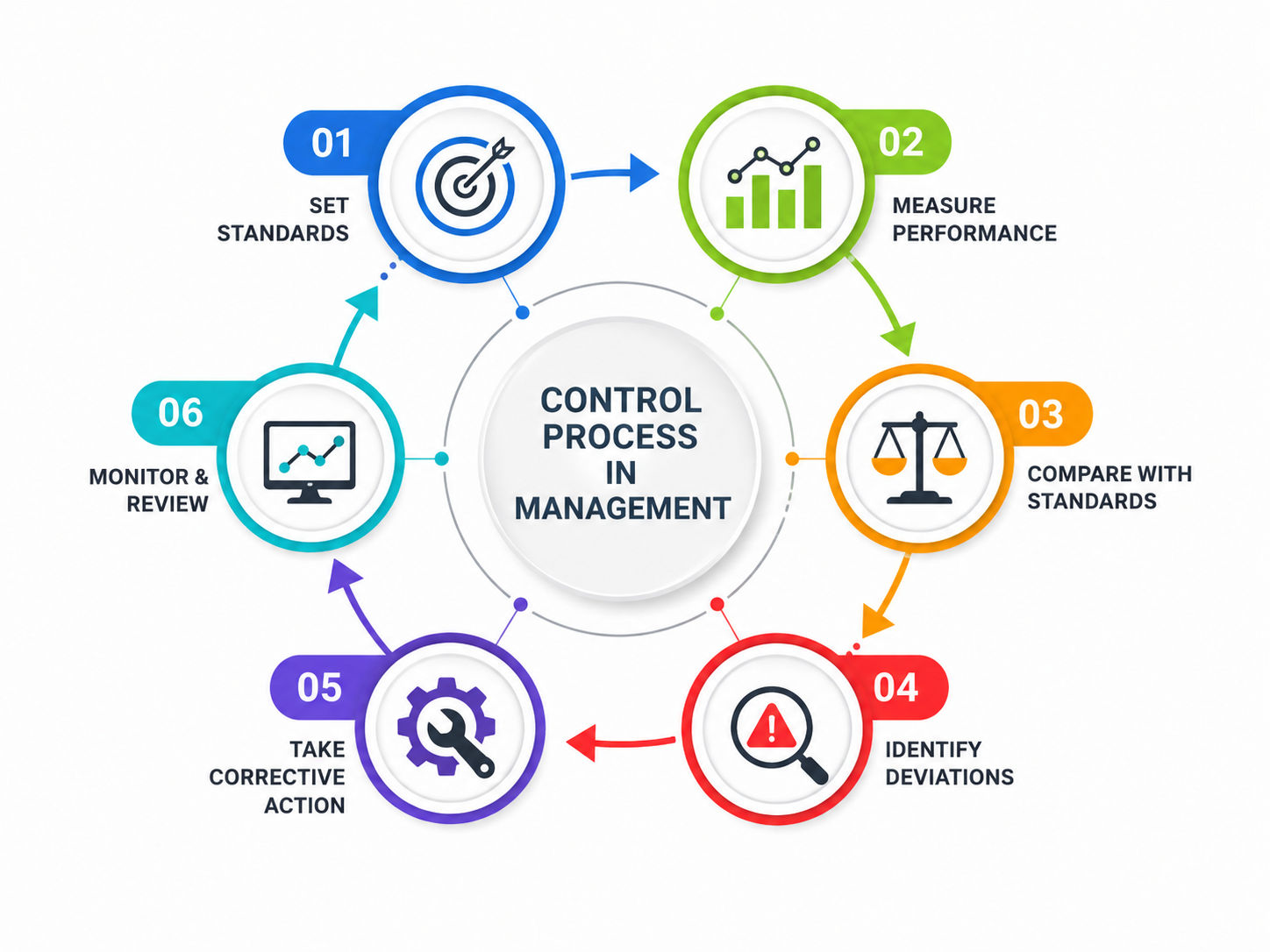
Workflow of control in management:
Set Standards → Measure Performance → Compare Results → Identify Deviations → Take Corrective Action → Review Results
Take your management skills to the next level with upGrad’s Master of Business Administration from Paris School of Business with IIM Lucknow Certification.
Build business expertise, strengthen leadership skills, and gain a globally relevant management education.
Management Courses to upskill
Explore Management Courses for Career Progression
IIIT-B & IIM, Udaipur
Chief Technology Officer & AI Leadership ProgrammeThe different types of control in management can work together across a single business process. The easiest way to understand their relationship is through timing.
Before Activity → During Activity → After Activity
Before production begins, a company may inspect raw materials, check equipment, confirm employee training, and review production plans.These checks aim to prevent predictable problems from entering the process.
Once production starts, supervisors can monitor output, quality, machine performance, and employee activity.If a problem appears, they can respond immediately instead of waiting until the entire production run is complete.
After production ends, managers can review defect rates, production costs, customer complaints, and output levels.
The findings can then influence the next production cycle.
Consider a simple example. A bakery checks ingredient quality before baking, monitors temperature during baking, and reviews customer feedback after products are sold. One process uses three controls at different points.
Also Read: Importance of Management in Every Organization
Control isn't classified only by timing. Managers also classify control according to the level of management, the area being monitored, and whether the focus is on employee behavior or final results.
Strategic control focuses on long-term organizational direction and whether major strategies are producing the intended results.
Senior managers may review market position, business expansion, competitive conditions, major investments, and progress toward long-term objectives.
Tactical control operates between strategic and operational activities. Department managers use it to monitor medium-term objectives and resource allocation.
For example, a marketing manager may review whether a quarterly campaign is meeting its lead-generation target and adjust resources if results are falling short.
Operational control focuses on routine activities and short-term performance.
Managers may track production output, delivery schedules, inventory levels, service quality, attendance, or daily sales.
Operational control is usually closer to the actual work than strategic control.
Also read : Management process: Definition, Features & function
Real-world examples make the different types of control in management easier to understand. The table shows how feedforward, concurrent, and feedback controls work across different business functions.
Area |
Feedforward |
Concurrent |
Feedback |
| Manufacturing | Check raw materials | Monitor production | Review defects |
| Sales | Train sales staff | Track sales activity | Review sales results |
| HR | Verify qualifications | Monitor performance | Conduct performance reviews |
| Finance | Approve budget | Track expenses | Review actual spending |
Do Read: Top Business Management Courses Online in 2026
Effective control helps managers track performance, correct problems, and keep work aligned with goals. However, too much control can increase costs and reduce flexibility.
The table below shows the advantages of control in management:
Advantage |
How It Helps |
| Better Performance Monitoring | Tracks actual results against targets |
| Faster Corrective Action | Helps managers address problems quickly |
| Reduced Operational Risk | Prevents errors, waste, and quality issues |
| Improved Efficiency | Identifies delays and resource waste |
| Better Coordination | Aligns teams with common standards |
| Greater Accountability | Makes responsibilities and targets clear |
Also Read: Importance of Management in Every Organization
The table below shows the limitations of control in management
Limitation |
How It Can Affect Management |
| High Cost | Monitoring and audits require time and money |
| Micromanagement | Excessive monitoring can reduce employee freedom |
| Employee Resistance | Strict controls may feel like surveillance |
| Reduced Flexibility | Rigid standards can limit quick responses |
| Poor Data Dependence | Inaccurate information can lead to wrong decisions |
| Outdated Standards | Changing business conditions can make old targets ineffective |
The three controls mainly differ in when they are applied, what they monitor, and how they respond to problems.
Basis |
Feedforward Control |
Concurrent Control |
Feedback Control |
| Timing | Before an activity | During an activity | After an activity |
| Approach | Preventive | Real-time | Corrective |
| Focus | Inputs and resources | Ongoing activities | Final results |
| Main Objective | Prevent problems | Fix problems immediately | Improve future performance |
| Example | Inspecting raw materials | Monitoring production | Reviewing sales results |
In simple terms Feedforward control prevents problems before work begins. Concurrent control identifies and fixes issues while work is happening. Feedback control reviews completed results to improve future performance.
Also read : Top 4 Functions of Management Process Explained
Choosing a control depends on the activity, the risk, and how quickly a problem needs to be addressed.
1. Consider When the Risk Can Occur
If a problem can be detected before work begins, feedforward or preventive control may be useful. If it develops during an activity, concurrent control may be more appropriate.
2. Identify What Needs to Be Controlled
Decide whether the focus is cost, quality, employee behavior, productivity, customer satisfaction, strategy, or another performance area.
3. Define Performance Standards
Standards should be measurable and relevant to the activity. A vague target makes meaningful comparison difficult.
4. Determine How Quickly Action Is Required
Some problems can wait for a monthly review. Others require immediate intervention because the cost of delay is high.
5. Combine Multiple Control Mechanisms
Organizations don't need to choose only one control. A manufacturing company might use feedforward checks, concurrent monitoring, and feedback reviews within the same production cycle.
Also read: What is Disaster Management? Importance, Stages, Guidelines, and More
Good control practices help managers track performance without adding unnecessary complexity. These practices keep standards clear, monitoring focused, and corrective action timely.
The types of control in management help managers keep performance aligned with organizational goals. Feedforward, concurrent, and feedback controls address problems at different stages of work.
Effective control isn't about monitoring everything. It's about using the right standards, measuring meaningful results, identifying important deviations, and taking timely action. When applied thoughtfully, control can improve performance, reduce waste, and support better management decisions.
Ready to start your journey? Book a free consultation with upGrad today to find the best path for your career.
There isn't one universal four-type classification of management control. Depending on the framework, the fourth category may be financial control, administrative control, or another mechanism. For this topic, timing-based controls are best understood as feedforward, concurrent, and feedback control.
The three timing-based types are feedforward, concurrent, and feedback control. Feedforward acts before work begins, concurrent control operates during an activity, and feedback control examines completed results. Organizations may also classify control differently based on behavior, outcomes, finances, or management level.
Types of management control vary by classification system. Common categories include behavioral, output, financial, bureaucratic, cultural, planning, and administrative controls. These approaches differ in what they monitor, such as employee actions, results, resources, policies, or organizational norms.
A commonly taught control process includes setting performance standards, measuring actual performance, comparing results with standards, taking corrective action, and reviewing outcomes. Some frameworks combine or separate these activities differently, but the basic purpose remains the same, which is keeping performance aligned with planned goals.
The answer depends on the classification being used. In internal control discussions, preventive and detective controls are commonly treated as two major categories. In management, however, control is also classified by timing, such as feedforward, concurrent, and feedback control
There isn't a single accepted list of seven types of control in management. Different textbooks classify controls by timing, management level, focus, or organizational mechanism. For example, behavioral, output, financial, cultural, planning, administrative, and bureaucratic controls may appear in broader management-control frameworks.
A management control system is the broader framework used to guide and monitor organizational performance. Individual controls are components within that system. For example, a company might use performance reports, budgets, employee standards, and review procedures together as part of its management control system.
Yes. Businesses commonly combine controls because one method rarely covers every risk or performance issue. A company might use behavioral controls for work practices, financial controls for spending, and output controls for results, creating a broader system rather than depending on one control alone.
Behavioral control evaluates how employees perform their work, while outcome control focuses on what they achieve. For example, a company may assess whether employees follow a required process or instead evaluate them through sales, productivity, quality, or customer-retention results.
Behavioral control is useful when the way a task is performed directly affects quality, safety, or compliance. Outcome control works better when results can be measured clearly and employees have reasonable freedom to decide how they achieve those results.
Managers can avoid excessive control by monitoring meaningful measures rather than every small action. Standards should match actual risks, employees should have reasonable decision-making freedom, and controls should be reviewed periodically so outdated or unnecessary checks don't continue adding cost and friction.
730 articles published
Sriram K is a Senior SEO Executive with a B.Tech in Information Technology from Dr. M.G.R. Educational and Research Institute, Chennai. With over a decade of experience in digital marketing, he specia...
Get Free Consultation
By submitting, I accept the T&C and
Privacy Policy
Top Resources
Certification
3 Months
Certification
6 Months
O.P. Jindal Global University
Masters in International Accounting and Finance (Accredited by ACCA, UK)Master's Degree
12 Months