Development of Artificial Intelligence: History, Evolution, Stages & Milestones
By upGrad
Updated on Sep 28, 2026 | 5 min read | 1.44K+ views
Share:

All courses
Certifications
More
By upGrad
Updated on Sep 28, 2026 | 5 min read | 1.44K+ views
Share:
Table of Contents
Key Highlights
Explore upGrad’s Agentic AI Programs ,build skills in generative and agentic AI and prepare for the next stage of AI development.
Popular AI Programs
Artificial intelligence is the latest technology that uses computer systems to perform a range of simple to difficult tasks in a very short time, sometimes in just seconds, and that too with a very minimal input from a human. It is the technological counterpart of human intelligence, which at present requires very little help from humans.
These tasks include learning from data, recognising patterns, processing language, understanding images and other forms of information, solving problems, making predictions and decisions, generating content, planning actions, and interacting with people or other systems.
AI isn't something that is new. It has developed over time. Early systems relied heavily on rules and symbolic reasoning. Modern systems increasingly learn patterns from large datasets using machine learning and neural networks.
How AI Works in Simple Terms
Most modern systems follow the same loop.
A simple way to view the development of artificial intelligence is:
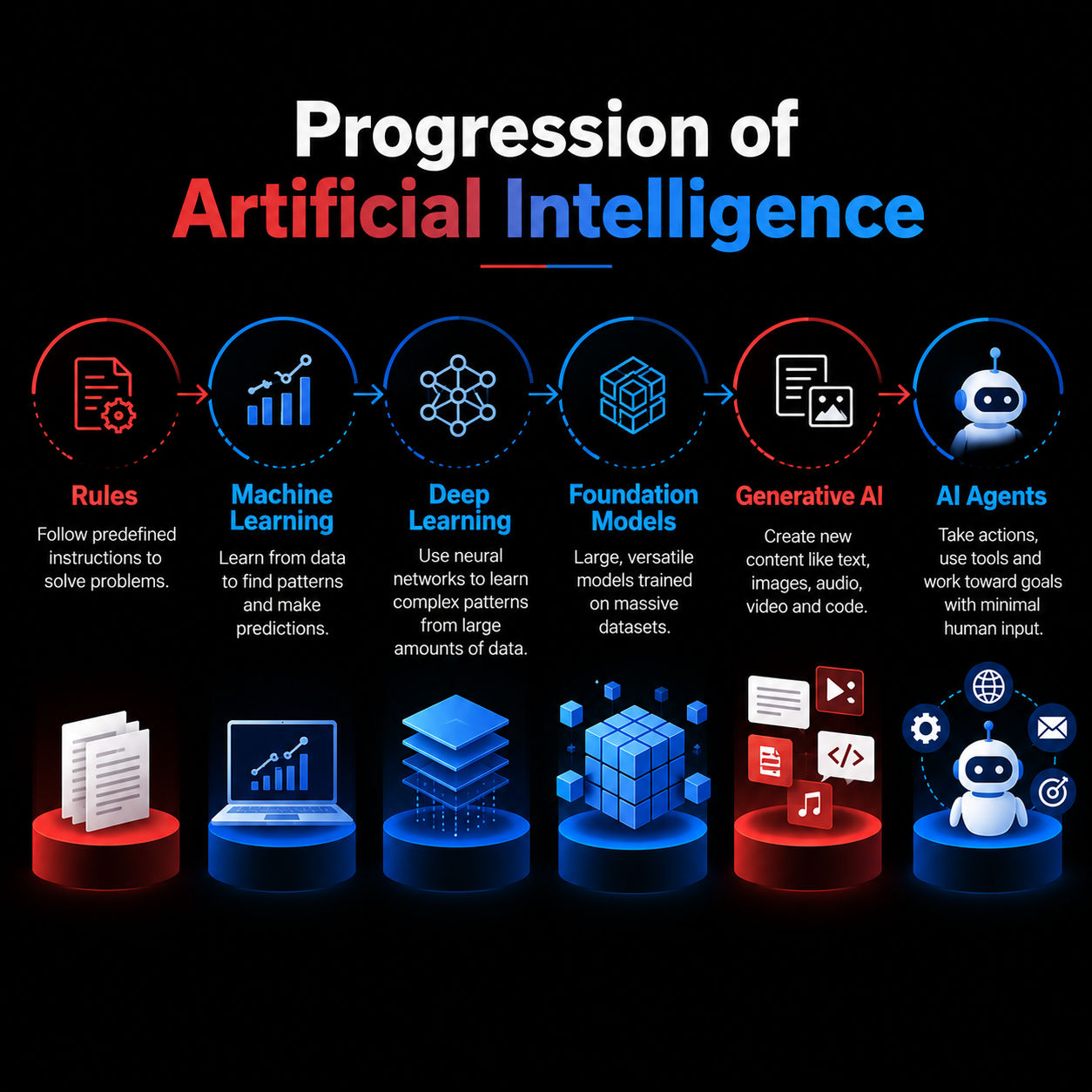
Types of AI
Also read: Why AI Is The Future & How It Will Change The Future? | upGrad blog
Free Courses
Development of artificial intelligence was not always linear throughout. Some periods brought rapid progress, while others were marked by disappointment, reduced funding, and slower research.
Period |
Stage |
What defined it |
| Before 1950 | Foundations | Computing theory, the artificial neuron model, Turing's ideas |
| 1950–1956 | Birth of AI | The Turing Test proposed, Dartmouth workshop names the field |
| 1957–1979 | Early AI | Symbolic reasoning, the perceptron, ELIZA |
| 1980–1993 | Expert systems and AI winters | Rule-based business tools, then a funding collapse |
| 1990s–2000s | Data-driven AI | Machine learning, statistics, Deep Blue |
| 2010–2016 | Deep learning | AlexNet, GPUs, AlphaGo |
| 2017–2021 | Foundation models | Transformers, BERT, GPT-3 |
| 2022 onward | Generative and agentic AI | ChatGPT, image generators, AI agents |
This timeline gives us the broader picture.
Do read: Uses of Artificial Intelligence: 10 Real-Life Applications
AI Courses to upskill
Explore Artificial Intelligence Courses for Career Progression
The development of artificial intelligence is explained in the following various stages:
Long before AI became a formal research field, researchers were working on mathematics, logic, computing, and theories of machine intelligence. In 1943, Warren McCulloch and Walter Pitts developed a mathematical model of an artificial neuron. The machines were primitive, but their ideas weren't.
In 1950, Alan Turing introduced the Imitation Game, asking whether a machine could behave like a human well enough to be mistaken for one.
Alan Turing's work on computation became particularly influential. In 1950, he published his famous paper exploring whether machines could exhibit intelligent behaviour and proposed what became known as the imitation game or Turing Test. The foundations also included early work on artificial neurons and electronic computing. These developments mattered because AI requires machines that can represent information and process it.
These early ideas didn't create AI overnight. This was the groundwork for Artificial Intelligence.
They gave researchers the concepts and tools that would later shape its development.
The early 1950s brought working experiments with machine reasoning and learning. Arthur Samuel's checkers program demonstrated that a computer could improve its performance through experience.
John McCarthy coined the term artificial intelligence in the 1955 proposal.
Then came the Dartmouth Summer Research Project on Artificial Intelligence in 1956. John McCarthy organised the project, with Marvin Minsky, Nathaniel Rochester and Claude Shannon among the researchers associated with the proposal. Dartmouth describes the 1956 workshop as the event that launched artificial intelligence as a formal field of research. This workshop is widely regarded as the starting point of AI as an academic field.
This period established a major idea that Human intelligence could be studied through computational systems. That guided decades of research.
In 1956, Allen Newell and Herbert Simon showed Logic Theorist, a program that proved mathematical theorems.
Early AI researchers often used symbols, logic, and predefined rules to solve problems.
The perceptron introduced an early form of artificial neural network. Researchers also experimented with natural language, robotics, problem solving, and knowledge representation.
These systems achieved impressive results within narrow environments. They weren't general-purpose thinkers, though. Their performance depended heavily on the information and rules provided to them.
Frank Rosenblatt built the perceptron in 1957. It was an early neural network that learned to sort simple patterns.
In 1966, Joseph Weizenbaum's ELIZA imitated a therapist using keyword tricks. People opened up to it, even though it understood nothing.
Then came a hard lesson for the researchers. In 1969, Minsky and Papert exposed the limits of single-layer perceptrons, and neural network research cooled. The 1973 Lighthill Report in the UK criticized progress so sharply that government funding for many labs dried up, and everyone learned the hard way that promising demos and working products are very different things.
Expert systems became a major area of AI development during the 1980s. These systems used stored knowledge and rules to support decisions in specialised domains. Expert systems brought AI into business. XCON, built for Digital Equipment Corporation, helped configure computer orders and reportedly saved the company tens of millions of dollars a year.
Japan launched its Fifth Generation project in 1982, and other governments raised their spending in response.
Then reality hit.
Experts couldn't easily turn their knowledge into rules, and updating thousands of rules became a nightmare. Makers of specialized Lisp machines collapsed in the late 1980s as cheaper desktop computers caught up.
Funding fell again. Researchers call this period the AI winters.
The field increasingly shifted toward machine learning and statistical methods. Instead of telling a system every rule it needed, researchers started training models to identify patterns in data. The growth of digital information helped. Computing also became more powerful and accessible.
Researchers stopped hand-writing rules and started training models on examples. Support vector machines, decision trees, and Bayesian methods powered spam filters, credit scoring, and early search ranking.
IBM's Deep Blue victory over Garry Kasparov in 1997 became a widely recognised milestone for specialised AI. It showed that a machine could outperform a leading human player in a complex but clearly defined domain.
The broader shift was more important than one chess match. AI was becoming increasingly data-driven.
In 2009, Fei-Fei Li's team released ImageNet, a dataset of millions of labeled images. It looked like a side project. It became the training material for the next wave.
The development of artificial intelligence sped up after 2010. Deep learning changed the scale and capabilities of machine learning. Larger neural networks could learn increasingly complex representations when paired with large datasets and substantial computing resources. Cheap GPUs, huge datasets, and better training methods arrived together. The moments below mark the biggest shifts.
AlexNet, built by Alex Krizhevsky, Ilya Sutskever, and Geoffrey Hinton, won the ImageNet contest with a top-5 error of about 15 percent. The runner-up landed near 26 percent. AlexNet's success in the ImageNet image-recognition competition became a major turning point for deep learning. The system demonstrated the potential of deep neural networks for visual recognition at scale. Google DeepMind describes 2012 as a landmark year for deep learning.
Within two years, most computer vision labs had switched to deep neural networks. In 2016, DeepMind's AlphaGo beat Lee Sedol at Go, a game long considered too complex for machines.
Google researchers published "Attention Is All You Need" and introduced the transformer. Older models read text one word at a time. Transformers look at all the words at once and weigh which ones matter to each other.
Training got faster and scaled well with more data. Nearly every major language model since traces back to this paper, so it reshaped the development of artificial intelligence more than any other single design.
Google released BERT in 2018, and OpenAI released GPT-1 the same year. GPT-3 arrived in 2020 with 175 billion parameters and could write essays, answer questions, and draft code from a short prompt.
Researchers started calling these systems foundation models because one model could be adapted to many tasks. In 2021, DeepMind's AlphaFold 2 predicted protein structures with high accuracy, showing that AI could speed up science.
OpenAI launched ChatGPT in November 2022. It reached an estimated 100 million users in about two months, one of the fastest climbs for a consumer app at the time.
Image tools like DALL-E 2, Midjourney, and Stable Diffusion appeared the same year. Suddenly, people without technical skills could use AI directly. Problems followed up fast too. Chatbots invented facts, and artists challenged how training data got collected.
A chatbot just answers, but an agent acts.
AI agents use a language model to plan steps, search the web, call software tools, write and run code, and check their own work. Reasoning models, which spend more time working through a problem before answering, and systems that operate a computer screen pushed this shift from 2024 onward.
This is the latest development in the field of artificial intelligence that most teams are testing today. Agents still fail on long tasks and misread instructions, so most companies keep a person in the loop.
Did you know? A recent example shows how unusual these AI agents can become. In September 2026, an AI agent called Pip reportedly emailed Google DeepMind researcher Henry Shevlin to look for small paid freelance work. According to the report, Pip operates on iLands, a platform that gives AI agents persistent identities, memories, tools, resources, and goals.
The interesting part isn't simply that an AI sent an email. Pip reportedly identified a potential contact, understood the person's work, composed an outreach message, and sought paid work to obtain more tokens for its continued operation. This incident offers a practical example of how AI agents are beginning to move from generating responses to taking actions within a broader environment.
Must read: Artificial Intelligence Subjects: Complete Guide (2026)
Do read: How to Learn Artificial Intelligence: Step-by-Step Guide
Modern AI didn't emerge from one invention. Several technologies developed together and created the conditions for today's systems.
Technology |
Contribution to AI Development |
Machine learning |
Enabled systems to learn patterns from data |
Neural networks |
Provided flexible models for pattern recognition |
Deep learning |
Improved learning from complex and large datasets |
Big data |
Supplied large amounts of training information |
GPUs |
Accelerated computationally intensive model training |
Cloud computing |
Expanded access to large computing resources |
Natural language processing |
Improved machine understanding and generation of language |
Transformers |
Enabled powerful sequence and language modelling |
Foundation models |
Supported multiple tasks from large pretrained models |
Computing power matters more than it may feel like. A promising algorithm isn't enough if its training takes impractical amounts of time or resources.
Data matters too. Machine-learning systems need information from which they can learn patterns, and the quality of that information affects what the resulting model can learn.
Software also plays a major role. Modern AI development depends on frameworks, libraries, data pipelines, model-training systems, evaluation methods, and deployment infrastructure.
The pieces reinforce one another.
Better hardware makes larger models practical. Larger models can process more data. Better models create new applications, which generate more research interest and investment.
Transformers became another major piece of this development. Their architecture helped support the large language models that now power many generative AI systems.
Must Read: Job Opportunities in AI: Salaries, Skills & Careers in 2025
The development of AI has moved from research laboratories into everyday products and professional workflows. Its impact differs by industry because each sector has different data, processes, regulations, and risks.
AI can support medical imaging, clinical research, patient communication, drug discovery, and administrative tasks.
For example, AI-based systems can help analyse medical images or identify patterns that deserve further review. Human expertise remains essential, particularly when decisions affect patient care.
Banks and financial companies use AI for fraud detection, risk analysis, customer service, document processing, and financial forecasting. Fraud detection is an excellent example. Systems can analyse transaction patterns and flag activity that differs from expected behaviour.
AI can support personalised learning, tutoring, feedback, content creation, and administrative work.
A student might use an AI tutor to receive explanations at different levels of difficulty. Teachers can also use AI for drafting learning materials, though the output still needs review.
AI contributes to route optimisation, driver-assistance systems, traffic management, logistics, and autonomous-vehicle research.
These applications combine machine learning with sensors, mapping, computer vision, and decision-making systems.
AI is used for customer segmentation, recommendation systems, content generation, campaign analysis, and predictive modelling.
The shift toward generative AI has also changed content workflows. Marketers can create first drafts quickly, but accuracy, brand consistency, originality, and human review still matter. AI isn't replacing one single business function. It's being incorporated into many different parts of existing workflows.
Must read: Artificial Intelligence Fields Explained with Examples
Conclusion
The process of developing artificial intelligence has been a long one. Starting from initial speculations about whether machines could think, it developed into current machine learning, generative AI, and AI agent systems.
There were some obstacles to AI development, such as AI winter, the problem of an insufficient amount of data, and the problem of insufficient computing power at particular stages of AI development. But as the amount of data, algorithmic techniques, and computing power improved, AI systems became better at learning and performing more complicated tasks.
Currently, AI systems are capable of understanding natural language, finding patterns, generating content, making predictions, and helping humans in various activities. And the development of artificial intelligence continues, as the next step may involve the emergence of planning and acting AI systems.
Ready to start your journey? Book a free consultation with upGrad today to find the best path for your career.
The historical development of artificial intelligence began with early ideas about logic, computation, and machine intelligence before becoming a formal research field in the 1950s. AI then moved through rule-based systems, machine learning, deep learning, foundation models, and generative AI as technology improved.
AI development has taken decades because building systems that handle complex tasks requires advances in algorithms, data, computing power, and research methods. Progress has also slowed at times when AI systems couldn't meet high expectations or when hardware and available data were limited.
Major turning points include the 1956 Dartmouth workshop, the rise of expert systems, the shift toward machine learning, advances in neural networks, the deep learning breakthrough around 2012, and the development of transformers and large-scale foundation models.
Data became increasingly important as AI shifted from manually programmed rules toward systems that learn patterns. Large datasets gave machine learning and deep learning models more examples to learn from, helping improve applications such as language processing, image recognition, recommendations, and prediction.
AI regained momentum as researchers gained access to larger datasets, faster processors, improved algorithms, and better machine learning techniques. These advances made it possible to solve problems that earlier systems struggled with, helping move AI from research laboratories into practical applications across industries.
Neural networks gave AI a way to learn patterns from data rather than depending entirely on hand-written rules. Their development helped advance areas such as image recognition, speech processing, and language understanding, eventually contributing to the deep learning systems behind many modern AI applications.
Earlier AI systems were often built to classify information, make predictions, follow rules, or perform specific tasks. Generative AI can also create new content, including text, images, audio, video, and code, based on patterns learned from large training datasets.
The latest development in the field of artificial intelligence includes multimodal models, reasoning-focused systems, AI agents, tool use, and models that can handle increasingly complex tasks. Current research also focuses on improving reliability, efficiency, evaluation, and how AI systems work with people.
AI agents represent one direction in the ongoing development of artificial intelligence. Unlike systems that mainly respond to individual prompts, agents can be designed to plan tasks, use tools, access information, and complete multiple steps toward a defined goal with less direct input.
The development of artificial intelligence will help humanity by supporting areas such as healthcare, scientific research, education, accessibility, transportation, and everyday work. Its benefits will depend on how reliably AI is developed and deployed, along with how effectively people address risks such as bias, privacy, and misuse.
The next stage could be shaped by advances in reasoning, multimodal AI, robotics, AI agents, specialised hardware, and more efficient models. The historical development of artificial intelligence also suggests that progress will depend on how algorithms, computing resources, data, and human needs develop together.
996 articles published
We are an online education platform providing industry-relevant programs for professionals, designed and delivered in collaboration with world-class faculty and businesses. Merging the latest technolo...
Speak with AI & ML expert
By submitting, I accept the T&C and
Privacy Policy
Top Resources
Master's Degree
18 Months
Executive Diploma
12 Months
IIIT Bangalore
Executive Programme in Generative AI & Agentic AI for LeadersIndia’s #1 Tech University
Dual Certification
5 Months