Artificial Intelligence Background: History, Evolution, Applications & Future
By upGrad
Updated on Aug 19, 2026 | 8 min read | 4.77K+ views
Share:

All courses
Certifications
More
By upGrad
Updated on Aug 19, 2026 | 8 min read | 4.77K+ views
Share:
Table of Contents
Key Highlights
Looking to build a career in AI? Explore AI courses in India and develop the skills needed to work with emerging AI technologies.
Popular AI Programs
Artificial intelligence refers to the development of machines and software that can perform tasks associated with human intelligence. These tasks include learning from data, recognising patterns, understanding language, solving problems and making decisions.
The field is built on ideas from several areas, including computer science, mathematics, logic, statistics, algorithms and the study of human intelligence. These disciplines provide the foundation for developing systems that can process information and respond to different situations.
AI is also a broad field rather than a single technology. It includes machine learning, deep learning, natural language processing, computer vision and generative AI, each designed to handle different types of intelligent tasks.
Humans have long been interested in building machines that could calculate, reason and perform repetitive tasks. The development of electronic computers made this idea more practical. It raised a bigger question:
Could machines do more than calculations and demonstrate intelligent behaviour?
During the 1940s and 1950s, researchers began exploring:
Alan Turing played an important role in this discussion. In 1950, he published Computing Machinery and Intelligence, explored whether machines could think and introduced the idea that later became known as the Turing Test.
His work helped establish machine intelligence as a serious area of research.
AI grew from several disciplines rather than one single invention.
Also read: How to Learn Artificial Intelligence and Machine Learning
Free Courses
There is no single person who invented AI. Several researchers shaped the field, but Alan Turing and John McCarthy played particularly important roles.
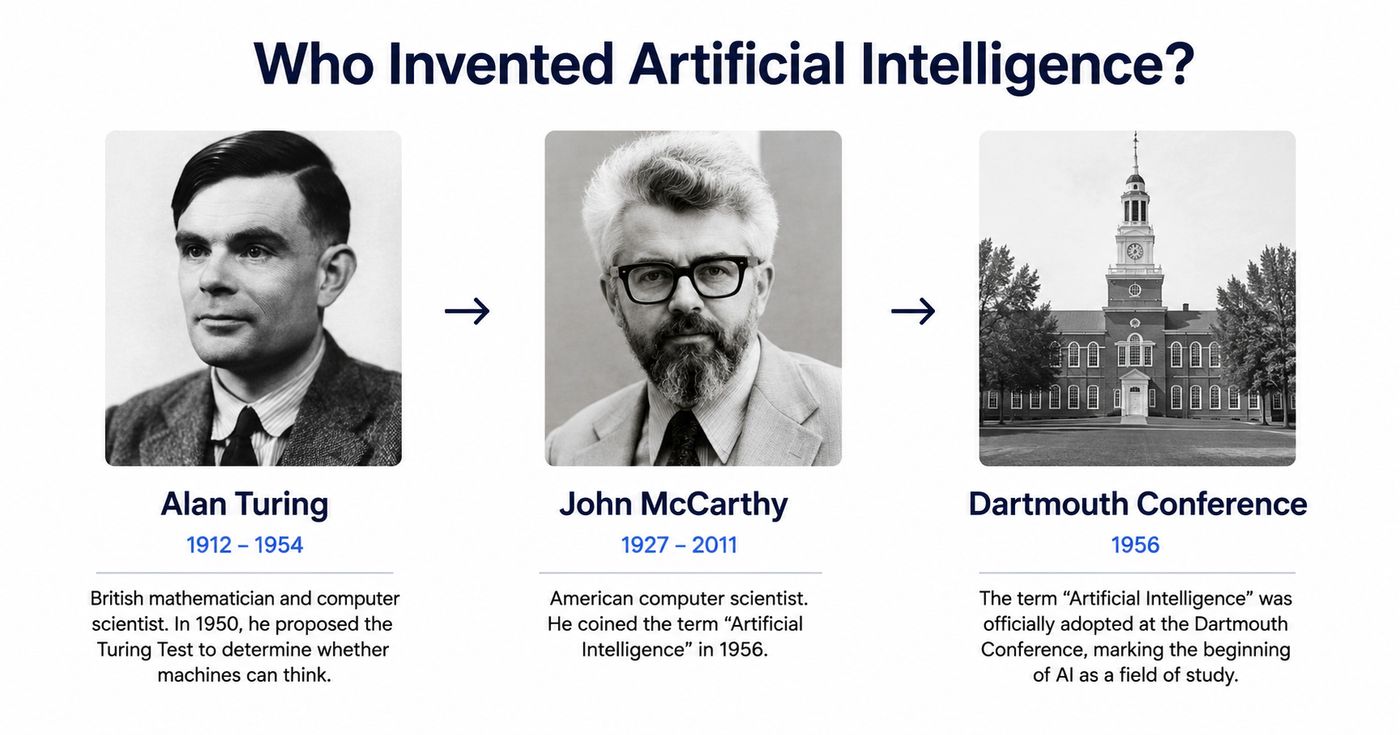
British mathematician Alan Turing laid important foundations for machine intelligence. In his 1950 paper Computing Machinery and Intelligence, he explored whether machines could imitate human-like thinking and introduced the idea that became the Turing Test.
His earlier work on computation also showed how machines could follow formal instructions to solve complex problems.
John McCarthy introduced the term artificial intelligence in the proposal for the 1956 Dartmouth Summer Research Project on Artificial Intelligence.
He later contributed to programming languages, knowledge representation and AI research.
Held in 1956 in Hanover, New Hampshire, the Dartmouth workshop brought researchers together to explore whether machines could simulate learning, reasoning and other forms of human intelligence.
It is widely regarded as a key starting point for AI as a formal research field. While early expectations were ambitious, the conference influenced decades of AI research that followed.
Also read: AI Developer Roadmap: Start Your AI Development Career
AI Courses to upskill
Explore Artificial Intelligence Courses for Career Progression
The history of artificial intelligence is not a straight line. AI went through periods of excitement, progress and disappointment. Each stage introduced new approaches to building intelligent systems.
The early development of AI began with electronic computers. These machines could perform complex calculations by following programmed instructions. Researchers soon began asking whether computers could also solve logical problems, play games and perform tasks that seemed to require reasoning.
Key developments:
Early AI systems had limited computing power and could only handle well-defined problems. Still, they introduced the idea that intelligent behaviour could be represented computationally.
AI research expanded rapidly during this period. Symbolic AI became a popular approach, with systems using symbols, rules and logical relationships to solve problems.
Researchers worked on:
The main limitation was that humans had to provide much of the system's knowledge. These programs could work well in controlled situations but struggled with unexpected real-world information.
The 1980s saw growing interest in expert systems. These programs used a knowledge base and predefined rules to imitate the decision-making of specialists.
For example, a medical expert system could analyse symptoms and suggest possible conditions.
Businesses adopted expert systems for specialised decision-making, but maintaining large rule sets became difficult. As systems became more complex, their limitations became increasingly clear.
AI gradually shifted from fixed rules toward machine learning. Instead of programming every possible decision, researchers developed systems that could learn patterns from data.
The growth of digital data and better computing hardware accelerated this change. Machine learning began supporting:
Deep learning transformed AI by using large neural networks to process complex data. Three factors drove its growth:
More data + powerful GPUs + improved neural networks = major AI breakthroughs
Deep learning became highly effective in image, speech and language tasks. In 2012, a deep neural network achieved a major breakthrough in image recognition. In 2016, Google's AlphaGo defeated Go champion Lee Sedol, showing the capabilities of deep learning in complex strategic tasks.
AI entered a new phase with generative AI and foundation models. Large language models can generate text, while other models can create images, video, audio and code.
Today's major developments include large language models, Generative AI, multimodal systems, AI coding tools, and AI agents.
Users can now interact with AI using natural language rather than specialised interfaces. AI is also moving toward systems that can use tools, plan tasks, and complete multi-step workflows.

Ready to strengthen your technology and management skills? Explore the IIT Kharagpur Executive Post Graduate Certificate designed for working professionals.
AI has gradually moved from systems that followed human-written rules to models that can learn patterns, generate content and perform multi-step tasks. Each stage introduced a new way for machines to handle information.
Early AI relied on predefined instructions. For example, a spam filter might follow rules such as:
This approach worked for predictable situations but struggled when new patterns appeared.
Machine learning changed this. Instead of writing every rule, developers provide examples of spam and legitimate emails. The algorithm learns patterns from the data and uses them to classify new messages.
Traditional machine learning often depends on identifying useful features in the data. Deep learning uses multi-layered neural networks that can learn these representations automatically.
For example, in image recognition: Pixels → Edges → Shapes → Objects
This ability helped improve computer vision, speech recognition and natural language processing.
Earlier AI was often used to classify or predict information. Generative AI added a new capability: creating content.
| AI Type | What It Can Do |
| Classification | Identify a cat in an image |
| Prediction | Forecast customer behaviour |
| Generative AI | Create text, images, code or audio |
Large language models also made AI easier to use because people can interact with them using natural language.
The latest shift is toward AI agents that can handle multi-step tasks rather than simply respond to individual prompts.
An AI agent can:
For example, instead of only creating a travel plan, an AI agent could compare options, organise the information and prepare an itinerary using connected tools.
Also read: Top Artificial Intelligence Applications Across Industries
AI is important because it helps organisations solve everyday problems more efficiently. Some of its key benefits include:
AI can process large volumes of information and identify patterns that may be difficult to spot manually.
Examples include:
However, AI does not guarantee better decisions. Its output depends on the quality of the data, model and context. Human judgement remains essential, especially for high-impact decisions.
AI can automate repetitive tasks while also handling less predictable inputs.
For example, an AI customer service system can classify queries and send them to the right department. AI assistants can also summarise documents, extract information and help employees find relevant knowledge.
This reduces routine work and gives employees more time for tasks requiring creativity, judgement and communication.
AI is changing how organisations operate and how people perform their jobs.
| Business Area | AI Application |
| Marketing | Customer analysis and content ideas |
| Software | Coding assistance |
| Operations | Predictive analysis |
| Customer service | Query handling and support |
AI does not necessarily mean that entire jobs will disappear. Instead, many roles are likely to change as employees use AI tools to complete tasks more efficiently.
AI can be adapted to solve different industry-specific problems.
Although the applications differ, the basic purpose remains similar: use AI to process information, identify patterns or automate parts of a complex workflow.
Must read: From AI to Quantum Computing: 25 New Technologies
AI is now part of many tools people use every day. It supports tasks such as fraud detection, product recommendations, medical analysis and personalised learning.
AI helps healthcare professionals process medical information. It can support medical image analysis, patient data analysis, drug discovery and administrative work.
For example, computer vision can identify patterns in medical images for further review. AI can also summarise information and assist with documentation.
Human oversight remains important because AI should not replace professional medical judgement.
Banks use AI to analyse financial data, detect unusual transactions and assess risks.
It can also support customer service, document processing and financial forecasting. Machine learning can identify unusual transaction patterns quickly, helping institutions detect possible fraud.
However, strong controls are needed because inaccurate or biased AI outputs can affect financial decisions.
Retailers use AI to understand customer behaviour and improve operations.
Recommendation systems can suggest products based on browsing and purchasing patterns. AI can also support:
For example, an online store can recommend products based on what a customer has viewed or purchased.
Manufacturers use AI for quality control, predictive maintenance and production planning.
Computer vision can identify product defects. Predictive models can analyse machine data and detect potential problems before equipment fails.
These applications can reduce downtime, minimise waste and improve resource utilisation.
AI is already part of many everyday digital experiences. Navigation apps predict traffic, streaming platforms recommend content and smartphones recognise faces in photos.
Email services use AI to filter spam, while voice assistants use speech recognition and natural language processing to understand requests.
Also read: 15 Best Artificial Intelligence Jobs in 2026 and Skills Needed
AI development has faced several technical and practical challenges. These limitations often slowed progress and influenced how researchers approached the field.
Early computers had limited processing power and memory. Complex AI algorithms could take too long to run, making many ideas difficult to implement. Advances in processors, GPUs and cloud computing later helped overcome these limitations.
Machine learning needs large amounts of quality data. Earlier AI systems had limited access to datasets, which restricted their ability to learn reliable patterns. The growth of the internet, digital platforms and cloud storage later provided much larger datasets.
AI winters were periods when funding and interest in AI declined. They often followed unrealistic expectations about what AI could achieve. These setbacks encouraged researchers to develop more practical and achievable approaches.
Modern AI faces challenges related to biased data, inaccurate outputs and limited transparency. Generative AI can also produce convincing but incorrect information. As AI adoption grows, fairness, privacy, security, accuracy and accountability remain important concerns.
Must read: Challenges of Artificial Intelligence with Solutions [2026]
The future of AI will likely focus on more capable models, better reasoning, wider software integration and stronger collaboration between humans and machines.
The next phase is not only about building larger models. It will also focus on reliability, efficiency, tool use, multimodal capabilities and responsible deployment.
Generative AI mainly responds to prompts, while AI agents can take a more active role in completing tasks.
An AI agent can:
For example, a business could use an AI agent to collect information, organise it, prepare a report and send it for human review.
As AI agents gain more capabilities, clear permissions and safeguards will become increasingly important.
The future of AI is likely to involve collaboration rather than complete replacement.
AI can handle repetitive analysis, search large amounts of information or create an initial draft. People can then review the output, add context and make the final decision.
For example, a content team could use AI to analyse search data and generate topic ideas, while writers select useful topics and ensure the content is accurate.
As AI becomes more powerful, responsible development will become essential.
Organisations need to consider:
Governance is especially important when AI is used in healthcare, finance, education or employment, where incorrect outputs can have serious consequences.
Several developments could influence the future of AI. Better models may improve reasoning and reliability, while efficient hardware could reduce operating costs.
Multimodal systems may become better at working with text, images, audio and video together. AI agents may also become more common as organisations connect AI with business software and digital tools.
At the same time, regulation and public expectations will shape how these technologies are developed and adopted.
The artificial intelligence history and future are closely connected. Challenges such as limited resources, unreliable outputs and unrealistic expectations will continue to influence the next phase of AI.
Must read: Future Scope of Artificial Intelligence in 2026 and Beyond
The artificial intelligence background reflects decades of progress from early computing and machine intelligence to machine learning, deep learning and generative AI. Today, AI supports data analysis, automation and decision-making across industries.
However, challenges such as bias, privacy, reliability and responsible use remain important. As multimodal AI and AI agents continue to develop, they may further change how people work with technology. Understanding the history of artificial intelligence helps explain how we reached this stage and what could shape AI's future.
Ready to take the next step in your AI career? Book a consultation call with upGrad and get personalised guidance on choosing the right programme for your goals.
Narrow AI is designed to perform specific tasks rather than handle every type of intellectual activity. Examples include recommendation systems, voice assistants and image recognition tools. Most AI applications used today fall into this category.
Artificial general intelligence, or AGI, refers to a hypothetical AI system capable of performing a wide range of intellectual tasks with abilities comparable to humans. Unlike specialised AI, AGI would not be limited to one particular task.
An AI model learns by processing examples during training and identifying patterns within the data. Developers then evaluate its performance using suitable tests and may adjust the model or training process to improve results.
A neural network is a computing model inspired loosely by the way biological neurons process information. It contains interconnected layers that transform input data and can learn useful patterns for tasks such as classification or prediction.
Automation generally follows predefined workflows to complete repetitive tasks, while AI can identify patterns, make predictions or handle less predictable information. Some modern business processes combine both approaches to automate tasks while responding to changing inputs.
Training data gives an AI model examples from which it can learn patterns and relationships. The quality, relevance and diversity of this data can strongly influence how well the resulting system performs on new information.
Supervised learning is a machine learning approach where a model learns from examples that include known answers or labels. During training, it compares its predictions with those answers and adjusts itself to improve future predictions.
Unsupervised learning involves analysing data without predefined labels or answers. The system attempts to discover meaningful structures, similarities or patterns within the information. Clustering customers into groups based on behaviour is a common example.
Reinforcement learning involves an AI system learning through interaction with an environment. It receives feedback based on its actions and gradually learns which behaviours produce better outcomes. This approach has been applied to games, robotics and optimisation problems.
Yes. Some AI systems can run locally on computers, smartphones or other devices without a continuous internet connection. However, cloud-based AI services often rely on remote servers for model processing, storage, updates and access to larger computing resources.
Useful skills depend on the role but can include programming, statistics, mathematics, data analysis and machine learning. Communication, problem-solving and the ability to evaluate AI outputs are also valuable as AI becomes more common across different professions.
1018 articles published
We are an online education platform providing industry-relevant programs for professionals, designed and delivered in collaboration with world-class faculty and businesses. Merging the latest technolo...
Speak with AI & ML expert
By submitting, I accept the T&C and
Privacy Policy
Top Resources
Master's Degree
18 Months
Executive Diploma
12 Months
IIIT Bangalore
Executive Programme in Generative AI & Agentic AI for LeadersIndia’s #1 Tech University
Dual Certification
5 Months