Artificial Intelligence in Civil Engineering: Applications, Benefits, Examples and Future
By Sriram
Updated on Jul 31, 2026 | 6 min read | 7.05K+ views
Share:

All courses
Certifications
More
By Sriram
Updated on Jul 31, 2026 | 6 min read | 7.05K+ views
Share:
Table of Contents
KeyHighlights
Ready to build practical AI skills? Explore upGrad's AI Courses in India and gain hands-on experience with machine learning, computer vision, and other in-demand AI technologies shaping the future of engineering.
Popular AI Programs
Artificial intelligence in civil engineering refers to the use of computer systems that can analyse data, identify patterns and help engineers to make better decisions throughout the life of a project. AI boosts productivity by automating data-intensive, repetitive tasks rather than replacing engineers.
With the growth of sensors, drones, IoT devices and Building Information Modelling (BIM), the use of artificial intelligence in civil engineering has rapidly expanded. Today, AI supports planning, design, construction, inspection and maintenance activities.
AI follows a methodical process that transforms raw engineering data into actionable insights that help you plan, monitor, and make decisions more effectively.
The process of AI is very straightforward.
AI can, for instance, analyse thousands of drone images to find cracks in a bridge within minutes. "Engineers validate the results and decide what to do.
Several technologies power the application of artificial intelligence in civil engineering.
Technology |
Primary Use |
| Machine Learning | Predict project outcomes using historical data |
| Deep Learning | Analyse complex images and sensor data |
| Computer Vision | Monitor construction sites and inspect structures |
| Natural Language Processing | Review reports and engineering documents |
| Robotics | Perform repetitive construction tasks |
| Digital Twins | Monitor infrastructure in real time |
These technologies form the foundation of modern AI systems and support a wide range of engineering applications.
Also read : Learning Artificial Intelligence & Machine Learning - How to Start
Free Courses
The use of artificial intelligence in civil engineering extends across every stage of an infrastructure project. AI analyses data, automates repetitive tasks and provides insights that help engineers Improve efficiency and reduce risks. Instead of replacing human expertise, AI supports engineers in making faster and more informed decisions.
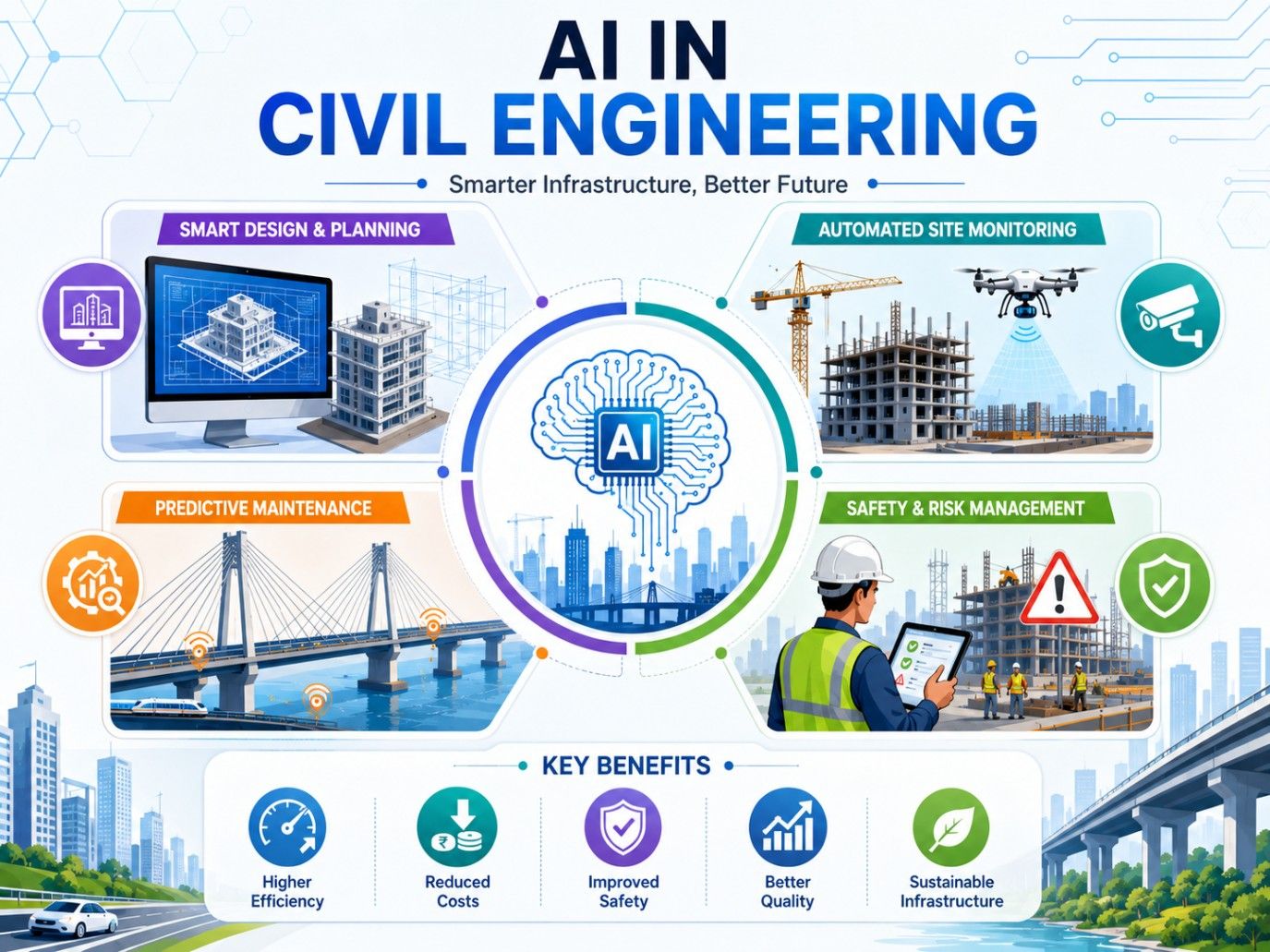
Structural engineers use AI to evaluate building and bridge performance using data from sensors, drones, and inspection reports. AI can identify cracks, predict structural failures, and recommend maintenance before serious damage occurs.
Example: An AI system monitoring a bridge can detect unusual vibrations and alert engineers before the structure becomes unsafe.
Also read : Artificial Intelligence in the Real World
Project managers use AI to track progress, allocate resources, and identify potential delays. It compares real-time project data with schedules to improve planning and decision-making.
AI in construction project management also helps reduce cost overruns and improve communication across teams.
AI enhances BIM by analysing digital building models and suggesting design improvements. It can detect design clashes, optimise layouts, and estimate project costs more accurately.
Using AI for Building Information Modelling (BIM) helps engineers reduce design errors before construction begins.
The application of artificial intelligence in civil engineering continues to grow across different areas.
Application |
How AI Helps |
| Site Safety | Detects unsafe practices using cameras and sensors |
| Quality Inspection | Identifies defects in concrete and steel components |
| Predictive Maintenance | Forecasts equipment and infrastructure failures |
| Traffic Management | Analyses traffic patterns to improve road efficiency |
| Sustainable Construction | Optimises material usage and reduces waste |
These examples show how is artificial intelligence used in civil engineering to improve project quality, increase safety, and support smarter infrastructure development.
Looking to lead AI-driven innovation? Explore upGrad's Chief Technology Officer Program - CTO & AI Course & Certification to build strategic leadership, AI expertise, and technology management skills for the future.
AI Courses to upskill
Explore Artificial Intelligence Courses for Career Progression
The benefits of artificial intelligence in civil engineering go beyond automation. AI helps organisations deliver projects more efficiently while improving long-term infrastructure performance.
Some key benefits include:
For example, AI can predict when equipment requires maintenance instead of waiting for a failure. This reduces downtime and extends the life of expensive machinery.
As the use of artificial intelligence in civil engineering continues to expand, engineers can focus more on solving complex engineering challenges while AI handles routine analysis and monitoring.
Also read: Applications of Artificial Intelligence and Its Impact
The examples of artificial intelligence in civil engineering below show how AI is solving real engineering challenges across different infrastructure projects.
These use cases highlight how AI improves safety, efficiency, and long-term asset management.
Real-World Examples :
Project |
AI Application |
Outcome |
| Bridge Monitoring | Structural health monitoring | Early crack detection and safer inspections |
| Construction Sites | AI-powered cameras | Improved worker safety and progress tracking |
| Smart Roads | Traffic analytics | Better traffic flow and reduced congestion |
| Infrastructure Maintenance | Predictive analytics | Lower maintenance costs and fewer breakdowns |
These examples of artificial intelligence in civil engineering demonstrate how AI is improving infrastructure management while helping engineers make faster and more accurate decisions.
Also read : Artificial Intelligence in the Real World
Many people confuse AI and machine learning, but they are not the same. Understanding artificial intelligence vs machine learning in civil engineering helps explain how modern engineering systems work.
Artificial intelligence is the broader concept of machines performing tasks that normally require human intelligence. Machine learning is a branch of AI that learns from historical data to make predictions without being explicitly programmed.
Artificial Intelligence |
Machine Learning |
| Broad field of intelligent systems | A subset of AI |
| Performs reasoning and decision support | Learns patterns from data |
| Uses multiple technologies | Focuses on data-driven learning |
| Includes robotics, NLP, and computer vision | Primarily builds prediction models |
| Supports many engineering tasks | Predicts project outcomes and failures |
In civil engineering, AI combines several technologies to improve planning, inspection, and maintenance. Machine learning contributes by analysing historical project data and generating accurate predictions that engineers can use for better decision-making.
Also Read: Best AI Tools for Business: Top Tools & Use Cases
Despite its growing adoption, organisations still face several challenges of implementing AI in civil engineering. Success depends not only on technology but also on data quality, skilled professionals, and proper planning.
1. Data Quality
AI models rely on acurate and complete data. Poor-quality or outdated project data can produce unreliable results and affect engineering decisions.
2. High Implementation Costs
Adopting AI often requires investment in software, sensors, cloud infrastructure, and employee training. Small organisations may find these initial costs challenging.
3. Integration with Existing Systems
Many engineering firms still use legacy software and manual workflows. Integrating AI with these systems takes time and careful planning.
4. Skills Gap
Civil engineers understand infrastructure, but AI requires knowledge of data analytics and machine learning. Organisations need multidisciplinary teams to use AI effectively.
5. Ethical and Security Concerns
AI systems must handle project data securely and produce transparent recommendations. Engineers remain responsible for validating AI-generated insights before making critical decisions.
Although there are challenges of implementing AI in civil engineering, they can be managed with quality data, proper training, and gradual adoption.
Also Read : Why AI Is The Future & How It Will Change The Future?
The future of artificial intelligence in civil engineering is bright as infrastructure projects become more connected and data-driven. AI will continue to be a tool for engineers, not a replacement for them.
Some of the emerging trends are:
As these technologies mature, engineers will spend less time doing repetitive analysis and more time solving complex engineering problems.
Artificial intelligence in civil engineering is reshaping how infrastructure is planned, designed, built, and maintained. It supports engineers with faster analysis, better decision-making, improved safety, and predictive maintenance, making projects more efficient and reliable throughout their lifecycle.
The application of artificial intelligence in civil engineering will continue to grow as technologies like machine learning, computer vision, digital twins, and BIM become more widely adopted. Engineers who combine AI with strong technical expertise will be better equipped to build smarter, safer, and more sustainable infrastructure.
Ready to start your journey? Book a free consultation with upGrad today to find the best path for your career.
Computer Science, Artificial Intelligence, Data Science, and Electronics are the most common choices for AI careers. However, AI is becoming an interdisciplinary technology, which means professionals from civil, mechanical, electrical, and other engineering fields can also specialise in AI by learning machine learning, data analytics, and intelligent automation.
If your goal is to apply AI to infrastructure, civil engineering combined with AI skills is an excellent option. Knowledge of structural design, construction management, and data-driven technologies allows engineers to solve real-world infrastructure challenges using intelligent systems instead of relying only on traditional methods.
Artificial intelligence in civil engineering refers to using intelligent computer systems to analyse engineering data, predict outcomes, and support better decision-making throughout construction and infrastructure projects. It combines engineering knowledge with technologies like machine learning and computer vision to improve project efficiency, safety, and long-term asset management.
AI continuously analyses data collected from bridges, roads, tunnels, and other assets using sensors and inspection reports. It identifies early signs of deterioration, prioritises maintenance activities, and helps infrastructure owners extend asset life while reducing emergency repair costs and operational disruptions.
Yes. AI isn't limited to large infrastructure projects. Smaller construction firms can use AI-powered scheduling, cost estimation, document management, and safety monitoring tools to improve productivity. Many cloud-based solutions are affordable, making AI adoption practical even for businesses with limited budgets.
AI predictions depend largely on the quality of training data and the models being used. When organisations use reliable project data and regularly validate results, AI can provide highly accurate forecasts for maintenance planning, risk analysis, resource allocation, and construction progress monitoring.
Civil engineers don't need to become software developers to work with AI. A basic understanding of data analytics, machine learning concepts, BIM, GIS, and programming fundamentals can help professionals interpret AI insights and collaborate effectively with technology teams on engineering projects.
Yes. AI helps engineers optimise material selection, reduce construction waste, lower energy consumption, and improve resource planning. These improvements contribute to more sustainable infrastructure while supporting environmental goals without compromising project quality or structural performance.
AI adoption is growing across transportation, smart cities, real estate development, water resource management, energy infrastructure, railways, airports, and public infrastructure projects. Governments and private organisations increasingly use AI to improve project planning, maintenance strategies, and operational efficiency.
AI is creating new career opportunities rather than eliminating existing ones. Engineers with AI knowledge are increasingly valued for roles involving digital construction, predictive maintenance, infrastructure analytics, smart city development, and intelligent project management, making technical upskilling an important career advantage.
Start by strengthening your civil engineering fundamentals before learning basic AI concepts such as machine learning, data analysis, and computer vision. Working on BIM-based projects, online AI courses, and small practical case studies helps build confidence and understand real-world engineering applications effectively.
725 articles published
Sriram K is a Senior SEO Executive with a B.Tech in Information Technology from Dr. M.G.R. Educational and Research Institute, Chennai. With over a decade of experience in digital marketing, he specia...
Speak with AI & ML expert
By submitting, I accept the T&C and
Privacy Policy
Top Resources
Master's Degree
18 Months
Executive Diploma
12 Months
IIIT Bangalore
Executive Programme in Generative AI & Agentic AI for LeadersIndia’s #1 Tech University
Dual Certification
5 Months