Unification in Artificial Intelligence: Meaning, Working, Algorithms, and Examples
By Sriram
Updated on Jun 22, 2026 | 8 min read | 2.51K+ views
Share:

All courses
Certifications
More
By Sriram
Updated on Jun 22, 2026 | 8 min read | 2.51K+ views
Share:
Table of Contents
Unification in artificial intelligence is a key concept. It helps AI systems compare and match expressions. This process is vital for reasoning and knowledge representation. Unification works by checking if two logical statements can be made the same by replacing variables. This is useful in AI applications. This process is the foundation of many AI applications that use unification, which includes, Expert systems, Automated theorem proving, Natural language processing and Logic programming.
In this blog, you’ll explore what is unification in artificial intelligence, how it works, unification algorithm in artificial intelligence, practical examples, applications, limitations, relationship between unification and lifting in artificial intelligence. This article is for anyone who wants to learn about unification, whether you are a student or an AI enthusiast.
Explore upGrad's Artificial Intelligence Courses today and deepen your understanding of AI unification concepts.
Popular AI Programs
Unification is what we use to make two logical expressions similar by finding the right values for the variables. This helps the AI system figure out if two statements represent the same information when we replace the variables with the right constants or other variables.
The idea of unification comes from something called first-order predicate logic, which is widely used in artificial intelligence and in solving problems.
Also Read: Artificial Intelligence Technology: A Complete Guide
AI systems often work with facts, rules, and logical statements. To draw conclusions, they must compare pieces of knowledge and identify matches.
Without unification an AI system would struggle to:
Simple Example
Consider the following expressions:
Here, the variable x can be replaced by Mary.
Substitution:
x = Mary
After substitution:
Both expressions become identical. Therefore, they are successfully unified.
Element |
Description |
| Constant | Fixed value such as John or Mary |
| Variable | Placeholder that can take different values |
| Predicate | Represents relationships or facts |
| Substitution | Replacing variables with values |
| Unifier | Set of substitutions that makes expressions identical |
Also Read: Beginner Guide to the Top 15 Types of AI Algorithms and Their Applications
It is helpful to consider unification in artificial intelligence as a way of matching patterns. The artificial intelligence system looks to see if it can change two patterns into the same structure.
Imagine a job portal searching for candidates.
Requirement:
Profile:
The variable "Name" can be replaced with Rahul, allowing a successful match. This simple matching behavior reflects how unification operates inside AI reasoning systems.
Also Read: Top Generative AI Use Cases: Applications and Examples
Free Courses
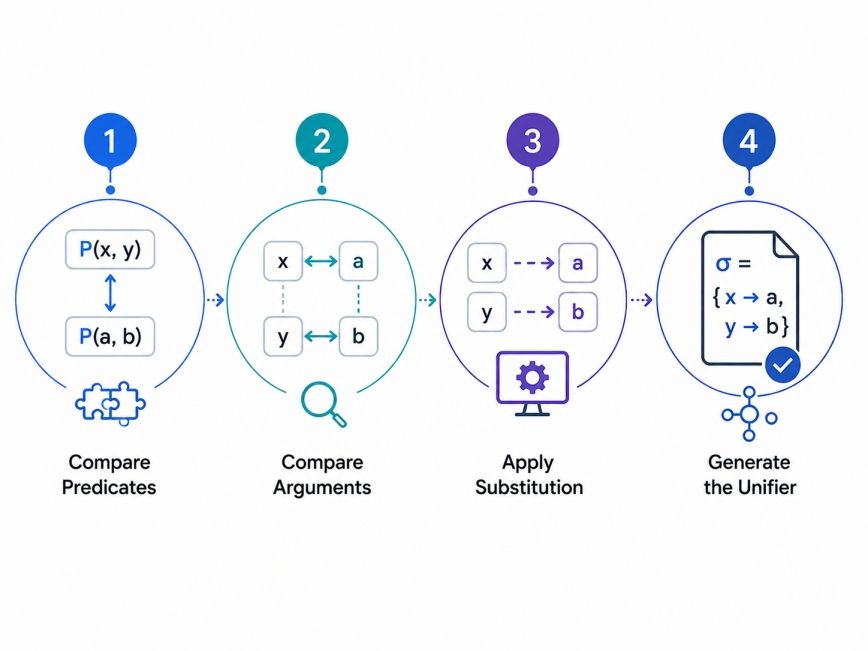
The unification algorithm in artificial intelligence is a systematic procedure used to determine whether two logical expressions can be unified.
The algorithm attempts to find substitutions that make both expressions identical.
The algorithm first checks whether both expressions have the same predicate name.
Example:
Since both use the predicate Friend, the process continues.
Each argument is examined one by one.
Comparison:
Variable x can be replaced with Mary.
Substitution:
x = Mary
Result:
The expressions now match completely.
The algorithm records the substitution.
Unifier:
{x/Mary}
Also Read: Generative AI Architecture: A Beginner’s Guide
One of the most important outcomes of the unification algorithm in artificial intelligence is the Most General Unifier (MGU).
An MGU is the simplest substitution set that successfully unifies two expressions.
Example:
MGU:
{x/John, y/Mary}
The MGU avoids unnecessary restrictions and allows maximum flexibility.
Example Table
Expression 1 |
Expression 2 |
Result |
| Likes (x, Ice Cream) | Likes (Ravi, Ice Cream) | Success |
| Student(x) | Teacher(x) | Failure |
| Parent (x, y) | Parent (John, Mary) | Success |
| Animal (Dog) | Animal (Cat) | Failure |
The algorithm fails when:
Example:
Different predicates prevent successful unification.
The artificial intelligence unification algorithm is really important because it helps machines link up facts and rules on their own.
Many artificial intelligence systems that use logic need this intelligence unification algorithm to answer questions and figure out conclusions; from the information they have stored.
AI Courses to upskill
Explore Artificial Intelligence Courses for Career Progression
When studying logical inference systems, students frequently encounter the concept of unification and lifting in artificial intelligence. These two concepts work together to improve reasoning efficiency.
While unification focuses on matching expressions, lifting allows reasoning to occur at a more abstract level using variables rather than specific instances.
Lifting is a technique that performs logical reasoning directly on generalized statements. Instead of repeatedly substituting specific values, the system reasons with variables.
The connection is straightforward:
Concept |
Purpose |
| Unification | Matches logical expressions |
| Lifting | Generalizes reasoning processes |
| Combined Effect | Efficient logical inference |
Example
Facts:
Rule:
Using unification:
x = Sam
Conclusion:
When combined with lifting, the system can apply the same rule to any human without creating separate copies for every individual.
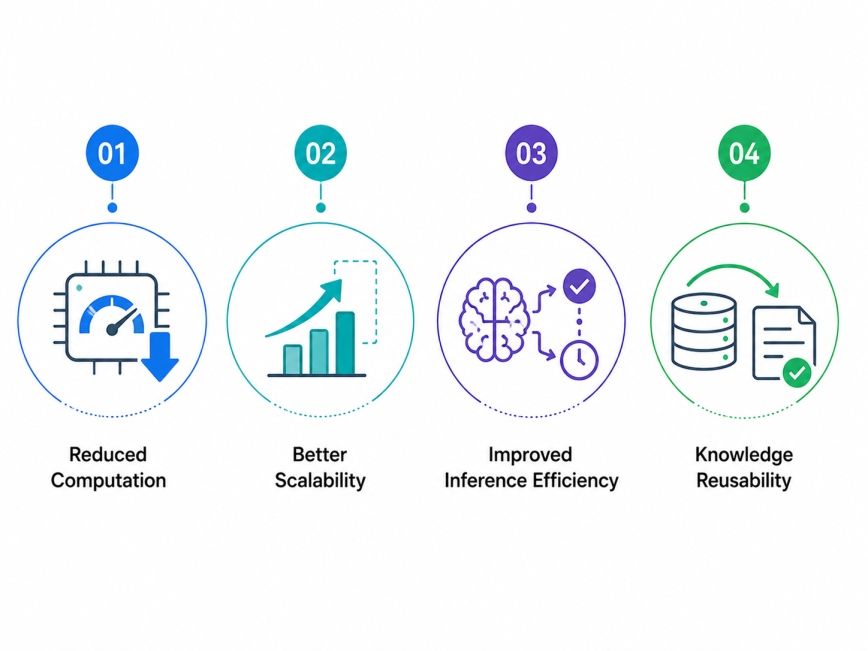
Unification and lifting streamline AI reasoning by enabling systems to work with general rules, dramatically boosting efficiency and scalability.
Modern reasoning systems often contain thousands or millions of facts. Without unification and lifting in artificial intelligence, inference engines would become inefficient because they would need to evaluate every possible instance separately.
By combining the two techniques, AI systems can:
Many students focus only on unification while preparing for AI examinations. However, understanding how lifting complements unification provides a deeper understanding of logical inference systems.
Together, they form the backbone of many classical AI reasoning frameworks.
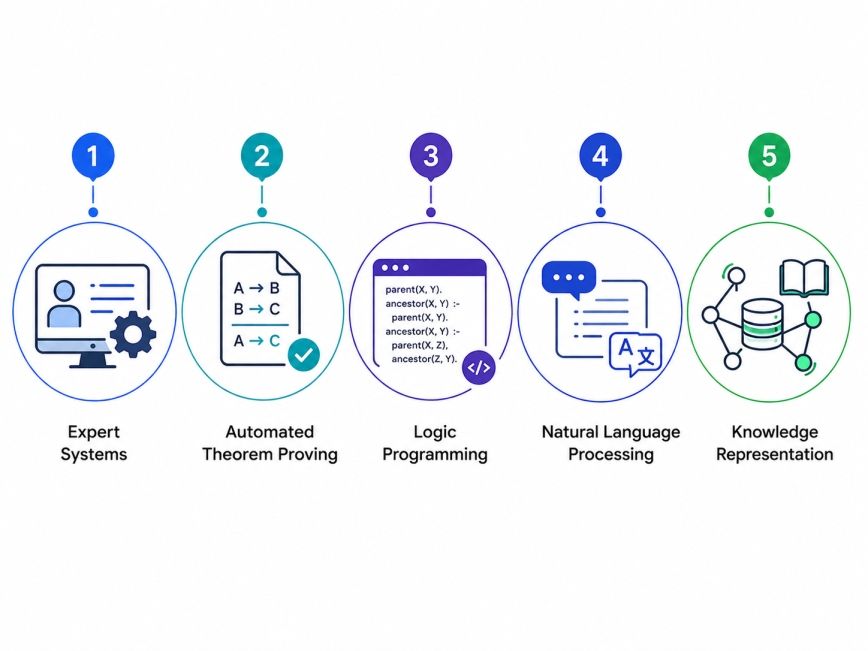
The importance of unification in artificial intelligence extends far beyond academic theory. It plays a central role in several real-world AI systems.
Expert systems use knowledge bases and inference engines to solve problems.
Unification helps:
Example:
Medical diagnosis systems compare symptoms against stored medical rules.
Theorem provers rely heavily on unification.
Applications include:
According to research published by the Association for Computing Machinery (ACM), unification remains a foundational mechanism in automated reasoning systems.
Languages such as Prolog depend on unification.
When a query is submitted, the interpreter searches for matching facts using unification techniques.
Example:
Query:
Fact:
Result:
x = Mary
Many NLP systems during the process of understanding language utilizes pattern matching.
Applications include:
Knowledge graphs and symbolic AI systems frequently use unification to connect related facts.
This allows machines to:
Also Read: AI Automation Explained: Tools, Benefits, and How It Differs From Automation
Although modern artificial intelligence often focuses on machine learning and deep learning, symbolic reasoning is still very important.
Many researchers think that if we combine networks with symbolic reasoning, it could help build more explainable artificial intelligence systems.
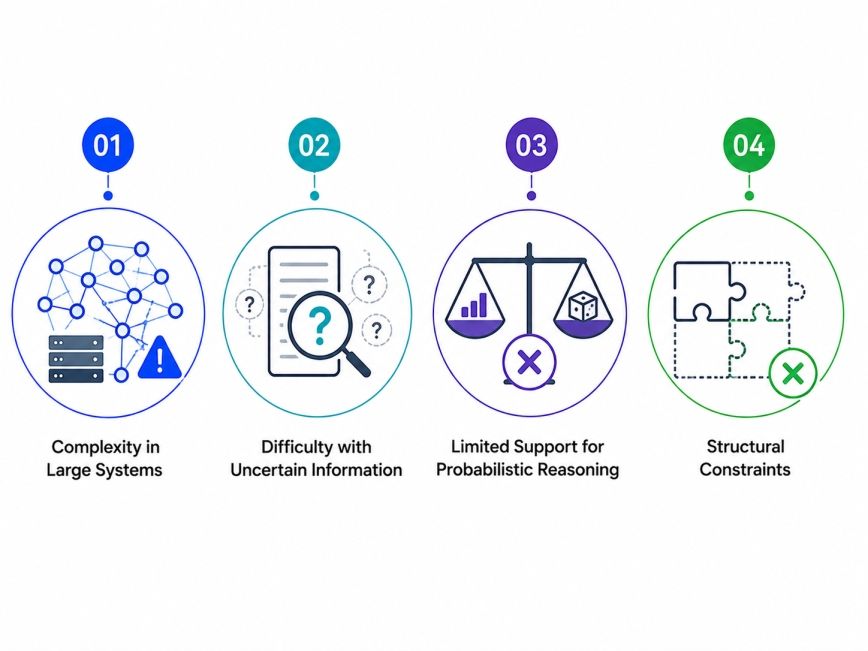
Despite its usefulness, unification is not perfect. Like any computational technique, it comes with limitations.
As the number of rules increases, matching operations become more computationally expensive. Large knowledge bases may require optimization strategies.
Traditional unification works best with exact logical expressions.
Real-world data often contains:
Situations like this can reduce effectiveness.
Modern AI systems frequently rely on probabilities. Classical unification does not naturally handle uncertainty.
Successful matching requires compatible structures. Even small differences can cause failure.
Example:
The expressions cannot be unified because predicates differ.
Subscribe to upGrad's Newsletter
Join thousands of learners who receive useful tips
Researchers continue exploring ways to combine symbolic reasoning with machine learning. This area is often called neuro-symbolic AI.
In these systems, the strengths of unification in artificial intelligence can be combined with the flexibility of neural networks.
The goal is to create AI systems that are:
Unification in artificial intelligence is a foundational concept that enables machines to match logical expressions through variable substitution. It serves as a core mechanism in reasoning systems, theorem proving, logic programming, expert systems, and knowledge representation.
The unification algorithm in artificial intelligence helps automate logical matching, while unification and lifting in artificial intelligence improve the efficiency of inference systems.
Although modern AI increasingly relies on machine learning, unification remains highly relevant. As neuro-symbolic AI continues to evolve, the role of logical reasoning and unification is expected to become even more important in building intelligent and explainable systems.
Want to explore more about Unification in artificial intelligence? Book your free 1:1 personal consultation with our expert today.
Unification is the process of making two logical expressions identical by replacing variables with appropriate values. It is widely used in artificial intelligence and first-order logic. The technique allows AI systems to compare facts, apply rules, and derive conclusions efficiently.
The purpose of unification in AI is to help systems match logical statements and identify relationships between facts and rules. It supports inference engines, theorem provers, and expert systems by enabling automated reasoning and knowledge processing.
Unification in AI involves finding substitutions that make two expressions identical. For example, Loves (John, x) and Loves (John, Mary) can be unified by replacing x with Mary. After substitution, both statements become the same.
A unifier is the set of substitutions that makes two logical expressions identical. It represents the solution found during the unification process. AI systems use unifiers to perform reasoning and answer logical queries accurately.
The Most General Unifier is the simplest valid substitution set that unifies two expressions. It avoids unnecessary restrictions and preserves flexibility. MGUs are widely used in theorem proving and logic programming systems.
Expert systems rely on rules and facts to make decisions. Unification allows the system to match user inputs with stored knowledge. This helps generate accurate recommendations and conclusions without manual intervention.
Pattern matching identifies similarities between structures, while unification goes further by determining substitutions that make expressions exactly identical. Unification is therefore more powerful and widely used in logical reasoning systems.
Applications include expert systems, automated theorem proving, logic programming, natural language processing, and knowledge representation. These areas depend on unification to connect facts, apply rules, and derive meaningful conclusions.
Unification and lifting work together to improve logical inference. Unification finds matching substitutions, while lifting enables reasoning using generalized variables. This combination reduces computational effort and improves scalability.
Traditional unification is designed for exact logical reasoning and does not naturally support uncertainty. For probabilistic environments, AI systems often combine symbolic methods with statistical or machine learning techniques.
Yes. While machine learning dominates many AI applications, symbolic reasoning remains important. Unification continues to be used in logic-based systems and is gaining renewed attention through neuro-symbolic AI research, which combines reasoning with learning.
704 articles published
Sriram K is a Senior SEO Executive with a B.Tech in Information Technology from Dr. M.G.R. Educational and Research Institute, Chennai. With over a decade of experience in digital marketing, he specia...
Speak with AI & ML expert
By submitting, I accept the T&C and
Privacy Policy
Top Resources
Master's Degree
18 Months
Executive Diploma
12 Months
IIIT Bangalore
Executive Programme in Generative AI & Agentic AI for LeadersIndia’s #1 Tech University
Dual Certification
5 Months