Generative AI Chatbot: How Intelligent Conversational Systems Work
By Sriram
Updated on Jun 16, 2026 | 7 min read | 7.31K+ views
Share:

All courses
Certifications
More
By Sriram
Updated on Jun 16, 2026 | 7 min read | 7.31K+ views
Share:
Table of Contents
Generative AI chatbots are advanced conversational systems powered by Large Language Models (LLMs). Unlike traditional chatbots that follow fixed scripts, they understand context, generate human-like responses, and adapt to different conversation styles. These intelligent systems support various tasks, including research, content creation, coding assistance, customer support, and workflow automation, making interactions more natural, efficient, and personalized.
In this blog , you'll learn how generative chatbots work, the technologies behind them, their real-world applications, limitations, and practical implementation insights. Whether you're a developer, student, or AI professional, this article will help you understand the topic beyond surface-level explanations.
Discover upGrad's Artificial Intelligence and Machine Learning programs and learn how to build, deploy, and optimize intelligent systems using technologies that are driving innovation across IT industries, healthcare, finance, and other sectors.
Generative AI Courses to upskill
Explore Generative AI Courses for Career Progression
IIIT Bangalore
Executive Diploma in Machine Learning and AI360° Career Support
Generative AI chatbots are AI systems that generate human-like responses rather than picking responses from a fixed database. It uses machine learning models that are trained on massive datasets to understand context, language patterns and user intent.
Conventional chatbots usually use decision trees or scripted flows. If a user asks an unforeseen question, the conversation might fail. Generative systems operate differently. They produce responses one word at a time based on learned patterns.
At a high level, a chatbot takes user input, predicts the most appropriate response, and returns it in natural language. Though it may seem straightforward for users, multiple AI components work together behind the scenes.
The following table explains the key components of a generative chatbot system.
Component |
Function |
| Language Model | Generates responses |
| Tokenizer | Breaks text into tokens |
| Embeddings | Captures semantic meaning |
| Memory Layer | Maintains context |
| Retrieval System | Fetches external data |
| Safety Filters | Reduces harmful outputs |
Modern chatbots often use transformer architectures, which became popular because they process language context more efficiently than earlier neural networks.
Consider a travel assistant chatbot:
User: "Can I visit Goa in July?"
The chatbot does not search for a predefined answer. Instead, it understands travel-related context, seasonal information, and generates a meaningful response.
This ability to create new text dynamically is what distinguishes a Generative AI chatbot from older conversational systems.
Must read : Easy Guide to the Generative AI Course Syllabus
Building a chatbot requires much more than connecting a language model to a user interface. Production-grade systems include several layers that work together.
A Generative AI chatbot typically combines machine learning, retrieval systems, APIs, and monitoring frameworks to deliver reliable responses.
Architecture behind generative AI chatbots
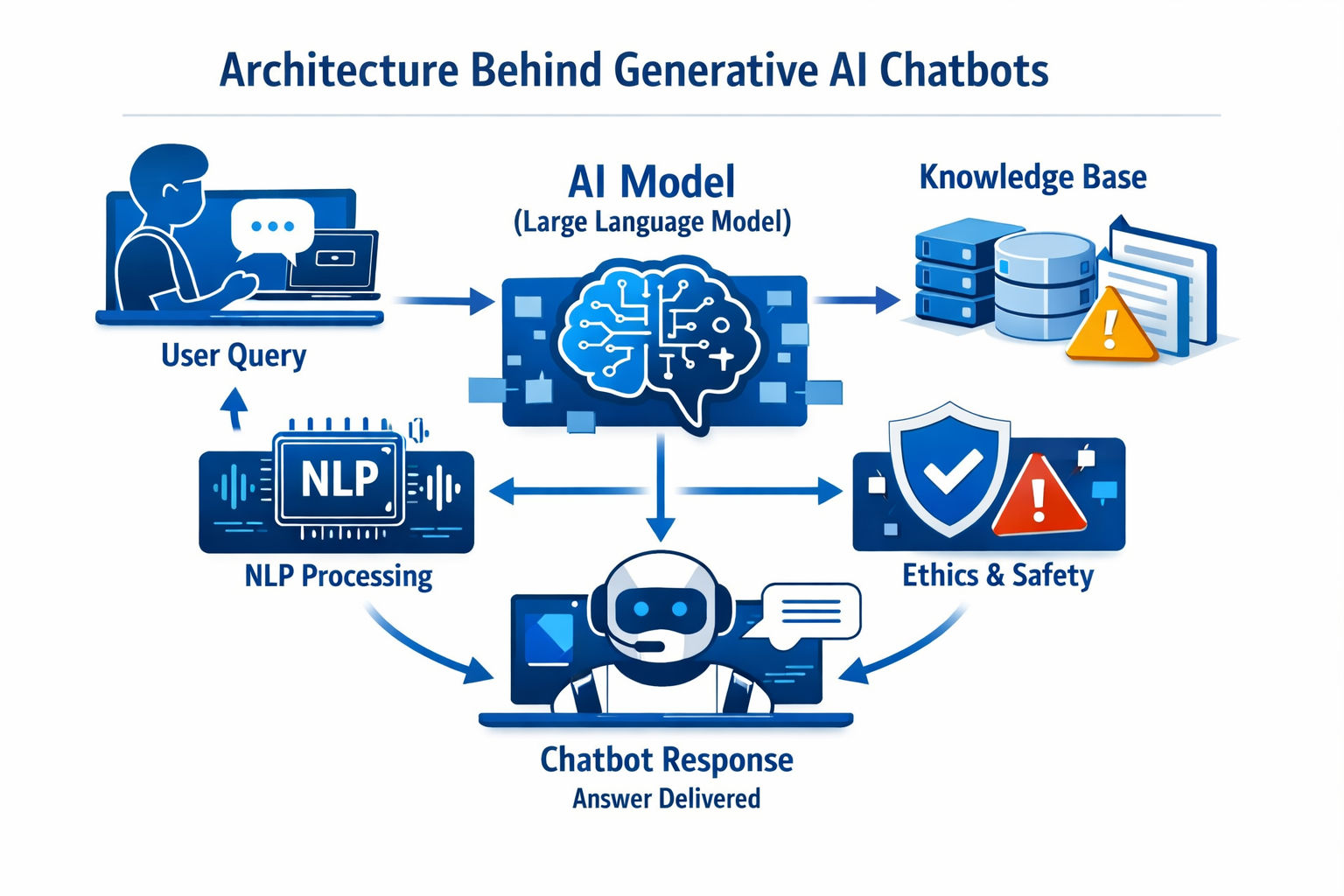
The following table shows commonly used technologies.
Technology |
Purpose |
| Transformers | Language understanding |
| Vector Databases | Semantic search |
| APIs | External integrations |
| Embedding Models | Context representation |
| Monitoring Tools | Performance tracking |
Large language models learn statistical relationships between words and phrases from massive data sets. At inference, the model predicts probable sequences of text.
But understanding is not prediction.
For example, a chatbot can generate fluent answers and still output wrong information, a problem called hallucination.
RAG architectures are used by many organizations to increase reliability.
In this method:
A banking chatbot using RAG can fetch current loan policies, rather than relying solely on training data.
This architecture reduces the production of stale or spurious responses and is gaining popularity in enterprise AI systems.
Also read : Top 25+ AI Chatbot Project Ideas in 2026
Companies in every industry have adopted conversational AI because users now demand instant, personalised support.
A Generative AI chatbot can automate repetitive interactions, freeing up human teams to focus on complex tasks.
It is commonly used in the following instances:
The table below highlights industry-specific use cases.
Industry |
Example Application |
| Education | Personalized tutoring |
| Healthcare | Appointment assistance |
| Retail | Product recommendations |
| Banking | Customer support |
| IT | Ticket resolution |
| HR | Employee assistance |
One big plus is scalability; A chatbot can handle thousands of conversations at the same time without increasing headcount.
Another advantage is availability. Unlike human teams, AI systems can provide round-the-clock support. But implementation in practice requires careful planning.
For example, a customer support chatbot may be able to answer common questions well, but may have a hard time with emotional situations. In such cases, escalation to human agents is still required.
Chatbot analytics also helps organizations recognize recurring customer problems, which can be valuable beyond the automation itself.
These systems are becoming critical interfaces between companies and users, as websites became critical interfaces decades ago.
Also Read: Top 20 Real-Time React Projects and Ideas for Beginners in 2026
Chatbot technology is still evolving, despite rapid advances. The majority of the limitations are only revealed post-deployment, when actual users engage with the system in unforeseen manners. Although these chatbots can produce fluent and human-like responses, they do not always provide accurate or reliable information.
A generative AI chatbot can sound confident even when it’s wrong. This brings unique challenges that developers and organisations must overcome before deploying these systems in production environments.
The following list highlights some of the most common challenges in generative AI chatbots:
One of the biggest limitations of generative AI systems is hallucination. A chatbot may generate responses that sound accurate but contain fabricated facts or outdated information. This issue becomes especially critical in domains such as healthcare, finance, and legal services, where incorrect information can lead to serious consequences.
To reduce hallucinations, many organizations use retrieval-augmented generation (RAG) systems that fetch information from trusted knowledge sources before generating responses.
Maintaining context across multiple conversation turns remains challenging for many chatbots. Users often refer to earlier messages without repeating details.
Consider this example:
User: "Book my meeting for tomorrow."
After several exchanges:
User: "Move it to Friday."
The chatbot must understand that "it" refers to the previously scheduled meeting. Without effective memory mechanisms, misunderstandings can occur and negatively affect the user experience.
AI models are trained on massive datasets which can contain social, cultural or historical biases. If these biases are not addressed, chatbot responses may be unfair or misleading.
Another big problem is privacy, since chatbots often handle sensitive information about users. To protect data, developers typically use encryption, anonymisation, and access controls.
Security vulnerabilities, including prompt injection attacks and unauthorised access, need ongoing vigilance and strong safeguards as well.
Generative models need to be creative and accurate. Highly creative systems can generate interesting conversations, but they also come with a higher risk of incorrect or inconsistent answers.
Another challenge is the evaluation of chatbot performance. Unlike traditional software, there are seldom one right answers for responses generated by a chatbot, so human review is an essential part of quality assessment.
As a result, most production systems combine AI-generated responses with rule-based safeguards, monitoring tools and human oversight to ensure reliable and safe interactions..
Generative AI chatbots are evolving rapidly, moving beyond simple question-answer systems toward intelligent digital assistants capable of handling complex tasks. Future chatbot platforms are expected to become more personalized, multimodal, and autonomous, transforming how individuals and businesses interact with technology.
Modern AI systems are already demonstrating advanced capabilities, and the next wave of innovation is likely to further blur the line between human and machine collaboration.
The next generation of chatbots will be driven by the following trends:
Trend |
Expected Impact |
| Multimodal AI | Richer and more natural user experiences |
| Agentic AI | Greater automation of complex tasks |
| Long-Term Memory | Improved continuity across conversations |
| Edge AI | Lower latency and enhanced privacy |
| Smaller Models | Reduced infrastructure costs |
Future chatbot systems may function as intelligent assistants capable of handling end-to-end workflows. Imagine a travel assistant that can:
Many of these capabilities are already being explored and integrated into modern AI ecosystems.
As chatbot capabilities increase, concerns around governance and responsible AI usage also become more important. Organizations must address challenges such as:
Even with rapid advances, there will still be a need for human input. AI systems need oversight, validation and ethical protections for accuracy, fairness and reliability.
The future of conversational AI is not in replacing humans altogether. Rather, it’s about complementing human abilities, enhancing productivity, and building more intuitive digital experiences across industries.
The Generative AI chatbot is a major shift in human-computer interaction. These systems generate dynamic responses, understand context, and power applications across industries.
With the constant evolution of language models, developers and organizations should focus not only on innovation but also on reliability, safety, and responsible deployment. The current understanding of how they work provides a solid basis to build the conversational applications of the future.
Ready to start your journey? Book a free consultation with upGrad today to find the best path for your career.
Traditional chatbots follow predefined rules and decision trees. They work well for fixed tasks but struggle with unexpected questions. Generative AI chatbots create responses dynamically using large language models. This allows them to understand context, maintain conversations, and handle complex queries. Businesses often use them for customer support, content assistance, and personalized interactions.
Yes, some Generative AI chatbot systems can run offline if deployed on local infrastructure or edge devices. However, offline models may have limited knowledge and fewer capabilities compared to cloud-based systems. Organizations handling sensitive data often choose private deployments to improve security and maintain compliance requirements.
Accuracy depends on training data quality, model selection, prompt design, and access to external knowledge sources. Many businesses integrate retrieval systems such as RAG to improve factual responses. Regular monitoring, user feedback, and model updates also help reduce errors and improve overall performance.
The amount of data depends on the chatbot's purpose. A domain-specific chatbot may require curated company documents, FAQs, and customer conversations. Large foundation models already possess general knowledge, so organizations often fine-tune or augment them instead of training models from scratch.
Modern chatbot platforms can maintain short-term and long-term memory depending on their architecture. Memory enables personalized interactions and continuity across sessions. However, businesses must carefully manage stored information to comply with privacy regulations and ensure users retain control over their data.
Industries such as healthcare, banking, retail, education, and travel are adopting chatbots at a fast pace. Healthcare providers use them for appointment assistance, while retailers deploy them for product recommendations. Educational institutions use AI assistants to answer student queries and provide learning support.
Organizations track metrics such as response accuracy, customer satisfaction, resolution rate, conversation completion, and cost savings. Monitoring user feedback also reveals areas for improvement. A successful chatbot should reduce manual workload while delivering faster and more useful customer experiences.
Yes, most modern chatbots support integration with CRM platforms, help desks, databases, and enterprise applications through APIs. This enables the chatbot to access customer information, process requests, and automate workflows. Proper integration often determines how valuable the chatbot becomes for daily operations.
AI models predict likely responses based on patterns in data rather than verifying facts. This can lead to hallucinations or outdated information. Organizations address this challenge by adding retrieval mechanisms, implementing validation rules, and keeping knowledge sources updated regularly.
Yes, smaller language models are gaining attention because they require fewer computing resources and lower operational costs. Businesses with limited infrastructure often prefer them for specialized tasks. While they may not match the capabilities of larger models, they can perform efficiently in targeted use cases.
Future chatbot systems are expected to become more multimodal, personalized, and autonomous. They may process text, voice, images, and video within a single interaction. Advances in memory systems, agentic workflows, and real-time personalization will likely make chatbot experiences more natural and task-oriented.
727 articles published
Sriram K is a Senior SEO Executive with a B.Tech in Information Technology from Dr. M.G.R. Educational and Research Institute, Chennai. With over a decade of experience in digital marketing, he specia...
Speak with AI & ML expert
By submitting, I accept the T&C and
Privacy Policy