Top 25+ AI Chatbot Project Ideas in 2026

By Rahul Singh

Updated on Apr 17, 2026 | 10 min read | 3.6K+ views

Share:

Top chatbot projects in 2026 focus on agentic AI, RAG-based systems, and domain-specific automation. Instead of general chatbots, you build focused solutions that solve specific problems with better accuracy and context.

Key chatbot projects include “Ecommerce Support” RAG systems, personalized AI assistants, customer support bots integrated with CRM tools, and career guidance chatbots. These projects help you build practical applications that handle real user needs and workflows.

In this guide, you will find 25+ highly descriptive AI chatbot project ideas categorized into beginner, intermediate, advanced, and Micro-SaaS levels.

Build in-demand AI skills with upGrad’s Artificial Intelligence Courses. Learn machine learning, prompt engineering, and real-world tools through hands-on projects. 

Beginner Friendly AI Chatbot Project Ideas

These AI Chatbot Projects introduce you to the core fundamentals of conversational AI, including basic API integration, simple state management, and deploying chatbots to familiar platforms like Telegram or Discord. They are perfect for developers writing their first LLM-powered applications.
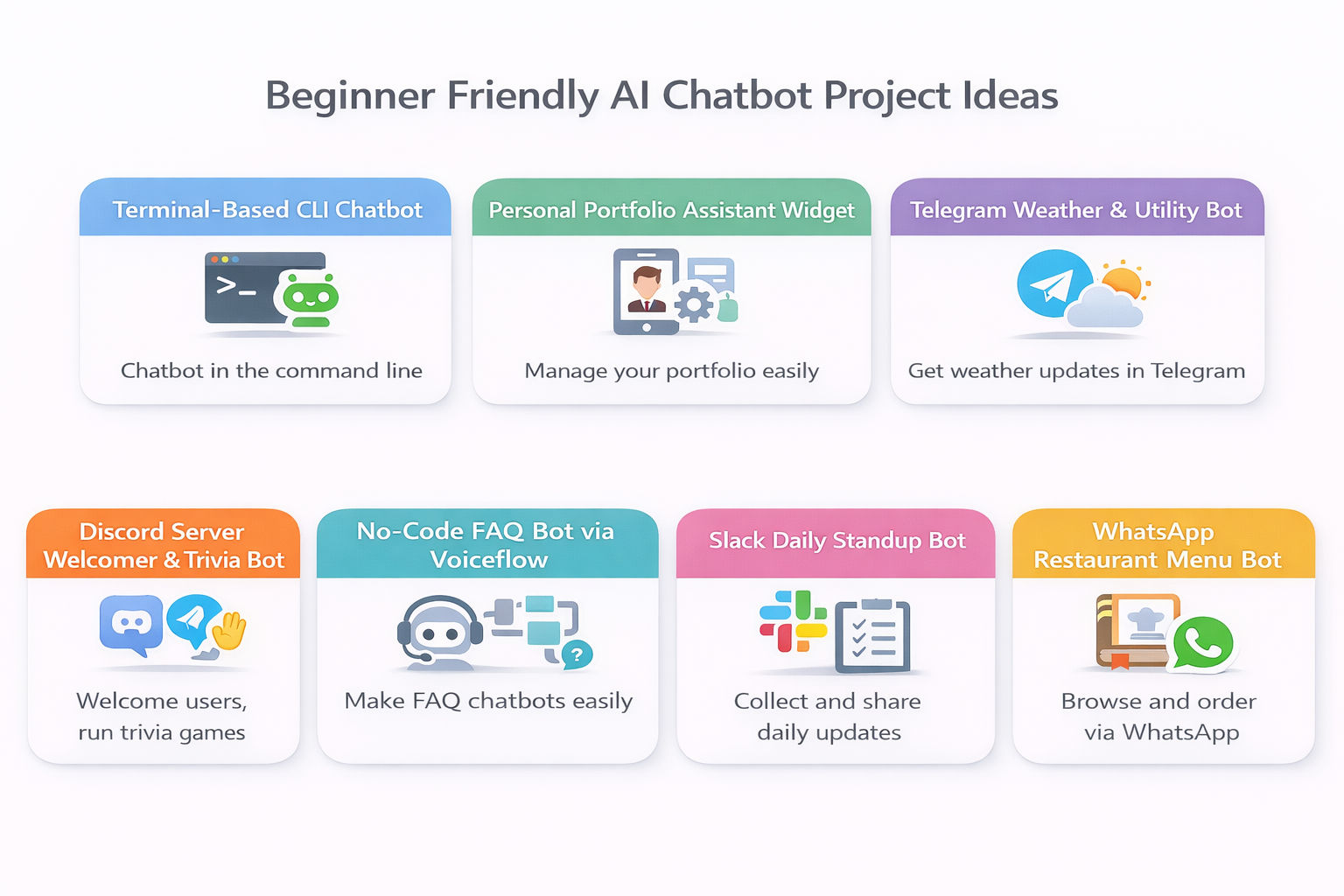
1. Terminal-Based CLI Chatbot

This project teaches you the absolute basics of interacting with an LLM API without the distraction of building a graphical user interface. You will build a Python script that runs in the terminal, allowing you to converse directly with an AI model.

Tools and Technologies Used

  • Python: For the core scripting logic.
  • Google Gemini API or OpenAI API: For text generation.
  • python-dotenv: To securely manage your private API keys.

How to Make It

  • Set up a Python virtual environment and securely store your API key in a .env file.
  • Write a script that initiates a continuous while loop, prompting the user for terminal input.
  • Pass the user's input to the LLM API, wait for the response, and print it back to the terminal.
  • Implement a simple exit command (like typing 'quit' or 'exit') to break the loop and gracefully close the application.

Also Read: Top 20+ Generative AI Project Ideas in 2026 

2. Personal Portfolio Assistant Widget

This project focuses on embedding a chatbot into a web environment. You will build a small chat bubble for your personal portfolio website that acts as a virtual clone of yourself, answering recruiter questions about your skills and experience.

Tools and Technologies Used

  • HTML/CSS/Vanilla JavaScript: For the frontend widget.
  • OpenAI API: For the conversational engine.
  • Strict System Prompts: To constrain the bot's knowledge.

How to Make It

  • Build a simple HTML floating widget in the bottom right corner of your website that expands into a chat window when clicked.
  • Construct a highly detailed system prompt outlining your resume, skills, and work history, instructing the AI to answer questions in the first person ("I am a developer...").
  • Use JavaScript's fetch API to securely send visitor messages to a serverless backend function, appending the system prompt.
  • Render the AI's response in the chat window, adding simple CSS animations to simulate typing.

3. Telegram Weather & Utility Bot

This project introduces routing user inputs to external data APIs before passing them to the LLM. You will build a Telegram bot that can hold a conversation but also fetch live weather data when asked.

Tools and Technologies Used

  • python-telegram-bot wrapper: To interface with Telegram's backend.
  • OpenWeatherMap API: To fetch live meteorological data.
  • LangChain: For basic tool calling.

How to Make It

  • Register a new bot with Telegram's "BotFather" to retrieve your access token.
  • Use LangChain to define a "Weather Tool" that executes a GET request to the OpenWeatherMap API.
  • Configure an LLM agent that interprets the user's Telegram message; if the user asks for the weather, the agent autonomously triggers the tool, reads the JSON response, and formats a conversational reply.
  • Deploy the Python script to a platform like Render or Heroku so the bot remains online 24/7.

Also Read: 15 Best Full Stack Coding Project Ideas & Topics For Beginners  

4. Discord Server Welcomer & Trivia Bot

This project focuses on event-driven chat triggers and engaging communities. You will build a Discord bot that automatically welcomes new users and hosts interactive trivia games within text channels.

Tools and Technologies Used

  • Discord.js: The industry-standard library for Node.js Discord bots.
  • Open Trivia DB: To source diverse trivia questions.
  • OpenAI API: To add conversational flair to the bot's announcements.

How to Make It

  • Create an application in the Discord Developer Portal and invite the bot to your test server with text permissions.
  • Set up an event listener for guildMemberAdd that triggers the LLM to generate a unique, funny, or themed welcome message every time a new user joins.
  • Implement a command (e.g., !trivia) that fetches a question from the trivia API and presents it to the channel.
  • Track user scores in a simple local JSON file and use the LLM to creatively announce the winner after a set time limit.

5. No-Code FAQ Bot via Voiceflow

This project teaches visual conversational design without requiring heavy backend coding. You will build a structured FAQ chatbot using a drag-and-drop conversational builder.

Tools and Technologies Used

  • Voiceflow or Botpress: Leading visual conversational AI platforms.
  • Company FAQ Document: As the knowledge base.
  • Web Integration Snippet: For deployment.

How to Make It

  • Create an account on Voiceflow and start a new web chat project.
  • Upload your static FAQ PDF or document to the platform's native knowledge base.
  • Design a visual flow featuring a welcome message and a series of interactive buttons for common queries (e.g., "Shipping Info," "Return Policy").
  • Configure the "Fallback" node so that if a user types a custom question, the bot uses an integrated LLM to read the uploaded document and generate a factual answer.

Also Read: Top 30 Django Project Ideas for Beginners and Professionals  

6. Slack Daily Standup Bot

This project involves scheduled interactions and aggregating team data. You will build a Slack bot that DMs team members every morning, asks what they are working on, and summarizes the responses in a main channel.

Tools and Technologies Used

  • Slack Bolt API (Node.js): For deep integration with Slack workspaces.
  • Node-Cron: To handle the scheduled morning triggers.
  • Anthropic Claude API: For generating the final summary.

How to Make It

  • Register an app in the Slack API dashboard and configure it with permissions to read/write direct messages and post to public channels.
  • Write a cron job that iterates through a list of user IDs at 9:00 AM, sending a friendly, automated DM asking for their daily tasks.
  • Listen for their replies, storing the text in a temporary array.
  • At 10:00 AM, pass all the collected responses to Claude to generate a concise, bulleted summary, and have the bot post this summary into the #engineering or #general channel.

7. WhatsApp Restaurant Menu Bot

This project focuses on conversational commerce and the Twilio ecosystem. You will build a bot that allows customers to text a WhatsApp number to view a restaurant's menu, check operating hours, and place a simple mock order.

Tools and Technologies Used

  • Twilio Sandbox for WhatsApp: For testing WhatsApp integrations without business verification.
  • Express.js API: To receive and process incoming webhooks.
  • JSON: To store the mock menu items and prices.

How to Make It

  • Set up your Twilio Sandbox and link it to your local server using a tunneling tool like Ngrok.
  • Build an Express endpoint that receives incoming WhatsApp text messages from Twilio.
  • Write basic routing logic: if the user texts "Menu," reply with the JSON menu formatted cleanly; if they text "Hours," reply with the schedule.
  • Integrate a basic LLM call to handle slight misspellings or conversational intents (e.g., understanding that "What do you have to eat?" equals "Menu").

Also Read: Top 21+ Next.js Project Ideas in 2026 

Intermediate Level AI Chatbot Project Ideas

These AI Chatbot Project Ideas require managing persistent conversational memory, integrating retrieval-augmented generation (RAG), and connecting chatbots to dynamic databases or complex third-party tools.

1. E-commerce Customer Support Bot (RAG)

This project moves beyond static PDFs and introduces a scalable vector database for customer support. You will build a bot that queries a retail store's massive catalog of return policies, product manuals, and shipping rules to provide instant answers.

Tools and Technologies Used

  • Pinecone: For scalable vector storage.
  • OpenAI Text Embeddings & GPT-4o: For vectorization and reasoning.
  • Next.js & Vercel AI SDK: For the frontend chat interface.

How to Make It

  • Compile dummy e-commerce data (policies, product descriptions) and vectorize it into Pinecone, ensuring you append metadata like "Category: Returns".
  • Build a chat interface utilizing the Vercel AI SDK's useChat hook for a smooth, streaming user experience.
  • When a user asks a question, embed the query, perform a similarity search in Pinecone, and inject the retrieved policy documents into the LLM's system prompt context window.
  • Instruct the LLM to strictly refuse answering questions outside the scope of the provided e-commerce documents (e.g., refusing to answer math or political questions).

Also Read: Top 45+ Nodejs Project Ideas for Beginners and Professionals  

2. Mental Health & Journaling Chatbot

This project focuses heavily on sentiment analysis, tone regulation, and ethical AI guardrails. You will build a secure, empathetic chatbot that helps users reflect on their day and offers positive reinforcement.

Tools and Technologies Used

  • Anthropic Claude: Known for highly steerable, safe, and empathetic responses.
  • PostgreSQL: For securely storing historic journal entries.
  • React Native: To build this as a mobile app experience.

How to Make It

  • Design a calming, distraction-free mobile chat interface using React Native.
  • Engineer a highly specific system prompt instructing Claude to act as a supportive listener, focusing on validating emotions and asking gentle follow-up questions, while strictly avoiding giving medical or psychiatric advice.
  • Implement an automated sentiment analysis pass before the bot replies; if the user's input indicates severe distress, trigger a hardcoded fallback response providing official crisis hotline numbers.
  • Save the daily conversations to a database so the user can look back at their mood history over the month.

3. Voice-Powered Language Practice Tutor

This project bridges text-based LLMs with advanced audio processing. You will build a conversational agent that helps users practice speaking a foreign language by conversing via voice notes.

Tools and Technologies Used

  • OpenAI Whisper API: For high-accuracy Speech-to-Text (STT).
  • ElevenLabs API: For ultra-realistic Text-to-Speech (TTS) in multiple languages.
  • WebRTC or HTML5 Audio: For browser-based microphone recording.

How to Make It

  • Build a frontend featuring a large, push-to-talk microphone button.
  • When the user speaks (e.g., in Spanish), capture the audio blob and send it to the Whisper API for transcription.
  • Pass the transcribed Spanish text to the LLM, prompting it to act as a friendly language tutor that responds in conversational Spanish and subtly corrects grammar mistakes.
  • Stream the LLM's text response to ElevenLabs to generate a realistic Spanish audio file, automatically playing it back to the user to simulate a phone call.

Also Read: Top 36+ Python Projects for Beginners in 2026 

4. IT Helpdesk Ticketing Bot

This project automates internal corporate workflows. You will build a Slack or Microsoft Teams bot that triages employee IT issues, attempts to solve common problems (like password resets), and automatically creates Jira tickets for complex issues.

Tools and Technologies Used

  • LangChain Agents: To handle dynamic tool routing.
  • Jira API: For programmatic ticket creation.
  • Slack Bolt API: For the user interface.

How to Make It

  • Connect your Slack bot to a backend agent equipped with two tools: a KnowledgeBaseSearch (for reading IT manuals) and a CreateTicket tool (connected to Jira).
  • When an employee messages the bot saying "My VPN isn't working," the agent first searches the knowledge base and replies with troubleshooting steps.
  • If the employee replies "That didn't work," the agent autonomously triggers the CreateTicket tool, pulling the employee's name and issue description, and pushes it to the Jira board.
  • The bot then messages the user back with their official Jira Ticket ID and a link to track the status.

5. Interactive Storytelling & RPG Bot

This project requires complex state management and continuous narrative generation. You will build a text-based adventure game where the chatbot acts as a Dungeon Master, dynamically altering the storyline based on user choices.

Tools and Technologies Used

  • Google Gemini Pro: For expansive, creative storytelling context.
  • Zep or Mem0: For long-term memory management.
  • React: For a stylized, terminal-like game interface.

How to Make It

  • Define the core setting, main antagonist, and user character sheet in an initial system prompt.
  • Implement a memory management layer (like Zep) to ensure the LLM remembers items the user picked up or NPCs they interacted with 20 turns ago without blowing up the context window.
  • Render the story on the frontend, providing an input box where the user types their actions (e.g., "I try to persuade the guard to let me pass").
  • Instruct the LLM to determine the success or failure of the action, generate the next paragraph of the narrative, and update the player's hidden inventory state.

Also Read: 35+ Android Projects with Source Code You MUST Try in 2026 (Beginner to Final-Year)  

6. Real Estate Lead Generation Bot

This project turns a chatbot into an automated sales funnel. You will build a web-based widget for a real estate agency that chats with visitors, collects their budget and location preferences, and passes qualified leads to a CRM.

Tools and Technologies Used

  • Flowise: For building the LLM flow visually.
  • HubSpot or Salesforce API: To ingest the final lead data.
  • Regex / Input Validation: To ensure phone numbers and emails are captured correctly.

How to Make It

  • Construct a conversational flow that starts by answering basic questions about available property listings.
  • Write a prompt that instructs the bot to naturally pivot the conversation toward scheduling a viewing after answering 2 or 3 questions.
  • Instruct the bot to extract the user's Name, Email, and Target Neighborhood.
  • Once the bot successfully extracts these three variables, trigger a backend webhook that securely pushes the structured JSON data into the agency's HubSpot CRM, tagging it as a "Warm Lead."

7. Internal HR Onboarding Bot

This project focuses on enterprise data security and document retrieval. You will build a secure bot that allows new hires to ask questions about company benefits, payroll schedules, and holiday policies.

Tools and Technologies Used

  • LlamaIndex: Optimized for querying complex, structured corporate documents.
  • PostgreSQL (pgvector): To keep company data strictly on a private, self-hosted database.
  • Streamlit: For rapidly building an internal, secure dashboard.

How to Make It

  • Gather PDF employee handbooks, 401k guidelines, and healthcare policy documents.
  • Use LlamaIndex to ingest and chunk these documents, storing the embeddings in your private PostgreSQL database to maintain strict data compliance.
  • Build a simple Streamlit interface hosted behind a secure corporate VPN.
  • Configure the bot to provide answers and explicitly cite the page number and document name (e.g., "According to the 2026 Employee Handbook, Page 14...") so employees can verify the information.

Also Read: 30 Best Cyber Security Projects Ideas in 2026  

Machine Learning Courses to upskill

Explore Machine Learning Courses for Career Progression

360° Career Support

Executive Diploma12 Months
background

Liverpool John Moores University

Master of Science in Machine Learning & AI

Double Credentials

Master's Degree18 Months

Advanced Level AI Chatbot Project Ideas

These AI Chatbot Project Ideas represent the cutting edge of conversational AI, featuring multimodal inputs, autonomous multi-agent systems, and real-time streaming capabilities requiring high-performance infrastructure.

1. Multi-modal Voice & Vision Assistant

This project combines text, audio, and image processing into a single conversational agent. You will build an assistant where a user can share their screen or camera and ask spoken questions about what the AI is currently "seeing."

Tools and Technologies Used

  • OpenAI GPT-4o (Omni): For native multimodal reasoning.
  • WebRTC: For low-latency video and audio streaming.
  • Deepgram: For backup ultra-fast transcription.

How to Make It

  • Set up a WebRTC connection in the browser to capture both the user's microphone audio and their webcam/screen-share video track.
  • Extract video frames at regular intervals (e.g., 1 frame per second) and convert them to base64 images.
  • When the user speaks a question (e.g., "What error is showing on my code editor?"), send the transcribed text alongside the most recent base64 image frame to the GPT-4o API.
  • Receive the multimodal analysis and instantly stream the response back through a Text-to-Speech engine, creating a seamless, sci-fi-like interaction.

Also Read: 15+ Web Development Projects  

2. Multi-Agent Customer Resolution System

This project utilizes multiple specialized AI models communicating with each other to solve a single problem. You will build a system where a user complaint triggers a hierarchy of agents: a Triage Agent, an Investigation Agent, and a Refund Agent.

Tools and Technologies Used

  • CrewAI or Microsoft AutoGen: To orchestrate the agentic workflows.
  • Zendesk API: For managing customer support tickets.
  • Stripe API: For executing automated refunds.

How to Make It

  • Define three distinct AI personas using CrewAI:
    • Triage Agent: Reads the incoming message and categorizes the intent.
    • Investigator: Queries the Zendesk API and shipping database to verify if an item was actually lost.
    • Action Agent: Authorized to hit the Stripe API to process a refund if the Investigator verifies the claim.
  • When a user messages "My package never arrived," the Triage Agent routes it to the Investigator, who autonomously checks the tracking number.
  • If the package is lost, the Action Agent processes the refund and drafts the final apologetic response to the customer without a human ever intervening.

3. In-App Copilot for a SaaS Platform

This project requires deep integration with an existing software application's user interface. You will build a "Copilot" sidebar that can not only answer questions but can actually navigate the app and click buttons on behalf of the user.

Tools and Technologies Used

  • Next.js & Vercel AI SDK: For the core application framework.
  • Shadow DOM manipulation: To programmatically execute clicks.
  • Function Calling (Tool Use): To map LLM intents to frontend React functions.

How to Make It

  • Take an existing SaaS application (like a CRM or email marketing tool) and embed a chat sidebar component.
  • Expose specific frontend React functions to the LLM via tool definitions (e.g., Maps_to_settings(), create_new_campaign(name)).
  • When a user types "Create a new email campaign for Black Friday," the LLM recognizes the intent and triggers the create_new_campaign tool.
  • Intercept the tool call on the frontend and physically execute the state changes, showing the user the new campaign screen instantly, effectively controlling the UI via natural language.

4. Autonomous Sales Negotiation Bot

This project pushes prompt engineering to its absolute limits by establishing complex, non-breakable guardrails. You will build a B2B sales bot authorized to negotiate pricing contracts with clients within strict mathematical margins.

Tools and Technologies Used

  • LangChain (Expression Language): For complex prompt chaining and logic routing.
  • Stripe API: To generate dynamic checkout links based on negotiated prices.
  • OpenAI GPT-4: For high-level reasoning and negotiation tactics.

How to Make It

  • Define a highly complex system prompt granting the bot a base price (e.g., Rs.10,000) and an absolute floor price (e.g., Rs.8,000).
  • Program the bot to use specific sales tactics: asking about the client's budget, offering alternative payment terms (like annual billing), and only offering discounts in small increments.
  • Implement a strict output parser that validates the bot's intended price; if the bot hallucinates and tries to offer a Rs.5,000 price, the system silently blocks the message and forces a rewrite.
  • Once the user agrees to a price within the valid range, the bot autonomously generates a customized Stripe payment link for that exact amount and drops it in the chat.

Also Read: GitHub Project on Python: 30 Python Projects You’d Enjoy  

5. Healthcare Triage Chatbot (HIPAA Compliant Architecture)

This project deals with extreme data sensitivity and strict regulatory compliance. You will build a symptom-checking chatbot that guides patients to the correct department without storing any Personally Identifiable Information (PII) improperly.

Tools and Technologies Used

  • BioBERT or specialized medical LLMs: For accurate clinical terminology understanding.
  • AWS Comprehend Medical: To automatically redact PII from logs.
  • Decision Tree fallback logic: To ensure absolute safety in medical routing.

How to Make It

  • Deploy your infrastructure on a HIPAA-eligible cloud environment, ensuring all databases are encrypted at rest and in transit.
  • Build a conversational interface that asks users for their symptoms. Use AWS Comprehend Medical to instantly strip out names, addresses, or SSNs before the data ever reaches the LLM.
  • Instead of letting the LLM diagnose the patient natively (which is highly dangerous), use the LLM solely to extract structured symptom data (e.g., {"symptom": "chest pain", "severity": "high"}).
  • Pass this structured data through a hardcoded, medically-approved decision tree; if "chest pain" is detected, bypass the chat instantly and trigger an emergency warning to call 911.

6. Fully Autonomous Social Media Community Manager

This project involves building an agent that operates independently in the wild. You will build a bot that monitors a brand's Reddit or Twitter mentions, analyzes the sentiment, and replies contextually in the brand's specific tone of voice.

Tools and Technologies Used

  • Twitter API / PRAW (Python Reddit API Wrapper): For platform integration.
  • Hugging Face Sentiment Analysis: For initial triage.
  • LangChain Agents: To formulate the contextual reply.

How to Make It

  • Write a backend script that continuously polls the social media API for mentions of a specific brand name.
  • Pipe the incoming mentions through a sentiment analyzer. If the sentiment is highly negative (e.g., a furious customer), flag it in a database for a human PR team and instruct the bot not to reply automatically.
  • If the sentiment is neutral or positive, pass the post to the LLM, prompting it to generate a witty, helpful, or appreciative response adhering to the brand's style guide.
  • Use the platform API to autonomously post the reply as a comment or tweet.

Also Read: Top 20 Real-Time React Projects and Ideas for Beginners in 2026 

7. Omnichannel Retail Chatbot with Persistent Memory

This project unifies the customer experience across multiple platforms. You will build a centralized chatbot brain that remembers a user whether they message the brand on WhatsApp, Facebook Messenger, or the website live chat.

Tools and Technologies Used

  • Botpress or Dialogflow CX: For handling complex omnichannel routing.
  • Mem0 / Zep: For cross-platform memory layer.
  • Shopify API: To fetch live order statuses.

How to Make It

  • Set up a centralized backend server that exposes webhooks for WhatsApp, Messenger, and a custom web widget.
  • When a message arrives, extract the user's phone number or email to generate a unique Customer_ID.
  • Query the Zep memory layer using this ID to load the customer's entire historic conversation history, regardless of which platform they used previously.
  • Use the Shopify API to pull their most recent order data. If they message via WhatsApp saying "Where is my order?", the bot inherently knows who they are, what they ordered, and replies with tracking info instantly.

Also Read: 40 Must-Try JavaScript Project Ideas for Developers of All Levels 

Micro-SaaS AI Chatbot Project Ideas

Micro-SaaS AI Chatbot Project Ideas are highly focused, niche software applications usually built by solo developers. By wrapping conversational AI pipelines into subscription models, you can create powerful B2B products tailored to specific industries.
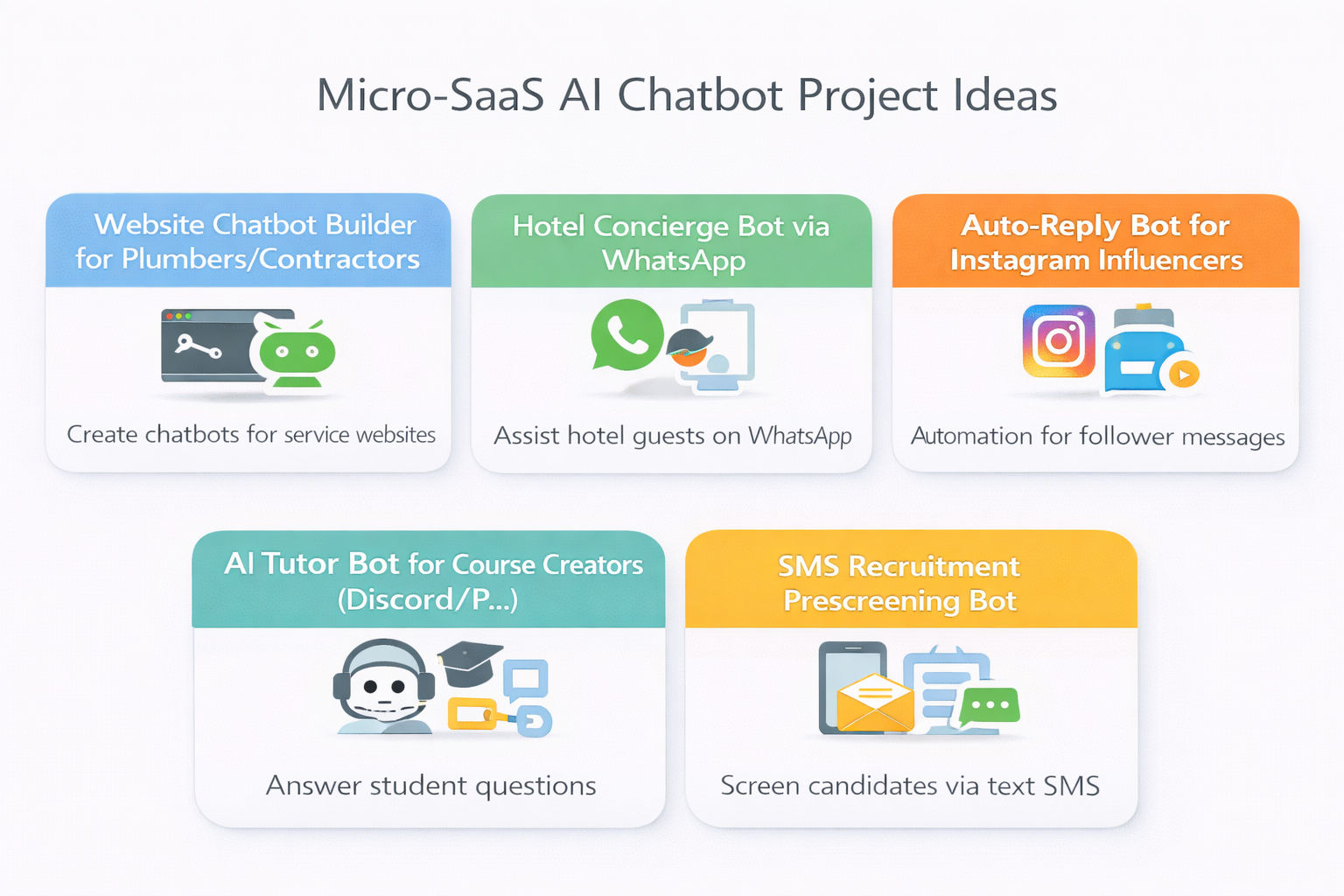
1. Website Chatbot Builder for Plumbers/Contractors

This project focuses on selling a productized service to non-technical local businesses. You will build a platform where service businesses can input their pricing and service areas to instantly generate an AI receptionist for their website.

Tools and Technologies Used

  • Flowise AI: For rapid chatbot flow generation.
  • Stripe Billing: For subscription management.
  • Embeddable Vanilla JS: To generate the installation snippet.

How to Make It

  • Build a SaaS dashboard where a plumber creates an account and fills out a simple form detailing their hourly rates, emergency fees, and postal codes they service.
  • Use these form inputs to dynamically generate a tailored system prompt for an LLM specifically instructed to capture leads and book appointments.
  • Generate a custom <script> tag that the plumber can easily paste into their WordPress or Wix site.
  • Charge a flat monthly fee (e.g., $49/mo) for the chatbot to handle out-of-hours inquiries and capture customer phone numbers while the business owner is asleep.

2. Hotel Concierge Bot via WhatsApp

This project targets the hospitality industry. You will build a white-labeled WhatsApp service that boutique hotels can offer to their guests for instant room service ordering, WiFi passwords, and local recommendations.

Tools and Technologies Used

  • Twilio Business API: For robust WhatsApp integration.
  • Guesty API (or similar Property Management System): To verify guest reservations.
  • PostgreSQL: For managing hotel-specific knowledge bases.

How to Make It

  • Provide an admin panel where hotel managers can upload their restaurant menus, spa schedules, and WiFi credentials.
  • When a guest texts the hotel's WhatsApp number, use a property management API to verify their phone number matches a currently checked-in room.
  • Route the guest's questions to an LLM grounded purely in the hotel's uploaded data.
  • If a guest asks for extra towels, configure the bot to parse the intent and send an automated Slack ping directly to the housekeeping team's channel.

Also Read: Top 25+ SaaS Project Ideas in 2026 

3. Auto-Reply Bot for Instagram Influencers

This project solves a massive bottleneck for social media creators. You will build a tool that connects to an influencer's Instagram account, scanning incoming DMs for specific keywords (like "Workout Plan") and using AI to generate personalized replies and sales links.

Tools and Technologies Used

  • Instagram Graph API: To securely read and send Direct Messages.
  • OpenAI API: To ensure replies feel human and personalized.
  • Next.js: For the creator's analytics dashboard.

How to Make It

  • Implement a secure Facebook OAuth flow allowing the creator to grant your app permission to manage their Instagram messages.
  • Set up a webhook to listen for incoming DMs. If a user asks a common question about a brand partnership or product link, intercept the message.
  • Use an LLM to read the context of the user's message and generate a friendly reply that includes the creator's affiliate link, matching the creator's specific tone (e.g., using emojis or specific slang).
  • Build an analytics dashboard showing the creator how many DMs were processed and how many affiliate links were successfully distributed.

4. AI Tutor Bot for Course Creators (Discord/Patreon)

This project monetizes AI within private communities. You will build a Discord bot that course creators can add to their private servers, trained exclusively on their course materials to answer student questions 24/7.

Tools and Technologies Used

  • Discord.js: For the bot interface.
  • Pinecone & LangChain: To ingest the specific course videos and PDFs.
  • Patreon or Stripe API: For gating access.

How to Make It

  • Build an ingestion pipeline where a course creator uploads their video transcripts and slide decks to create a highly specialized vector database.
  • Deploy a Discord bot to their server that acts as a "Teaching Assistant."
  • Implement role-based access control: configure the bot to only answer queries from users who have a specific "Premium Student" role, verified via Patreon or Stripe integration.
  • Allow the creator to view a dashboard of the most frequently asked questions, highlighting areas where their course material might be confusing and need updating.

Also Read: 50 Java Projects With Source Code for Beginners  

5. SMS Recruitment Prescreening Bot

This project streamlines the hiring process for high-volume jobs (like retail or warehouse work). You will build an SMS-based bot that automatically texts applicants, asks them 5 qualifying questions, and scores their responses for the hiring manager.

Tools and Technologies Used

  • Twilio SMS API: For ubiquitous, low-friction communication.
  • OpenAI API (JSON Mode): To score and extract answers.
  • React: For the recruiter's candidate dashboard.

How to Make It

  • Provide an interface where recruiters define the job requirements and 5 mandatory prescreening questions (e.g., "Do you have a valid driver's license?").
  • When a candidate applies, trigger Twilio to send an automated SMS initiating the conversational interview.
  • Pass the candidate's conversational replies to the LLM, instructing it to extract the core answers and output a structured JSON scoring matrix (Pass/Fail).
  • Aggregate the data on a dashboard, allowing recruiters to filter out unqualified candidates instantly without conducting a single phone call.

Conclusion

AI chatbot project ideas help you build systems that handle real conversations and automate tasks. Start with simple bots to learn flow and logic, then move to advanced AI and RAG-based solutions for better accuracy and context.

Focus on practical AI chatbot project ideas that solve specific problems, improve responses, and add real value. This approach helps you build strong skills and create impactful applications.

"Want personalized guidance on AI and upskilling opportunities? Connect with upGrad’s experts for a free 1:1 counselling session today!"   

Similar Reads:  

Frequently Asked Question (FAQs)

1. What are some AI chatbot project ideas for students to start with?

AI chatbot project ideas for students include simple bots like FAQ assistants, reminder bots, or basic customer support chatbots. These projects help you understand conversation flow, user input handling, and basic AI integration while keeping the complexity manageable for beginners.

2. Where can you find chatbot projects with source code for learning?

You can explore platforms like GitHub and open-source communities. Many developers share complete chatbot implementations with setup instructions, making it easier to understand real-world structures and build your own projects step by step.

3. Which chatbot ideas are best for college-level projects?

For college projects, you can build apps like student helpdesk bots, event assistants, or course recommendation systems. These projects show practical use cases and help you demonstrate both technical and problem-solving skills.

4. What are some good chatbot projects for final year students?

Final year students can build advanced chatbots like RAG-based assistants, AI career advisors, or customer support bots with CRM integration. These projects highlight your ability to handle real-world applications and complex workflows.

5. How do AI chatbot project ideas help in learning real-world AI systems?

AI chatbot project ideas help you understand how AI models interact with users and data. You learn prompt design, API integration, and context handling, which are important for building useful and accurate conversational systems.

6. What are some beginner-friendly chatbot ideas to start with?

You can start with rule-based chatbots, simple Q&A bots, or basic assistant apps. These projects help you understand conversation design and logic without dealing with complex AI models in the beginning.

7. Do you need coding experience to build chatbot applications?

Basic coding knowledge is helpful, especially in Python or JavaScript. Many tools provide simple interfaces, so you can start small and gradually improve your coding skills while building projects.

8. What are some advanced AI chatbot project ideas for real-world use?

Advanced AI chatbot project ideas include agent-based assistants, RAG chatbots, and automation bots for business workflows. These projects involve handling real data, improving accuracy, and building scalable systems for practical use.

9. How long does it take to complete a chatbot project?

Simple chatbot projects can take a few days, while intermediate ones may take a few weeks. Advanced projects with multiple integrations and real-time features can take longer depending on your experience and scope.

10. How can AI chatbot project ideas improve your portfolio?

AI chatbot project ideas help you showcase real applications like support bots or automation tools. These projects demonstrate your ability to solve problems using AI, making your portfolio stronger and more relevant for job roles.

11. What mistakes should you avoid while building chatbot projects?

Avoid building overly complex systems at the start. Do not ignore testing or user experience. Focus on clear conversation flow, accurate responses, and solving one problem well before adding more features.

Rahul Singh

15 articles published

Rahul Singh is an Associate Content Writer at upGrad, with a strong interest in Data Science, Machine Learning, and Artificial Intelligence. He combines technical development skills with data-driven s...

Speak with AI & ML expert

+91

By submitting, I accept the T&C and
Privacy Policy

India’s #1 Tech University

Executive Program in Generative AI for Leaders

76%

seats filled

View Program

Top Resources

Recommended Programs

LJMU

Liverpool John Moores University

Master of Science in Machine Learning & AI

Double Credentials

Master's Degree

18 Months

IIITB
bestseller

IIIT Bangalore

Executive Diploma in Machine Learning and AI

360° Career Support

Executive Diploma

12 Months

IIITB
new course

IIIT Bangalore

Executive Programme in Generative AI for Leaders

India’s #1 Tech University

Dual Certification

5 Months
