Top 20+ Generative AI Project Ideas in 2026

By Rahul Singh

Updated on Apr 14, 2026 | 10 min read | 5.88K+ views

Share:

Top generative AI projects in 2026 focus on building practical, real-world applications like RAG-based document assistants, AI agents for task automation, and multi-modal systems that handle text, images, and more.

With tools like LangChain, Gemini Pro, and Vertex AI, you can create apps that generate personalized content, automate workflows, and analyze data intelligently, making your projects more useful and job ready.

In this comprehensive guide, you will find 20+ Generative AI project ideas carefully categorized into beginner, intermediate, and advanced levels. 

Generative AI Courses to upskill

Explore Generative AI Courses for Career Progression

Certification Building AI Agent

360° Career Support

Executive Diploma12 Months

Beginner Friendly Generative AI Project Ideas

By using these project ideas, you can build up your good understanding in basics completing in 2-3 hours, for intermediate and advanced level projects. 
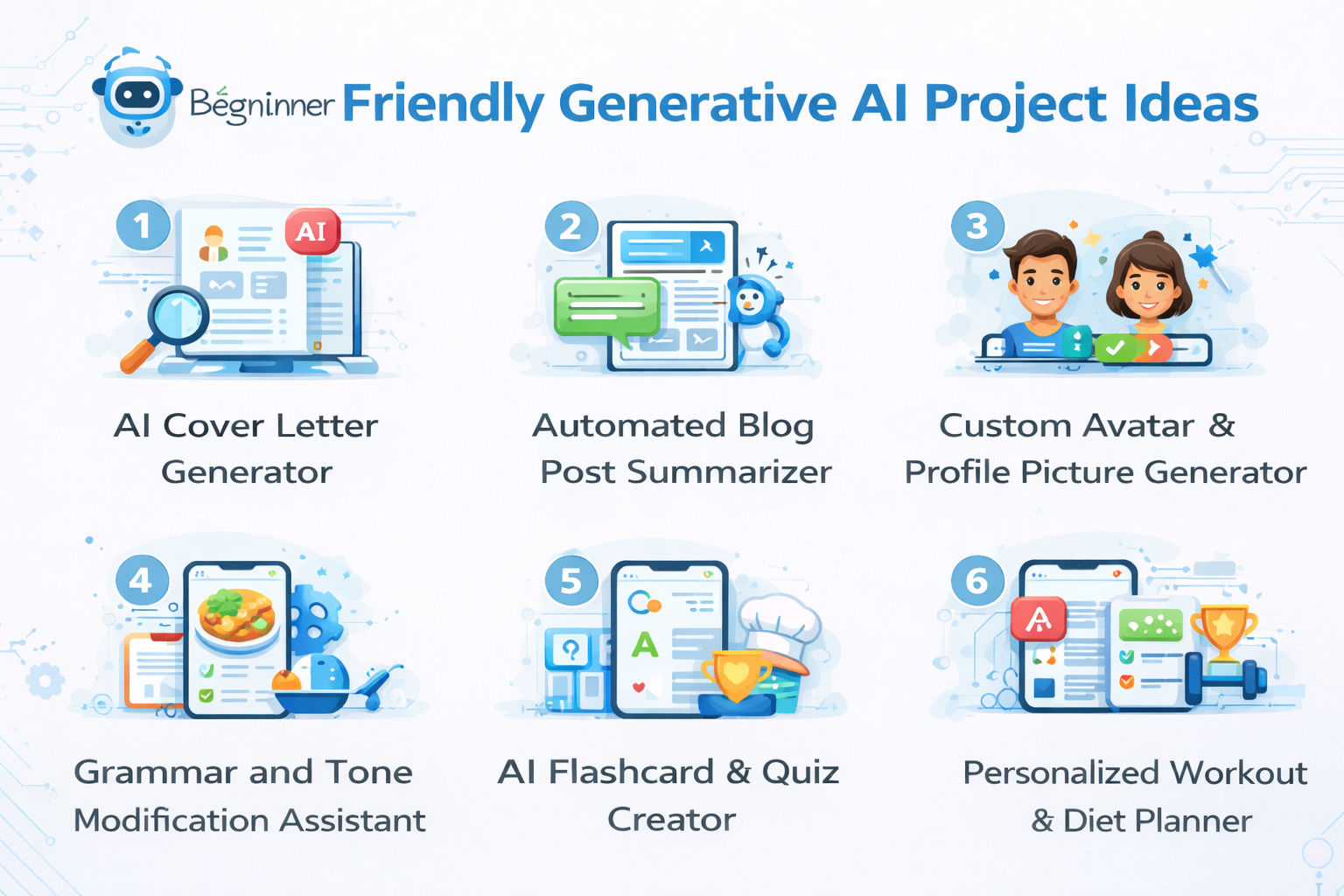
1. AI Cover Letter Generator

This project introduces you to the fundamentals of prompt engineering and working with LLM APIs. You will build a web application where job seekers paste their resume and a target job description, and the system generates a highly tailored, professional cover letter, teaching you how to combine dynamic user inputs into a structured AI prompt.

Tools and Technologies Used

  • OpenAI API (GPT-4) or Anthropic API
  • Next.js or React for the frontend interface
  • Tailwind CSS for rapid styling

How to Make It

  • Build a user interface with two large text areas: one for the user's resume and one for the target job description.
  • Write a secure backend API route that accepts these two strings and constructs a strict system prompt instructing the AI to act as an expert career coach.
  • Send the concatenated prompt to the OpenAI API, ensuring you set the temperature parameter to a moderate level (around 0.7) to allow for professional creativity without hallucination.
  • Stream the generated text back to the frontend, displaying it in a rich text editor so the user can easily copy or edit the final output.

Also Read: Top 10 Agentic AI Project ideas

2. Automated Blog Post Summarizer

This project focuses on natural language processing and text reduction. You will create a tool that takes a long-form article or a URL, parses the text, and utilizes an LLM to generate a concise, bulleted summary of the core concepts, highlighting key takeaways and action items.

Tools and Technologies Used

How to Make It

  • Create an input field that accepts either a raw block of text or a valid webpage URL.
  • Implement a backend function using Cheerio to fetch the URL, strip away all HTML tags, navigation bars, and ads, leaving only the core article text.
  • Pass the cleaned text to a summarization model via the Hugging Face API, explicitly prompting the model to return exactly five key bullet points.
  • Render the returned summary on the frontend in a clean, easily readable card format.

3. Custom Avatar & Profile Picture Generator

This project dives into the world of image generation and diffusion models. You will build an interface where users type a physical description or a fantasy concept, and the application connects to a text-to-image model to generate a unique, high-resolution digital avatar.

Tools and Technologies Used

  • Stability AI API (Stable Diffusion 3) or DALL-E 3 API
  • Python FastAPI backend
  • React frontend

How to Make It

  • Design a form with a text input for the character description and dropdown menus for specific art styles (e.g., Cyberpunk, Watercolor, 3D Render).
  • Write a function that concatenates the user's input with specific "negative prompts" (e.g., "blurry, distorted, low quality") to ensure high-quality outputs.
  • Make a POST request to the image generation API, passing the engineered prompt and specifying a square aspect ratio (like 1024x1024).
  • Display the returned image URL on the screen with a download button, handling loading states gracefully since image generation takes several seconds.

Also Read: 15+ Web Development Projects

4. Grammar and Tone Modification Assistant

This project teaches you how to strictly constrain LLM outputs for specific editorial tasks. You will build a writing assistant that not only corrects grammatical errors but allows the user to rewrite their text into different emotional tones, such as "Aggressive," "Diplomatic," or "Humorous."

Tools and Technologies Used

  • Google Gemini API
  • Next.js App Router
  • Framer Motion for text transition animations

How to Make It

  • Build a split-screen interface featuring an input text area on the left and a read-only output area on the right.
  • Create a row of buttons representing different tones (e.g., Professional, Casual, Persuasive) that act as state variables.
  • Construct a prompt that feeds the original text and the selected tone to the Gemini API, instructing it to rewrite the text while maintaining the original core message.
  • Use Framer Motion to smoothly fade the old text out and the newly generated, tone-shifted text into the output box.

5. Culinary Recipe Generator

This project focuses on conditional generation and handling constraints. You will build an application where users input the random ingredients they currently have in their fridge, and the AI generates a step-by-step recipe utilizing exclusively those items.

Tools and Technologies Used

  • OpenAI API
  • Vue.js or React
  • CSS Grid for layout

How to Make It

  • Implement a tagging input system where users can type an ingredient, press enter, and see it added as a visual "chip" on the screen.
  • Add checkboxes for dietary restrictions (e.g., Vegan, Gluten-Free, Keto) to pass additional constraints to the model.
  • Engineer a prompt that lists the provided ingredients and strictly commands the AI not to include any major unlisted ingredients (except basic pantry staples like salt and oil).
  • Parse the AI's response to separately display the dish title, estimated cooking time, and a numbered list of cooking instructions.

Also Read: GitHub Project on Python: 30 Python Projects You’d Enjoy

6. AI Flashcard & Quiz Creator

This project bridges unstructured text with structured JSON data generation. You will build a study tool where a user pastes their lecture notes, and the LLM automatically extracts the most important facts to generate a set of question-and-answer flashcards.

Tools and Technologies Used

  • Anthropic Claude API
  • Dart and Flutter (for a cross-platform mobile experience)
  • JSON schema validation

How to Make It

  • Build a mobile interface allowing users to paste large blocks of educational text.
  • Prompt the Claude API using its JSON mode capabilities, instructing it to extract 10 key concepts and return them strictly as an array of JSON objects containing "question" and "answer" keys.
  • Parse the returned JSON string directly into Dart objects within your application state.
  • Build an interactive flashcard widget utilizing 3D transform animations so the user can physically tap the card to flip it over and reveal the generated answer.

7. Personalized Workout & Diet Planner

This project involves multi-variable logic and personalized generation. You will create a fitness application that takes a user's physical metrics, goals, and equipment availability to generate a customized, week-long workout and meal plan.

Tools and Technologies Used

  • OpenAI API
  • Node.js backend
  • MongoDB (to save the generated plans)

How to Make It

  • Build a comprehensive onboarding wizard that captures age, weight, target goal (e.g., hypertrophy, fat loss), and available gym equipment (e.g., dumbbells only, full gym).
  • Construct a highly detailed system prompt that instructs the AI to act as a certified personal trainer, feeding it all the collected user metrics.
  • Request the AI to output a 7-day schedule, breaking down specific exercises, sets, reps, and corresponding daily macronutrient goals.
  • Save the generated text to MongoDB and display it on the frontend as an interactive daily checklist.

Also Read: Top 19 Spring Boot Projects with Source Code

Intermediate Level Generative AI Project Ideas

Intermediate generative AI project ideas help you move beyond basic prompts and build structured, real-world applications.

You work with workflows like RAG, multi-step prompting, and API integrations to create more useful and scalable AI systems.

1. PDF Document Q&A Bot (RAG Implementation)

This project is a deep dive into Retrieval-Augmented Generation (RAG), the foundational architecture of enterprise AI. You will build an application where users upload massive PDF documents and can ask a chatbot highly specific questions, with the AI answering based strictly on the document's contents.

Tools and Technologies Used

  • LangChain framework
  • Pinecone or ChromaDB (Vector Databases)
  • OpenAI API (Embeddings and LLM)

How to Make It

  • Implement a file upload component that accepts PDF files and uses a library like pdf-parse to extract all raw text from the document.
  • Use LangChain's text splitters to break the massive text into smaller, overlapping "chunks" (e.g., 1000 characters per chunk).
  • Pass these chunks through an embedding model (like text-embedding-3-small) to convert the text into mathematical vectors, and store these vectors in Pinecone.
  • When a user asks a question, embed their query, perform a cosine similarity search in the vector database to retrieve the most relevant chunks, and feed those chunks to the LLM as context to answer the question accurately.

Also Read: Top 20 Interesting Final Year Computer Science Project Ideas & Topics [2026]

2. High-Fidelity AI Voiceover Generator

This project explores the rapidly advancing field of generative audio. You will build a studio-like application where users input text, select distinct voice personas, and generate incredibly realistic, human-sounding voiceovers for videos or podcasts.

Tools and Technologies Used

  • ElevenLabs API (Industry leader in Text-to-Speech)
  • React and Next.js
  • HTML5 Audio API

How to Make It

  • Connect to the ElevenLabs API to fetch the list of available voices and render them in a visually appealing dropdown or grid selection menu.
  • Build a large text area equipped with character counters to ensure users do not exceed API limits during generation.
  • Make a secure POST request to the API containing the selected voice ID and the text string, adjusting parameters like "stability" and "similarity enhancement" to tweak the emotional delivery.
  • Receive the raw audio buffer from the API, convert it into a playable blob, and render an HTML5 audio player on the screen for the user to listen to and download the .mp3 file.

3. Automated Social Media Content Calendar

This project requires orchestrating chained prompts and generating structured, multi-part outputs. You will build a marketing tool that takes a single business topic and automatically generates a month-long content calendar tailored for different platforms like LinkedIn, Twitter, and Instagram.

Tools and Technologies Used

  • OpenAI API
  • Python and Flask
  • Pandas (for data manipulation)

How to Make It

  • Create an intake form capturing the business niche, target audience, and the overarching theme for the month.
  • Design a sequence of chained LLM calls: the first call generates 12 overarching post ideas, the second call expands those ideas into full LinkedIn articles, and the third translates them into short-form Twitter threads.
  • Instruct the model to format its final output as a structured JSON array containing dates, platforms, text content, and suggested image prompts.
  • Use Python's Pandas library to convert this JSON array into a downloadable CSV or Excel file that the user can import directly into scheduling tools.

Also Read: 50 Java Projects With Source Code for Beginners

4. Customer Support Chatbot with Buffer Memory

This project tackles the critical concept of LLM memory management. You will build a conversational agent that remembers the context of the user's past messages throughout the session, allowing for natural, multi-turn conversations without losing the thread.

Tools and Technologies Used

  • LangChain (ConversationBufferMemory)
  • React (for a chat-bubble UI)
  • FastAPI backend

How to Make It

  • Design a standard chat interface utilizing distinct visual styles for user message bubbles and AI message bubbles.
  • Set up a LangChain conversational chain on the backend, explicitly initializing a ConversationBufferWindowMemory to store the last 5-10 conversational turns.
  • Whenever a new message arrives, the backend automatically injects the stored conversation history into the prompt alongside the new query before sending it to the LLM.
  • Implement streaming responses so the user sees the chatbot typing its answer in real-time, greatly improving the perceived speed of the application.

5. Storyboarding Tool with Integrated AI Imagery

This project combines text generation and image generation into a single, cohesive workflow. You will build a tool for filmmakers or writers where they type a script, and the AI automatically breaks it into scenes and generates corresponding storyboard sketches.

Tools and Technologies Used

  • Anthropic Claude API (for scene extraction)
  • Midjourney API (via third-party endpoints) or Stable Diffusion
  • Next.js App Router

How to Make It

  • Provide a large text input for the user to paste a movie scene or short story script.
  • Use a text LLM to analyze the script and extract distinct visual scenes, outputting a list of highly descriptive, visual prompts (e.g., "Wide shot, dimly lit room, character looking out window").
  • Iterate through this list of visual prompts, sending each one to the image generation API, appending styling keywords like "pencil sketch, storyboard style, monochrome" to ensure visual consistency.
  • Render the final output as a grid of sequential panels, displaying the generated image side-by-side with its corresponding script dialogue.

Also Read: 15 Best Full Stack Coding Project Ideas & Topics For Beginners

6. SQL Query Generator from Natural Language

This project solves a major business pain point by allowing non-technical users to interact with databases. You will build an interface where a user asks a business question in plain English, and the AI generates the correct SQL query and executes it against a live database.

Tools and Technologies Used

  • LangChain (SQLDatabaseChain)
  • PostgreSQL DBMS
  • OpenAI API

How to Make It

  • Set up a mock PostgreSQL DBMS containing sample business data (e.g., tables for Users, Orders, Products).
  • Extract the database schema (table names, column names, data types) and feed it to the LLM as the system context, teaching it the structure of your specific DBMS.
  • Accept a natural language query from the user (e.g., "Show me the top 5 customers by revenue last month") and prompt the LLM to output ONLY a valid SQL string based on the provided schema.
  • Execute the generated SQL query securely against your PostgreSQL DBMS and render the returned rows in a clean, paginated HTML data table.

7. AI Podcast Script Writer (Multi-Persona)

This project focuses on multi-persona generation and dialogue formatting. You will build an application that takes an article URL and converts it into a lively, back-and-forth conversational podcast script featuring a designated "Host" and "Expert Guest."

Tools and Technologies Used

  • Google Gemini API
  • Cheerio (for text scraping)
  • React Markdown

How to Make It

  • Scrape the text content from a user-provided news article or blog post URL.
  • Construct a complex system prompt defining two distinct personas: a curious, energetic Host who asks questions, and an authoritative, analytical Guest who explains the concepts found in the article.
  • Instruct the LLM to write a 1000-word script utilizing the provided text, formatting the output strictly with character names in bold preceding their dialogue.
  • Render the output on the frontend using React Markdown, allowing the user to read the script clearly or export it as a text file.

Also Read: Top 30 Django Project Ideas for Beginners and Professionals

Advanced Level Generative AI Project Ideas

Advanced generative AI project ideas push you to build production-level systems with real-world impact.

You work on AI agents, multi-modal apps, scalable architectures, and systems that automate complex tasks end to end.

1. Autonomous Coding Agent (AutoGPT Style)

This project dives into the bleeding edge of agentic AI workflows. You will build a local Python tool where you provide a high-level goal (e.g., "Build a snake game in Python"), and the AI autonomously writes the code, saves the files to your hard drive, runs the code, reads the terminal errors, and debugs itself until the application works.

Tools and Technologies Used

  • LangChain Agents or AutoGen
  • Python subprocess and os modules
  • OpenAI GPT-4 API

How to Make It

  • Create an agentic loop utilizing LangChain, equipping the LLM with specific "Tools" it is allowed to call, such as a FileWriteTool and a TerminalExecutionTool.
  • Pass the user's main objective to the agent. The agent will first generate a plan, then use its tools to write the necessary Python scripts directly to your local file system using the os module.
  • The agent then uses the subprocess module to execute the script it just wrote, capturing any error tracebacks outputted by the terminal.
  • If the execution fails, the agent analyzes the traceback, rewrites the flawed code, and recursively attempts execution again until it achieves a successful run without errors.

Also Read: Top 45+ Nodejs Project Ideas for Beginners and Professionals

2. Autonomous Financial Report Analyzer

This project explores multi-modal AI and complex financial reasoning. You will build an enterprise tool that ingests massive, complex quarterly earnings reports (including charts and graphs) and autonomously generates investment summaries and risk assessments.

Tools and Technologies Used

  • OpenAI GPT-4o (Omni) for Vision and Text capabilities
  • LlamaIndex for advanced document parsing
  • FastAPI backend

How to Make It

  • Utilize LlamaIndex to parse massive PDF financial reports, specifically extracting not just the text paragraphs, but isolating the images of balance sheets and revenue charts.
  • Pass the extracted images and corresponding text chunks to a multi-modal vision model, prompting it to analyze the numerical trends depicted in the graphs.
  • Instruct the LLM to cross-reference the visual data with the CEO's written statements to detect discrepancies or highlight major revenue drivers.
  • Generate a final, highly structured markdown report detailing EPS growth, year-over-year revenue changes, and potential market risks identified within the document.

3. Custom Fine-Tuned LLM for Legal Drafting

This project moves away from prompt engineering and into actual model training. You will take an open-source LLM and fine-tune it on a dataset of specific legal contracts so that it natively understands complex legal jargon and formatting without needing massive context prompts.

Tools and Technologies Used

How to Make It

  • Curate a high-quality dataset of hundreds of legal contracts (like NDAs or employment agreements), formatting them into strict prompt-completion JSONL pairs.
  • Load a quantized open-source model (like Llama 3 8B) into a Google Colab notebook to ensure it fits within standard GPU VRAM limits.
  • Apply QLoRA techniques to train a small adapter model on top of the base LLM using your legal dataset, fundamentally altering the model's weights to favor legal terminology.
  • Export the fine-tuned adapter weights and build a simple Gradio or Streamlit web interface where lawyers can type short prompts and receive highly accurate, legally sound contract clauses.

4. Real-Time Voice Translation Earpiece App

This project tackles extreme low-latency data streaming and pipeline optimization. You will build a mobile application that constantly listens to a foreign language, translates it, and speaks the translation back to the user almost instantaneously, mimicking a sci-fi universal translator.

Tools and Technologies Used

  • Deepgram API (for blazing-fast streaming STT)
  • Groq API (for ultra-fast LLM inference)
  • ElevenLabs WebSocket API (for streaming TTS)

How to Make It

  • Establish a WebSocket connection from the mobile device microphone to Deepgram, sending raw audio buffers and receiving a continuous stream of transcribed foreign text.
  • The moment a sentence boundary is detected in the transcription, instantly route that text string to an LLM running on Groq hardware (which provides inference speeds of hundreds of tokens per second) to translate it to English.
  • Stream the translated text output directly into the ElevenLabs WebSocket API, which begins generating the English audio bytes before the LLM has even finished translating the entire paragraph.
  • Pipe the incoming audio buffer directly into the device's speaker, achieving a total pipeline latency of under one second.

Also Read: 35+ Android Projects with Source Code You MUST Try in 2026 (Beginner to Final-Year)

5. Generative UI Dashboard Designer

This project explores "UI as Code" generation. You will build a development tool where a user types a description of a web interface (e.g., "A dark mode analytics dashboard with a line chart and three metric cards"), and the AI generates the React code and visually renders the live interface immediately.

Tools and Technologies Used

  • Next.js App Router
  • Vercel AI SDK (specifically UI generation tools)
  • Tailwind CSS and Shadcn UI components

How to Make It

  • Define a strict set of pre-built React components (like Cards, Charts, Buttons) and feed their property signatures to the LLM via a system prompt.
  • Prompt the LLM to output its response not as conversational text, but as a structured JSON object detailing exactly which components to render and what data to populate them with.
  • Use the Vercel AI SDK to intercept this structured data stream on the frontend and dynamically map the JSON instructions to your actual React components in real-time.
  • Allow the user to type follow-up prompts (e.g., "Make the chart bigger and change the buttons to red") to iteratively update the rendered UI state.

6. AI Video Generator and Timeline Editor

This project tackles the heavy computational requirements of video generation models. You will build an interface that allows users to write a script, generate a series of short video clips from text prompts, and arrange them on a playable timeline.

Tools and Technologies Used

  • Runway Gen-2 API or Luma Dream Machine API
  • React frontend with HTML5 Canvas (for timeline UI)
  • FFmpeg (for backend video concatenation)

How to Make It

  • Build a frontend interface featuring a video player and a horizontal, drag-and-drop timeline track.
  • Allow users to input specific scene descriptions and send these prompts to the text-to-video API, receiving short 3-5 second MP4 clips in return.
  • Render these downloaded clips as visual blocks on the timeline, allowing the user to drag them left or right to reorder the sequence of the film.
  • When the user clicks "Export," send the array of video URLs and their precise chronological order to a backend Node.js server that utilizes FFmpeg to seamlessly stitch the clips together into a single master video file.

Also Read: 30 Best Cyber Security Projects Ideas in 2026

7. Multi-Agent Debate and Research System

This project explores the power of specialized, interacting agents. You will build a system where you input a controversial topic, and three distinct AI agents (a Proponent, an Opponent, and a Moderator) autonomously research the web and debate the topic in a chat interface.

Tools and Technologies Used

  • CrewAI or Microsoft AutoGen framework
  • Tavily API (for autonomous web searching)
  • OpenAI API

How to Make It

  • Use CrewAI to instantiate three distinct agent objects, providing each with a highly specific persona prompt and objective (e.g., "You are the Opponent, your job is to find flaws in the Proponent's argument").
  • Equip the Proponent and Opponent agents with a web search tool allowing them to autonomously fetch real-time data to back up their claims.
  • Define a sequential workflow where the Moderator introduces the topic, the Proponent makes an opening statement, the Opponent rebuts, and the Moderator summarizes.
  • Execute the crew process on the backend and stream the inter-agent dialogue to the frontend, allowing the user to read the autonomous debate as it unfolds.

Conclusion

Most developers don’t struggle with Generative AI; they struggle with building something useful. The ones who move faster don’t stop at basic chatbots; they create systems that connect data, automate tasks, and deliver real outcomes. That’s what stands out. If your Generative AI project ideas solve clear problems and go beyond prompts, you move ahead.

"Want personalized guidance on Generative AI and upskilling opportunities? Connect with upGrad’s experts for a free 1:1 counselling session today!

Similar Reads:

Frequently Asked Question (FAQs)

1. What are the best generative AI project ideas to build in 2026?

Generative AI project ideas in 2026 focus on real use cases like AI chatbots, RAG-based document assistants, and content generation tools. These projects help you learn how AI works in real environments and improve your ability to build practical applications.

2. How do you start building projects if you are new to AI?

Begin with simple apps like text generators or basic chatbots. Focus on understanding prompts, APIs, and outputs. Once you are comfortable, move to structured workflows like summarization or question answering systems.

3. Which tools are commonly used for building modern AI applications?

Popular tools include LangChain for workflows, OpenAI or Gemini for models, and vector databases for storing embeddings. These tools help you build applications that can process and generate content efficiently.

4. Are generative AI projects useful for getting a job in AI roles?

Yes, building real-world applications shows practical skills. Recruiters prefer candidates who can demonstrate working systems instead of just theoretical knowledge. Strong projects help you stand out during interviews and hiring processes.

5. How do generative AI project ideas help in learning advanced concepts?

Generative AI project ideas push you to work with workflows like RAG, multi-step prompting, and data pipelines. This helps you understand how large models interact with external data and how to build more reliable AI systems.

6. What are some beginner-friendly project ideas to start with?

You can start with projects like email generators, simple chatbots, or text summarizers. These projects help you learn prompt design and API usage without dealing with complex architectures in the beginning.

7. Do you need coding experience to build AI projects?

Basic coding knowledge is helpful, especially in Python. However, many tools now provide simple interfaces, so you can start small and gradually improve your coding skills while building projects.

8. What are some advanced generative AI project ideas for real-world use?

Advanced generative AI project ideas include AI agents, multi-modal apps, and enterprise tools like automated support systems. These projects involve scaling, integration, and handling large data, which are important for real-world applications.

9. How long does it take to complete AI projects?

Simple projects can take a few days, while intermediate ones may take weeks. Advanced systems that involve multiple components and integrations can take a month or more depending on your experience.

10. How can generative AI project ideas improve your portfolio?

Generative AI project ideas help you showcase real applications like chatbots or automation tools. These projects demonstrate your ability to solve problems using AI, which makes your portfolio stronger and more relevant for job roles.

11. What mistakes should you avoid while building Generative AI projects?

Avoid overcomplicating your first project. Do not ignore prompt quality or testing. Focus on solving one problem at a time and ensure your outputs are useful and accurate before adding more features.

Rahul Singh

11 articles published

Rahul Singh is an Associate Content Writer at upGrad, with a strong interest in Data Science, Machine Learning, and Artificial Intelligence. He combines technical development skills with data-driven s...

Speak with AI & ML expert

+91

By submitting, I accept the T&C and
Privacy Policy
